


Choosing between Retool and Same.new is a procurement choice between two entirely different visual paradigms. Retool is a developer-centric internal tool builder designed to read and write database structures via visual components, SQL queries, and custom JavaScript.
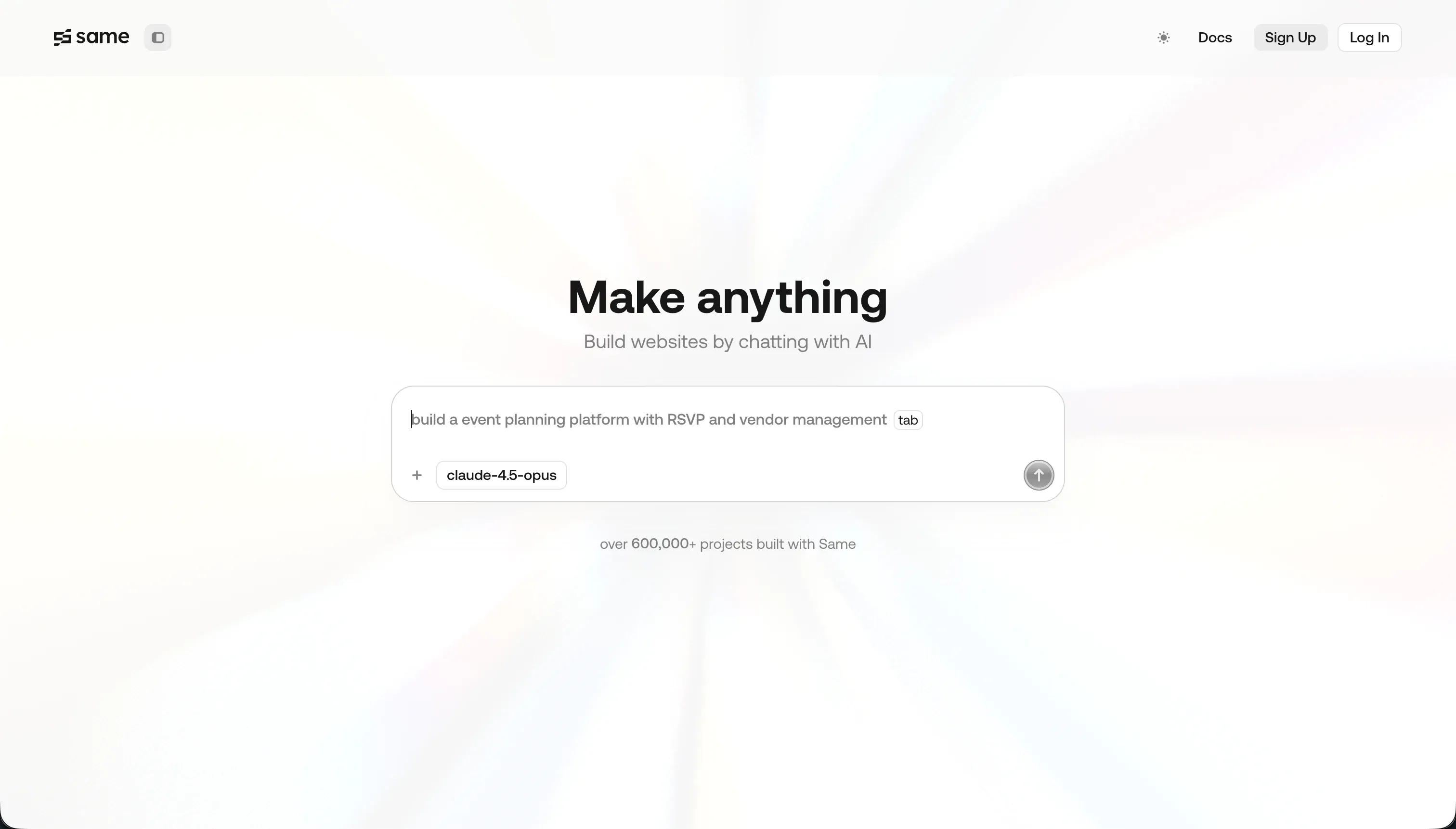
Same.new functions as a pure frontend styling and cloning engine that converts live website URLs into editable React and Tailwind components.
Retool wins the choice for any software intended for actual business use, scoring 6.8 against Same.new at 4.1. The aggregate difference points to Same.new lacking a backend database, user authentication, or a stable codebase structure. Only a temporary design mockup or brief UI prototyping run without operational dependency flips this decision to Same.new.
The decision in 30 seconds
| If your priority is… | Pick | Why |
|---|---|---|
| Connecting to existing SQL / GraphQL data | Retool | scores 8.5 on data depth with native database connectors and custom console queries |
| Client portals, partner directories, or CRMs | Neither | both charge per-seat pricing or lack native external user authentication setups entirely |
| Rapidly cloning a visual layout from a URL | Same.new | features automated styled React component generation from a pasted web address |
| Version-controlled deployments and self-hosting | Retool | supports environment branching on Team and self-hosted instances on Enterprise |
| Long-term codebase stability and maintenance | Retool | retains deterministic custom SQL variables while Same.new prompts risk code deletion |
| Direct pixel-level styling revisions | Same.new | generates direct Tailwind CSS and React frontend code editable via conversational prompts |
What each platform is
What is Retool?
Retool is an operational interface builder built to sit over existing data resources, primarily databases and web services. It provides a drag-and-drop workspace where engineers lay out data listings, charts, and input fields.
Under the interface, builders wire state variables, triggers, and execution properties using SQL queries to retrieve records and custom JavaScript blocks to transformation-map those arrays.
The platform ships with a prebuilt component library of 100+ items optimized for density and data manipulation, alongside a managed PostgreSQL database and a serverside workflow scheduler. Retool targets software engineering groups and developer teams who require administrative consoles and dashboards but want to avoid coding those operational interfaces from scratch.
What is Same.new?
Same.new is an AI-assisted frontend cloning tool that extracts visual styling from live URLs and copies them into React structures. A buyer pastes a target website address, and the AI agent reproduces the design, layout grid, typography, and visual assets into a sandbox project. Builders then edit the generated code visually via natural language prompts.
The tool focuses entirely on visual layouts and code export, incorporating a component forking system to duplicate specific UI containers and standard React/Tailwind export packages. Same.new targets дизайнеры, front-end visualizers, and product managers who require quick layout mocks or code foundations for local front-end developers to refine.
The core difference
The primary operational division is the depth of the application stack each platform generates.
- Retool creates a full-stack, visually wired data dashboard running on custom SQL queries and JavaScript handlers.
- Same.new outputs static frontend React assemblies that require external backend engineering to function.
Where the scores diverge
Production readiness: Retool 7.5, Same.new 3.0. Retool scores 7.5, while Same.new drops to 3.0. Retool provides staging environments, version control, and actual database write limits, with deductions coming from external login flows requiring manual coding and reviews mentioning occasional UI bugs.
Same.new scores 3.0 because it is a frontend prototyper with no native hosting or database; additionally, its recent rebrand transition from Same.dev left several active projects broken or read-only.
Security & access control: Retool 7.5, Same.new 3.0. Retool scores 7.5 against Same.new’s 3.0. Retool holds enterprise-ready access features, including SAML-based SSO and role configuration on the Business tier. It misses a higher score because these roles target internal employees, meaning client or buyer signup paths require custom engineering.
Same.new scores 3.0 because it contains zero security infrastructure; any login gating, identity, or resource clearance must be coded from scratch outside the platform.
Data & integrations: Retool 8.5, Same.new 4.0. Retool scores 8.5, which is its highest scorecard line, while Same.new scores 4.0. Retool interacts directly with relational databases, REST instances, and GraphQL layers, and includes its own fast cloud PostgreSQL database.
Same.new holds a low score because it does not provide native business databases or certified connectors, generating only frontend code arrays that must be manually wired to servers elsewhere by a developer.
Maintainability: Retool 6.0, Same.new 3.0. Retool scores 6.0, whereas Same.new lands at 3.0. Retool relies on standard release management and commit logs, although developers report keep-alive complexity as application structures grow and custom code accumulates.
Same.new’s low score reflects severe model fragility, where simple prompt requests can lead to destructive updates, including reported instances of trivial section changes wiping over 1,500 lines of working code.
Ease of build: Retool 4.0, Same.new 5.0. Same.new scores 5.0, leading Retool’s 4.0. Same.new wins the initial phase by letting a buyer paste a URL to generate a styled React template instantly, though conversational revisions on complex setups remain fragile.
Retool has a low score here because it is not a true no-code tool; anything beyond basic element mapping requires typing SQL statements, structuring JSON arrays with JavaScript, and manually parsing API parameters.
Design flexibility: Retool 7.0, Same.new 6.5. Retool scores 7.0, slightly exceeding Same.new’s 6.5. Retool leverages over 100 dense dynamic components and supports custom JS packages, but the output looks like an admin tool unless heavily styled. Same.new uses Tailwind logic but struggles on nested grids and complex interactive animations, limiting what it can successfully clone.
Cost comparison
The two tools follow differing billing tracks. Retool uses seat-based licensing, starting with a 5-user free tier, moving to Team at $8 per user/month, Business at $40 per user/month, and custom Enterprise agreements.
This per-user structure is predictable for small administrative groups but scales exponentially if exposed to large client lists or external operations. Same.new operates on a Pro model at $10/month including 2 million tokens, backed by custom tiers, following user complaints regarding the unpredictability of its previous pay-as-you-go model.
For cost evaluation, Retool’s main expense beyond user licenses is engineering time, as developers must maintain the SQL and JavaScript structures. Same.new’s long-term cost is code rewriting, as prompts that corrupt existing layouts force developers to manually reconstruct files or burn excessive tokens in repetitive debugging runs.
Lock-in and the exit path
Retool has strong lock-in properties; while you can copy-paste custom JavaScript handlers and SQL text, you cannot export the visual interface architecture or the Retool Database as a portable web application. Same.new offers a clean visual exit, permitting full code export of the generated React and Tailwind CSS markup to local environments.
Same.new has the cleaner exit path, though the exported code is only a frontend skin that needs backend engineering to go live.
- Copy-paste custom JavaScript handlers
- Copy-paste SQL text
- Visual interface can't be exported
- Retool Database can't be exported
- Full React export
- Full Tailwind CSS markup export
- Runs locally
- Frontend skin only, needs backend work
Who should pick Retool
Pick Retool if:
- Internal development teams building database administration panels or operations consoles
- Organizations with existing SQL, GraphQL, or REST API data pipelines that need secure interface overlays
- Enterprise administrators needing SAML SSO, audit logs, and on-premise self-hosting capabilities
Do not pick Retool if you are creating public customer-facing applications, marketing websites, or client-facing onboarding portals where per-user licensing fees become prohibitively expensive.
Who should pick Same.new
Pick Same.new if:
- Frontend developers looking to quickly scaffold visual layouts from existing web designs
- Product managers wanting to create high-fidelity user interface mockups without backend integration
- Designers who plan to export pure React and Tailwind code to a local development team
Do not pick Same.new if your software requires user logins, relational data storage, transactional workflows, or any form of dynamic database persistence.
What neither platform answers
Both compared systems are designed for developers and technical operators. If your goal is to build secure client portals, partner directories, member CRMs, or operational internal tools, Retool will quickly demand custom SQL/JS integration alongside extensive user-authentication development, while Same.new will leave you with a static frontend code skeleton with no database backend.
For those operational requirements, Softr represents the standard choice. Softr scores 7.5 on production readiness, 6.0 on maintainability, and 7.5 on security & access control because basic user authentication, custom user groups, dynamic table listings, and secure databases are built-in native infrastructure.
If your team requires a code-export option to host in custom cloud environments, a developer-centric tool like Replit or Lovable offers a more complete engineering path than Same.new.
Analyst verdict
Retool wins this matchup on aggregate score, leading 6.8 to 4.1. Retool takes five criteria including data depth, production readiness, maintainability, security, and design flexibility, while Same.new claims ease of build by allowing instant page clones from pasted links.
The final decision is clear: choose Retool if you are building an actual internal tool that must read, write, and safely alter database tables with true user permissions and stable workflows. Only select Same.new if you are in the design phase and need to quickly scaffold a static front-end page draft that will be handed off to an engineer to write the backend code.
Related reading: the Retool scorecard, the Same.new scorecard, and our scoring methodology.