

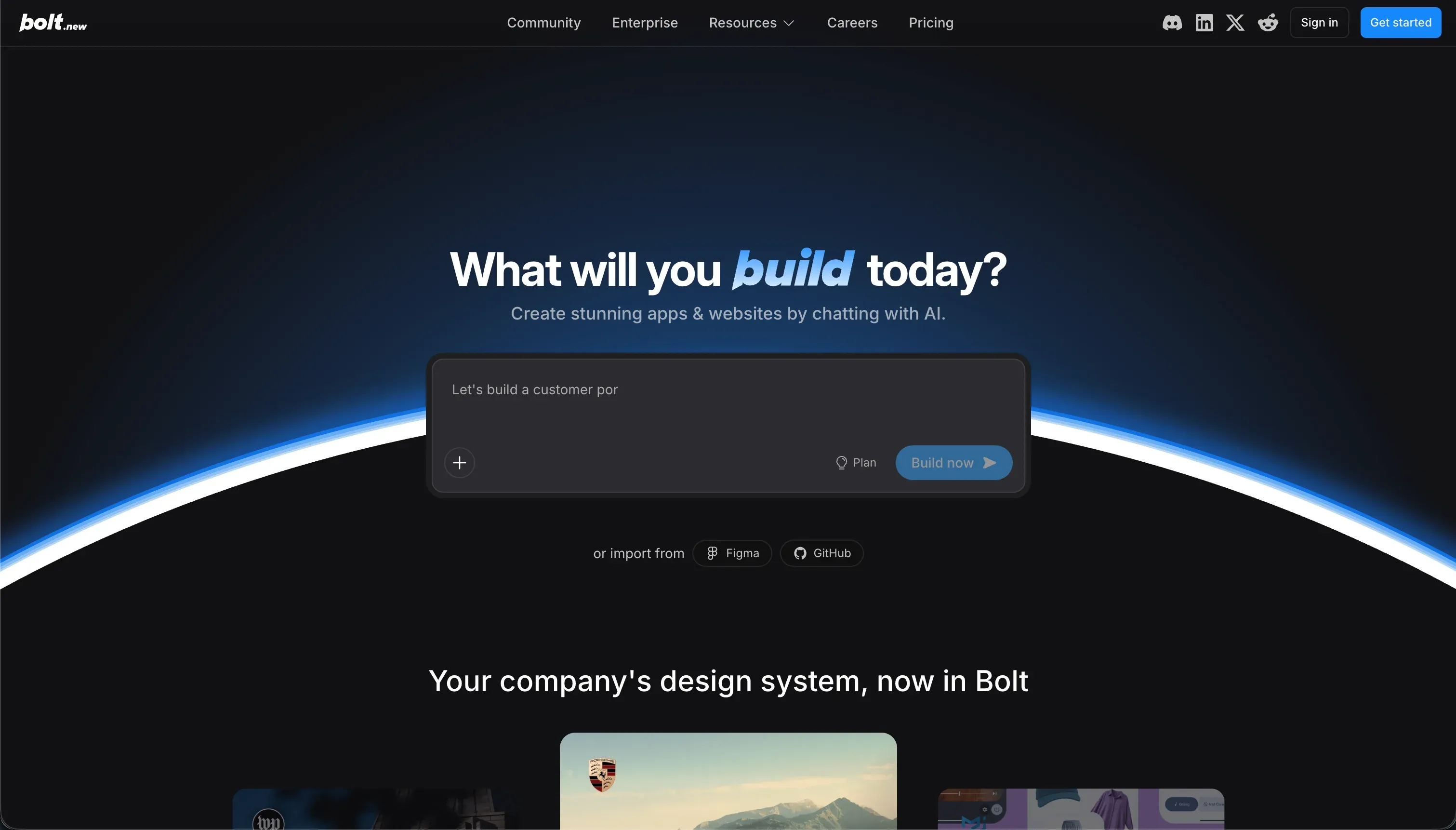
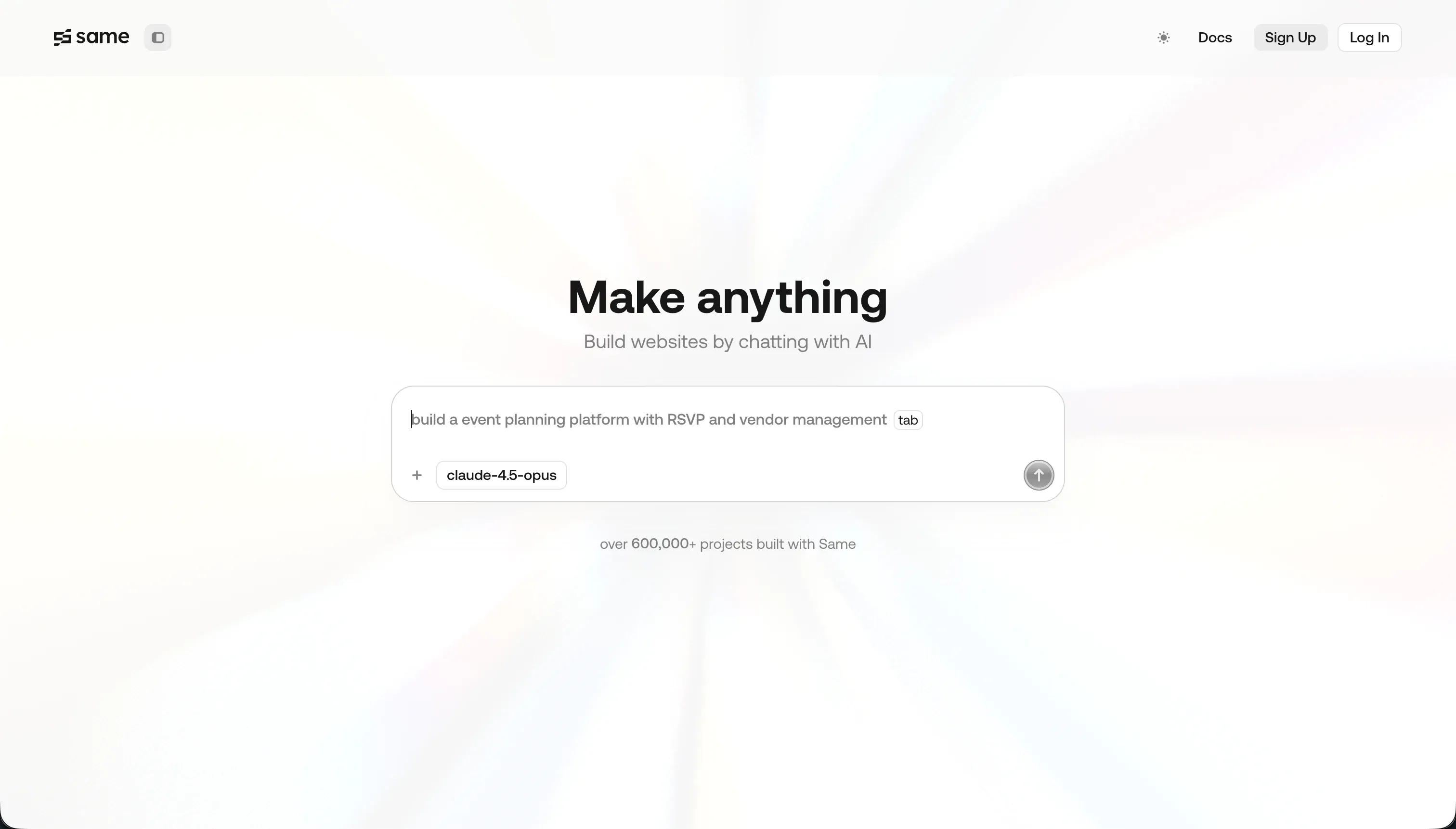
This comparison evaluates two browser-native generative development tools built on distinct paths. Bolt serves as a browser-based IDE that spins up full-stack code sandboxes from a single prompt, while Same.new focuses purely on visual cloning by translating an existing URL into editable React components.
Bolt wins the general decision with an aggregate score of 5.1/10 compared to Same.new’s 4.1/10. Because both tools produce raw codebases that are prone to layout regressions and silent build failures, the matchup is decided by infrastructure: Bolt generates real database schemas and handles full-stack codebases, whereas Same.new is capped as a fragile frontend prototyping canvas.
The decision in 30 seconds
| If your priority is… | Pick | Why |
|---|---|---|
| Generating full-stack code & databases | Bolt | scores 6.0 on data & integrations, outputting real PostgreSQL schemas and Node.js backend logic in one pass |
| Replicating a visual layout from a live URL | Same.new | possesses a visual cloning engine that translates live URL layouts directly into React and Tailwind code |
| Pixel-level canvas refinement | Neither | both tools require conversational prompts to tweak visual styling, causing prompt fatigue and regression loops |
| A production client portal or CRM | Neither | neither platform provides pre-built authentication, visual permission tables, or robust production hosting |
| Predictable software development costs | Bolt | provides standard paid tiers with rolled-over token pools, whereas Same.new has historically run on unpredictable token burn |
What each platform is
What is Bolt?
Bolt is an AI-powered browser-based integrated development environment (IDE) built on WebContainers tech. Operating entirely inside the client browser, it generates complete React frontends, Node backends, and PostgreSQL databases from a single natural-language description.
Bolt is designed for developers and tech-literate builders who want to skip local environment configuration. By packaging a complete Node.js container within the browser window, it allows teams to install packages via npm, execute terminal commands, and sync codebases directly to GitHub while maintaining full code ownership.
What is Same.new?
Same.new (formerly Same.dev) is a frontend prototyping tool built around an automated UI cloning engine. Builders paste a live website URL, and the platform’s AI agent attempts to translate the visual layout, typography, colors, and styling into a React and Tailwind CSS codebase.
Built for designers and developers looking to quickly scaffold UI drafts, it uses conversational text prompts to execute revisions. It generates visual code structures meant for export rather than hosting complex relational data or background integrations.
The core difference
The primary axis of variance between these platforms lies in the depth of their execution targets.
- Bolt provides an entire browser-native developer container that executes full-stack sandboxes, including databases and routing.
- Same.new operates purely as a frontend canvas that converts design layouts into raw, stateless UI code.
Where the scores diverge
Data & integrations: Bolt 6.0, Same.new 4.0. Bolt scores 6.0/10, outputting real PostgreSQL schemas that connect cleanly via code to external engines like Supabase. The deduction stems from its lack of a native visual database editor, requiring users to manage data entirely via generated code.
Same.new scores 4.0/10 because it possesses no native state storage or database integrations, requiring teams to manually wire its generated frontend to an external backend elsewhere.
Design flexibility: Bolt 8.0, Same.new 6.5. Bolt scores 8.0/10, outputting standard React and Vite components that carry no visual limits, supported by Figma imports and npm packages.
Same.new scores 6.5/10; while the tool handles simple visual duplication well, the prompt engine struggles to accurately replicate complex nested wrappers or interactive layouts, necessitating manual CSS cleanup to match consumer-grade UI standards.
Production readiness: Bolt 4.0, Same.new 3.0. Bolt secures a 4.0/10, offering Bolt Cloud hosting and automated Netlify deployments. Its rating is restricted by user reports of container crashes, memory-limits on larger codebases, and account-pausing ‘Project too large’ thresholds.
Same.new lands at 3.0/10, as it lacks a native backend layer, databases, or hosting parameters. Additionally, its transition from Same.dev to Same.new caused structural instability, leaving some active projects read-only or broken.
Ease of build: Bolt 5.5, Same.new 5.0. Bolt scores 5.5/10, providing an incredibly fast prompt-to-app workflow that establishes a working preview in minutes. However, because it acts as a browser-based IDE, handling build failures and reading terminal outputs requires web development knowledge.
Same.new scores 5.0/10; while its URL-cloning capability is impressively fast, the resulting layouts are visually static, and refining interactive states or complex grid alignments requires manual developer intervention.
Maintainability: Bolt 3.5, Same.new 3.0. Both tools struggle under the weight of iterative prompting. Bolt scores 3.5/10, yielding standard React codebases that are theoretically portable, but builders complain of AI ‘bootloops’ where edits erase working features and consume tokens.
Same.new scores 3.0/10, plagued by highly destructive updates where basic prompt requests can ruin layout hierarchy - highlighted by one community report where a simple section reordering wiped 1,500 lines of functional code.
Security & access control: Bolt 3.5, Same.new 3.0. Bolt scores 3.5/10, lacking any visual access control layer; builders must prompt the AI to write middleware or configure row-level security rules, meaning non-technical users cannot visually verify permissions.
Same.new scores 3.0/10, offering zero native authentication, user session management, or backend security, meaning any authorization architecture must be written from scratch in exported code.
Cost comparison
Bolt runs on a structured SaaS model layered on token consumption, starting with a free tier of 1M tokens, moving to Pro at $25/mo for 10M tokens, and scaling to intermediate tiers up to $2,000/mo. Rolled-over tokens remain active on paid memberships, which is crucial because fixing runtime errors burns credits rapidly.
Same.new historically operated on a pay-as-you-go credit structure of $10 per 2 million tokens. It has since transitioned toward fixed-tier options to limit unpredictable billing during visual generation. Buyers must plan for extreme variability on both platforms: every re-prompt, layout adjustment, or build regeneration acts as a variable charge against your monthly balance.
Lock-in and the exit path
Bolt provides an exceptional exit path, allowing teams to download standard React, Vite, and Tailwind codebases with direct GitHub synchronization and no proprietary vendor lock-in.
Same.new similarly allows code export, but because its outputs are strictly frontend prototypes with no backend scaffolding, the integration layer must be entirely rewritten upon leaving. Bolt provides the cleaner, more standard output template for external developers to adopt.
- Standard React, Vite, Tailwind codebases
- Direct GitHub sync
- No proprietary lock-in
- External devs adopt it directly
- Code export available
- Outputs are frontend prototypes only
- No backend scaffolding
- Integration layer rewritten on leaving
Who should pick Bolt
Pick Bolt if:
- Developers looking for a zero-setup browser IDE to scaffold full-stack boilerplates instantly.
- Builders who require clean, standard React/Vite exports paired with automatic GitHub sync.
- Teams creating functional frontend schemas mapped directly to a Supabase PostgreSQL instance.
Do not pick Bolt if your team lacks the technical skills to read code, debug terminal runtime errors, or manage environment variables when WebContainers crash.
Who should pick Same.new
Pick Same.new if:
- Designers seeking to clone a basic visual layout of an existing website directory from a URL.
- Prototypers who need quick, stateless HTML and CSS codeblocks to edit in their local editor.
- Product managers wanting to show visual layout drafts under strict token spending limits.
Do not pick Same.new if you are trying to deploy a live, transactional web application that requires database connections, user login flows, or secure client-side privileges.
What neither platform answers
Both Bolt and Same.new assume you are building custom application architecture: where every layout block, button function, and button margin must be generated line-by-line using AI. If you are actually building a client portal, internal operations hub, CRM, or document directory, this setup is highly inefficient.
Rather than forcing your team to manage and debug thousands of lines of generated code, a dedicated business software builder like Softr handles the infrastructure natively.
Softr scores 4.0 or higher across maintainability, production readiness, and security precisely because authentication, user groups, and relational database connections are pre-hardened platform elements rather than hallucinated code files.
It connects directly to Softr Databases and external platforms like Airtable, allowing non-tech operators to tweak filters, modify visibility rules, and publish updates in seconds. For teams that strictly require native mobile execution instead, a dedicated mobile builder like FlutterFlow serves as the industry standard.
Analyst verdict
Bolt wins this comparison on aggregate, scoring 5.1/10 against Same.new at 4.1/10. Bolt outscores Same.new across five of the six evaluation criteria, driven by its full-stack WebContainers sandbox, real database integration capabilities, and cleaner code export pipelines. Same.new is only viable for visual, stateless design prototyping where URL layout reproduction is the singular buyer priority.
For any team seeking to launch a reliable business application, Bolt’s database flexibility and GitHub sync make it the only logical choice in this head-to-head. However, buyers should remember that both tools present high maintenance overheads, meaning a developer will be required to manage terminal container errors on day two.
Related reading: the Bolt scorecard, the Same.new scorecard, and our scoring methodology.