

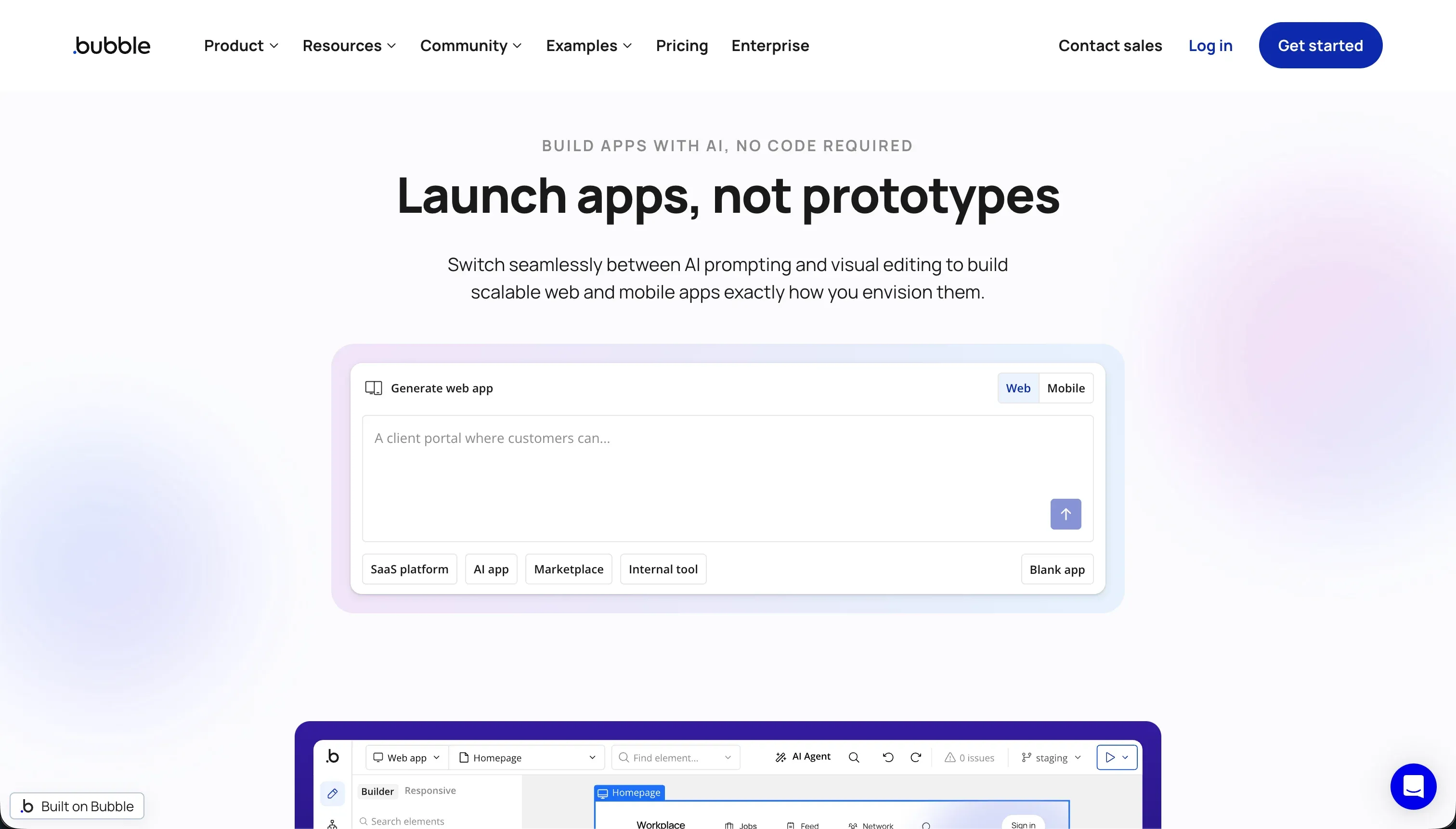
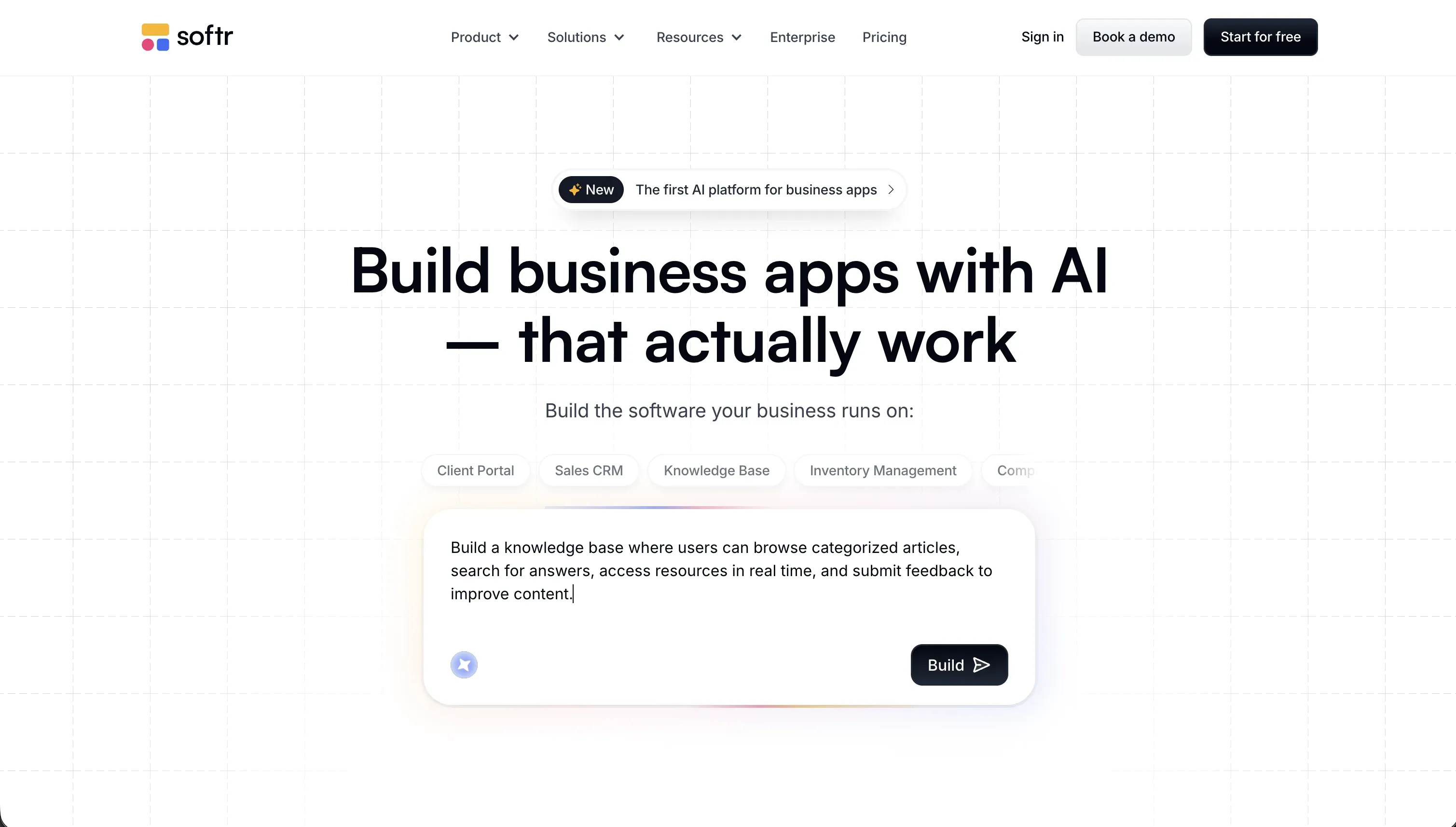
Bubble and Softr both sell no-code, but they solve different procurement problems. Bubble is a visual programming environment with maximum design and logic depth. Softr is a business app platform with pre-built infrastructure and a narrower application model.
Softr wins the general business-app decision, 8.1 to 6.8. Bubble still wins when custom interface or workflow logic is the product requirement rather than a nice-to-have.
The decision in 30 seconds
| If your priority is… | Pick | Why |
|---|---|---|
| Client portals, internal tools, CRMs, or partner apps | Softr | Auth, permissions, data restrictions, and hosting are pre-built |
| A marketplace or custom workflow product | Bubble | Its visual logic and interface ceiling are substantially higher |
| Fastest path for a non-technical operations team | Softr | Ease of build scores 9.0 against 5.0 |
| Pixel-level frontend control | Bubble | Design flexibility scores 8.5 against 5.5 |
| Predictable software spend | Softr | Published flat tiers instead of workload-unit consumption |
| An exportable application codebase | Neither | Bubble and Softr both require rebuilding the interface to leave |
The final row is important. Bubble offers much more application freedom inside its platform, but neither product gives you an exportable codebase. Buyers who require code ownership should compare a code-first route such as Replit instead.
The core difference
Bubble gives the builder primitives. You design responsive interfaces, define data types, create workflows with conditional branches, configure privacy rules, schedule backend events, and extend the app through an ecosystem of more than 8,000 plugins. It is the deepest customization ceiling in mainstream no-code.
Softr gives the builder an assembled business-app foundation. Its AI Co-Builder can generate database tables, pages, navigation, blocks, and user groups from a description. The same application can then be edited manually through the visual editor.
Authentication, utility flows, permissions, hosting, and responsive business components are platform infrastructure rather than parts the builder must architect.
That distinction explains nearly every score:
- Bubble asks you to design the application system.
- Softr asks you to configure the business workflow.
Bubble rewards the team that needs freedom and accepts responsibility. Softr rewards the team that knows its process and wants the platform to absorb the technical decisions.
- Design responsive interfaces yourself
- Define data types and workflows
- Configure privacy rules and backend events
- 8,000+ plugins extend the app
- AI Co-Builder generates tables, pages, navigation
- Edit the same app in a visual editor
- Auth, permissions, hosting are platform infrastructure
- Responsive business components included
Building the first working version
Ease of build is the widest scored gap: Softr 9.0, Bubble 5.0.
Building in Softr
A Softr builder can start in three ways: generate with AI, select a template, or build manually. The AI Co-Builder produces a connected first version with data structure, navigation, user groups, and pages. Native blocks cover the standard business-app surfaces: tables, lists, forms, kanbans, calendars, charts, and dashboards.
The important point is what happens after generation. Every AI-created setting can also be changed manually. A builder can add a field, adjust a filter, change a button action, or update a permission without asking the AI to regenerate the application.
Building in Bubble
Bubble removes code syntax, but not software architecture. A production build still requires decisions about:
- Data types and relationships.
- Responsive page structure.
- Workflow triggers and conditional branches.
- Privacy rules for every sensitive data type.
- API connections and plugin dependencies.
- Workload-unit behavior under real usage.
That depth is valuable when the requirements are custom. It is overhead when the target is a standard portal, CRM, directory, or internal workflow. Trustpilot reviewers describe production-quality Bubble work as requiring developer-like conceptual understanding, which is why the platform scores 5.0 rather than being treated as an easy drag-and-drop tool.
For a first business app, Softr should reach the pilot faster. Bubble becomes the better build environment only when the pilot proves that the app needs behavior Softr’s platform model cannot express.
Security and permissions
Security & access control scores Softr 8.5, Bubble 6.5. Both platforms can protect production data. The difference is how much security work remains with the builder.
| Security layer | Softr | Bubble |
|---|---|---|
| Authentication | Native password, OTP, magic link, Google sign-in, domain restrictions | Built-in authentication configured within the app |
| Record access | Visual user groups and global data restrictions | Server-side privacy rules written per data type |
| Interface visibility | Page, block, and action-button rules | Conditional visibility and workflows |
| Verification | Preview impersonation for selected users | Builder testing and privacy-rule review |
| Enterprise controls | SSO and advanced controls on Custom plan | Available through platform configuration and higher plans |
Bubble’s privacy rules are real server-side controls, not cosmetic filters. The deduction comes from configuration risk. A missed or incomplete rule can leave data exposed without an obvious interface error.
Softr centralizes access through user groups and data restrictions, then lets the builder preview the application as a selected user. The safer model for a non-technical team is the one it can inspect directly. For a client portal, where one client seeing another client’s record is an unacceptable failure, that visibility has procurement value.
Day-two maintenance
Maintainability scores Softr 9.0, Bubble 6.0. This is the second-largest gap and the one most likely to determine total cost after launch.
Consider a normal month-six request: add a regional manager role, expose one extra field to that role, and create an approval action for records above a threshold.
In Softr, the owner edits the user group, data restriction, block visibility, and action settings. The application remains on native platform components, with no generated code or framework dependencies to update.
In Bubble, the owner may need to update privacy rules, page conditions, database searches, workflow branches, and any reusable elements affected by the role. The change is possible, often with greater flexibility, but its impact surface is larger. Complex apps accumulate workflow sprawl, and reviewers report editor memory problems on large projects.
Three maintenance obligations deserve a line in the Bubble operating plan:
- Workload-unit optimization. A feature can change the monthly bill depending on how searches and workflows are implemented.
- Plugin review. Community plugins can be abandoned or break after updates.
- Privacy-rule regression testing. New data types and workflows must preserve the intended access model.
Both platforms can run applications for years. Softr is designed for the business owner to remain the operator. Bubble increasingly rewards a dedicated builder as complexity grows.
Data, integrations, and custom logic
Data & integrations is an 8.0 tie, but the platforms reach it differently.
Bubble includes a managed relational database, custom data types, an API Connector for REST services, backend workflows, and a large plugin ecosystem. It is stronger when the data model and application logic are being invented together inside one product.
Softr includes its native database and connects to sources business teams may already operate, including Airtable, Google Sheets, Notion, SQL, and REST APIs depending on plan. Native connectors cover services such as HubSpot, Stripe, Google Calendar, and OpenAI. It is stronger when the application is an interface and workflow layer over business data.
Bubble wins custom logic. Multi-sided matching, arbitrary conditional workflow chains, and product-specific backend behavior are its lane. Softr’s workflow engine and Vibe Coding block extend standard business apps, but a custom component does not replace a fully programmable application architecture.
Choose based on where the complexity belongs. If complexity belongs in the business process, Softr usually contains it. If complexity is the software product itself, Bubble gives it more room.
Design flexibility and user experience
Design flexibility is Bubble’s decisive win: 8.5 against Softr’s 5.5.
Bubble offers a pixel-level visual editor with responsive positioning and control over the full page structure. A team can build a highly branded customer product, unusual navigation, interactive visual states, and layouts that do not resemble standard business software.
Softr uses native blocks under a global theme system. Builders can control typography, colors, sizing, border radius, block styling, and custom CSS. The Vibe Coding block can generate isolated custom React components that inherit the app theme and respect permissions. That is enough for professional portals, dashboards, intranets, and CRMs, but it remains a block-based model.
This is the cleanest exclusion in the comparison:
- Pick Bubble when the interface is part of the product’s moat.
- Pick Softr when users primarily need to find records, submit data, approve work, or track a process reliably.
Pricing and total cost of ownership
The sticker prices do not describe the same cost model.
| Plan level | Softr | Bubble |
|---|---|---|
| Free | 5 app users, 5,000 records | 200 records, 50k workload units |
| First paid tier | Basic, $19/mo billed annually | Starter, $69/mo |
| Typical production tier | Pro, $99/mo billed annually | Growth, $249/mo |
| Higher team tier | Business, $329/mo billed annually | Team, $649/mo |
| Variable usage meter | No traffic or compute meter within the tier | Workload units consumed by workflows and database operations |
Softr Pro includes 10 Team and 50 Client app users, 500,000 records, and custom user groups. Business includes 30 Team and 100 Client app users, 1 million records, and higher-end sources such as SQL and REST APIs. AI credits are metered, but manual editing remains available when credits run out.
Bubble plans include workload-unit allowances. Independent analyses describe the model as difficult to forecast, with inefficient configurations capable of producing bills in the thousands of dollars. The same feature can consume different amounts depending on how it is built.
The ownership calculation should include more than subscriptions:
- Builder time before launch.
- Monthly maintenance and permission changes.
- Usage or workload overages.
- Plugin subscriptions and dependency review.
- Migration cost if the platform stops fitting.
For a standard business app, Softr’s higher score comes partly from reducing those hidden labor lines. For a custom software product, Bubble’s additional labor may be the price of requirements Softr cannot meet.
Lock-in and the exit path
Neither platform exports a complete application codebase.
Bubble lets you export data rows, but the pages, visual workflows, privacy rules, and database architecture must be rebuilt on another stack. Its larger customization ceiling can therefore create a larger migration project.
Softr also requires rebuilding the interface elsewhere. Its data position can be less restrictive when the app runs on an external source such as Airtable, Google Sheets, or SQL. Softr Database records can be exported, but the blocks, permissions, and workflows remain platform configuration.
Bubble has more build freedom, not more exit freedom. Teams choosing either platform should keep data ownership clear, document permissions and workflows, and price a future rebuild into the initial decision if code ownership is strategic.
- Data rows you enter
- Data rows export
- Pages and blocks
- Pages rebuilt on a new stack
- Visual workflows
- Workflows rebuilt by hand
- Privacy rules and permissions
- Privacy rules rebuilt by hand
- Database architecture
- Database rebuilt from scratch
Where neither platform fits
Because Softr is one of the compared tools, this section should not recycle either contender as the fallback. There are two important requirements that point elsewhere:
- Native mobile apps for app-store distribution. FlutterFlow compiles native iOS and Android packages and supports Dart code export. Softr produces responsive web apps and PWAs; Bubble’s core strength remains web applications.
- Mandatory code ownership and self-hosting. Replit generates real code that can sync to GitHub. It carries a higher technical burden, but it provides an exit path neither Bubble nor Softr offers.
These are not edge-case features to bolt on later. If either is contractual, remove both Bubble and Softr from the final shortlist before running a pilot.
Who should pick Bubble
Pick Bubble if:
- The application is the product, such as a marketplace, workflow SaaS, or multi-sided platform.
- Custom interface behavior and design freedom matter more than speed of implementation.
- The team accepts a multi-week learning curve and ongoing workload-unit optimization.
- A dedicated builder can own privacy rules, plugins, workflows, and production incidents.
Do not pick Bubble for a standard portal or internal tool simply because it can build one. Capability without a requirement becomes maintenance overhead.
Who should pick Softr
Pick Softr if:
- The application is a client portal, internal tool, CRM, intranet, partner app, or operational dashboard.
- Business users need to maintain the app after launch.
- Permissions must be visually configured and auditable without reading code.
- Predictable tier pricing matters more than pixel-level interface control.
Do not pick Softr for a custom consumer product, native mobile distribution, or a project whose exit plan requires exported application code. Its 5.5 design-flexibility score is a real boundary, not a minor deduction.
How to pilot Bubble and Softr
Use the same one-week test for both platforms:
- Import or connect a realistic slice of production data.
- Create an administrator, manager, and two external users with different record access.
- Build one dashboard, one form, and one multi-step workflow.
- Change the data model after the first version is working.
- Add a new user role and verify every affected page and action.
- Ask a non-builder to make a small change without help.
- Forecast the 12-month subscription, usage, plugin, and maintenance cost.
Score the pilot on the same six criteria, but weight them for the actual use case. A portal should emphasize security and maintainability. A marketplace should emphasize design flexibility, data, and custom logic.
The key observation is which platform makes the difficult requirement feel ordinary. That is a better buying signal than which one produces the prettier first-day demo.
Analyst verdict
Softr wins 8.1 to 6.8 because it wins where most business buyers carry operational risk: ease of build, production readiness, maintainability, and security. For portals, internal tools, CRMs, and partner apps, it is the higher-scoring purchase and usually the lower-risk operating model.
Bubble remains the better tool when fully custom interface or workflow logic is the requirement. Its 8.5 design-flexibility score is not cosmetic; it represents an application class Softr deliberately does not try to replace.
Choose Softr for business software your team needs to operate. Choose Bubble for custom software your team is prepared to build and maintain.
Related reading: the client portals ranking, Lovable vs Bubble, Softr scorecard, Bubble scorecard, and the build vs buy guide.