


Mobile is the use case where eligibility does most of the ranking work. Most app builders produce web apps; only a few compile genuinely native packages, and the gap between “works on a phone browser” and “lives in the App Store” decides budgets, timelines, and which platforms belong on this page at all.
We score the credible routes against the six criteria, weighted here toward design flexibility and production readiness, because mobile is where native interface quality and store packaging decide everything.
The field now splits three ways. FlutterFlow and the visual builders give you a canvas; Replit hands you real code from prompts; and VibeCode, new to this ranking, is the dedicated AI-native mobile builder that prompts straight to a native app with a backend attached. Each route trades something, and the trade is what the scores below make visible.
One scoping note before the list: this page ranks platforms for consumer-style native and mobile-first apps. If what you actually need is a business app your team or clients use on their phones, see the aside further down; that is a different shortlist.
How the field scores
| Platform | Overall | Mobile advantage | Main reason to exclude it |
|---|---|---|---|
| FlutterFlow | 6.3 | Genuinely native iOS and Android plus Dart code export | Steep learning curve and manual backend setup |
| Replit | 7.4 | Real, owned code with live on-device preview | Needs a technical owner and variable credit spend |
| VibeCode | 6.1 | Native apps from prompts with a built-in backend | Day-two production risk; export gated to Pro and Max |
| Adalo | 4.6 | Drag-and-drop route to a store-published app | Documented native performance and reliability problems |
| Glide | 6.3 | Fast, polished mobile-first builds | PWA only, with no path to the app stores |
| Bubble | 6.8 | Companion mobile for teams already on Bubble | Immature native engine and no code export |
Overall scores are the unweighted average of the six platform criteria. The rank order changes for this use case because a mobile buyer should weight native interface quality and store readiness above the headline average, which is why FlutterFlow leads despite a lower overall than Replit or Bubble.
1. FlutterFlow
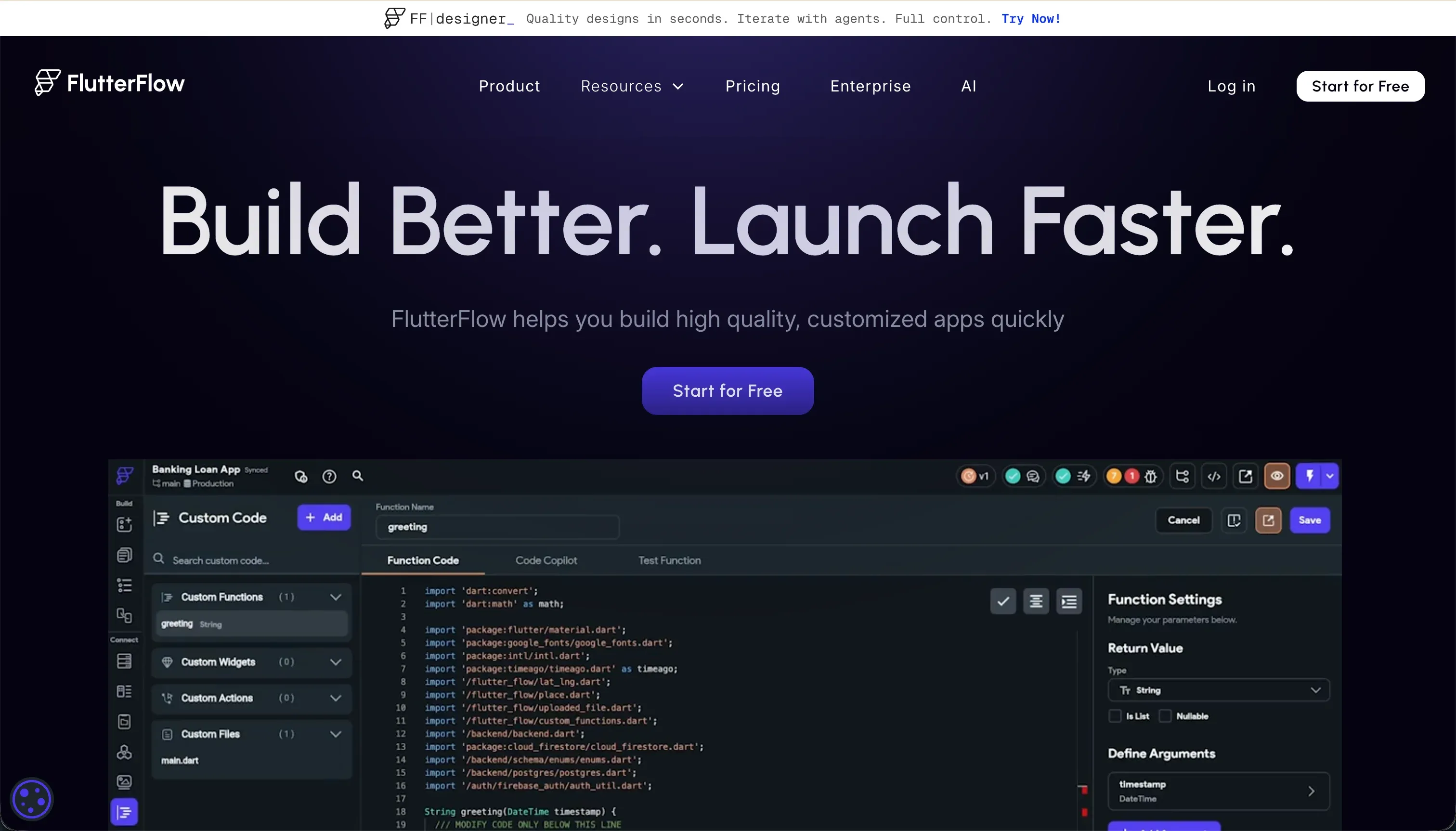 FlutterFlow homepage snapshot
FlutterFlow wins this ranking on the two criteria that matter most for mobile. Design flexibility scores 9.0, the strongest mobile design ceiling in our roster: widget-level visual control compiled to genuinely native iOS and Android interfaces, avoiding the web-wrapper performance bottlenecks that drag down most of the field.
Production readiness scores 7.0, with codeless deployment pipelines straight to Google Play and Apple TestFlight.
What keeps it at the top is ownership. Complete Flutter (Dart) source code can be downloaded at any time on paid plans, so the app you build is an asset you keep rather than a tenancy you rent. Pricing is flat and legible: Standard at $22/mo, Pro at $50/mo with Git integration and app-store deployment, and Teams at $50/seat/mo, all billed annually.
Code export on every paid tier is the cleanest exit path among visual mobile builders, and it is the single biggest reason FlutterFlow outranks the prompt-first tools below it.
The cost is the learning curve, and we will not soften it: ease of build scores 4.5. Reviewers describe a steep ramp through Flutter layout logic and state management, debugging without useful error messages, and a browser editor that lags past roughly a dozen screens.
Backend setup on Firebase or Supabase is manual, which is also why security & access control scores only 5.0: the platform gives you the hooks, not the protection. Plan for a builder with developer instincts, not a business user with a free afternoon.
2. Replit
 Replit homepage snapshot
Replit is the code-first route, and it carries the highest overall score on this page at 7.4. The agent builds mobile applications from prompts, previews them live on your device, and prepares configurations for App Store and Google Play submission.
Because the output is real code on managed infrastructure, design flexibility scores 8.5 and the logic ceiling is effectively unlimited; data & integrations also scores 8.0 on managed PostgreSQL and open API access.
It ranks second rather than first for mobile because eligibility and ownership both come with conditions. Replit prepares store configurations, but the native packaging is more hands-on than FlutterFlow’s codeless pipeline, and the result is only as maintainable as your team’s discipline with the code it generates.
Maintainability scores 7.5 precisely because the output is real, version-controlled code that ages well, provided someone technical owns it.
The bill needs active management. Core starts at $20/mo billed annually with $25 of monthly credits, Pro at $95/mo with $100 of credits, and agent usage is effort-priced.
The public record includes documented single-day bills of $350 during debugging loops, and mobile development, with its device quirks and store-review iterations, generates plenty of those loops. Replit is the right pick for an engineering team that wants to own a real codebase; it is a poor handoff to a non-technical owner.
3. VibeCode
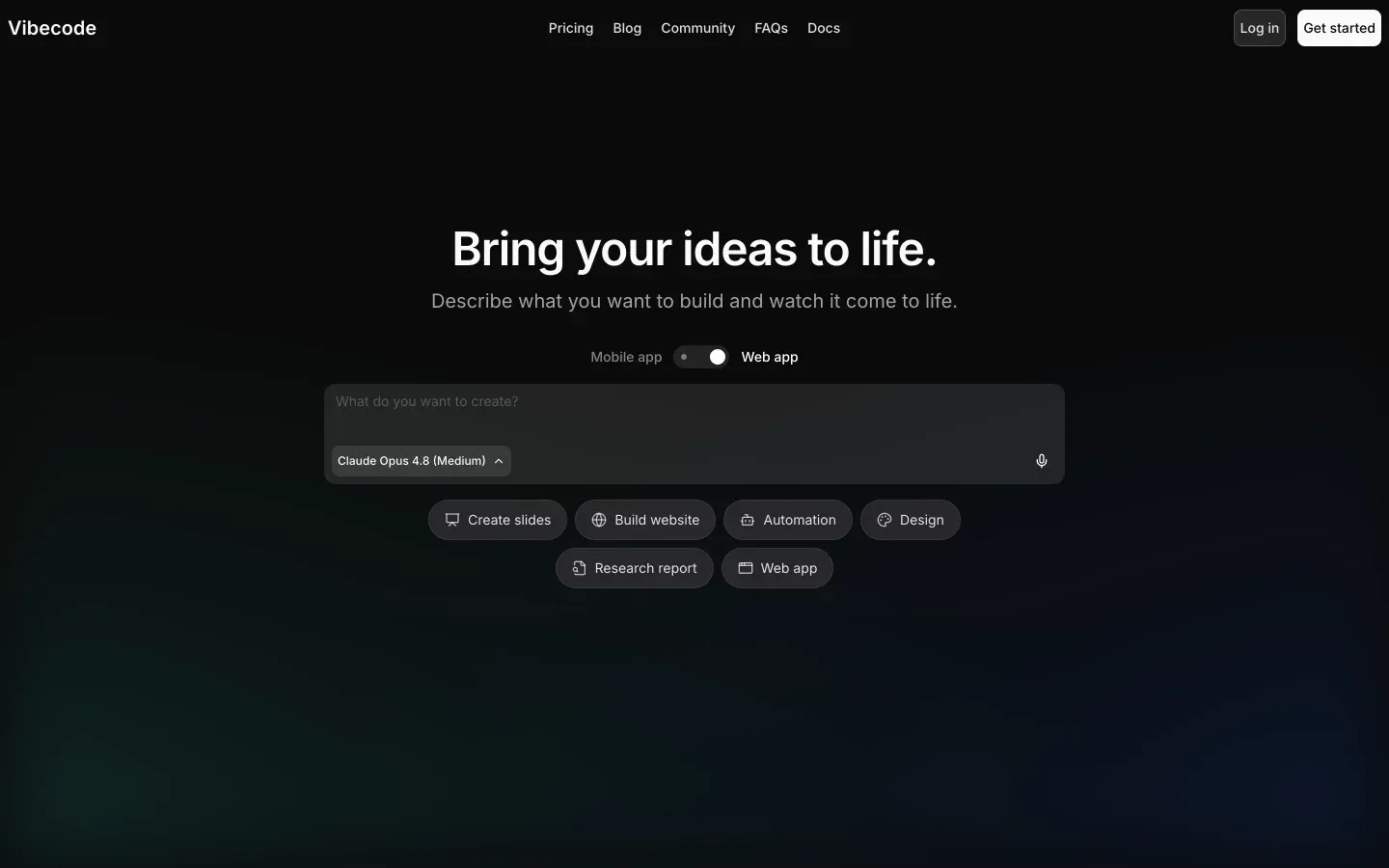 VibeCode homepage snapshot
VibeCode is the newcomer built for exactly this page: a mobile-first AI builder that turns plain-English prompts into native iOS and Android apps, provisions a backend, authentication, and cloud storage automatically, and packages directly to the app stores on paid tiers.
Where Replit is a general code-first platform that also does mobile, VibeCode does mobile and little else, which is why it edges past the web-first builders below it. Ease of build and design flexibility both score 7.0 on prompt-driven creation with instant on-device testing.
Its pricing model is unusually honest about AI cost. The credit system is no-markup, so $1 of credits equals $1 of raw model usage: Free includes $2.50 of credits, Plus is $20/mo, Pro is $50/mo, and Max is $200/mo.
Code export and SSH access to an editor like Cursor arrive only on Pro and Max, so base-tier users trade away the exit path that FlutterFlow includes on every paid plan, and that gating is the main reason VibeCode ranks behind it.
The deductions are the generated-code tax. Production readiness scores 5.5 because shipping a complex app entirely by prompt risks edge-case crashes and security gaps that fail store review without manual code checks.
Maintainability and security & access control both sit lower because the AI can lose context in larger codebases and produce messy, hard-to-manage code, and per-app security depends on generation a human still has to audit.
Treat VibeCode as the fastest route to a native MVP, not as a platform you hand a complex production app without review.
4. Adalo
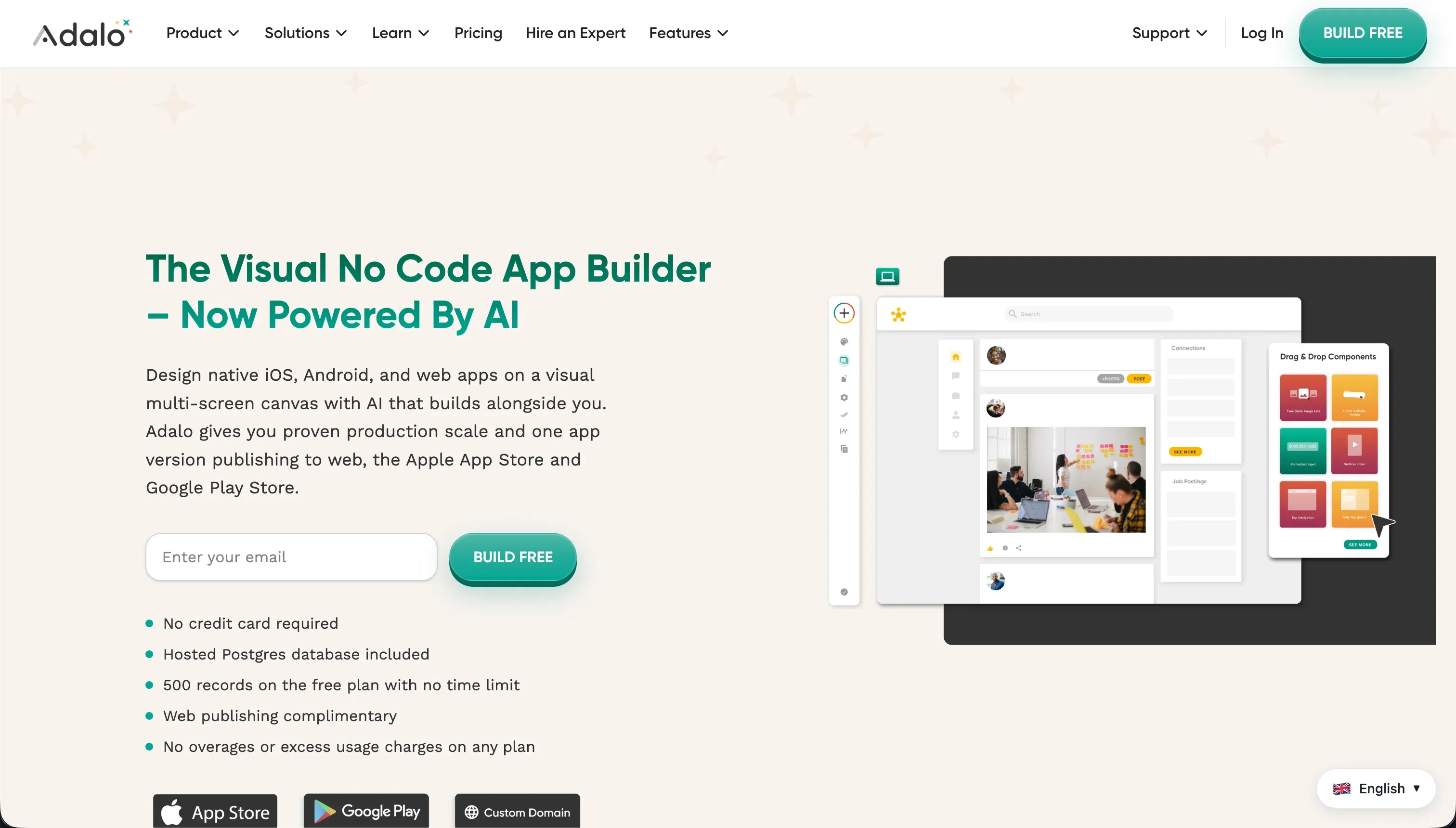 Adalo homepage snapshot
Adalo is the gentlest on-ramp to a store-published app: a drag-and-drop canvas, built-in database, and packaged submission to Google Play and the App Store, with Professional at $52/mo billed annually covering one native app. Ease of build scores 6.0, the highest comfort level for a true non-technical founder on this page. For a simple consumer MVP, that is a defensible budget line.
The deductions are heavy and documented, which is why the average sits at 4.6, the lowest here.
Production readiness scores 3.5 and maintainability 4.0 on the back of consistent complaints: users report native Android performance they call unacceptable, with one CEO noting a PWA ran roughly ten times faster than the native build, alongside database reliability complaints and strict record limits that force plan upgrades as data grows.
Treat Adalo as a validation tool for simple app ideas, not a production platform, and re-evaluate the moment the app gains real data or real users.
5. Glide
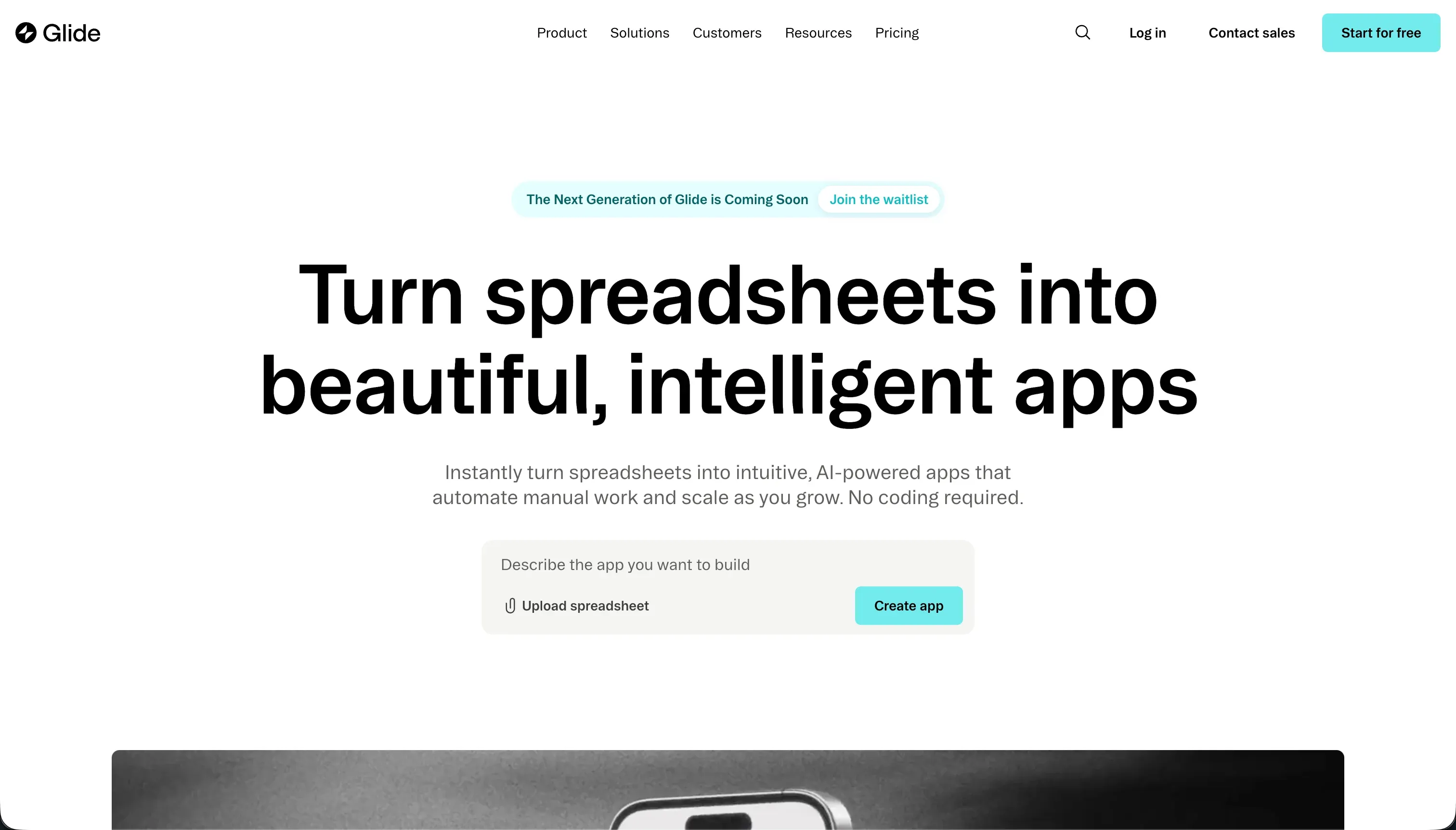 Glide homepage snapshot
Glide builds the most polished mobile-feeling apps per hour of effort on this list (ease of build 8.5), scaffolding clean, mobile-optimized interfaces directly from Google Sheets, Airtable, or its own tables. The Maker plan at $49/mo billed annually is hard to beat for a small, known audience.
The limitation is categorical, and it is why design flexibility scores only 4.0: Glide delivers PWAs only. There is no path to the app stores, which competitor evaluations note costs consumer apps the discoverability they depend on.
Rank it here if your users are a known group who can install from a link; rank it off the page entirely if store presence is a requirement. Shared external users also cap at 100 on the $249/mo Business plan before an Enterprise contract, so the economics tighten exactly when a consumer app succeeds.
6. Bubble
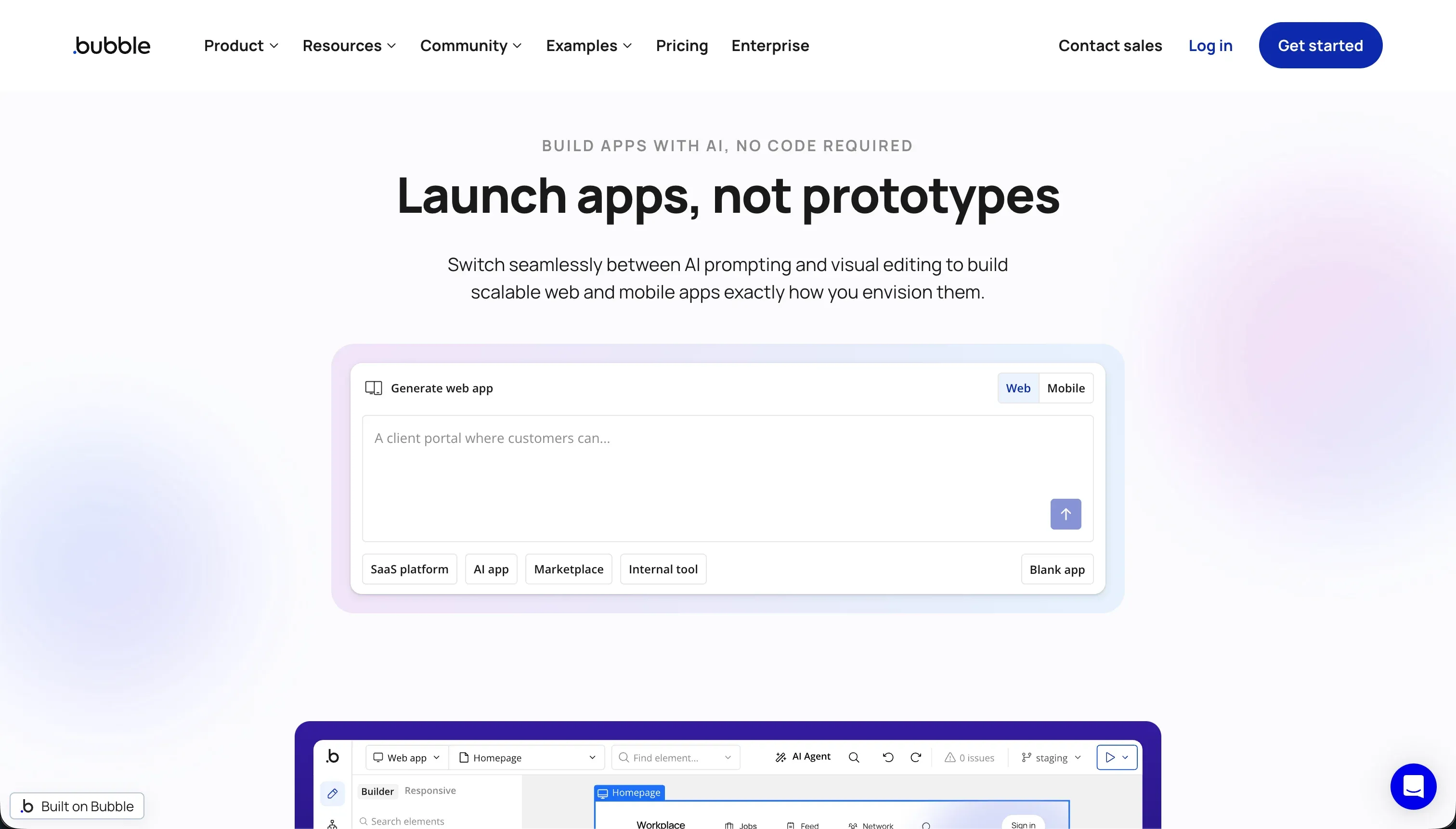 Bubble homepage snapshot
Bubble closes the list because its native mobile support, while real, is documented by evaluators as a maturing feature that lacks the performance of native iOS and Android frameworks. Its overall score of 6.8 is strong, but it is earned on the web side: design flexibility 8.5 and data & integrations 8.0 describe a deep web-app platform, not a native mobile one.
If your team is already deep in Bubble and wants a companion mobile experience, it spares you a second platform. As a primary mobile bet, the combination of an immature mobile engine, a learning curve that scores 5.0 on ease of build, and workload-unit billing with no code export is the weakest package on the page for this specific job.
Pricing starts at $69/mo Starter and climbs to $249/mo Growth and $649/mo Team, with the bill partly a function of how efficiently your app is built.
Building a business app instead?
If “mobile app” actually means a portal, field tool, or internal app your team and clients open on their phones, stop optimizing for the app stores. A platform like Softr ships apps that are mobile-responsive out of the box and installable as PWAs from a simple link, with the auth, user groups, and row-level permissions that business apps need, and none of the store-review overhead.
It scores 8.5 on production readiness and 9.0 on maintainability precisely because that infrastructure is built in rather than generated or hand-coded. IT and operations teams use it to let departments build their own governed tools without standing up native pipelines. Our client portals ranking is the right shortlist for that job.
How to shortlist
Decide the distribution question first, because it eliminates half the field:
- App stores required, with a real builder budget points to FlutterFlow for code export and the strongest native design ceiling, or Replit for an engineering team that wants to own the code.
- App stores required, fastest path from an idea points to VibeCode for prompt-to-native speed, or Adalo for a simple drag-and-drop MVP, accepting the day-two and reliability tradeoffs each carries.
- Known users who install from a link points to Glide, or to the business-app route above.
Then match the builder to your team: FlutterFlow for developer-minded builders who want code export, Replit for engineering teams comfortable with variable credit spend, VibeCode for solo builders who want native output without learning Swift or Kotlin, and Adalo for non-technical founders validating a simple idea.
Pilot one screen and one real data flow on your top pick before committing the roadmap; our methodology explains the criteria to score it on.