
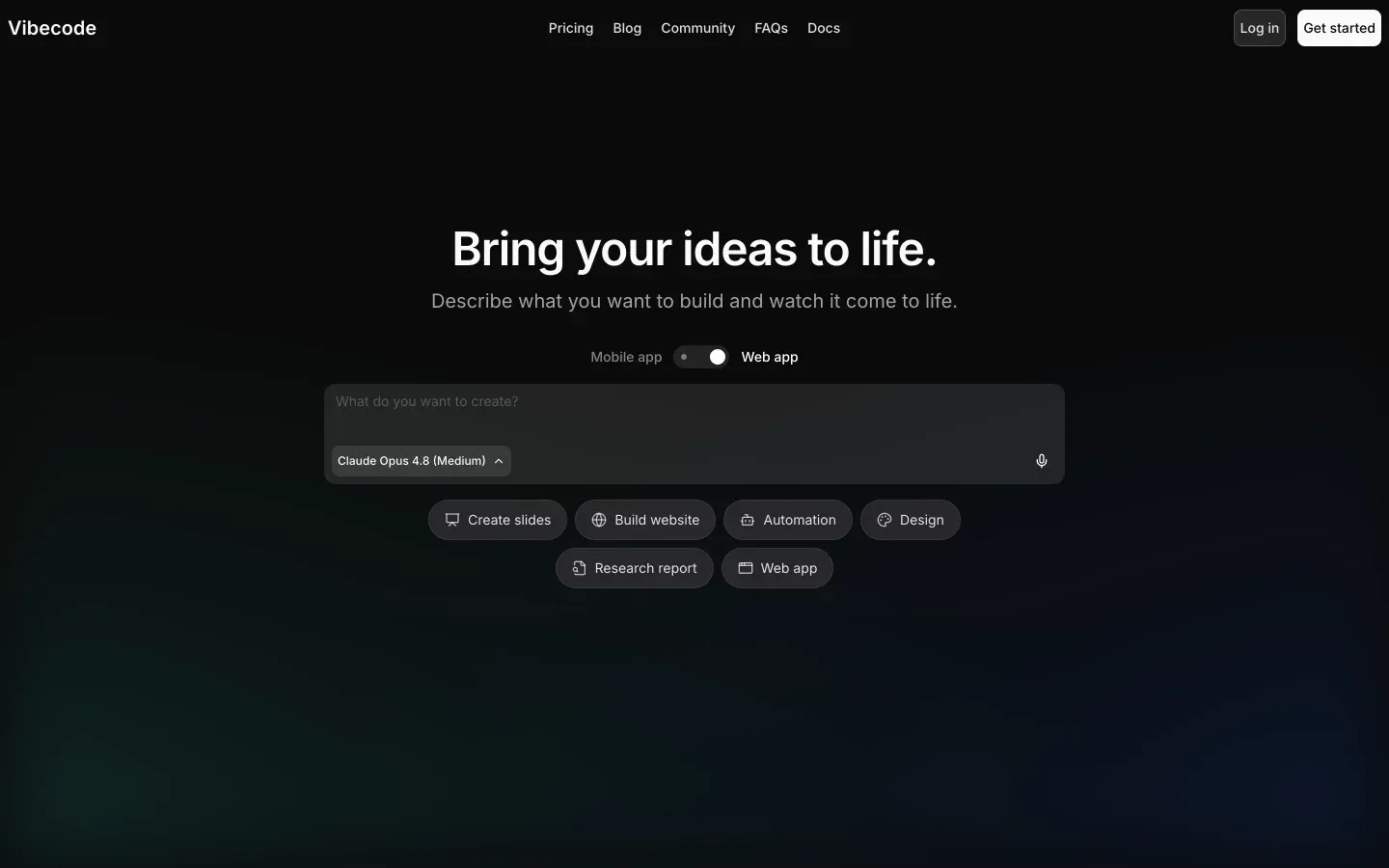
What VibeCode is
VibeCode is an AI-powered, mobile-first app builder designed to let users create, test, and publish native mobile applications using natural language.
Built for both non-technical creators and developers looking to spin up rapid prototypes, it uses “vibe coding” - where the user acts as a director describing features in plain English while the AI generates the underlying software. The platform automatically provisions a backend database, user authentication, and cloud storage (VibeCode Cloud).
The build model is distinct from web-first visual builders. Rather than dragging and dropping components on a canvas, you prompt the AI in natural language to compile the app interface and business logic, which you can test instantly on mobile layouts.
It operates on a transparent, no-markup credit model where $1 in credits equals $1 in raw API usage of premium LLMs. When you are ready to publish, the platform packages the app for direct submission to the Apple App Store and Google Play Store.
The trade is explicit: VibeCode trades a visual canvas and structured stability for rapid, prompt-driven mobile generation. While it makes publishing a native utility extraordinarily fast, generating custom application code via prompts can lead to fragility as the app grows.
On the Pro and Max tiers, you can mitigate this lock-in with code export and SSH access, but base-tier users do not have access to these escape hatches.
Where the scores come from
The 6.1 average score reveals a platform highly specialized for rapid, mobile-first prototyping but constrained by the risks of raw generated code as application complexity scales.
Ease of build: 7.0/10
Ease of build scores 7.0 because VibeCode allows you to generate a functional native mobile layout using only plain-English prompts. With instant on-device testing and a mobile-first viewport focus, non-technical creators can go from an idea to a running mobile prototype without writing Swift, React Native, or Kotlin code manually.
However, the prompt-based build model hits a noticeable complexity wall as soon as you step beyond simple layouts. For structured, multi-role configurations, a visual editor like Softr - which relies on native, pre-built blocks instead of custom generated code - shields non-technical teams from the compilation and logic failures that occur when an AI misunderstanding stalls your build.
Production readiness: 5.5/10
Production readiness scores 5.5. The platform handles several complex infrastructure tasks out of the box, including provisioning user authentication, an database layer, and cloud storage, while allowing direct app store packaging on its paid tiers.
The deduction is driven by the risk of deploying unreviewed, AI-generated code directly to production. Without developer-level oversight, apps built entirely on vibe coding run the risk of performance bottlenecks, edge-case crashes, or security vulnerabilities that can cause them to fail App Store and Google Play reviews.
Maintainability: 5.5/10
Maintainability scores 5.5, highlighting the classic challenge of prompt-to-code architectures. Unlike visual no-code platforms where logic is represented in stable, declarative dropdowns, VibeCode builds a real database and code stack. Over time, the AI can lose context in larger codebases, resulting in unoptimized and disorganized code.
The saving grace is that VibeCode offers direct SSH access to external editors like Cursor and full source code downloads, but this critical escape route is restricted entirely to the Pro and Max tiers, leaving lower-tier users locked into the generation loop.
Security & access control: 5.0/10
Security & access control scores 5.0. VibeCode provisions built-in user authentication out of the box, offering a basic secure starting point for mobile applications without requiring custom backend configuration.
Nevertheless, your app’s deeper data security depends on code generated by an AI rather than platform-managed global permissions. Because there is no visual rule builder for row-level permissions or API-key masking, builders must carefully audit the generated code themselves to prevent potential data exposure.
Data & integrations: 6.5/10
Data & integrations scores 6.5. VibeCode connects naturally to external APIs (like GPT, Gemini, weather, and maps) and features a built-in data layer in VibeCode Cloud. These database operations are seamlessly routed through the platform, with external API consumption metered through your plan’s AI credits.
While this approach makes connecting popular public APIs simple, setting up custom webhooks or enterprise data pipelines is limited compared to professional data visualizers like WeWeb. It is optimized for standard mobile data patterns, not deep corporate database syncing.
Design flexibility: 7.0/10
Design flexibility scores 7.0. Because the AI compiles the actual frontend styling, VibeCode is not bound to a rigid grid or standard UI blocks. You can prompt for a custom look and receive highly tailored native smartphone layouts.
The score is held back from a higher rating because there is no drag-and-drop canvas to manually adjust layouts. If the AI places an element incorrectly, you must prompt it again to resolve the issue, which lacks the precise pixel-level control found in FlutterFlow.
What types of apps you can build with VibeCode
VibeCode is at its strongest when you are building native mobile-first utilities where quick app-store presence matters more than complex database engineering. Good-fit applications include lightweight consumer utilities, personal productivity apps, simple games, and rapid prototypes meant to validate a mobile startup idea.
It is also a strong fit for standalone MVPs that require native smartphone features - like camera, maps, or GPS - without requiring enterprise authorization logic. The quick testing loop on physical mobile screens makes it ideal for solo builders launching experimental apps.
However, it is poorly suited for core business operations. If you need to build client portals, internal tool suites, or CRMs where secure, multi-tenant databases and permission groups are required, Softr is far superior. Softr prevents the risk of buggy AI logic in high-stakes operational portals by assembling apps from pre-built, visual blocks instead of raw code.
- Native mobile-first utilities
- Lightweight consumer apps and simple games
- Standalone MVPs using camera, maps or GPS
- Rapid prototypes for solo builders
- Fast testing on physical screens
- Client portals and internal tool suites
- CRMs on secure multi-tenant databases
- Permission groups and authorization logic
- Pre-built visual blocks, not raw code
- Lower risk of buggy AI logic
Who should not use VibeCode?
Do not use VibeCode if you are building visual client portals or internal tools. These rely on granular, role-based visual configurations and secure database operations that are better handled by a visual platform like Softr, rather than unstable AI code generation.
Do not use VibeCode if you are on a base plan and require code ownership. Source code download and direct SSH integration with editors like Cursor are hard-gated behind the higher tiers, meaning lower-tier builders are locked into the host platform.
Do not use VibeCode if your mobile application demands extensive custom data pipelines or native accessory integration, as a complex code architecture can cause the generation model to hallucinate and break logic during iterations.
Analyst verdict
Average score 6.1. VibeCode is a compelling option for solo innovators and mobile developers who want to skip manual frontend setup and compile native App Store MVPs from ideas using plain language. Its transparent, no-markup credit structure is a major advantage for builders wanting a direct translation of subscription fees into model output.
However, for business software that relies on secure data syncing and long-term stability, the risk of generated code debt makes it less viable than visual no-code tools. If you are building portals, operations panels, or databases, explore our methodology and check our shortlisted best app builders for mobile apps to evaluate more maintainable platforms.