

This head-to-head comparison evaluates two very different approaches to application construction: a classic visual programming runtime versus mobile-first AI generation. Bubble represents the mature, visual no-code standard that runs your application logic on a proprietary engine you configure manually.
VibeCode represents the mobile-first “vibe coding” paradigm, where you compile native iOS and Android apps by describing what you need in plain English.
Bubble wins this comparison with an aggregate score of 6.8/10 against VibeCode’s 6.1/10. Multiple criteria favor Bubble’s manual, deterministic configuration model for apps destined to stay in production. This verdict flips only if your time horizon is counted in days and your end product must compile into native mobile package files for the public app stores.
The decision in 30 seconds
| If your priority is… | Pick | Why |
|---|---|---|
| Deep relational logic & custom databases | Bubble | Its managed database and custom types score 8.0 over VibeCode’s 6.5 |
| Rapid mobile app prototypes from prompt | VibeCode | Builds native UI, auth, and backend from plain-English prompts |
| Predictable, flat-rate monthly software bills | Neither | VibeCode meters bills via AI credits, while Bubble charges by workload units |
| Client portals or internal operational tools | Neither | Softr offers a much higher production readiness score for secure web-based business portals |
| Direct export of application source code | VibeCode | Pro and Max plans allow code export and external SSH access to editors like Cursor |
| A massive plugin and integration ecosystem | Bubble | Features a marketplace of over 8,000 plugins to extend the visual editor |
What each platform is
What is Bubble?
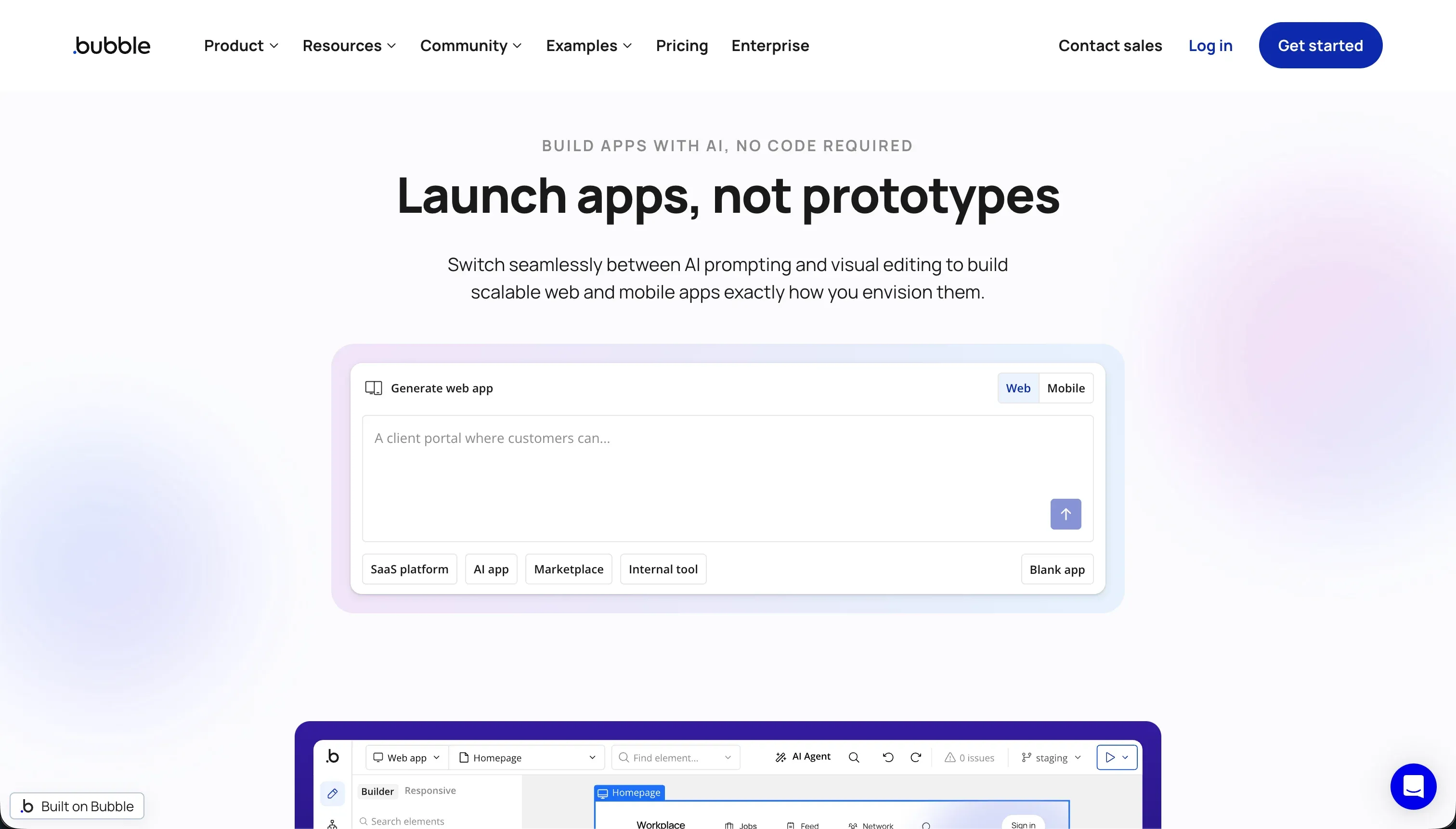
Bubble is a visual full-stack programming platform that allows users to build and host web applications without writing code.
Unlike prompt-to-code builders, Bubble implements a visual editor where you drag elements onto a canvas, establish database relationships, and define processing actions manually through a structured, visual workflow interface. It operates as a fully hosted, proprietary runtime.
Key features include server-side privacy rules, a built-in scheduler for background actions, and an API Connector designed to link external REST services directly to your workflows. Bubble is built for operations teams, product founders, and builders who want to launch custom multi-user web platforms without maintaining code repositories.
What is VibeCode?
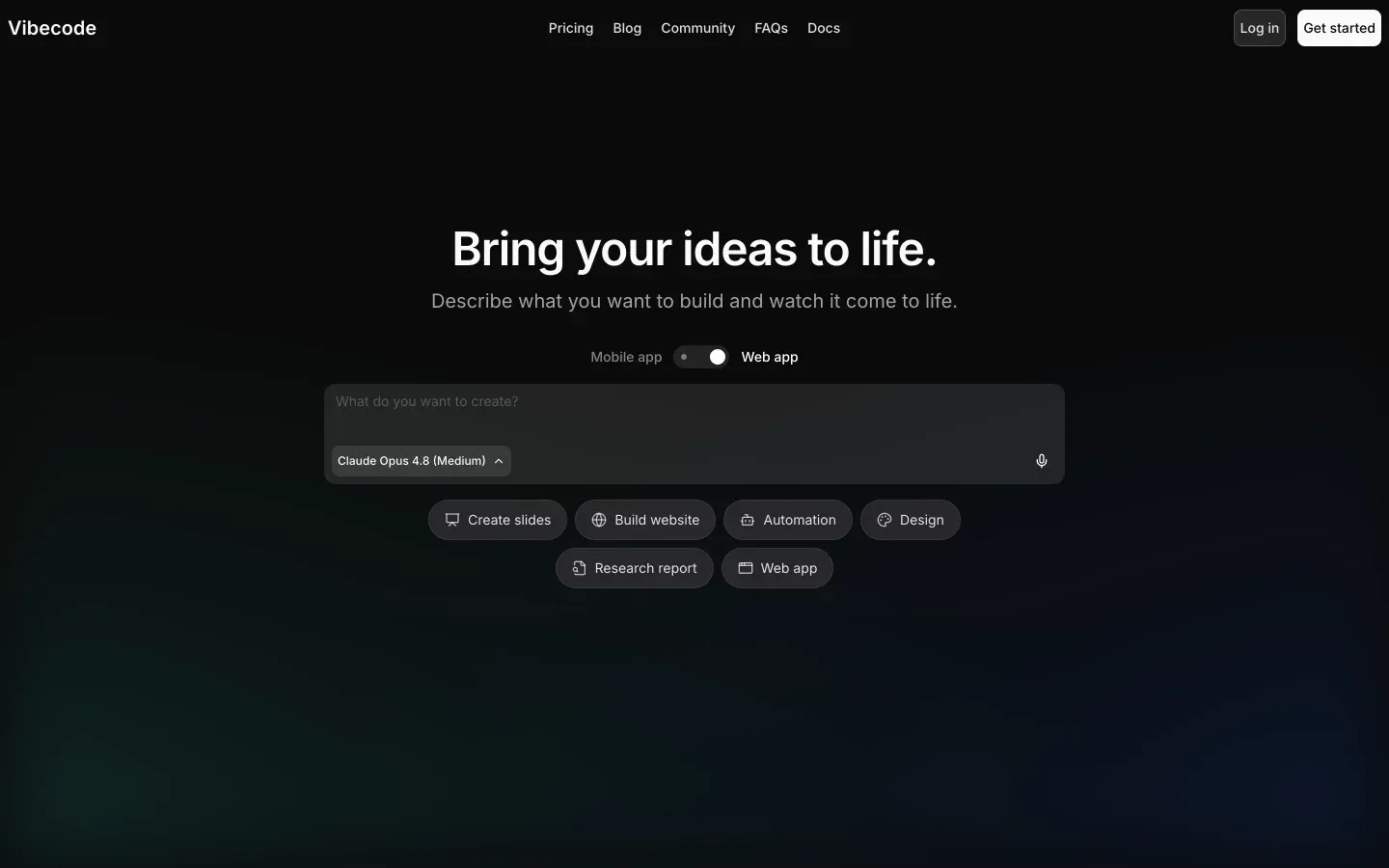
VibeCode is an AI-powered, mobile-first app builder that lets users create, test, and publish native mobile applications using natural language.
The compilation model relies entirely on prompting: the builder acts as a director explaining layout behaviors and database requirements in plain English, and the platform provisions the authentication, backend tables, and mobile-optimized interfaces dynamically.
Key features include instant preview interfaces directly on target mobile formats, pre-configured connections to services like GPT and Gemini, and direct publishing pipelines to the App Store and Google Play. It is built specifically for designers, prototypers, and non-technical mobile creators who want to compile native smartphone utilities and lightweight consumer MVPs.
The core difference
The primary dividing line between these two platforms is how much control you yield to generative AI versus setting up the application logic manually.
- Bubble requires you to master visual programming, constructing every row, database privacy rule, and API payload by hand to guarantee absolute operational predictability.
- VibeCode delegates the execution syntax to an AI model, relying on conversational prompts to wire up screens, with visual editing as a secondary tool.
Where the scores diverge
Ease of build: Bubble 5.0, VibeCode 7.0. VibeCode makes getting a functional smartphone app live dramatically faster than the classic no-code model. By constructing user registration flow, databases, and native UI entirely from plain-language prompts, non-programmers bypass the mechanical assembly steps.
Bubble presents a notoriously steep learning curve; database design, workflow conditional actions, privacy rules, and API connections require an upfront investment of weeks. While Bubble’s editor is deep, it is dense and requires a developer-like conceptual understanding before you can launch.
Production readiness: Bubble 7.0, VibeCode 5.5. Bubble is proven under real production scale for thousands of applications, utilizing built-in server-side privacy rules, an native authentication layer, and a robust background scheduling system that runs independently of visual sessions.
Deductions on Bubble stem from unoptimized database operations occasionally triggering server lag.
VibeCode scores lower here because generating a complex application purely through text instructions risks introducing security gaps, edge-case crashes, and database inconsistencies that can cause mobile app submissions to fail strict app store reviews without a developer manually auditing the generated output.
Security & access control: Bubble 6.5, VibeCode 5.0. Bubble implements true server-side role security and database privacy rules that ensure specific user roles only access data records they are explicitly permitted to view.
This makes it viable for secure, multi-tenant databases, even though configuration remains completely on the builder and is vulnerable to silent failures if a rule is omitted. VibeCode ships user authentication out of the box, but securing individual data fields and operations depends on AI-generated code.
Unaudited, prompt-compiled security logic is highly vulnerable to client-side exposure, requiring manual review to prevent data leaks.
Data & integrations: Bubble 8.0, VibeCode 6.5. Bubble features a robust native database with customizable fields, relational data mapping, an API Connector for linking with any external REST endpoint, and a vast ecosystem of over 8,000 plugins. The risk lies in dependencies on abandoned third-party plugins that can break over time.
VibeCode maps data tables, cloud storage, and simple integrations natively, but operations are limited to its cloud database and are metered through your plan’s AI credit allowance, making it less viable for high-throughput transactional database architectures.
Design flexibility: Bubble 8.5, VibeCode 7.0. Bubble offers a highly advanced, pixel-level canvas layout editor with responsive systems and custom style rules that let you build highly polished custom desktop and mobile views. Among no-code platforms, only code-generation frameworks offer similar freedom.
VibeCode specializes in smartphone screens and handles responsive layouts gracefully from prompts, but it lacks a visual canvas tree comparable to standard layout editors, making pixel-perfect adjustments via direct drag-and-drop difficult.
Maintainability: Bubble 6.0, VibeCode 5.5. Bubble application logic remains explicitly visible and editable in visual workflows that do not require re-prompting or code generation. While complex Bubble apps can accumulate workflow sprawl that is challenging to audit, you retain direct, deterministic visual control of spelling, colors, and layout fields.
VibeCode relies on AI prompts for ongoing revisions, which frequently introduces the danger of context loss in larger projects. When codebases exceed the LLM context window, the AI can produce unoptimized, duplicate functions or break previously working logic during simple updates.
Cost comparison
Bubble and VibeCode take very different approaches to pricing, and both require careful budgeting.
VibeCode operates on a credit-based system where plan levels from Free through Plus ($20/mo), Pro ($50/mo), and Max ($200/mo) deliver set allowances of dollar-denominated credits that are consumed by the under-the-hood LLM calls during prompts, generation, and API operations.
This makes your bill directly dependent on how many iterations the AI needs to write and debug your application modules.
Bubble begins with a limited Free tier, moving to Starter ($69/mo), Growth ($249/mo), and Team ($649/mo). It uses a Workload Unit (WU) model, which charges you for the compute power and data reads consumed by your app on its shared servers.
Inefficient backend workflows, unoptimized searches, or a sudden spike in active users can cause your Workload Units to overrun, triggering unexpected bill increases. For both platforms, buyers must treat subscription pricing as a baseline and expect variable performance and credit costs to vary significantly in production.
- Free, Plus $20, Pro $50, Max $200
- Credits cover LLM calls in prompts, generation, APIs
- Cost tracks AI iterations and debugging
- Budget around how much you build
- Free tier, Starter $69, Growth $249, Team $649
- WUs charge compute and data reads on shared servers
- Inefficient workflows or user spikes trigger overruns
- Budget around backend efficiency
Lock-in and the exit path
The lock-in profile is a clean win for VibeCode on its upper tiers. While VibeCode locks lower-tier users into its hosting environment, Pro ($50/mo) and Max ($200/mo) plans include full code export and SSH terminal access, allowing you to move your app directly to external visual editors like Cursor, VS Code, or custom hosts.
Bubble is a closed garden with absolute lock-in: there is no function to export source code or database structures. If you decide to migrate away from Bubble, you can export your database rows as CSV files, but you must rebuild all interface design, workflow conditional logic, and authentication layers from scratch.
Who should pick Bubble
Pick Bubble if:
- Builders who require high-security multi-tenant applications with granular data privacy controls that are enforced on the server.
- Operations teams delivering desktop-first SaaS platforms, client workspaces, or custom web portals with complex visual layouts.
- Organizations planning a multi-year software lifecycle where visual workflows must be edited directly instead of re-prompting an AI agent.
Do not pick Bubble if you require direct export of your application’s raw source code or native on-device compiling for native iOS and Android store deployment.
Who should pick VibeCode
Pick VibeCode if:
- Mobile app prototypers and designers who need to rapidly compile native application packages for target phones from simple text descriptions.
- Creators targetting publishing pipelines to the official Apple and Google app stores without custom coding.
- Teams demanding an immediate code export option and terminal access to connect to external developer tools.
Do not pick VibeCode if you are building complex business portals with highly sensitive data schemas that require visual audits and explicit, non-prompt-based security structures.
What neither platform answers
Both tools assume your application is a custom consumer-facing product requiring either pure design complexity or native mobile packaging. However, a significant portion of business software buyers are simply trying to ship operational tools: client portals, vendor dashboards, project management trackers, or internal CRMs.
For these systems, VibeCode hands you generated code that is prone to bugs as complexity scales, while Bubble demands weeks of mastery over database schemas, workflow engines, and security modules to configure basic features.
For standard business portals and internal databases, Softr represents a much more appropriate selection, scoring 8.5 on production readiness and 9.0 on maintainability on our scorecard.
Rather than generating unpredictable raw code or requiring manual visual programming, Softr compose your app visually using native, responsive business blocks (tables, calendars, and kanbans) with user authentication, permissions, and direct connections to Softr Databases built in from day one.
This delivers secure portal architectures with transparent, predictable budgeting without requiring a choice between learning curves or fragile AI loops.
Analyst verdict
Bubble wins this head-to-head comparison with an aggregate score of 6.8/10 over VibeCode’s 6.1/10. VibeCode secures a notable victory in ease of build (7.0 to 5.0) because natural-language prompting lets you compile a functional smartphone interface in minutes. However, Bubble secures its overall victory by dominating the long-term production, security, and data integrity categories.
Bubble’s visual workflow database and server-side privacy systems (6.5 on security and 8.0 on integrations) outperform VibeCode’s generated approach for applications that need to stay online. If your roadmap requires compiling a native mobile app for app stores from natural language, VibeCode remains the designated path.
If your priority is building a reliable, secure cloud interface that runs predictably without prompt regression bugs, Bubble’s visual programming model is the superior business commitment.
Related reading: the Bubble scorecard, the VibeCode scorecard, and our scoring methodology.