
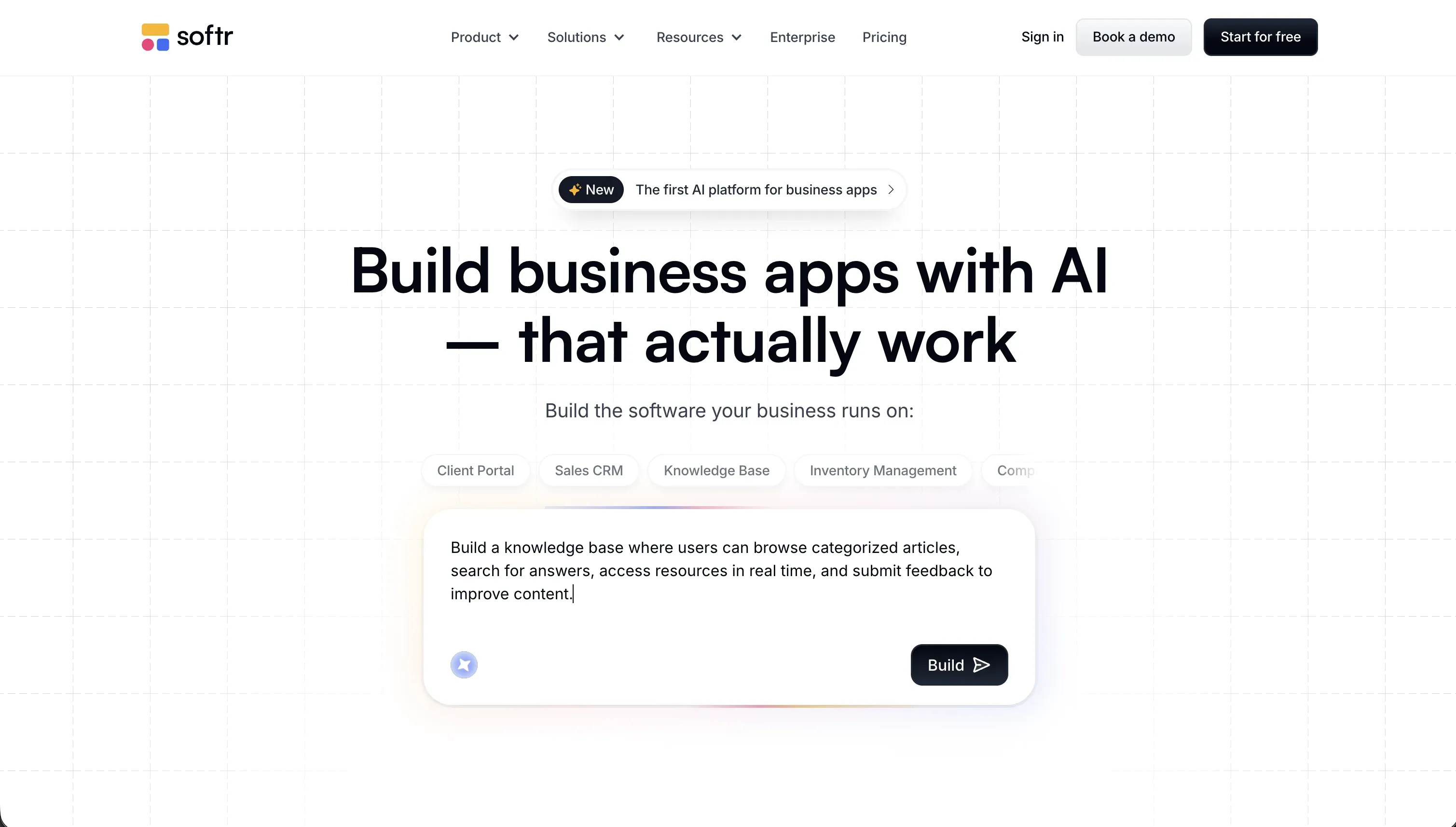
What Softr is
Softr is an AI app builder that scales from SMBs running their core business operations to large Enterprises. Over 1 million users build on it.
The platform combines four native products in one place (a database, an interface builder, a workflow automation engine, and standalone forms), and in enterprise environments, IT departments deploy it to let different business teams safely build custom tools, replace spreadsheets, and automate workflows in a secure, governed space.
The build model is what separates it from both classic no-code and AI code generators. You can describe the app to the AI Co-Builder and get a working application with database tables, pages, user groups, and navigation in minutes. You can also start from a template or build manually.
Critically, the AI and the visual editor have near-parity: anything the AI configures, you can adjust by hand, and vice versa. That removes the failure mode that defines pure prompt-to-code tools, where every change requires another prompt and another credit.
The trade is explicit. Softr does not generate or export application code, and its interfaces are composed from native blocks rather than freeform canvases. You get pre-built, production-tested infrastructure instead of a codebase you own and a pixel grid you control. For the business buyer this site is written for, that trade usually favors Softr.
For teams building custom consumer products or whose exit plan requires self-hosted code, it does not, and we score it accordingly.
Where the scores come from
The 8.1 average is not a generic “good platform” score. It comes from a specific shape: Softr scores highest where business apps usually fail after launch, and lower where design-led consumer products need full layout control.
Ease of build: 9.0/10
Ease of build scores 9.0 because Softr gives buyers three creation paths instead of one. You can describe the app to the AI Co-Builder, start from a template, or build manually in the visual editor.
That matters for non-technical teams because there is no single skill gate: a founder can prompt the first version, an operations manager can adjust permissions by hand, and an IT owner can review the structure before rollout.
The AI Co-Builder is context-aware inside the editor. It reads the current page, connected data sources, and available fields, so requests like “add a kanban board showing Tasks sorted by status” can land as a real configured block rather than a generic mockup. G2 reviewers consistently describe functional portals built in hours to days by non-developers, which supports the top-line score.
Production readiness: 8.5/10
Production readiness scores 8.5 because the application foundation is platform infrastructure, not generated code. Hosting, authentication, user management, utility pages, and permission logic are included in every app. For a portal, CRM layer, intranet, or vendor app, that removes the part of the build most likely to become fragile under real users.
The deduction is mostly about enterprise gating. Softr carries SOC 2 Type II compliance and EU data hosting, but SSO and some advanced security controls sit on the Custom plan. For most SMB and mid-market app builds, the published tiers cover the production basics; larger procurement teams still need to verify the enterprise package.
Maintainability: 9.0/10
Maintainability scores 9.0, and that number is the main buying argument against prompt-to-code tools. There is no generated codebase to maintain, no dependency drift, no framework version to chase, and no agent-written code that nobody on the team can read. Apps are built from native blocks with visual settings, so fixing a layout issue or changing a button action is a configuration change, not a re-prompt.
The Vibe Coding block keeps custom UI contained. Each block inherits the global theme, connects to data sources with permission controls, exposes manually editable settings, and carries version history. One custom component should not destabilize the application around it. Compare that with Lovable, where reviewers report regression loops in which fixes reintroduce bugs.
Security & access control: 8.5/10
Security & access control scores 8.5 because the risky parts are visual and server-side. Authentication ships as toggles: password, one-time passcodes, magic links, Google sign-in, and domain-based signup restrictions, with recovery and utility flows included rather than left for an AI to remember.
Access control runs through visual user groups with global data restrictions for row-level security. Visibility rules reach down to individual pages, blocks, and action buttons, and database operations execute server side, hidden from the client browser.
The practical result: a builder can review who sees what without reading database policies or inspecting frontend queries. The deduction is the same enterprise one: SSO and advanced controls require the Custom plan.
Data & integrations: 8.0/10
Data & integrations scores 8.0 because Softr covers the main business-app data patterns without forcing every buyer into a developer stack. Native Softr Databases handle structured records, relationships, imports, API access, and AI-ready database workflows. External data sources include Airtable, Google Sheets, Notion, and SQL databases.
The Business plan matters here. SQL, REST API, and HubSpot integrations sit there, so teams that need custom backends or deeper CRM connectivity should price against Business from the start. The upside is forecastability: the data layer is part of the platform, and the interface can still sit on sources a team already owns.
Design flexibility: 5.5/10
Design flexibility scores 5.5, and it is the honest deduction on the card. A centralized theme engine controls colors, fonts, sizing, border radius, and app-wide styling. Individual blocks can be refined, custom CSS is available, and the Vibe Coding block can generate custom components that inherit the app theme.
What Softr does not offer is a freeform canvas. Apps are assembled from native blocks: tables, lists, kanbans, calendars, charts, forms, dashboards, and custom contained components. That block model is exactly why Softr is reliable and responsive by default, and exactly why a design-led consumer product should shortlist Bubble, FlutterFlow, or a code-first tool instead.
What types of apps you can build with Softr
Softr is strongest when the app has a known user base, structured data, and permission rules. The clean fit is not “any app.” The clean fit is business software with authenticated users.
Good-fit app types include:
- Client portals: project updates, file sharing, approvals, onboarding flows, account-specific dashboards, and client-facing knowledge bases.
- Internal tools: operations dashboards, task trackers, inventory views, lightweight ERPs, team directories, and reporting layers over existing data.
- CRMs and account workspaces: lead intake, pipeline views, customer records, relationship notes, and team-specific access to sensitive fields.
- Partner and vendor apps: external collaborator portals where each company or role sees only the records it should see.
- Intranets and department apps: HR hubs, policy libraries, request forms, onboarding centers, and tools built by business teams inside a governed environment.
- AI-assisted workflow apps: interfaces that trigger Softr Workflows, use database AI fields, or expose Ask AI over permissioned data.
The common thread is not company size. Softr can serve SMBs running core operations and larger enterprises where IT wants departments to build safely without creating shadow IT. The common thread is the shape of the problem: logged-in users, real data, role-specific access, and a need for the app to keep working after the first version ships.
Who should not use Softr?
Do not use Softr if the app’s main value is a custom visual experience. Consumer social apps, interactive games, design-led marketplaces, and highly animated product experiences need more layout freedom than Softr’s block model is designed to provide. The 5.5 design flexibility score is the warning.
Do not use Softr if native mobile distribution is a hard requirement. Softr apps work on mobile and can be published as PWAs, but they are not native iOS or Android apps. If App Store and Google Play distribution decide the project, FlutterFlow is the cleaner shortlist.
Do not use Softr if code export is a procurement requirement. Softr lets you control or export data depending on the source, but the application interface and logic are not exported as a self-hosted codebase. If owning the code is the point, Replit, Cursor, or Codex are better-aligned options.
Analyst verdict
Average score 8.1, with the profile concentrated exactly where business buyers carry risk: getting to production safely, keeping the app maintainable after launch, and controlling who sees what.
If you are building portals, intranets, or CRM layers with a known user base - whether as an SMB running day-to-day operations or a large Enterprise deploying it via IT to empower departmental builders safely - Softr is the strongest fit we have scored, and the Bubble vs Softr comparison shows the gap in detail.
The exclusion list is real: custom consumer UI, native mobile app stores, and code-export requirements all point away from Softr. For the portal and internal-tool class, though, the scorecard is unusually clear. Softr gives up freeform design control to score higher on the operating questions that decide whether a business app survives year two.
See the methodology for how the six criteria are weighted.