


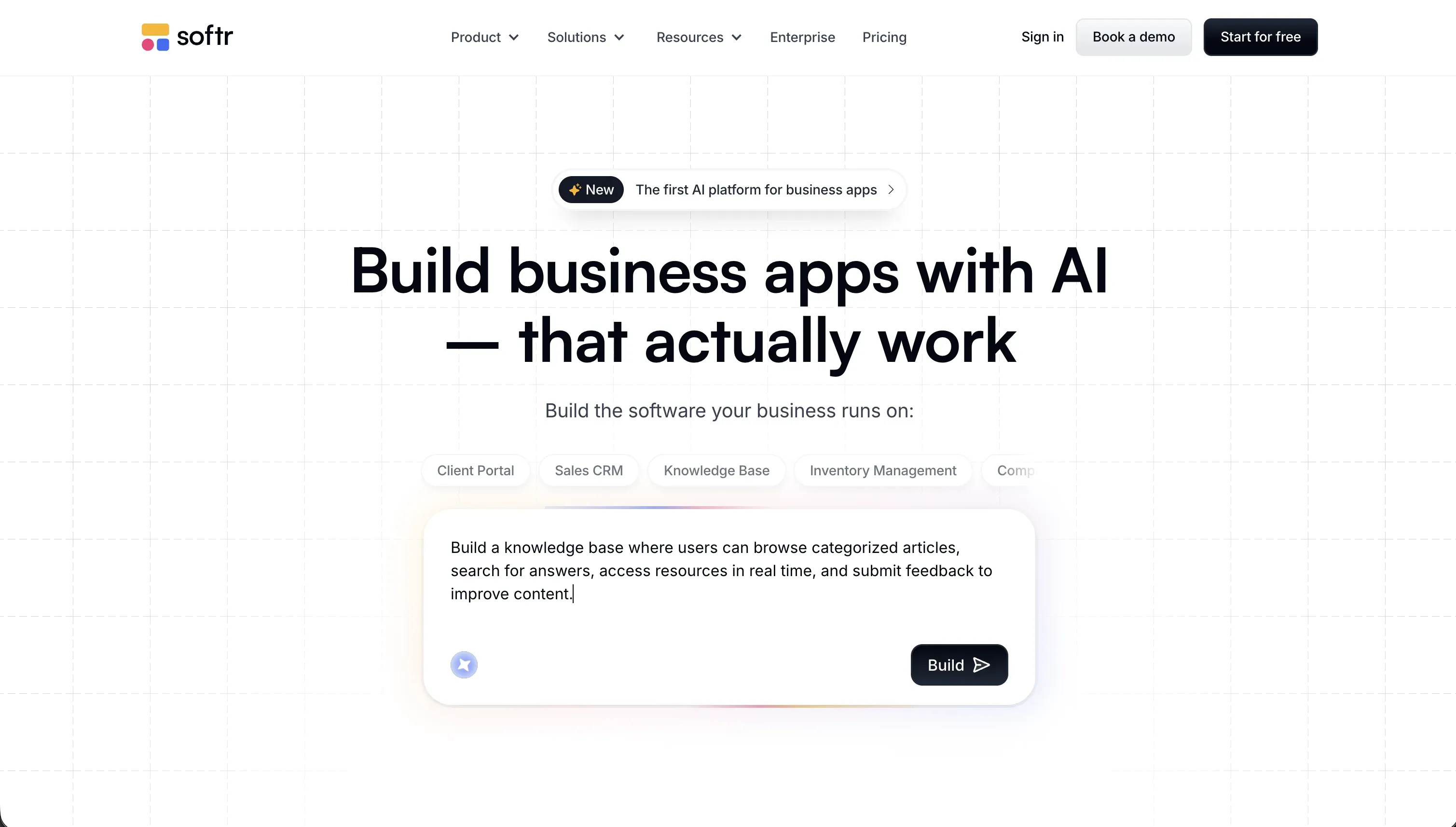
Claude Code and Softr approach the challenge of custom software creation from fundamentally opposing paradigms. Claude Code is an agentic command-line interface helper that works headlessly inside any local terminal to edit raw files, run tests, and manage repositories.
Softr is a visual AI app builder designed to compose business operational software out of pre-built, battle-tested visual blocks.
Softr wins the general business-app decision with an aggregate score of 8.1 to Claude Code’s 6.6. That verdict flips only when a developer with setup terminal environments requires pixel-level frontend freedom and needs to maintain local file custody of a raw codebase.
The decision in 30 seconds
| If your priority is… | Pick | Why |
|---|---|---|
| Client portals, internal tools, or CRMs | Softr | Authentication, user groups, and hosting are pre-built and secure out of the box |
| Local environment control and raw code execution | Claude Code | Runs headlessly in the terminal to modify local repositories directly |
| Fastest path for a non-technical manager | Softr | Ease of build scores 9.0 against Claude Code’s 4.0 due to no CLI setup overhead |
| Full design flexibility on real frameworks | Claude Code | Design flexibility scores 9.0 since outputs are bounded only by raw code |
| Predictable billing with known price caps | Softr | Offers flat-rate monthly tiers with explicit app-user limits |
| App store distribution or native mobile app code | Neither | Neither tool produces native compiled mobile app packages |
What each platform is
What is Claude Code?
Claude Code is an agentic, terminal-based code editor developed by Anthropic. Unlike traditional IDE overlays, it operates headlessly, directly inside local terminal shells like bash or zsh to read files, run tests, execute shell commands, and automate Git tasks.
This agent is built as a command-line interface companion for software engineers. It natively edits code files across a local directory, reviews history, manages commits, and queries active build configurations to fix code in place, making it a local assistant for developers inside real repositories.
What is Softr?
Softr is an AI-powered, visual no-code development platform designed for modern business operations. The tool generates complete functional web applications including databases, user groups, and page layouts from simple plain-language prompts via its AI Co-Builder.
Softr is explicitly built for non-technical business operators, department leaders, and IT teams looking to digitalize workflows. It includes a native relational database, a granular security permissions engine, integrated workflow automations, and a visual canvas to build operational tools without managing server configurations.
- Headless agent in local shells
- Edits raw code files directly
- Runs tests and shell commands
- Manages Git history and commits
- For engineers in real repositories
- Visual canvas, plain-language prompts
- Native relational database
- Granular permissions engine
- Workflow automations and hosting
- For business operators and IT teams
The core difference
The primary axis of divergence between these tools is structural abstraction: manual execution of raw code files versus platform orchestration of visual blocks.
- Claude Code requires local development environment configuration, terminal execution, and manual management of code syntax, frameworks, and deployment scripts.
- Softr abstracts the entire development stack into structured visually editable configurations, hosting, and native business blocks.
Where the scores diverge
Ease of build: Claude Code 4.0, Softr 9.0. Softr scores 9.0 because non-technical users can describe their operational flow to the AI Co-Builder, which instantly generates the database schema, layouts, and permissions in minutes, all visually editable. Claude Code scores 4.0 because it lives entirely inside the developer’s terminal.
If a builder cannot configure local environments, read code frameworks, or diagnose shell output, they cannot construct a working system.
Design flexibility: Claude Code 9.0, Softr 5.5. Claude Code scores 9.0 because design bounds are limited only by the language framework and the engineer’s frontend capability, offering maximum visual freedom.
Softr scores 5.5 because user layouts are assembled from predefined, responsive UI blocks, though builders can leverage custom styling, global theme overrides, and custom React code blocks via their AI Vibe Coding block.
Production readiness: Claude Code 6.0, Softr 8.5. Softr scores 8.5 because core production requirements - including authentication, role permissions, hosting, and SOC 2 compliance - are built directly into the platform infrastructure rather than being generated on the fly.
Claude Code scores 6.0 because while it creates real working code, its context compaction algorithm occasionally discards project memories in large repositories, causing it to output incorrect logic, while terminal latency slows down execution loops.
Maintainability: Claude Code 6.5, Softr 9.0. Softr scores 9.0 because there is no raw codebase to manage or break. Any block attribute can be fine-tuned manually by a non-developer without prompting.
Claude Code scores 6.5 because direct terminal edits remain version-controlled in Git, but the agent’s tendency to compact and forget context over long sessions forces developers to supervise modifications to prevent logic regression.
Security & access control: Claude Code 6.0, Softr 8.5. Softr scores 8.5 because critical access rules, dynamic user groups, server-side dynamic filters, and web-app credentials are managed directly on the platform, although single sign-on is gated behind the Custom plan.
Claude Code scores 6.0 because user authentication is written in code that you must manually maintain. While its prompt-for-approval terminal mechanism is secure, granting system-level terminal write-access to an autonomous model presents inherent operating risks.
Data & integrations: Claude Code 8.0, Softr 8.0. Claude Code scores 8.0 because it can write backend integrations to any API, database, or service supported by modern frameworks, though you must write and maintain every piece of plumbing yourself. Softr scores 8.0 because it integrates natively with Softr Databases, plus Airtable, HubSpot, and SQL.
It is docked half a point because SQL and custom REST API connections require the Business tier.
Cost comparison
Claude Code operates on a pay-as-you-go model, charging directly per million tokens utilized. Because active CLI tasks frequently scan directory structures and re-read workspace indexes, developers note that token consumption can burn through credits rapidly, with complex debugging loops resulting in unpredictable spikes.
Softr utilizes flat-rate subscription pricing starting at $19 per month, rising to standard business-grade plans at $99 or $329 per month, which makes software spend highly predictable. Buyers must forecast secondary cost lines, including developer execution hours and token usage on Claude Code, compared to plan limits on users, records, and AI features on Softr.
Lock-in and the exit path
Claude Code has no platform lock-in because it outputs raw code files directly to your local file system, allowing you to self-host or migrate repositories at any point.
Softr keeps visual database schemas and relational structures portable via CSV exports, API integrations, and its Model Context Protocol standard, but requires rebuilding user interfaces from scratch if migrating off its managed environment. Claude Code offers the cleanest platform exit path.
- Visual interface on managed host
- Interface rebuilt from scratch
- Relational schemas live in Softr
- Schemas preserved via CSV export
- CSV, API and MCP access available
- API integrations and MCP still portable
Who should pick Claude Code
Pick Claude Code if:
- Software engineers who need deep shell integration to run code tests and manage local repositories
- Teams building highly custom web products requiring framework-level aesthetic and functional freedom
- Projects requiring zero vendor lock-in and complete codebase ownership from day one
Do not pick Claude Code if you or your team cannot configure terminal environments, manage active database hosting layers, or read the generated application code.
Who should pick Softr
Pick Softr if:
- Operations teams building robust portals, employee directories, partner intranets, or CRM platforms
- Organizations requiring built-in enterprise authentication and row-level visual permissions out of the box
- Knowledge workers who need to configure and scale business apps visually without managing codebase debt
Do not pick Softr if your application requires compiled native mobile app-store distribution or pixel-perfect layout control outside of block frameworks.
Where neither platform fits
If you require true app-store distribution and compiled native mobile applications, neither platform will meet your requirements. Softr produces highly optimized responsive web apps and PWAs, while Claude Code generates raw directory layers. You should utilize FlutterFlow, which compiles native iOS and Android environments with clean code export.
If project mandates require full self-hosting along with automated backend file generation, look to Replit. Replit hosts visual previews directly and provides a complete browser cloud container, dodging local terminal complexities while maintaining full raw code custody.
Analyst verdict
Softr wins this comparison with an aggregate score of 8.1 to Claude Code’s 6.6. Softr takes the lead across ease of build, production readiness, maintainability, and security by converting complex application requirements - such as security rules and user sessions - into standard, easily configured platform infrastructure.
Claude Code remains a powerful assistant only for developers who prefer modifying directory files from their local shell. For business applications, dashboards, or portals, Softr minimizes implementation delays and removes technical debt.
Related reading: the Claude Code scorecard, the Softr scorecard, and our scoring methodology.