

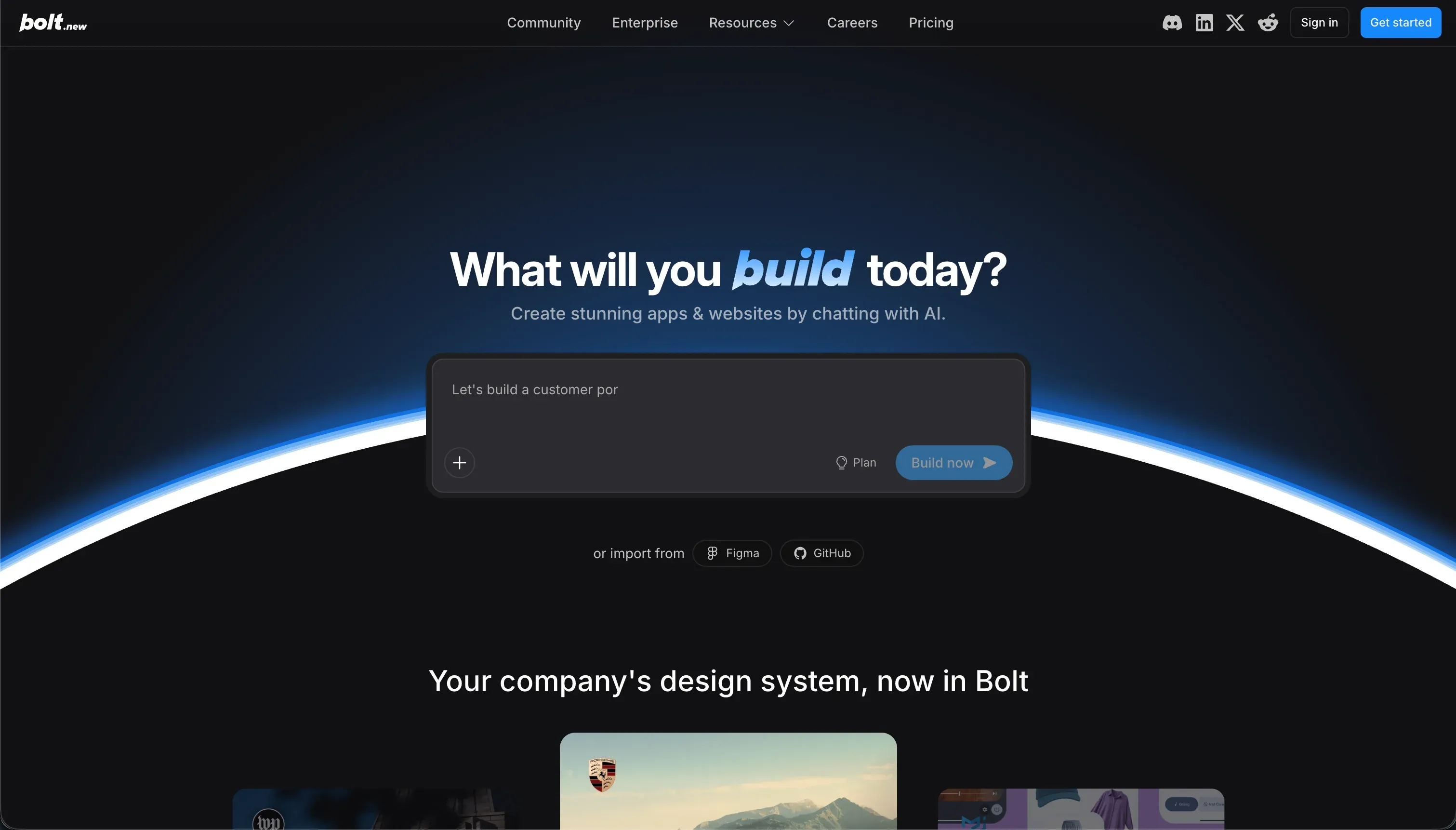
Bolt and Softr operate on opposite sides of the AI software creation divide. Bolt is a browser-based developer IDE that uses WebContainers to write, run, and execute full-stack code from natural language prompts.
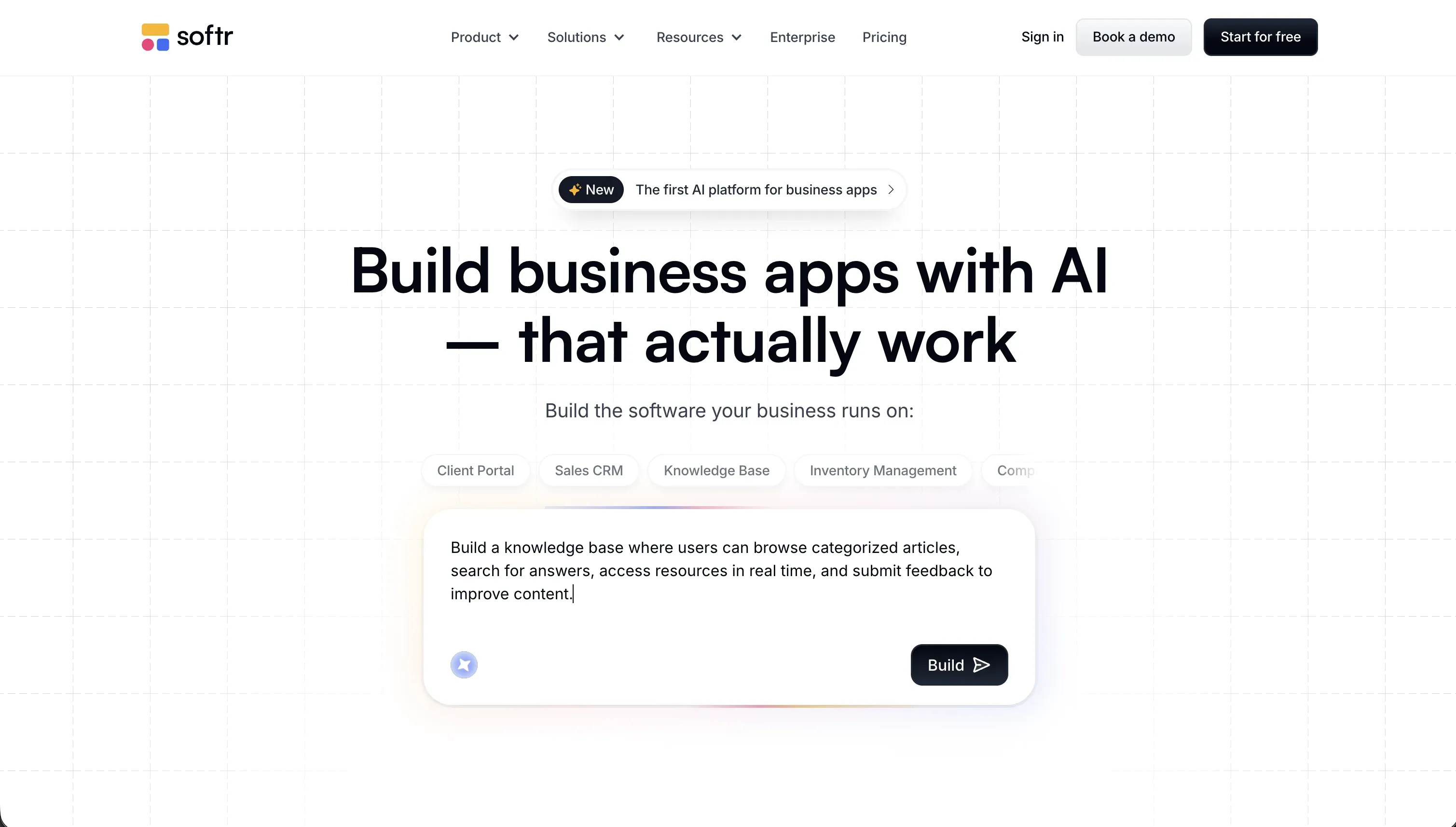
Softr is an AI-powered no-code business application platform that composes and configures pre-built, battle-tested visual and data infrastructure without generating raw codebases.
Softr wins the general decision, 8.1 to 5.1. While Bolt presents a zero-lock-in React export, it offloads significant technical debt, deployment overhead, and manual debugging onto the buyer. Softr delivers immediate business utility because its permissions, databases, and authentication are managed as platform infrastructure rather than fragile, generated code templates.
The decision in 30 seconds
| If your priority is… | Pick | Why |
|---|---|---|
| Client portals, internal tools, and CRMs | Softr | Permissions, user auth, and server-side CRUD are platform native and secure by default |
| Zero platform lock-in and raw React code export | Bolt | Output is a standard React and Vite codebase running in a browser-native WebContainer |
| Evolving the app without developer intervention | Softr | Visual editing has near-parity with AI prompting, requiring no code debugging |
| Pixel-perfect, freeform frontend layouts and custom npm packages | Bolt | Design flexibility scores 8.0 with no structural template ceiling |
| Predictable software spend and budget compliance | Softr | Flat monthly plans with stated record and user limits instead of token burn limits |
| Native Apple Store and Google Play deployment | Neither | Both platforms target responsive web applications and PWAs rather than native mobile packages |
What each platform is
What is Bolt?
Bolt is an AI-powered development workspace that generates and runs complete React, Node.js, and PostgreSQL codebases directly in the browser. Using WebContainers technology, it creates a virtual operating system environment where builders can install npm packages, run development servers, and execute terminal commands through a conversational interface.
Bolt is built primarily for developers, technical founders, and builders who understand full-stack web architectures. It produces a real codebase hosted on Bolt Cloud or deployed with one click to Netlify. However, users must manage environment variables, troubleshoot build failures, and handle typical web development errors when projects expand.
What is Softr?
Softr is an AI no-code app builder designed for business operators to build operational tools and client portals. Instead of generating raw, unmaintained code from scratch, its AI Co-Builder composes and assembles pre-built, secure components like data tables, forms, kanbans, and automated workflows.
Softr is designed to bridge the gap between initial setup and production scaling. It includes a native, relational database with Model Context Protocol support alongside direct connectors to external platforms like Airtable and HubSpot. The entire system is fully hosted, enterprise-ready, and SOC 2 Type II compliant out of the box.
The core difference
The division between these tools is a choice between raw code generation and managed platform composition.
- Bolt provides an AI-driven browser IDE that writes and runs custom full-stack React code, leaving the developer to debug framework updates and handle database infrastructure.
- Softr provides an AI-assisted visual builder that configures secure, standard business software components without exposing the user to runtime errors or unmaintained code.
Where the scores diverge
Maintainability: Bolt 3.5, Softr 9.0. Softr scores 9.0 since there is no generated codebase to maintain. Builders can make direct, visual changes to blocks and workflows by hand without burning credits or re-prompting. Bolt scores 3.5 because ongoing maintenance requires managing raw React code.
In complex editing loops, the platform’s AI frequently suffers from regression bugs, overhauling functioning sections of code or reverting previous changes, making iterative updates highly unpredictable and credit-intensive.
Security & access control: Bolt 3.5, Softr 8.5. Softr scores 8.5, offering structured, visual user groups and server-side CRUD processing that prevents client-side data leaks out of the box. Bolt scores 3.5 due to the complete lack of a visual permissions editor.
Authentication, row-level rules, and API routes must be coded entirely via prompts, which requires manual code auditing and developer-level review to verify that sensitive database fields are not exposed to unauthorized users.
Production readiness: Bolt 4.0, Softr 8.5. Softr scores 8.5 by keeping user management, row-level roles, and EU hosting secure within its platform infrastructure rather than leaving them to chance. Bolt scores 4.0 due to severe operational stability concerns.
Under real usage, larger projects frequently experience container crashes, out-of-memory errors in browser WebContainers, and account prompts that freeze entirely under Bolt’s ‘Project too large’ limit.
Ease of build: Bolt 5.5, Softr 9.0. Softr scores 9.0 by focusing on zero-code assembly where description generates pages, workflows, and database tables in minutes, all editable visually without re-prompting. Bolt scores 5.5 because while its initial prompt-to-preview is fast, it operates as a full browser IDE.
Connecting databases, debugging local containers, and diagnosing runtime errors require web development knowledge that non-technical teams do not possess.
Design flexibility: Bolt 8.0, Softr 5.5. Bolt scores 8.0, allowing complete custom styling, Figma imports, npm library integrations, and custom frontend components with zero platform layout ceilings. Softr scores 5.5, which is its primary functional trade-off.
While Softr includes global theme controls, custom CSS, and an AI Vibe Coding block for building custom React components, its layout is structurally bound to native columns and pre-defined block designs.
Data & integrations: Bolt 6.0, Softr 8.0. Softr scores 8.0, recommending its native relational database first but easily syncing with Airtable, Notion, and HubSpot. Advanced SQL and REST connections require the Business plan.
Bolt scores 6.0 because while it can write PostgreSQL schemas and integrate any library, it provides no native database administration UI. Teams are forced to configure external BaaS platforms like Supabase to safely process and manage app records.
Cost comparison
The financial cost of these two tools reflects their divergent operational models. Softr uses a predictable, flat-rate monthly tier system starting at $19 for Basic and scaling up to $329 for Business (billed annually), which supports 30 Team and 100 Client app users (expandable to 100 and 500) and 1 million database records.
Because Softr does not charge per-seat or usage-based compute fees for app users, billing remains constant regardless of active traffic or manual visual edits. AI credits are metered, but manual visual editing is always available when credits are exhausted.
Bolt charges on a hybrid subscription and token consumption model, with plans like Pro starting at $25 per month for 10 million tokens and scaling up to $2,000 per month for larger allocations. These tokens are aggressively consumed not just during build prompts, but also during error loops when Bolt attempts to resolve its own runtime issues.
Builders face high indirect labor costs from developer hours needed to resolve build failures, alongside migration costs when a project reaches browser container limits.
Lock-in and the exit path
Bolt is built on complete code ownership, allowing builders to download standard React and Vite codebases or sync directly to GitHub, offering an easy exit path. Softr allows builders to export their database rows, but the interface blocks, visual page rules, backend workflows, and user permissions are proprietary and must be completely rebuilt to leave.
Bolt offers the cleaner exit path, but only for teams capable of compiling and hosting the exported code themselves.
- Download React and Vite codebase
- Sync directly to GitHub
- Full code ownership
- You compile and host it yourself
- Database rows export
- Blocks are proprietary
- Page rules are proprietary
- Workflows and permissions are proprietary
- Everything else rebuilt to leave
Who should pick Bolt
Pick Bolt if:
- Software developers who want to use AI to scaffold working React templates before writing custom code manually
- Builders requiring complete code exportability and native GitHub version control from day one
- SaaS MVP teams building highly custom frontends that must integrate arbitrary npm packages without layout constraints
Do not pick Bolt if your team lacks a developer to audit security rules, debug container crashes, and manage external backend hosting like Supabase.
Who should pick Softr
Pick Softr if:
- Business operations teams who need to deploy client portals or internal tools that are secure and compliant from day one
- Orgs requiring granular user permissions and visibility rules that managers can visually audit and verify with instant impersonation previews
- SMEs requiring flat-rate pricing with unlimited visual updates that do not rely on constant credit burn
Do not pick Softr if your software product requires a completely custom, pixel-perfect consumer interface or native iOS and Android store distribution.
Where neither platform fits
For teams requiring native mobile applications distributed directly through the Apple App Store or Google Play Store, neither Bolt nor Softr is the correct purchase. Both platforms prioritize responsive web architectures and Progressive Web Apps (PWAs). Buyers targeting native app environments should evaluate FlutterFlow, which compiles native mobile binaries and exports clean Dart code.
If your organization requires absolute raw code ownership and self-hosting, but needs a production-ready application environment rather than a fragile browser sandbox, Replit offers a superior developer agent experience. Replit handles full-stack deployments on stable server environments, avoiding the WebContainer memory crashes and token-burning regression loops seen in browser IDEs.
Analyst verdict
Softr wins this comparison with a scorable aggregate of 8.1 against Bolt’s 5.1. The difference lies in the ‘day two’ reality of software operations. Softr builds on platform infrastructure - secure user authentication, SOC 2 compliance, physical server-side CRUD handling, and stable, block-based UI.
Once generated by AI, a Softr app can be operated and expanded entirely via hands-on visual settings, making it an asset of low technical carriage.
Bolt’s 8.0 design flexibility makes it a powerful initial scaffolding tool, but it offloads the complexity of software engineering back to the user. Its 4.0 production readiness and 3.5 maintainability scores reflect realistic risks of unmanaged technical debt, database vulnerabilities, and unpredictable billing.
Softr is the professional operational choice for internal business software; Bolt is a fast sandbox for developers prototyping React codebeds.
Related reading: the Bolt scorecard, the Softr scorecard, and our scoring methodology.