

The procurement decision between Base44 and Bolt represents a choice between two distinct approaches to AI-driven application development. Base44 belongs to the all-in-one conversational app-scaffolding category, attempting to hide databases, user login, and hosting behind a single prompt.
Bolt occupies the browser-native IDE category, compiling a real React and Vite codebase directly inside browser WebContainers.
Base44 wins the aggregate review scorecard with a 5.2/10 mean compared to Bolt’s 5.1/10, though both platforms carry steep reliability penalties. This decision flips toward Bolt if your target architecture demands complete frontend design flexibility and an exportable React codebase, while Base44 is chosen for rapid MVP generation that avoids frontend assembly hurdles entirely.
The decision in 30 seconds
| If your priority is… | Pick | Why |
|---|---|---|
| Speed from a single prompt | Base44 | Scaffolds database, auth, and hosting from one initial message, achieving an 7.5 on ease of build |
| Figma import and React custom layouts | Bolt | Generates unconstrained React and Vite components with an 8.0 design flexibility score |
| Deep backend control and custom logic | Neither | Both systems isolate logic behind closed AI feedback loops that break on complex modifications |
| Granular user per-field permissions | Neither | Base44 roles are basic and Bolt requires reading raw code to verify row-level permissions |
| Code portability and GitHub sync | Bolt | Syncs a clean standard front-end directory directly to GitHub repositories |
What each platform is
What is Base44?
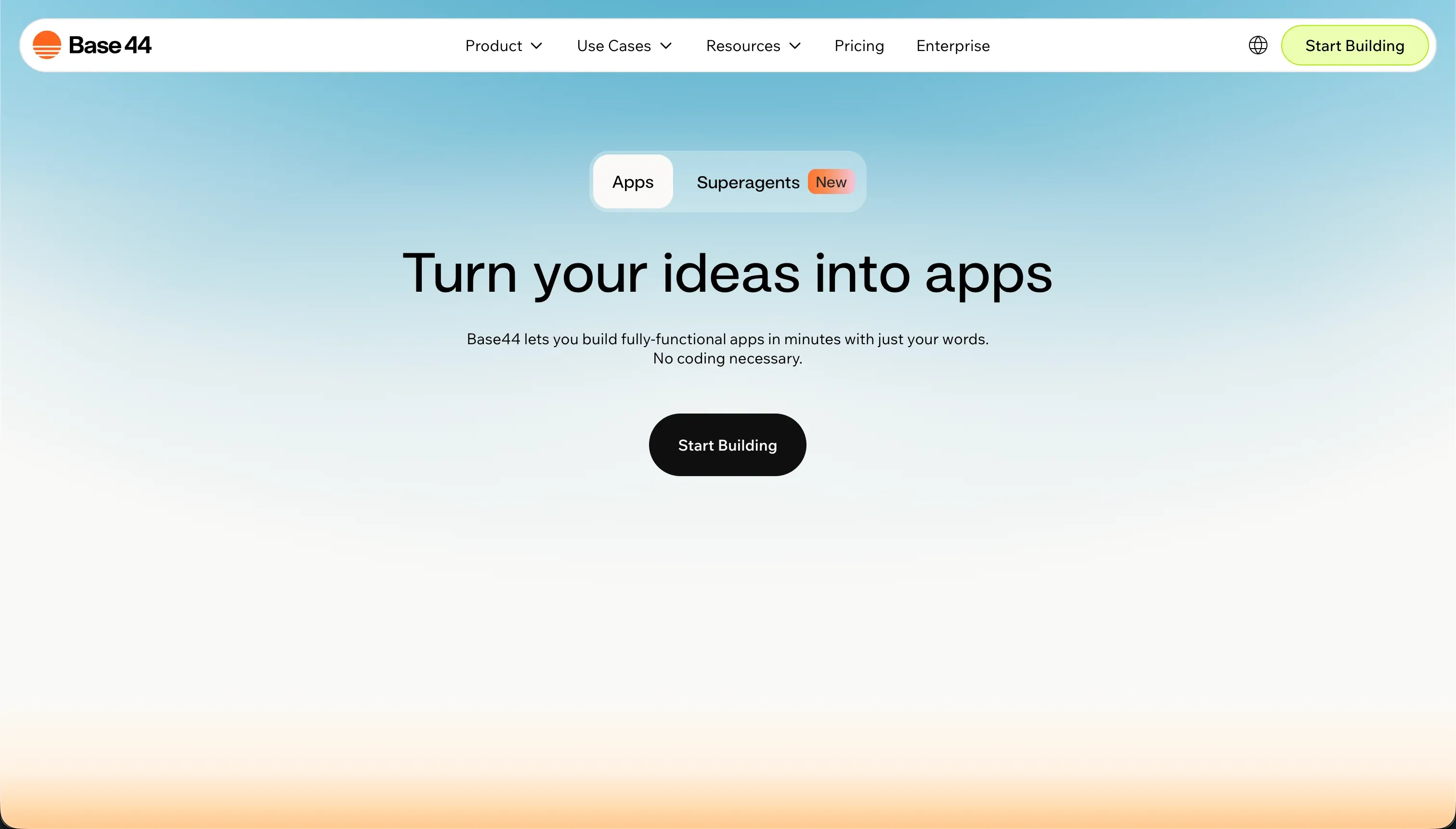
Base44 is an AI-powered conversational application builder designed to compile full-stack web applications from free-text prompts, bundling hosting, managed databases, and user login inside a closed system.
The build model focuses on non-developers: users state their logical workflow in plain English, and the platform scaffolds the required interface templates, database schemas, and global configurations in a single conversational pass.
Two concrete features define its workspace - a Click-to-Tweak visual styling editor that lets operators refine layouts without writing prompts and an Idea Library with pre-set design tokens like glassmorphism. It is built for operations teams and non-technical founders seeking to stand up lightweight internal workflows and standard transactional MVPs without managing deployment pipelines.
What is Bolt?
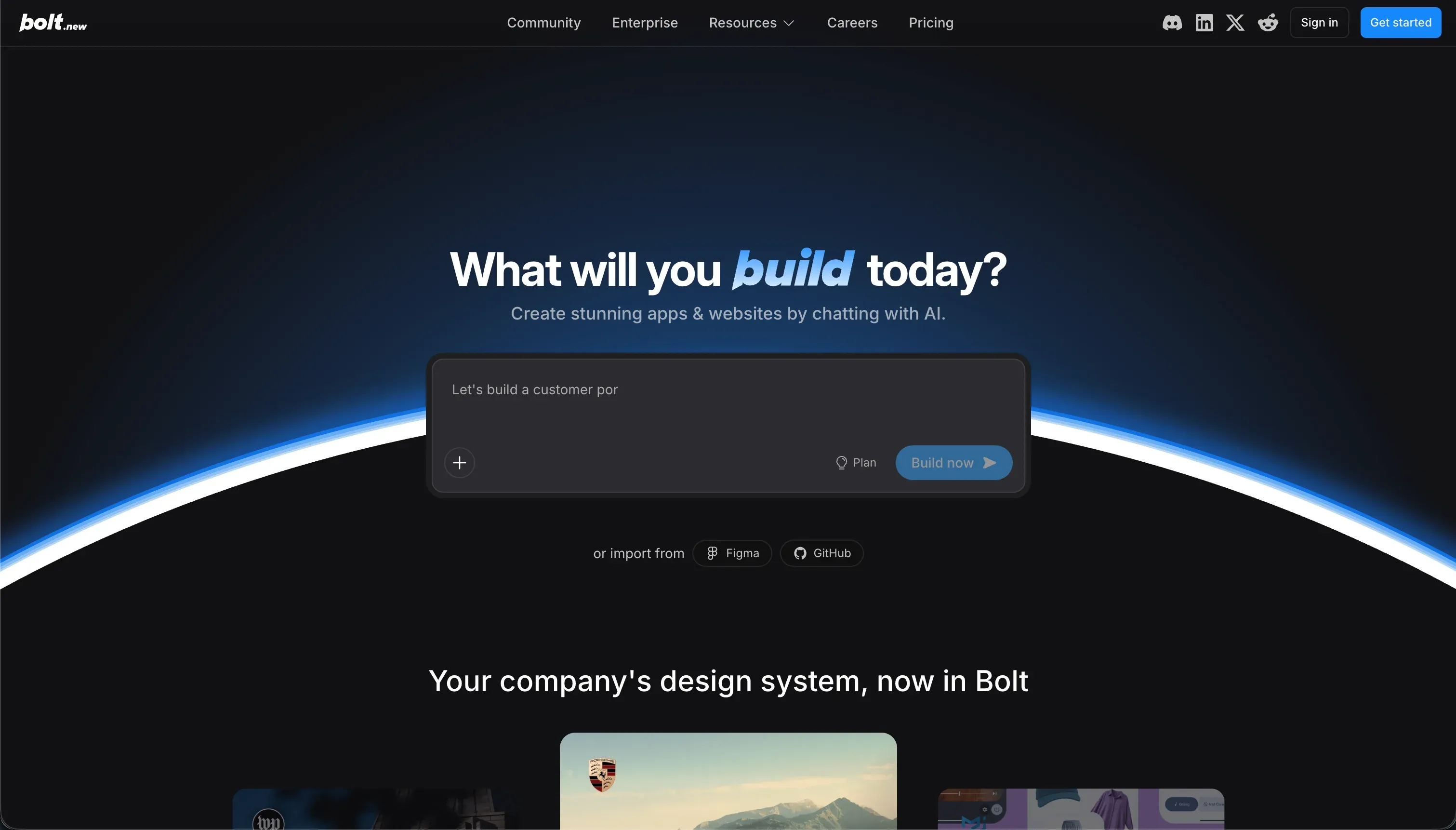
Bolt is a browser-native integrated development environment (IDE) powered by StackBlitz’s WebContainers technology. It allows users to prompt, compile, and run full-stack Node.js and React applications directly inside a browser-based container, executing terminal commands and installing npm packages client-side with zero local configuration.
Key capabilities include native Figma import, Storybook component support, and one-click deployment pipelines to Netlify or custom staging domains. It is specifically built for developers, technical founders, and advanced builders who require direct codebase manipulation and complete ownership of standard React/Vite repositories without local environmental setup.
The core difference
The primary axis of divergence between these systems comes down to the abstraction layer of their development environment.
- Base44 orchestrates pre-built, conversational templates and click-to-tweak layouts to shield non-technical users from backend plumbing.
- Bolt exposes a raw WebContainer terminal, compiling real, deployable code that expects its builder to understand web-development error streams.
Where the scores diverge
Ease of build: Base44 7.5, Bolt 5.5. Base44 wins heavily due to its structured conversational onboarding. Database, auth, and hosting are scaffolded instantly from a single initial prompt with zero manual environment configuration, complemented by a click-to-tweak editor for visual layout modifications.
Bolt scores lower because it functions as an actual browser IDE, meaning that editing, connecting external backends, and reading raw compile errors assume a foundational understand of web development concepts.
Design flexibility: Base44 6.5, Bolt 8.0. Bolt scores a strong win on frontend styling. Because it authors standard React and Vite components with support for Storybook and npm packages, there is no template ceiling. Base44 relies on pre-defined layout tokens, keeping the core directory layout, navigation elements, and login flows constrained to Base44 defaults.
Security & access control: Base44 4.0, Bolt 3.5. Base44 edges ahead slightly because it provides standard, pre-built authentication screens, though registration layouts cannot be custom branded and role permissions are entirely basic. Bolt lacks a visual user group or permissions manager.
Securing data rows on Bolt requires prompting the AI to draft custom code, meaning verifying access boundaries requires reading the underlying codebase, posing an invisible risk for sensitive client databases.
Data & integrations: Base44 5.5, Bolt 6.0. Bolt secures a slightly higher score because its open code architecture has no native schema ceilings, allowing it to integrate with any API or backend. Base44 relies on connections running through LiteLLM, imposing structural API limits. Builders flag significant limits on PDF data handling, alongside noticeable page latency once datasets expand.
Production readiness: Base44 4.0, Bolt 4.0. This criterion is a critical failure point for both platforms, yielding a locked score. Base44 builders complain of system instability, where servers go down once a week and production updates break workflows for existing users.
Bolt suffers from container crashes, build failures, and out-of-memory errors on larger files. Once a project reaches Bolt’s internal file limits, builders run into ‘Project too large’ account locks that freeze all prompting entirely.
Maintainability: Base44 3.5, Bolt 3.5. Both systems tie at a problematic 3.5, driven by AI regression loops. On Base44, the editing agent frequently triggers loops where bug fixes break unrelated existing pages, wasting high quantities of message credits.
Bolt is plagued by similar edit patterns where the model rewrites working code or reverts manual changes, forcing non-technical builders into costly token-burning loops to resolve minor interface errors.
Cost comparison
Base44 presents a dual credit pricing structure: subscriptions run from the Free tier up to Elite ($160/mo billed annually), tracking both Message credits for prompting and Integration credits consumed whenever a published app runs database queries, calls APIs, or triggers emails.
Bolt uses scaling subscription tiers starting at $25/mo for 10 million tokens and scaling up to $2,000/mo for high-end enterprise workloads, charging a subscription floor simply to roll unused tokens over to the next month.
From a total cost of ownership perspective, both platforms present high risk. Buyers must forecast high human editor overhead due to AI debugging loops that quickly deplete monthly tokens and prompt credits on false-positive code edits.
Additionally, both architectures run on closed cloud execution layers that may incur high computing, API, and storage overages once real users generate heavy daily transaction volumes.
Lock-in and the exit path
Bolt has a cleaner exit route than Base44 because it allows builders to download standard React, Vite, and TypeScript repositories on any plan or sync directories automatically to GitHub with zero platform lock-in.
Conversely, Base44 limits code export features, keeping databases, backend functions, and system configurations locked within its proprietary hosting environment. This means leaving Base44 requires a complete backend rebuild, whereas leaving Bolt merely requires hosting the exported frontend files on platforms like Netlify or Vercel.
- Download standard React, Vite, TypeScript repos
- Any plan allows code export
- Auto-sync directories to GitHub
- Host frontend on Netlify or Vercel
- Code export is limited
- Database stays in proprietary hosting
- Backend functions stay locked
- System configurations not portable
Who should pick Base44
Pick Base44 if:
- Non-technical operators who must launch a simple MVP in days with zero database, auth, or server-side hosting setup.
- Builders looking for a click-to-tweak visual styling editor to adjust UI elements without repeating natural-language AI prompts.
- Teams that do not want to manage development terminal windows or manually audit React codebase dependencies.
Do not pick Base44 if your application requires custom per-user data isolation, branded login pages, or a portable backend database that can be fully exported.
Who should pick Bolt
Pick Bolt if:
- Technical builders who want the AI to write first-draft React code but want access to a browser IDE to debug code modifications manually.
- Organizations with strict design standards that need to import Figma structures and install external frontend components via npm.
- Developers requiring direct codebase sync to GitHub repositories to avoid proprietary vendor runtime lock-in.
Do not pick Bolt if you do not understand frontend assembly, terminal structures, or how to manually provision database platforms like Supabase.
What neither platform answers
Both Base44 and Bolt treat the application as a complex, custom coding assignment. Whether you are prompting Base44 to wire up custom table rules or debugging Bolt’s WebContainer compilation traps, you are forcing non-technical operators to think like software engineers.
This introduces systematic security, maintenance, and budget risks if you simply need to display database records securely to specific user categories.
For standard business portals, secure intranets, CRMs, or client-facing dashboards, Softr represents a much safer allocation. Softr scores 8.5 on production readiness, 9.0 on maintainability, and 8.5 on security & access control because it uses pre-built, battle-tested visual blocks directly linked to native Softr Databases.
Rather than generating unstable code that can break during updates, Softr handles authentication, domain hosting, and granular user roles visually, making maintenance completely deterministic. Organizations seeking a developer-centric agentic platform for custom algorithms should shortlist Replit instead.
Analyst verdict
The final scorecard awards Base44 the aggregate victory of 5.2/10 to Bolt’s 5.1/10. Base44 takes ease of build (7.5) and security (4.0) by shielding operators from manual backend configurations; Bolt takes data & integrations (6.0) and design flexibility (8.0) because it generates a real React codebase free from default template caps.
However, both are high-risk options for long-lived systems. Outstanding complaints regarding server instability on Base44 and container memory crashes on Bolt make both platforms difficult to recommend for production environments. If your goal is custom web development, Replit represents a superior procurement choice for code ownership; if the target is secure operations software, Softr is the safer business buy.
Related reading: the Base44 scorecard, the Bolt scorecard, and our scoring methodology.