
What Base44 is
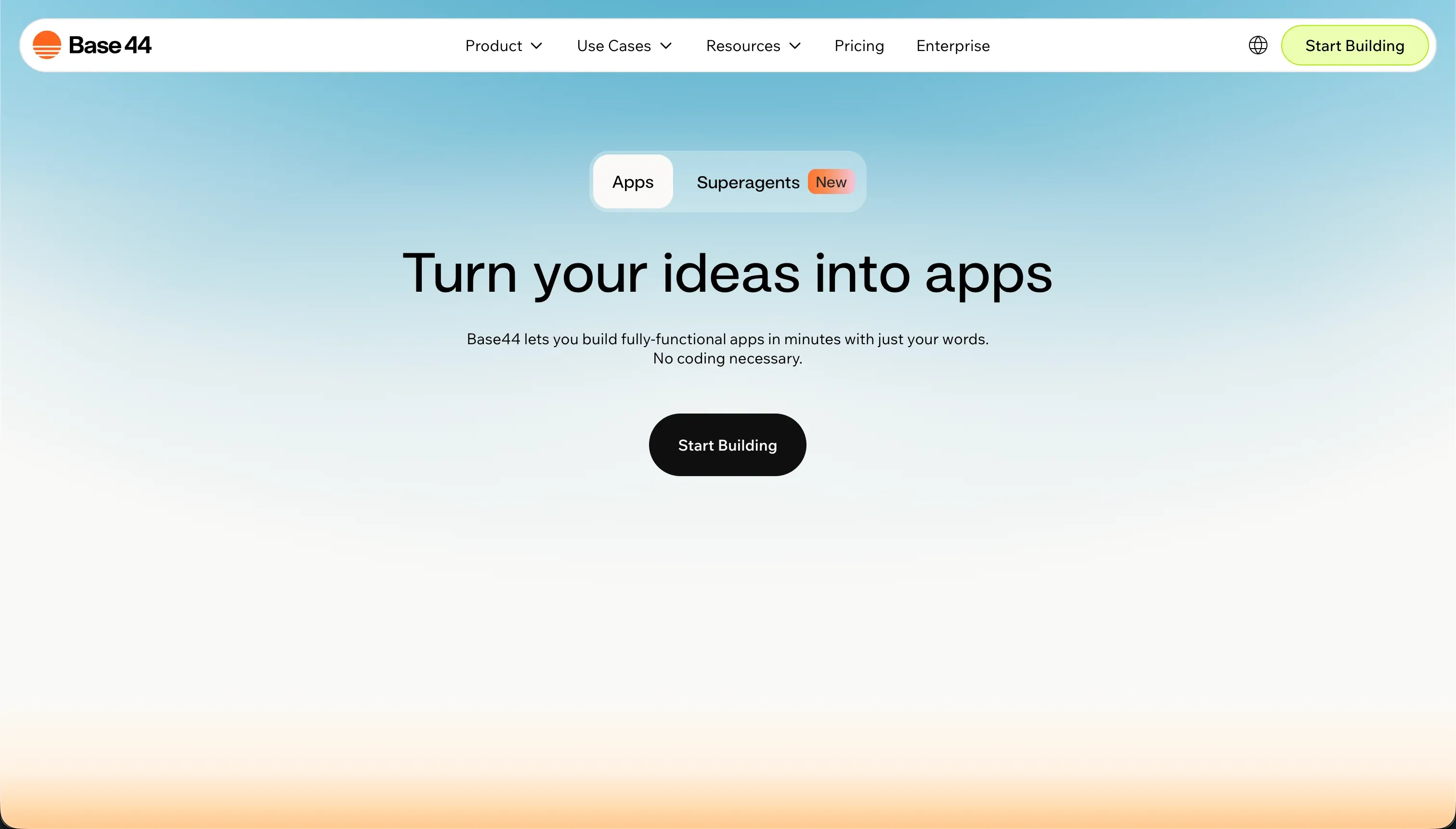
Base44 is an AI-powered, full-stack application builder acquired by Wix that aims to generate functional web applications directly from conversational text prompts. By entering a plain-English prompt, users can instantly provision a front-end interface, database models, user authentication, and managed hosting without compiling any code by hand.
It targets non-technical founders, operations teams, and rapid-prototyping developers looking to go from idea to interactive demo in a single pass.
The core of the Base44 build model is the automated translation of text requests into structured application elements. In addition to initial generation, Base44 includes an in-editor conversational chat agent and a visual “click-to-tweak” layout editor, allowing users to make adjustments visually or via follow-up prompts.
Frontend source code can be exported to GitHub, allowing traditional developers to take over the user interface layers once the autonomous scaffolding is complete.
However, the platform introduces a highly restrictive structural trade-off. While the front-end user interface is exportable, the database schema and back-end application logic remain entirely closed and locked into Base44’s managed hosting environment.
Furthermore, the platform operates on a dual-credit consumption model where both editing the application and having your staging or live users interact with standard app operations deplete non-rollover credits rapidly.
Where the scores come from
With an overall average of 5.2/10, Base44’s scores peak sharply at the scaffolding phase but show significant structural weaknesses when evaluated for live deployment, long-term maintenance, and persistent data operations.
Ease of build: 7.5/10
Ease of build scores a 7.5/10 because of its low-friction, zero-setup onboarding experience. New builders can describe an application idea and immediately provision a complete tech stack - combining database models, authentication flows, and hosted pages - all from a single conversational interface.
The interactive “discuss mode” lets authors refine application architectures before spending message credits, while the visual click-to-tweak UI controls make basic style changes approachable for non-programmers. However, the initial prompt accuracy can be deceptive; when the generated app deviates from the user’s intent, course-correcting through the chat interface quickly introduces structural friction.
Production readiness: 4.0/10
Production readiness is graded at a low 4.0/10 due to documented server instability and frequent live deployments breaking for existing mock users. Builders report that the core hosting infrastructure and application builder experience persistent downtime, often as frequently as once a week.
Because the underlying hosting is tightly managed and closed, when a server outage or critical backend error occurs, developers have no infrastructure access or diagnostic logging to manually resolve the issue. This severe instability makes the platform highly risky for public launches or commercial software deployment.
Maintainability: 3.5/10
Maintainability receives a 3.5/10, reflecting the highly fragile nature of Base44’s autonomous editing agent. Users repeatedly flag a severe regression loop when trying to iterate: directing the AI agent to resolve a specific visual or logic bug frequently introduces multiple new errors across unrelated pages, rendering previously working applications completely unstable.
This flaw is exacerbated by the platform’s execution model. Because every edit instruction consumes non-rollover message credits, builders report spending significant development budgets and hundreds of credits running in circles to fix bugs introduced by the platform’s own automated updates, without ever reaching a stable code state.
Security & access control: 4.0/10
Security & access control scores a 4.0/10 because the platform’s security mechanisms are restricted to generic out-of-the-box defaults. While managed user authentication is scaffolded automatically, user-facing login and registration pages remain unbranded templates that cannot be customized to match an organization’s visual style.
More critically, the platform is not architected for advanced multi-tenant isolation or granular row-level security. Builders trying to establish complex workspaces, unique permission settings, or absolute data protection between different user classes quickly run into the limits of the basic visual permissions, making it unsuitable for secure corporate environments.
Data & integrations: 5.5/10
Data & integrations scores a 5.5/10. Base44 does provide a managed PostgreSQL database right out of the box, handling simple relational tables natively. However, external integrations and data processors run through a LiteLLM management layer, which introduces strict API limits and performance bottlenecks.
Builders note that processing media like large PDFs or syncing massive external datasets results in heavy system latency and fast credit depletion. Because integration credits are consumed every time a live user queries a database, runs an email script, or communicates with external APIs, operating data-heavy apps becomes highly expensive and unpredictable.
Design flexibility: 6.5/10
Design flexibility scores a 6.5/10. The browser-based interface allows teams to customize general themes, colors, and layout tokens via single-word design presets, establishing common UI styles like glassmorphism with minimal effort.
Despite these quick visual options, the overall canvas layout follows rigid layout grids. Customization of default authentication interfaces and core checkout setups remain unavailable, locking teams into structural layouts generated during the initial prompt cycle.
What types of apps you can build with Base44
Base44 is best suited for visual prototyping, stakeholder demonstrations, and disposable minimum viable products (MVPs). If you need to generate a fast, clickable web application to validate a layout pattern, test a database schema, or secure early-stage startup funding, the platform’s rapid automated generation lets you spin up functional pages on a live sharing URL in a few minutes.
In contrast, if your goal is to launch a secure, stable business system - such as a secure client portal, internal operations tracker, or collaborative team directory - the platform’s structural instability and lack of granular access control make it a poor fit.
For those types of authenticated, data-sensitive business use cases, native no-code environments like Softr are a stronger fit.
Softr avoids automated database and permission bugs by using production-ready visual components, user permissions, and stable native databases that do not risk breaking on “day two” of your launch.
Who should not use Base44?
Do not use Base44 if your application demands continuous, reliable uptime for real-world clients or live transactions, as users frequently report severe platform outages and unexpected production breakage.
Do not use Base44 if you are building a commercial SaaS product that requires multi-tenant isolation, custom-branded authentication pages, or workspace-level billing controls, as these features are not supported natively by the platform’s basic security architecture.
Do not use Base44 if you expect complete platform independence, full source code ownership, or the ability to migrate your operational database, as the backend logic remains locked to Base44 and exporting your build often requires prohibitive annual upfront costs.
Analyst verdict
With an average score of 5.2/10, Base44 is a specialized testing playground rather than a viable long-term production environment. It acts as an incredibly rapid concept validator, enabling founders to transform a prompt into a working prototype instantly.
However, the combination of frequent service interruptions, code regression issues, and absolute backend lock-in makes it a high-risk gamble for actual production software, where platforms like Softr or Bubble remain the industry-standard alternatives.
For teams that absolutely require full UI code export to GitHub and are comfortable with throwing away the backend to rebuild it later, Base44 can save significant early front-end scaffolding hours.
For business administrators, SaaS teams, and enterprise operational departments looking for stable portals and apps, explore platforms that score higher on stability. Read how we test and analyze platform reliability in our methodology.
- Score: 5.2/10 average
- Rapid prompt-to-prototype
- Frequent service interruptions
- Code regression issues
- Backend lock-in
- Industry-standard alternatives
- Stable portals and apps
- Higher stability scores
- Suited to ongoing production