

The decision between Base44 and Softgen represents a procurement problem in the early-stage conversational AI generation category. Both platforms attempt to turn plain-language prompts into hosted full-stack applications, bypassing traditional visual drag-and-drop interfaces to accelerate early prototyping.
They target creators who want to validate software ideas without learning complex layouts.
Analyst scores place Base44 slightly ahead with an aggregate value of 5.2/10, compared to Softgen at 5.1/10. While Base44 has a marginally faster first-build speed, its production stability is a severe concern.
The decision flips to a team’s need for long-term code portability, where Softgen’s clear code export path offers a safer exit than Base44’s restricted backend ecosystem.
The decision in 30 seconds
| If your priority is… | Pick | Why |
|---|---|---|
| Fastest first working software scaffolding | Base44 | Scaffolds database, auth, and hosting from a single prompt with click-to-tweak UI |
| Relational schema mapping before page generation | Softgen | Interactive planning flow architectures database schemas before writing code |
| Custom client portals and secure internal tools | Neither | Both score 4.5 or lower on security and lack granular role permissions |
| Clean codebase ownership and exit path | Softgen | Supports physical code export if a team outgrows the hosted environment |
| Predictable monthly software operational bills | Neither | Both enforce complex credit usage meters that make running costs variable |
What each platform is
What is Base44?
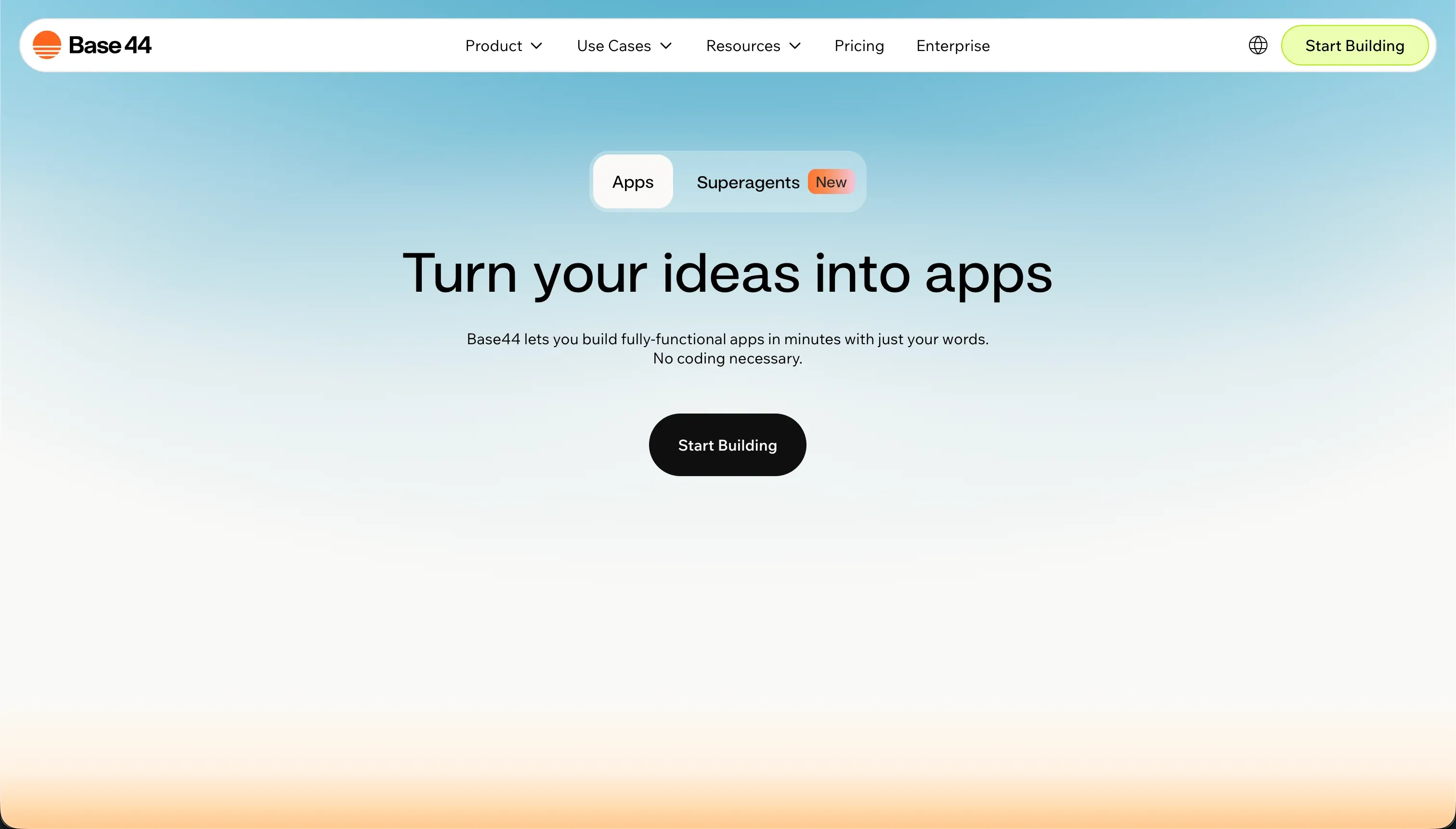
Base44 is an AI-powered conversational application builder that generates a hosted user interface, a managed PostgreSQL database, and user authentication from a single text prompt. It is designed to act as an integrated full-stack environment where creators bypass developer setups entirely.
Builders change visual properties of their app using a click-to-tweak preview editor or by chatting with the built-in AI editing agent.
Under the hood, the platform scaffolds standard templates and handles infrastructure tasks automatically. It features distinct workspace capabilities such as Github synchronization and a discuss mode that lets teams map architectural flows before burning credits. It is built primarily for non-technical founders and operations teams who prioritize speed over deep customization.
What is Softgen?
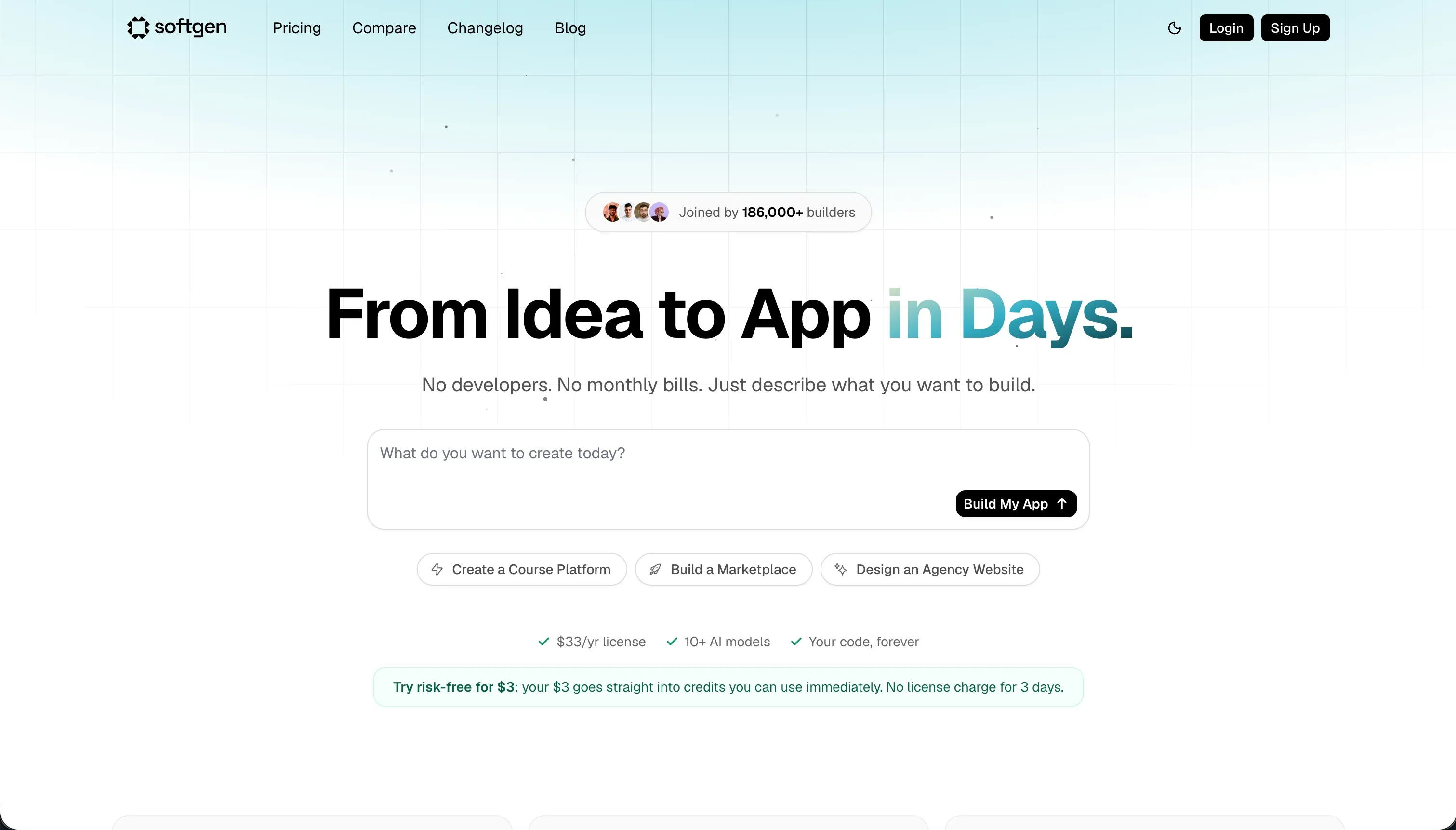
Softgen is a conversational application generator that utilizes its Cascade AI assistant to structure full-stack web applications. Instead of a manual visual editor, the building experience is conversations-first, prompting the AI to change styles, update copy, or alter layouts.
It attempts to build relational databases, user registration modules, and third-party utility flows purely through natural language.
To keep generation orderly, the platform incorporates an interactive planner that assists non-technical users in declaring data schemas before the frontend is assembled. It offers preset database and authentication configurations alongside Stripe payment options out of the box. Softgen is marketed broadly to creators and indie hackers looking to rapidly launch directories and SaaS MVPs.
The core difference
The primary axis of divergence between these two systems is the workflow for ongoing editing and visual refinement.
- Base44 combines natural language prompting with a visual click-to-tweak editor to let non-developers execute manual styling tweaks directly in a live preview.
- Softgen has no visual drag-and-drop builder, requiring all updates, adjustments, and visual refinements to take place via conversational chat prompts.
Where the scores diverge
Design flexibility: Base44 6.5, Softgen 5.0. Base44 scores 6.5 because of its click-to-tweak visual interface and design tokens, which help non-technical users style applications cleanly, though elements like auth layouts are locked to structural defaults. Softgen scores 5.0 due to aesthetic rigidity.
The AI works strictly within pre-built layout modules, making custom visual identities difficult to achieve, and attempting to fine-tune alignments through chat prompts regularly triggers credit-burning loops.
Ease of build: Base44 7.5, Softgen 7.0. Base44 scores 7.5 on ease of build because it scaffolds the database, user auth, and server environments dynamically from a single initial prompt. The inclusion of a click-to-tweak editor dramatically speeds up manual UI adjustments.
Softgen scores a close 7.0, leveraging its Cascade agent to architect features in plain language and mapping relational schemas systematically via its interactive wizard. Both platforms succeed in reducing the first-build friction to hours for non-technical creators.
Production readiness: Base44 4.0, Softgen 4.5. Neither platform is currently fit for mission-critical business software. Softgen scores 4.5, with reviewers highlighting that its visual templates and scaling capabilities are in very early stages of development.
Base44 scores 4.0 due to severe, documented server instability, with users reporting the builder going down nearly once a week. Builders also flag destructive AI update loops that break existing live applications, with some apps becoming completely unusable in production after repeated feedback cycles.
Maintainability: Base44 3.5, Softgen 4.0. Maintaining software on these platforms presents major challenges once the software scales. Softgen scores 4.0, primarily because the absence of a drag-and-drop editor means every single bug fix or design revision must be routed back through chat prompts, increasing technical debt.
Base44 scores a lower 3.5 because its editing agent frequently enters regression loops, where resolving one bug introduces several new errors. Real-world builders report spending hundreds of message credits on iterative fixes that fail to address fundamental application flaws.
Security & access control: Base44 4.0, Softgen 4.5. Both systems provide standard configuration schemas but lack enterprise security depth. Softgen scores 4.5, rendering pre-configured sign-in forms and secure database templates out of the box, though it fails to offer button-level or field-level rendering rules.
Base44 scores 4.0, permitting basic role settings but lacking custom branding options for registration screens. Furthermore, reviewers confirm Base44 is not engineered to support per-user data isolation natively, presenting risks for multi-tenant software.
Data & integrations: Base44 5.5, Softgen 5.5. This criterion is a direct tie at 5.5, but for distinct technical reasons. Softgen designs clean relational database tables and coordinates standard integrations such as Stripe payments, though its overall integration surface remains narrow.
Base44 bundles a managed PostgreSQL database, but its reliance on LiteLLM connections introduces strict platform API limits. Builders flag latency during large dataset runs and significant handling caps for document processing such as PDF rendering.
Cost comparison
Base44 runs a dual-credit tier system beginning at the Free tier, going to Starter ($20/month billed monthly), and capping at the Elite tier ($200/month). Builders must track both message credits used for prompts and integration credits consumed when users trigger database actions, send emails, or call LLMs within the live app.
Softgen uses an annual access membership model of $33/year, paired with pay-as-you-go credit packages to handle iterations.
Buyers must calculate the severe maintenance and reconstruction costs associated with conversational tools. Credit consumption can spike dramatically during bug-resolution loops, meaning debugging a single page can drain a month’s credit allocation in hours. Additional developer hours will be required to rebuild application structures when AI regression loops break database and frontend schemas.
- Free tier up to Elite at $200/month
- Starter is $20/month billed monthly
- Message credits cover prompts
- Integration credits cover database actions, emails, LLM calls
- Two credit pools to track
- $33/year access membership
- Pay-as-you-go credit packages
- Packages sized for iterations
- One cost model to track
Lock-in and the exit path
Softgen provides a cleaner exit path than Base44 by allowing builders to export their generated source code to physical files once they outgrow the hosting platform. Base44 supports exporting frontend code to GitHub, but its managed database, server-side functions, and backend architecture stay entirely locked in Base44’s proprietary cloud infrastructure.
Rebuilding the database schema and backend logic from scratch is mandatory for any team migrating a Base44 app.
Who should pick Base44
Pick Base44 if:
- Creators who need to generate a fast, aesthetic mockup in under an hour utilizing design tokens.
- Builders who want to visually tweak landing page colors directly inside a live preview without prompting.
- Teams wanting built-in postgres storage and auth scaffolded in one conversational flow.
Do not pick Base44 if your web application requires stable, weekly uptime for paying customers or granular data isolation rules.
Who should pick Softgen
Pick Softgen if:
- Indie hackers launching directories and standard MVPs who want to map their database schemas first.
- Makers who want a low-cost $33/year hosting footprint and prefer pay-as-you-go credit usage.
- Teams seeking a code export option as an ultimate exit plan to prevent vendor lock-in.
Do not pick Softgen if you require a visual, precise drag-and-drop page editor to make styling adjustments without chat prompting.
What neither platform answers
While Base44 and Softgen offer impressive conversational scaffolding, they do not resolve the primary requirements of production business software. If your target is an internal operational tool, a client onboarding portal, or a CRM, you require structured authentication, rock-solid security, and visual certainty.
Conversational generation tools introduce code vulnerability and fragile layouts, requiring non-technical operators to essentially debug code through natural language.
For business-critical lanes, Softr presents a far more durable infrastructure. Softr scores 8.5 on production readiness and 9.0 on maintainability because its login screens, data syncing rules, and visual user permissions are native, battle-tested settings rather than AI-generated scripts.
For teams requiring custom backend code, Replit offers the ideal developer-focused alternative, providing deep workspace intelligence combined with literal deployment environments.
Analyst verdict
Analyst scores show Base44 slightly ahead at 5.2/10 versus Softgen at 5.1/10. Base44 secures visual design flexibility and ease of build, while Softgen takes the maintainability and custom code export advantages. However, neither platform achieves a viable score in production readiness, maintainability, or security and access control.
If you are choosing strictly between the two for a short-horizon landing page or interactive mock, Base44 is the pick. If you need clean code portability, pick Softgen. For production operational software, bypass both in favor of Softr, as both aggregate scores of 5.2 and 5.1 denote tools that risk breaking your database structure during standard maintenance cycles.
Related reading: the Base44 scorecard, the Softgen scorecard, and our scoring methodology.