
What Softgen is
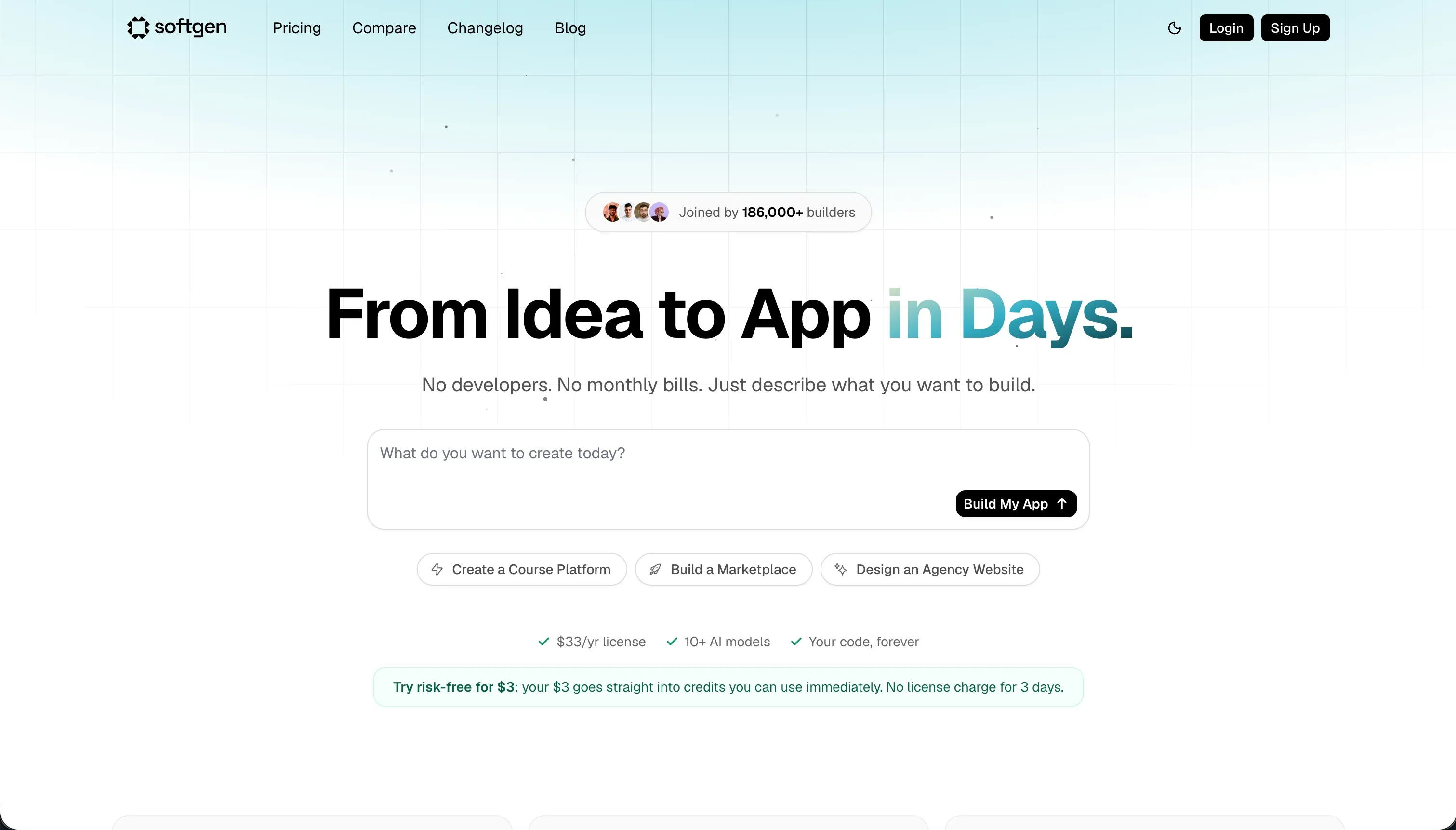
Softgen is a conversational AI web-app builder designed to scaffold applications based on plain-language chat commands. Operating via a guided AI interface, users describe their application goals to a central assistant called Cascade, which then automatically generates user interfaces, configures database schemas, and deploys the resulting application directly to the web with custom domain support.
The build model is entirely chat-driven, which sets it apart from traditional visual development. Instead of using a pixel canvas or drag-and-drop workflow, you map your logic and database layout through an interactive planning helper, then prompt the agent to handle the heavy lifting.
The platform handles the initial database setup, user authentication forms, and standard software scaffolding without requiring direct code manual input.
The trade-off is focused on speed versus long-term control. By relying purely on conversational requests, creators gain the ability to launch working prototypes in hours under a highly economical annual base membership.
However, because there is no visual layout editor, fine-tuning styling and layout elements requires repetitive prompting loops that consume pay-as-you-go credits, making minor aesthetic edits much harder than on visual-first builders.
- Describe app goals to Cascade
- Scaffolds UI, database, auth
- Deploys to web with custom domain
- Prototypes in hours
- Edits need prompting loops that burn credits
- Pixel canvas or drag-and-drop editing
- Fine-tune styling and layout directly
- Slower path to a working prototype
Where the scores come from
An average score of 5.1 reflects a development profile optimized for rapid proof-of-concept creation, but one that presents long-term maintainability hurdles as application complexity scales past a basic MVP.
Ease of build: 7.0/10
Ease of build scores a 7.0 because Softgen removes the initial interface design hurdle for non-technical users. The Cascade AI assistant behaves as an active co-developer, guiding builders through a step-by-step schema setup and drafting functional pages based on a plain-language outline.
This structure makes rapid prototyping highly accessible for solo creators and indie hackers. However, the score is capped because the absence of a visual canvas forces builders to describe styling tweaks and component reordering via text, which is inherently slower and more abstract than making a quick manual edit.
Production readiness: 4.5/10
Production readiness lands at 4.5 due to a fundamental tilt toward early-stage validation over seasoned enterprise scaling. While you get one-click deployments, direct database generation, and option for custom domains automatically, reviewers consistently describe the framework as early days with limited polish.
Softgen simplifies standard user registration and basic Stripe payments, but it lacks the enterprise-grade testing, multi-environment hosting, and performance monitoring pipelines standard on more mature application builders.
Maintainability: 4.0/10
Maintainability is rated 4.0, representing a major risk area for apps that must evolve. Because Softgen lacks any drag-and-drop structural editor, every bug fix, button relocation, and column adjustment must go back through the Cascade conversational prompt, exposing the system to unpredictable prompt-based regression loops.
As applications scale, parsing and modifying the generated schema solely through text descriptions creates developer debt. Fortunately, the platform provides a clean exit path by allowing users to export the generated code, preventing complete platform lock-in if you outgrow the AI environment.
Security & access control: 4.5/10
Security & access control scores 4.5 because the platform includes built-in sign-up forms, standard password authentication, and automatic session management out of the box. This provides a baseline level of protection without requiring custom developer configuration.
However, Softgen provides only basic access structures and lacks the granular row-level security, column permissions, or dynamic visibility settings required for complex business applications. For projects requiring tight enterprise rules, platforms like Softr offer much stronger security frameworks.
Data & integrations: 5.5/10
Data & integrations scores 5.5. The interactive planner is a strong detail, helping creators architect a relational model, organize fields, and stitch together database associations before generating code.
The AI natively supports standard operations like Stripe payments and basic user management. However, the external integration pipeline remains narrow, lacking deep pre-built third-party connectors or visual middleware interfaces, meaning users must rely on the AI agent writing custom code connections to interact with external APIs.
Design flexibility: 5.0/10
Design flexibility is limited to 5.0. Softgen constructs modern web layouts, but Cascade works inside predefined visual structures and UI modules, which forces apps to adopt highly standardized aesthetic layouts.
Without a visual layout grid, custom spacing, typography sizing, or specific component alignments must be programmed through conversational commands. This dynamic easily leads to frustrating prompting loops that unpredictably drain pay-as-you-go credits on minor aesthetic details.
What types of apps you can build with Softgen
Softgen is best suited for building initial software scaffolding, directories, and standard SaaS visual frameworks that do not require non-standard aesthetics.
Good-fit app types include:
- SaaS Mockups & MVPs: Quickly validating a web-app concept with user login and standard dashboard elements to present to early customers or investors.
- Directories and Information Hubs: Generating structured, relational lists of products, resources, or services that rely on a clean, template-style layout.
- Simple Stripe-Enabled Portals: One-time transactional tools, curated list memberships, or subscription-gated web portals that do not require intricate database routing.
For teams building operational portals, complex internal business platforms, or detailed CRM interfaces, there is a clear contrast with Softr, which uses native, editable block structures to achieve reliable day-two updates and security without relying on AI code generation.
Who should not use Softgen?
Do not use Softgen if you plan to launch a rapidly scaling software product, where long-term maintainability, automated regression testing, and avoiding visual technical debt are essential operational requirements.
Do not use Softgen if your application relies on a heavily customized, brand-aligned visual identity that requires pixel-precise canvas layout control outside of standard layout grids.
Do not use Softgen if your data handling demands complex row-level permission policies or granular visibility controls where specific blocks or fields must be hidden based on a user’s organizational tier.
Analyst verdict
With an average score of 5.1, Softgen represents an interesting solution for indie hackers, early-stage founders, and prototype builders who want to launch a basic MVP quickly at a very low annual base membership barrier.
However, users must be comfortable with the operational limits of prompt-led maintenance and template design. For teams building custom operational tools or enterprise portals, comparing this platform’s scores against Softr highlights how a visual-first builder avoids the prompt loops of chat-driven code generation. Review our scoring process on the official methodology page.