

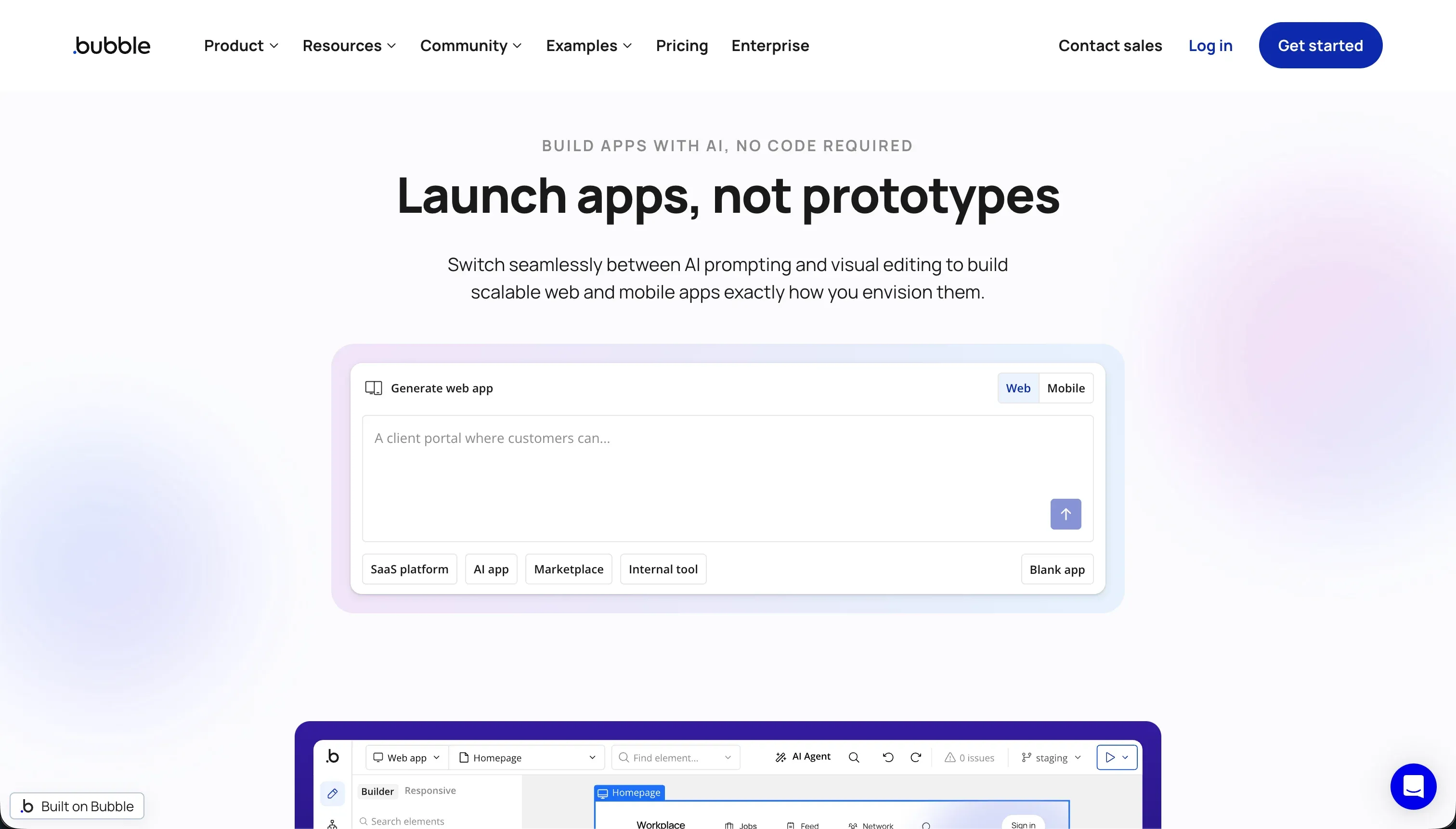
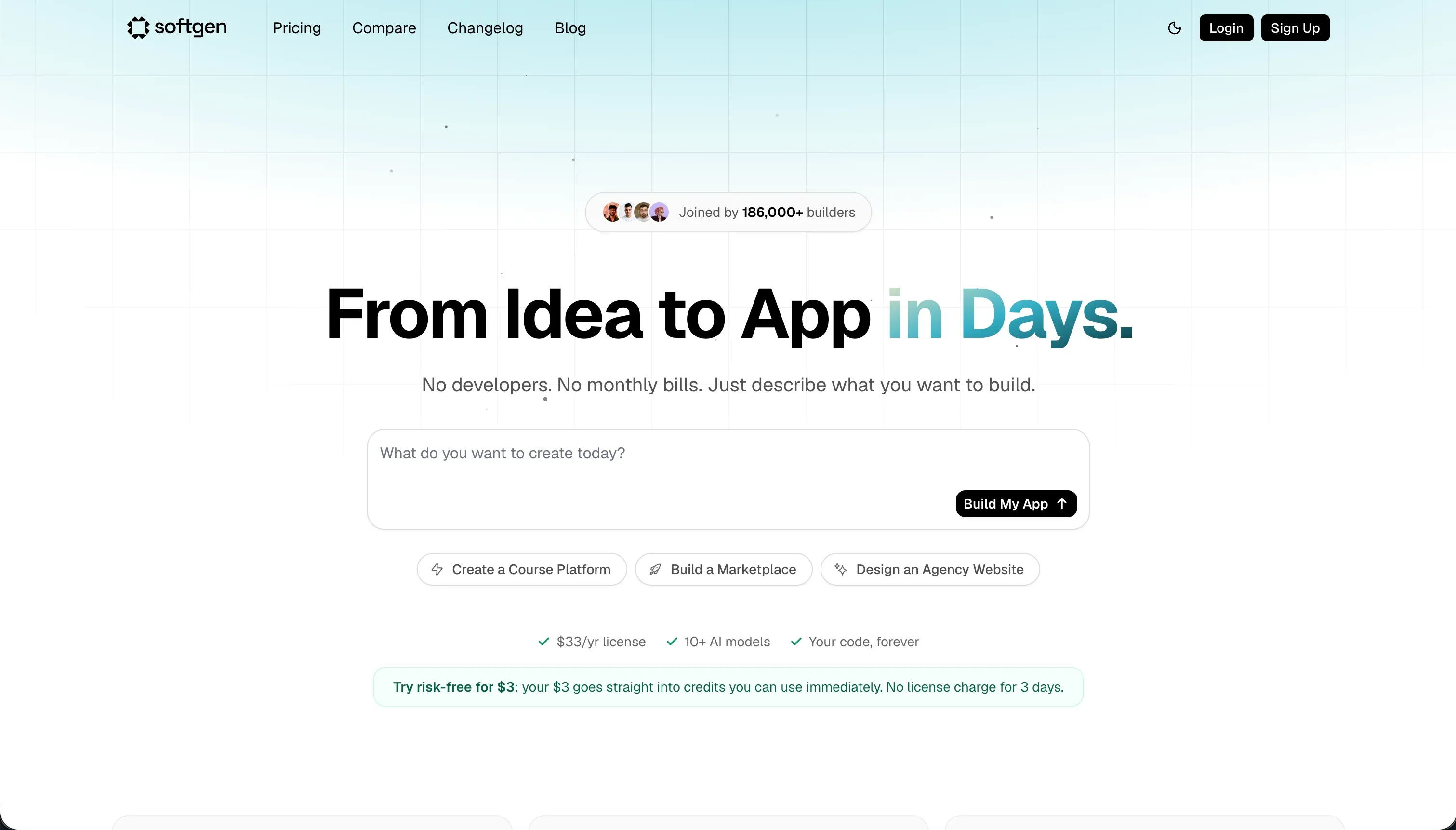
This head-to-head comparison evaluates two very different approaches to application building. Bubble is a veteran visual programming platform that requires you to configure custom relational logic, database privacy parameters, and server workflows manually.
Softgen represents the conversational AI-native paradigm, using a conversational assistant to outline, generate, and edit web interfaces and database schemas via natural-language prompts.
Bubble wins the aggregate decision with a score of 6.8/10 against Softgen’s 5.1/10, proving to be the more mature environment for applications that must run in production.
Softgen’s conversational drafting is highly efficient for rapid MVP scaffolding, but its limited visual customization and lack of granular access controls make Bubble the safer choice to host a live business. The choice flips to Softgen only if your immediate priority is generating a simple functional layout without mastering visual programming variables.
The decision in 30 seconds
| If your priority is… | Pick | Why |
|---|---|---|
| Pixel-level UI and layout control | Bubble | Its responsive design system and drag-and-drop editor offer visual styling authority |
| Genuinely custom database structures | Bubble | A managed relational DB with custom types and complex conditional workflows |
| Rapid AI-driven MVP generation | Softgen | The Cascade agent drafts interfaces and database tables from conversational text prompts |
| Granular user permissions | Bubble | Server-side privacy rules and role-based access are proven at scale |
| A client portal or operational CRM | Neither | Softr scores higher on authentication, permissions, and predictable flat tier pricing without workload volatility |
What each platform is
What is Bubble?
Bubble is a full-stack, visual programming platform that allows you to construct and host custom web applications without typing code.
Instead of generating raw files, Bubble uses a dense visual builder where you draw interfaces pixel by pixel, construct relational tables on a proprietary database layer, and connect them to multi-step logic scripts called visual workflows. Every element is manually configured, requiring you to think like an engineer while using a visual interface.
The platform includes built-in server-side configurations, custom data types, a native backend scheduler, and an API Connector to establish custom REST endpoints with secure external services. It is explicitly designed for founders and product teams who want to build highly customized transactional databases, multi-sided marketplaces, or backend-heavy apps without being constrained by rigid templates.
What is Softgen?
Softgen is a conversational AI application builder built around the Cascade assistant. Rather than visually dragging elements, you describe what you want the application to do in plain English. The conversational agent outlines the schema, creates relational database patterns, setups standard sign-in forms, and links endpoints to build functional SaaS structures or landing layouts.
The software ships with standard templates for user authentication and relational database schema generation, alongside narrow pre-configured payment integrations like Stripe. It is targeted at creators and indie hackers who want to quickly generate and deploy initial MVPs to Softgen’s hosting environment with custom domain support.
The core difference
The primary dividing line between these platforms is the visual programming model versus conversational prompting.
- Bubble requires the manual drag-and-drop configuration of every workflow state, database field, and pixel constraint in a dense editor.
- Softgen abstracts away the editor entirely, relying on conversational prompts to instruct an AI assistant to layout interfaces, databases, and logic.
Where the scores diverge
Design flexibility: Bubble 8.5, Softgen 5.0. Bubble achieves an 8.5/10 on the back of its absolute and responsive positioning rules, giving builders pixel-level visual layout custody matched only by pure code-gen utilities. Softgen finishes with a 5.0/10 because the conversational agent operates within predefined layout grids.
Tweak iterations on aesthetics frequently lead to repetitive prompting loops that consume credits without reaching custom visual designs.
Production readiness: Bubble 7.0, Softgen 4.5. Bubble leads with a 7.0/10 because its authorization systems, background workflow schedulers, and server-side rules are battle-tested and proven at scale, though configuration remains entirely manual. Softgen scores a weak 4.5/10 due to its early-stage maturity.
While it provides basic hosting and one-click deployment, reviewers report it lacks polished scale tools, forcing builders into a critical trade-off between speed and long-term production reliability.
Data & integrations: Bubble 8.0, Softgen 5.5. Bubble scores an 8.0/10 by combining a robust built-in database with the API Connector and an ecosystem of over 8,000 community plugins. However, this relies heavily on unverified third-party libraries that can break over time.
Softgen scores a 5.5/10 because it handles database schemas and common templates like Stripe, but remains severely restricted for complex stacks, with a narrow integration surface compared to established platforms.
Ease of build: Bubble 5.0, Softgen 7.0. Softgen takes this criterion with a 7.0/10 because the Cascade agent drafts functional interfaces, mapping database schemas and creating standard configurations directly from chat. This allows non-technical users to quickly scaffold an application without structural expertise.
Bubble struggles here at 5.0/10 because its dense editor requires mastering relational database concepts, API endpoints, privacy logic, and workflow conditionals, which Trustpilot reviews frequently warn demands developer-like understanding.
Maintainability: Bubble 6.0, Softgen 4.0. Bubble scores 6.0/10 because logic is edited visually. While large apps can accumulate complex workflow sprawl that is difficult to audit, and the editor can suffer from RAM and stability complaints on large projects, edits are deterministic and do not require code regeneration.
Softgen drops to a 4.0/10 because it lacks a standard drag-and-drop builder. Every minor alteration must be prompt-engineered through conversational chat, creating technical debt risks at scale as the codebase grows.
Security & access control: Bubble 6.5, Softgen 4.5. Bubble achieves a 6.5/10 with proven server-side privacy rules and role-based permissions that are secure when constructed correctly, though a misconfigured rule will fail silently.
Softgen scores a 4.5/10 because its native access controls are basic, relying on standard login templates but missing granular, field-level or action-button visibility controls to isolate dynamic data across diverse user groups.
Cost comparison
The billing models of these platforms diverge completely. Softgen leverages an annual membership fee of $33/year for base platform access and hosting, and operates a pay-as-you-go credit structure for development iterations.
Every visual tweak, feature generation, or bug fix consumes your credit balance, which can make ongoing experimental iterations difficult to budget. Bubble uses subscription tiers starting at $69/mo (Starter) and scales up to $649/mo (Team), but layers on a complex billing mechanic based on Workload Units (WUs).
Your bill is tied directly to backend operations, meaning unoptimized workflows can cause unpredictable pricing spikes.
Buyers should also forecast secondary costs. On Bubble, inefficient workflows require premium optimization or third-party plugin investments, and its steep learning curve often requires hiring a specialized consultant to resolve performance bottlenecks.
On Softgen, the main cost is the risk of prompt iteration overhead, where debugging cycles run through pay-as-you-go packages, alongside eventual developer costs if the application outgrows the AI’s layout limits.
Lock-in and the exit path
Bubble has historically locked in users completely; you cannot export the proprietary visual layouts or backend workflows, meaning migrating off the platform demands a ground-up codebase redesign. Softgen offers code export as a clean exit path, allowing technical teams to take ownership of the generated code and host it externally.
However, for a non-technical builder, both platforms present high transition friction: Bubble requires complete recreation of app architecture, while Softgen’s exported files require developer expertise to host, debug, and scale once off the platform.
- No export of visual layouts or workflows
- Migration means a ground-up redesign
- Rebuild the whole app architecture
- Code export is a clean exit path
- Own the generated code, host it externally
- Off-platform it needs developers to host, debug, scale
Who should pick Bubble
Pick Bubble if:
- Builders creating software with highly complex relational logic, custom workflows, and multi-user configurations
- Teams wanting complete pixel-level layout and styling custody using a visual design system
- Buyers with a multi-year project horizon who want to make direct visual edits without relying on prompt generation
Do not pick Bubble if you require direct source code export or need a highly predictable, flat-rate hosting bill that is immune to workload consumption spikes.
Who should pick Softgen
Pick Softgen if:
- Indie hackers scaffolding simple SaaS templates or directory layouts in hours via plain language
- Creators who want to export code files to retain ownership of an early prototype
- Non-technical teams looking for a builder with low up-front annual platform pricing
Do not pick Softgen if your application requires granular, role-based database security, custom layout designs, or long-term maintainability for multi-user scaling.
What neither platform answers
Both Bubble and Softgen assume you are building custom application logic from scratch. Bubble requires you to configure security, databases, and variables piece by piece, while Softgen relies on conversational prompts that can become unstable as requirements scale.
If your actual intent is to deploy an internal operational tool, a client portal, a real estate portal, or a CRM, this shortlist forces you to choose between steep visual development curves or fragile chat-prompt loops.
For operational software, Softr is the higher-scoring allocation. With scores of 8.5 on production readiness, 9.0 on maintainability, and 8.5 on security & access control, Softr provides authentication, user groups, and dynamic databasing out of the box.
Instead of coding from scratch or prompting an AI through loops, you assemble responsive building blocks connected to Softr Databases or Airtable. This provides instant user restrictions, solid performance, and a predictable flat-pricing tier.
If your goal is to build highly custom web interfaces with programmatic code export, Replit remains a much stronger candidate for developer-led teams.
Analyst verdict
Bubble wins this head-to-head comparison on scored criteria, taking five of the six categories to secure a 6.8/10 aggregate score over Softgen’s 5.1/10. Bubble is the structurally superior choice for production deployments, scoring higher on data & integrations (8.0), security (6.5), production readiness (7.0), maintainability (6.0), and design flexibility (8.5).
Softgen remains an interesting alternative for non-technical creators aiming to scaffold and launch simple transactional MVPs on a low annual budget, taking ease of build with a 7.0/10.
However, because it lacks visual database editors and granular role-based security visibility, any business looking to run scaling multi-user software will quickly face maintainability and customization limits. For teams building business applications, Bubble remains the only long-term production environment here.
Related reading: the Bubble scorecard, the Softgen scorecard, and our scoring methodology.