
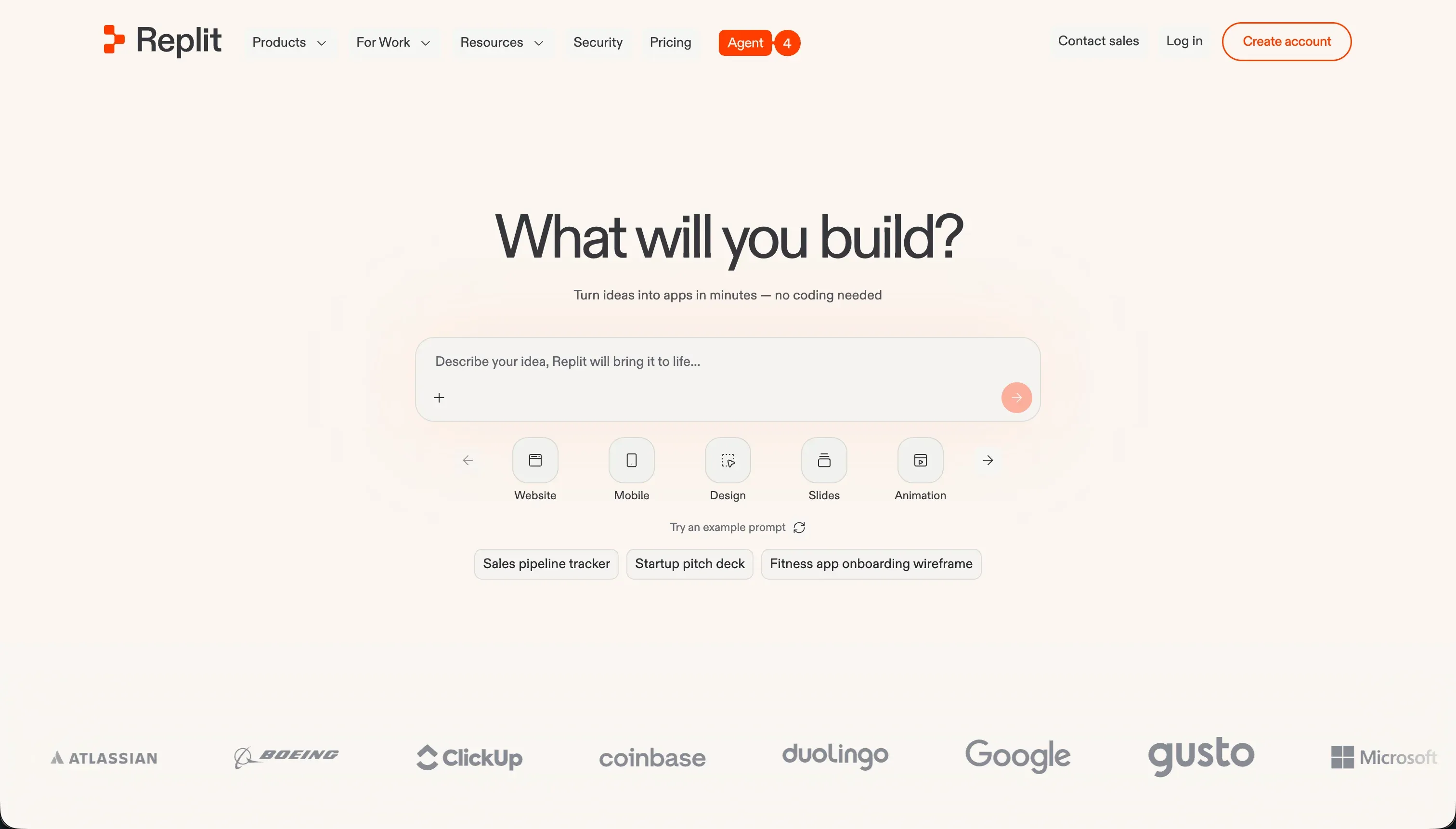
What Replit is
Replit is an AI-native cloud development environment designed to build, test, and deploy applications from natural language prompts. It couples a collaborative, multi-language IDE with the Replit Agent, allowing developers and technical teams to generate full application architectures, edit underlying code in real time, and scale projects.
Built on containerized infrastructure, the platform handles standard web and mobile deployments with managed PostgreSQL database backing.
The build model is code-first and heavily assisted by autonomous agents. Developers type prompts to trigger the Replit Agent to generate directory structures, install package dependencies, write real application code, and run diagnostic feedback loops to self-correct run-time errors automatically.
Unlike visual builders, any generated output can be edited down to raw files, allowing users to bridge visual preview tweaks with manual code overrides inside a terminal-backed sandbox.
The core tradeoff is code ownership versus maintenance overhead. Replit guarantees you own real, exportable code with zero template constraints, but it places the responsibility for fixing agent-produced bugs, tracking dependency drift, and monitoring server scale directly on your team. It delivers maximum developer flexibility, but demands manual code upkeep and exposes you to consumption-based billing risks.
Where the scores come from
Replit’s weighted scores reveal a platform optimized for unconstrained application development and rapid deployment, earning high Marks where developers need code ownership, but dropping significantly in areas requiring visual administration and point-and-click security controls.
Ease of build: 6.5/10
Ease of build scores 6.5/10. Replit achieves this with its conversational Replit Agent, which generates fully functional code scaffolds, configures live-reloading preview environments, and automatically installs package managers on the fly. This unified workflow makes starting a brand-new application extremely fast and approachable, as it handles the tedious initial environment provisioning in a single click.
However, the platform holds back from higher scores because of the sudden technical cliff encountered during build phases. Navigating broken environments, resolving deployment-to-editor mismatches, and debugging LLM-generated code errors require developer-level technical diagnostics.
If the agent becomes trapped in a circular loop, non-technical builders face a hard ceiling that prevents their application from running.
Production readiness: 8.0/10
Production readiness scores 8.0/10 because Replit provides genuine cloud infrastructure rather than a superficial mock sandbox. Its autoscaling infrastructure, managed PostgreSQL database layers, point-in-time database rollbacks, and native custom-domain routing provide a enterprise-grade publishing environment capable of supporting live user traffic.
The score is tempered by reported system instability during complex deployment operations. Developers have noted instances where local container environment variables fail to map accurately to visual deployment setups, or where automated agent-driven updates trigger unexpected data errors in active databases.
These discrepancies require manual logs inspection and rollback configurations to ensure stable operation.
Maintainability: 7.5/10
Maintainability scores 7.5/10, representing a strong advantage over platforms that trap users in proprietary visual interfaces. Because Replit projects compile into standardized, clean, and version-controlled files, teams can easily export their code to other hosts or edit it directly, assuring long-term code viability without platform lock-in.
The major maintainability risk stems from AI self-correction loops. When the agent attempts to fix its own bugs, it can enter repetitive failure cycles that consume large volumes of credit resources without resolving the underlying error. In these instances, developers must intervene manually to stop the automated loops and clean up messy, agent-suggested code patterns.
Security & access control: 6.0/10
Security & access control scores 6.0/10. Replit succeeds in offering credential isolation for credentials through an environment variables manager, alongside standard, industry-standard authentication libraries that can protect raw files and endpoints.
However, the deduction is due to the complete lack of visual visual policy configuration tools. Setting up row-level security or custom permission groups requires writing custom middleware directly in code.
For teams building administrative panels filled with sensitive corporate data, verifying access constraints must be performed through manual code audits instead of visual toggle menus, making configuration errors easier to miss.
Data & integrations: 8.0/10
Data & integrations scores 8.0/10. This high score is driven by the fact that Replit has no arbitrary API limits or connector constraints. Because your application is built on real code, you can import any SDK or NPM package to integrate with any third-party rest api or external service that code can naturally reach.
The slight deduction exists because data schema management is not visually abstracted. Provisioning and scaling the database remains a developer’s task, requiring knowledge of structured schemas, SQL migrations, and indexing to ensure long-term, high-capacity query performance.
Design flexibility: 8.5/10
Design flexibility scores 8.5/10, making it one of the strongest platforms in our index under this criterion. Supporting over 50 programming tools, full frontend frameworks, and raw CSS/HTML overrides, the platform can deploy complex interfaces with no template constraints.
Its unified workspace supports direct Figma conversions, enabling developers to translate vector graphics into production-ready frontends. The minor point deduction addresses the layout environment, which lacks visual absolute-positioning grids found in basic web builders, requiring familiar CSS layout concepts to clean up minor design issues.
What types of apps you can build with Replit
Replit is strongest for building custom applications that require native code ownership, high computational complexity, and unique architectural design. It is optimized for projects where template blocks are too restrictive.
Good-fit app types include:
- Custom SaaS-MVPs: software seeking to test proprietary logic, custom worker queues, and unique frontend interfaces on real code.
- Technical utility applications: tools using scripts, data scrapers, custom API aggregations, and specialized processing pipelines.
- AI automation engines: chatbots, Slack integrations, and automated operational tasks running continuous background jobs.
For standard business tools, there is a natural contrast with Softr. While Softr uses restricted pre-built visual blocks to assemble client directories and internal databases, Replit allows you to build custom data configurations from scratch.
This makes Replit better suited for projects requiring custom backends, while Softr remains the choice for rapid visual internal tooling.
- Custom SaaS-MVPs with proprietary logic
- Technical utilities: scrapers and pipelines
- AI automation with background jobs
- Custom data configurations from scratch
- Native code ownership
- Client directories
- Internal databases
- Pre-built visual blocks
- Rapid assembly
Who should not use Replit?
Do not use Replit if your team has no developers to maintain raw code. If the agent creates code-level implementation errors, the responsibility to inspect, debug, and maintain that code lands on your internal staff.
Do not use Replit if you require a highly predictable monthly build budget. Its consumption-based model charges by the computational effort of the agent, making debugging loops difficult to forecast and prone to sudden billing spikes.
Do not use Replit if your main requirement is configuring granular user security permissions visually. Setting up row-level security policies and complex access filters must be written manually into code, which increases administrative risk for non-technical managers.
Analyst verdict
Replit finishes with an average score of 7.4. It is an strong match for technical teams, solo developers, and product teams searching for a rapid environment to build custom products while retaining absolute code ownership on modern, managed servers. It is a strong choice for prototyping custom codebases without the limitations of visual visual interfaces.
If your primary goal is building client dashboards or collaborative partner spaces, the maintenance of raw code presents too much overhead, making visual leaders like Softr or Retool a better option. Read our comprehensive methodology to evaluate how development and hosting criteria are scored.