

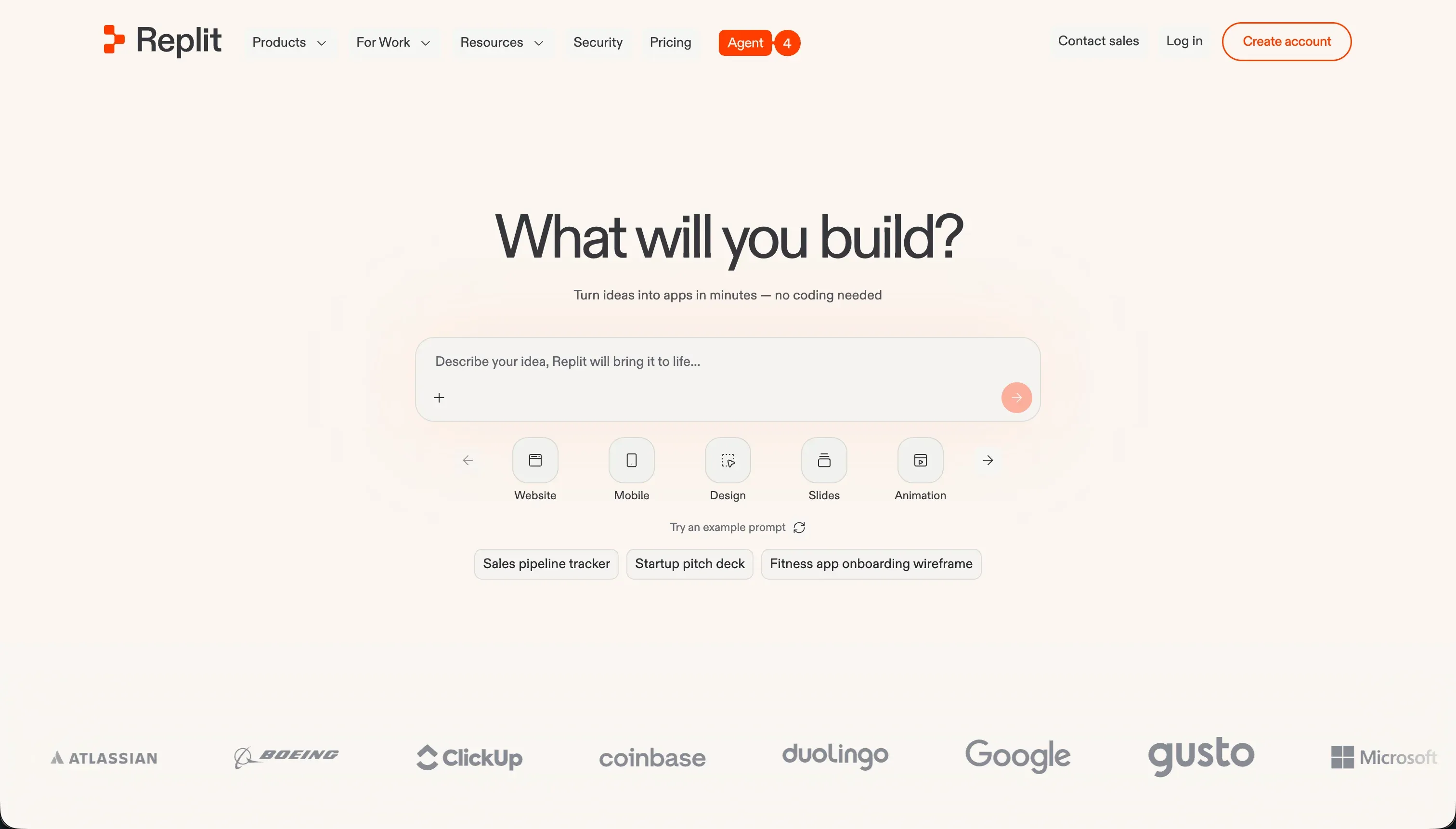
Choosing between an interactive, browser-based cloud development environment and a pixel-level, no-code mobile app builder represents a fundamental fork in a buyer’s engineering roadmap. Replit uses an autonomous AI agent to generate and host actual, multi-language application code from plain-English prompts.
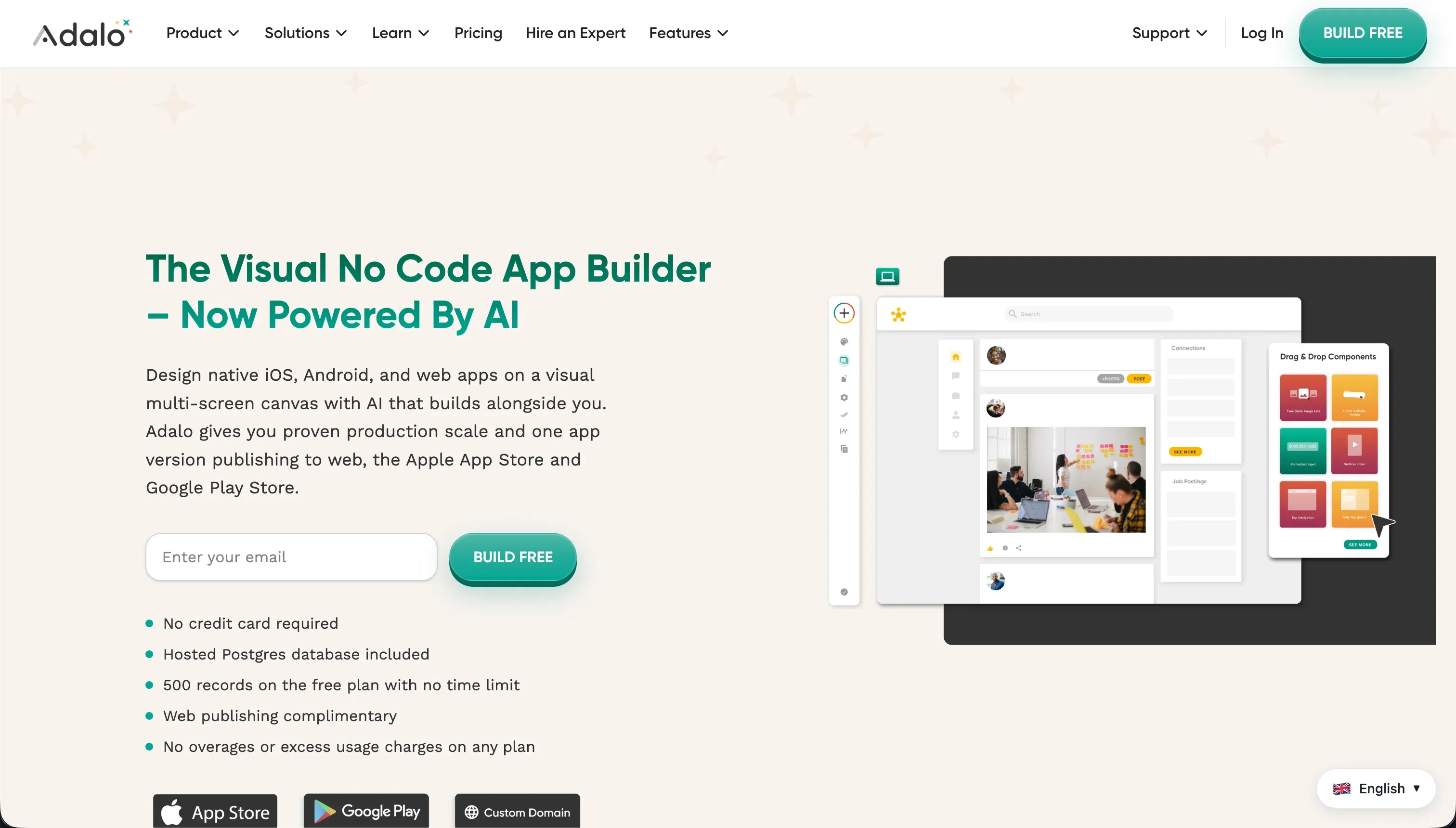
Adalo acts as a visual visual-canvas platform designed for dragging, dropping, and connecting pre-built components to a simple native database.
Replit wins this matchup decisively with a scored aggregate of 7.4 out of 10 against Adalo’s troubled 4.6 out of 10. For a technical team, or a builder comfortable managing API secrets in a console, Replit provides a professional, scalable infrastructure with real code.
The decision only flips to Adalo if the primary priority is packaging a basic mobile layout for native app stores without touching a single deployment parameter.
The decision in 30 seconds
| If your priority is… | Pick | Why |
|---|---|---|
| Deploying a native mobile MVP to Apple or Google stores | Adalo | Adalo handles native app bundling out of the box |
| Extending logic with real code and 50+ languages | Replit | Replit hosts actual, un-templated code on production infrastructure |
| Relational databases that scale past simple thresholds | Replit | Replit spins up a managed PostgreSQL database with rollbacks |
| Client portals, secure CRM dashboards, or internal tools | Neither | Neither tool provides granular, visual role-based access control out of the box, whereas Softr is built for this |
| Total freedom from AI context windows and regenerations | Replit | Replit produces standard code files that can be edited manually |
| Responsive desktop layout formats | Replit | Adalo is locked to a fixed-width mobile screen size model |
What each platform is
What is Replit?
Replit is a collaborative, browser-based development environment that abstracts away local machine configuration, package managers, and server setup in over 50 programming languages. With its built-in Replit Agent, the platform builds, installs, refactors, and deploys full-stack applications from natural-language prompts.
Instead of hiding the underlying technology, Replit exposes real code files, a live interactive terminal, and standard container specifications directly to the builder.
For production software, Replit provides genuine infrastructure in the form of managed PostgreSQL databases with 28-day rollbacks, autoscaling deployments, and custom domain mapping. It operates as a dual-mode platform appropriate for both educational exploration of real coding concepts and professional rapid prototyping where builders can easily transition from AI-driven prompt generation to manual code adjustments.
What is Adalo?
Adalo is a visual drag-and-drop no-code development platform designed specifically to let non-technical makers lay out screens, define navigation, and publish to web or native mobile environments.
Its editor features a free-form digital canvas where buttons, images, form blocks, and custom component marketplace add-ons can be positioned relative to a target workspace. Database architecture in Adalo relies primarily on a built-in relational model with basic CRUD triggers linked to standard user clicks.
Historically deployed for simple directories, lightweight portfolios, and proof-of-concept mobile apps, Adalo’s structural scope is focused heavily on the visual interface. Its core workflow model is built around basic screen navigation and form submission actions, accompanied by integrations to external backends like Airtable through standard Zapier connectors or REST APIs.
The core difference
The defining divide between these tools lies in code ownership versus visual encapsulation.
- Replit generates real, standard code files that remain open to manual modification, developer handoff, or external hosting.
- Adalo locks application logic inside a closed, visual interface builder where changes are entirely dependent on Adalo’s proprietary runner.
Where the scores diverge
Production readiness: Replit 8.0, Adalo 3.5. This represents Adalo’s lowest ranking, scoring only 3.5. Capterra reviewers warn of persistent internal server errors, unacceptably sluggish native Android performance, and documented cases of catastrophic database data loss. Multiple reviewers state Adalo is adequate for mockups but not live production.
Replit scores an 8.0, offering autoscaling infrastructure and managed databases, with the only deductions being occasional agent-introduced bugs and discrepancies between the development sandbox and live deployment.
Maintainability: Replit 7.5, Adalo 4.0. Replit scores 7.5 because its output is standard, version-controlled code that can be easily exported, backed up, or maintained manually by any engineer. It completely avoids the trap of prompting loops because a builder can always jump in and fix mistakes.
Adalo scores 4.0; complex workflows and nested conditional approvals are highly fragile in its visual model. Reviewers also report clunky REST integrations that often have to be rebuilt from scratch whenever an external system undergoes minor updates.
Design flexibility: Replit 8.5, Adalo 5.0. Replit scores 8.5 because it works with any framework a developer can deploy, meaning custom CSS, React, tailwind, or un-templated visual components are standard. Adalo scores 5.0; its canvas allows absolute visual coordinate placement, but it forces builders to design on a fixed-width screen size model.
This results in desktop layouts that look like stretched phone interfaces instead of responsive web apps.
Data & integrations: Replit 8.0, Adalo 5.0. Replit scores 8.0 by virtue of open code; if a language has a package, library, or API connector, Replit can launch it securely. This includes live web scraping, API calls, and SQL queries executed directly at the container level.
Adalo scores 5.0, as its internal database quickly becomes a bottleneck under scale. Reviewers note that its external API connection features are clunky, prone to timeouts, and lack any native, real-time two-way synchronization.
Security & access control: Replit 6.0, Adalo 4.0. With a score of 6.0, Replit handles databases and environment variables securely, but because permissions and roles are written directly into the code by the AI agent, verification requires reading the code files. Adalo, scoring a weak 4.0, lacks native role-based access control or Row-Level Security.
To create a multi-tenant client portal in Adalo, builders must apply individual visibility filters on every visual element on every screen, making it unfeasible for sensitive external data sharing.
Ease of build: Replit 6.5, Adalo 6.0. Replit’s Agent scaffolds software rapidly, but the platform assumes a certain baseline familiarity with managing credentials, understanding software errors, and configuring API webhooks. Adalo’s drag-and-drop model requires zero prior development knowledge, offering a shorter initial learning curve.
However, Adalo loses its early lead during real builds; basic tasks like forgot-password links or multi-image forms can become incredibly difficult. Replit scores 6.5, just ahead of Adalo’s 6.0, as prompt-based generation is ultimately more adaptive than rigid visual templates once the happy path is exceeded.
Cost comparison
Replit operates on an AI credit and effort-based pricing model. While Replit Core starts at $25/mo ($20/mo annually), AI activities and database backup operations consume developer credits that can scale unpredictably based on the complexity of the agent run and VM uptime.
Adalo is structured around flat monthly tiers, starting with its Starter plan at $45/mo ($36/mo annually) and scaling to $250/mo. Adalo enforces database record limits and app action limits per tier, locking out further usage unless you upgrade.
From a total cost perspective, buyers must forecast different hidden cost lines. For Replit, the primary risk is circular agent debugging loops that burn credits rapidly, alongside database checkpoint and migration charges during deployments.
For Adalo, the cost lies in the operational drag of rebuilding fragile integrations, purchasing premium marketplace plugins for basic features, and the overhead of managing severe performance issues.
Lock-in and the exit path
Adalo has deep platform lock-in; you cannot export your backend code, database structure, or relational workflows, meaning an exit requires rebuilding the app from the ground up on another platform. Replit offers a clean exit path because your workspace is built directly on standard, portable code with Git integration.
You can export your codebase, back up the Postgres SQL schema, and self-host the entire system elsewhere with minimal rework.
- Can't export backend code
- Database structure stays locked in
- Relational workflows can't be extracted
- Exit means rebuilding from scratch
- Workspace is standard, portable code
- Git integration included
- Export the full codebase
- Back up the Postgres schema
- Self-host elsewhere with minimal rework
Who should pick Replit
Pick Replit if:
- Technical builders or product managers who want to prototype in real, un-templated code and value clean Git exports.
- Projects demanding a genuine relational SQL backend that needs database rollbacks and has data scaling goals.
- Applications that require custom API scripting, web scrapers, or third-party background services.
Do not pick Replit if you have zero technical baseline on the team to read, debug, and verify the env secrets or deployment errors generated by the agent.
Who should pick Adalo
Pick Adalo if:
- Non-technical founders who strictly need a quick, simple visual prototype to package and publish to the mobile app stores.
- Designers who want a free-form visual canvas to place elements with pixel-coordinate precision for validation.
- Lightweight mobile-only apps that do not require complex data workflows or secure portals.
Do not pick Adalo if you are building an operational business application, a client portal, or a system where data security and performance are critical.
What neither platform answers
Both of these tools assume the application must be designed and constructed as a completely custom software project. Replit hands you an extensive, containerized developer environment with code to maintain, while Adalo hands you a rigid, mobile-first visual canvas with no native security role-based protections.
If you are trying to deploy a secure client portal, internal tool, or team CRM, neither option offers the reliable, pre-built operational foundation a standard business needs.
For business-grade portals and internal databases, Softr represents the more secure option, scoring 8.5 for production readiness, 9.0 for maintainability, and 8.5 for security & access control. Softr provides secure user groups, role-based visibility, and zero-risk login pages out of the box.
Rather than coding or dragging individual buttons, builders connect Softr to native Softr Databases, Airtable, or Google Sheets, delivering clean, responsive layouts that work perfectly on day one.
If your focus is purely on building a custom native mobile interface with intricate data pipelines, FlutterFlow represents the correct professional alternative.
Analyst verdict
Replit wins this comparison decisively, scoring 7.4 to Adalo’s 4.6. Replit dominates five of the six evaluation criteria, driven by its standard, version-controlled developer architecture and production-grade Postgres database layer.
While Adalo is easier to get started with visually, its poor server performance, lack of responsive design, fragile workflows, and documented security gaps make it highly risky for any live business use case.
The final decision is clear: choose Replit if you want a reliable development stack where the final output is actual code you can own, export, and maintain safely. Choose Adalo only if you are deploying a temporary mobile mockup and need to publish it to native app stores without writing code.
Related reading: the Replit scorecard, the Adalo scorecard, and our scoring methodology.