

Choosing between Adalo and Same.new is really choosing between 2 different procurement problems. Adalo is a no-code app builder with a built-in database and publish flow, while Same.new is an AI frontend generation tool that turns a URL into editable React and Tailwind.
One is bought to ship a simple app without code; the other is bought to accelerate UI scaffolding for a team that can code.
Adalo wins the general decision 4.6/10 to 4.1/10 because it covers more of the actual application stack. The decision flips only if your real need is a fast visual clone with cleaner frontend output, where Same.new’s 6.5 score in Design flexibility beats Adalo’s 5.0.
The decision in 30 seconds
| If your priority is… | Pick | Why |
|---|---|---|
| Deploying a simple app to mobile stores | Adalo | native packaging and a built-in database make the path shorter, reflected in its 6.0 Ease of build score |
| Cloning an existing website layout into React | Same.new | URL-to-UI generation and Tailwind output give it the matchup’s best Design flexibility score at 6.5 |
| Building a database-backed MVP without engineers | Adalo | it includes relational data and app logic natively while Same.new does not |
| Predictable maintenance after launch | Neither | Maintainability is weak on both at 4.0 for Adalo and 3.0 for Same.new |
| Strict role-based security for a client portal | Neither | both score poorly on Security & access control, and Same.new has no native auth layer |
| Owning exportable frontend code from day one | Same.new | code export is its cleanest advantage over Adalo’s closed runtime |
What each platform is
What is Adalo?
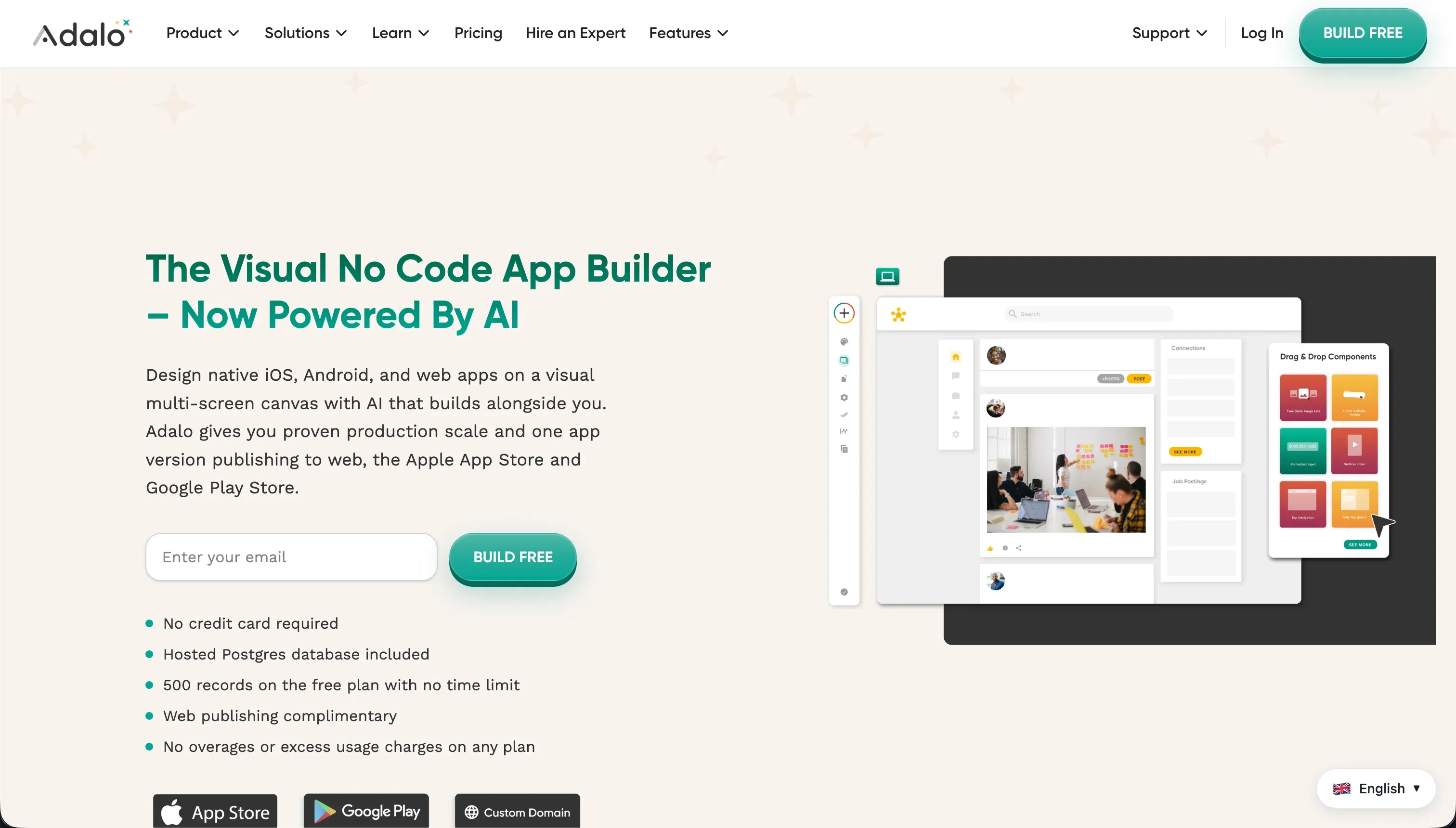
Adalo is a visual no-code app builder for mobile apps and PWAs that uses a drag-and-drop canvas plus a built-in relational database. You assemble screens, actions, and data relationships inside Adalo’s managed runtime rather than writing application code or wiring your own backend.
It includes native publishing paths, a component marketplace, and database collections with linked records, which is why it appeals to founders and small teams trying to ship directories, simple MVPs, or event-style apps quickly. The tradeoff from the research is that performance, Android load times, and reliability complaints show up once the app becomes more complex or more business-critical.
What is Same.new?
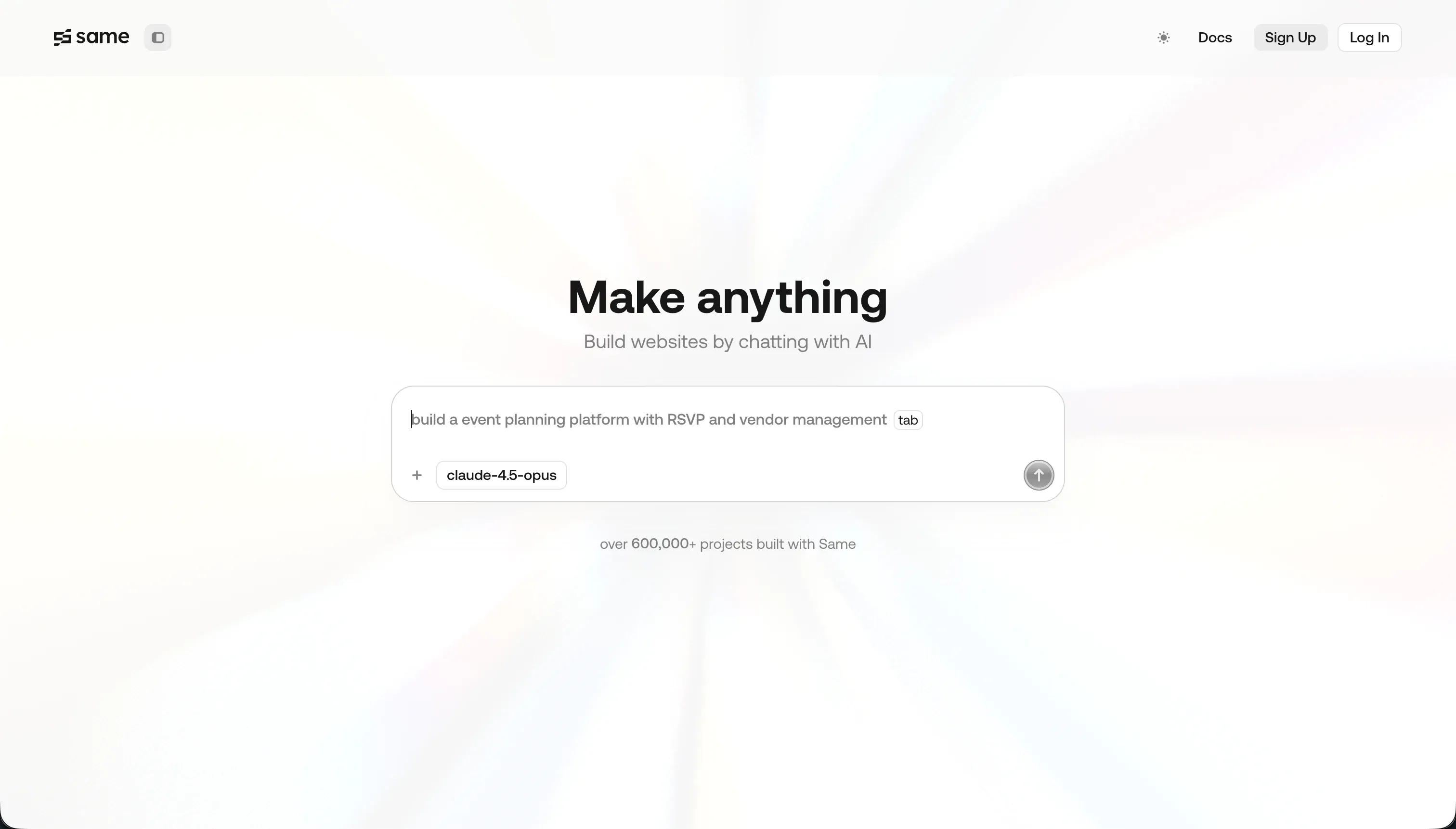
Same.new is an AI frontend generation tool that creates editable React and Tailwind interfaces from a pasted website URL or conversational prompt. Its build model is not a managed application stack; it generates UI code that a developer can refine, export, and then connect to real data and logic elsewhere.
The research points to concrete behaviors like URL-based visual cloning, conversational edits, forking experiments, and code export in React and Tailwind. That makes it genuinely useful for designers and frontend engineers who want a fast scaffold, but not for buyers who need a database, permissions, auth, or a production backend in the same product.
The core difference
These tools diverge most on one axis: managed application runtime versus generated frontend code. Adalo tries to be the app platform, while Same.new tries to accelerate only the interface layer.
- Adalo packages UI, data, and publish workflows into a closed no-code runtime so non-technical teams can assemble a working app without writing code.
- Same.new generates editable React and Tailwind from prompts and URLs, leaving data, authentication, and production architecture to the team using it.
Where the scores diverge
Design flexibility: Adalo 5.0, Same.new 6.5. This is Same.new’s clear win because generating React and Tailwind from an existing site or prompt creates more frontend freedom than Adalo’s constrained mobile-first canvas. It is the better fit when the visual goal is to mimic or iterate on a web interface quickly.
The deduction is that the output can still break on more complex layouts and follow-up prompts, so the flexibility is real but not fully reliable. Adalo falls behind because its fixed-frame approach makes polished responsive desktop experiences harder to achieve.
Ease of build: Adalo 6.0, Same.new 5.0. Adalo is easier for a non-technical buyer because the product already contains screens, actions, records, and publishing flow in one place. A builder can stay inside a visual canvas instead of translating prompts into missing backend work.
Same.new feels fast at the first prompt, but that speed applies mainly to UI scaffolding, not to finishing a working app. Adalo still loses points because its editor and app behavior get harder to manage as workflows and data relationships grow.
Maintainability: Adalo 4.0, Same.new 3.0. Adalo is easier to keep alive than Same.new because its logic and data model remain inside one managed environment, even if that environment becomes awkward at scale. The downside is that more collections, conditions, and API dependencies can make changes brittle and time-consuming.
Same.new loses harder because the research describes prompts that can wipe or distort substantial sections of generated UI, turning small edits into repair work. When the editing mechanism itself is unstable, long-term maintenance becomes difficult to trust.
Security & access control: Adalo 4.0, Same.new 3.0. Adalo wins only because it has some native account structure and visibility controls, not because it offers strong enterprise-grade security. The research notes that builders often have to define visibility logic manually on components, which increases the chance of mistakes in real apps.
Same.new is fundamentally weaker because it is a frontend generator with no native authentication, permissions, or row-level access model. Any serious access control has to be designed and coded outside the product.
Data & integrations: Adalo 5.0, Same.new 4.0. Adalo takes this because it includes a relational database with linked records, which gives a buyer a usable data layer from the start. That is enough for basic MVP workflows, forms, and list views without external engineering.
It still loses points because larger data volumes can introduce latency and integration upkeep. Same.new trails because it contributes no native database or application data model at all; exported UI must be connected to external services by a developer.
Production readiness: Adalo 3.5, Same.new 3.0. Neither tool is strong here, and that matters because this criterion exposes the gap between a demo and a dependable product.
Adalo at least gives you a deployable application stack, but the research notes recurring server errors, sluggish Android performance, and reliability concerns that cap how confidently you can run it in production. Same.new falls further behind because it does not provide the backend, auth, or operational guardrails required to run a real app on its own.
Even Adalo’s edge is a weak one, not a decisive production endorsement.
Cost comparison
Adalo uses flat subscription tiers tied to database limits, starting with a free plan capped at 200 records, then $36 per month billed annually for 10,000 records, and up to $200 per month for a business tier capped at 250,000 records.
Same.new historically used usage pricing at $10 per 2 million tokens and later added fixed plans with token quotas, so the bill moves with generation and editing volume rather than a simple app tier alone.
The hidden cost lines are different. With Adalo, forecast builder time spent managing performance issues, debugging brittle integrations, and eventually migrating if the app outgrows the platform.
With Same.new, forecast token or plan consumption, engineering time to repair generated UI, third-party hosting and backend setup, and the migration work of turning a prototype-like frontend into a maintainable production system.
Lock-in and the exit path
Adalo lets you export database rows, but not the underlying application logic or code, so leaving means rebuilding screens, workflows, and runtime behavior elsewhere.
Same.new has the cleaner exit because you can export the generated React and Tailwind frontend, but you still have to rebuild or separately provide the backend, auth, and application logic to run it as a complete product. In short, Adalo traps more of the app inside its platform, while Same.new lets you leave with the UI layer only.
- Database rows export
- React and Tailwind export
- Logic and code stay
- UI code leaves with you
- Rebuild screens and workflows
- Rebuild backend and auth
Who should pick Adalo
Pick Adalo if:
- Non-technical founders who need a database-backed MVP and value Adalo’s 6.0 Ease of build more than deep frontend control
- Teams shipping simple mobile-first apps where built-in publishing and linked records matter more than perfect responsive design
- Small businesses testing directories, forms, or lightweight operational apps without hiring engineers for the first version
Do not pick Adalo if the app is business-critical, heavily trafficked, or dependent on strict security roles and reliable production performance.
Who should pick Same.new
Pick Same.new if:
- Frontend engineers who want to turn an existing URL into React and Tailwind quickly and can wire the rest themselves
- Design teams optimizing for visual iteration first, where Same.new’s 6.5 Design flexibility score is the main buying reason
- Product teams that need exportable UI code rather than a closed no-code runtime
- Prototype-heavy workflows where a rough frontend scaffold is valuable even before backend architecture is decided
Do not pick Same.new if you need the product itself to provide a database, authentication, permissions, hosting guardrails, or a complete production app stack.
What neither platform answers
Many buyers reading this matchup do not actually need a mobile-first no-code app or an AI UI cloner. They need a business app: a client portal, internal tool, or CRM defined by logins, permissions, stable data access, and low maintenance after launch.
In that lane, Softr is the better fit because its research scores are far stronger where business software lives or dies: 8.5 for Production readiness, 9.0 for Maintainability, and 8.5 for Security & access control.
Choose Softr when the job is a secure portal or operational app that should stay easy to manage, not a custom frontend experiment.
If the real requirement is different - especially a more custom native-mobile product rather than a business portal - pair that recommendation with a tool like FlutterFlow, which is a more sensible lane than either Adalo or Same.new for richer mobile app UX and exportable code.
Analyst verdict
Adalo wins 4.6/10 to 4.1/10. It takes Ease of build, Production readiness, Maintainability, Security & access control, and Data & integrations, while Same.new keeps Design flexibility as its one meaningful edge.
That makes Adalo the better general purchase if you need a simple database-backed app and want the platform to handle more of the application stack for you. The flip case is clear, though: if your team can code and the real priority is frontend speed plus exportable React/Tailwind output, Same.new is the smarter buy despite losing the aggregate.
The important caveat is that this is a weak-field win, not a glowing endorsement. Adalo’s 3.5 Production readiness score and Same.new’s 3.0 both signal that buyers with serious security, reliability, or maintainability requirements should likely shop outside this comparison.
Related reading: the Adalo scorecard, the Same.new scorecard, and our scoring methodology.