

This comparison evaluates two distinct approaches to fast, low-friction application building. Base44 represents the conversational AI-generation paradigm, where a single text prompt builds your database, authentication, and layout in one pass.
Adalo, by contrast, is a legacy visual programming platform based on a drag-and-drop canvas, tailored primarily for mobile app store scaffolding without native AI co-building capabilities.
From a procurement perspective, neither platform achieves a level of stability suitable for mission-critical enterprise software. Base44 takes the lead with an aggregate score of 5.2/10, winning on ease of build and styling speed. Adalo finishes at 4.6/10, held back by daily server errors and unappealing desktop scaling.
If you must select between the two, choose Base44 for rapid, prompt-powered web MVPs, and pick Adalo only if you require native iOS or Android app store packaging.
The decision in 30 seconds
| If your priority is… | Pick | Why |
|---|---|---|
| Speed of first visual prototype | Base44 | Scaffolds database, auth, and frontend from a single prompt with zero manual setup |
| Publishing native iOS and Android packages | Adalo | Handles mobile store packaging natively, albeit with poor Android performance |
| Secure client portals or company intranets | Neither | Both fail at role permissions and user-level data isolation, making Softr the correct pick |
| Evolving an app without bugs or regression loops | Neither | Base44 suffers from AI editing loops, while Adalo’s external integrations are clunky and fragile |
| Predictable billing with real scale | Neither | Base44 bills on dual credit usage, and Adalo enforces strict, penalizing database record caps |
What each platform is
What is Base44?
Base44 is an AI-powered, full-stack application builder that turns text descriptions into working web applications. It deploys a managed environment that bundles a PostgreSQL database, user authentication, and web hosting in a single pass. Modifying the resulting application is handled through a conversational AI assistant paired with a visual, click-to-tweak design editor.
Base44 is built primarily for non-technical founders, operation teams, and builders who want to skip the technical overhead of database schemas, environment variables, and visual layouts. Key features include a conversational builder chat, design token prompt keywords for fast CSS formatting, and a GitHub integration that allows front-end code export to support traditional developer edits.
What is Adalo?
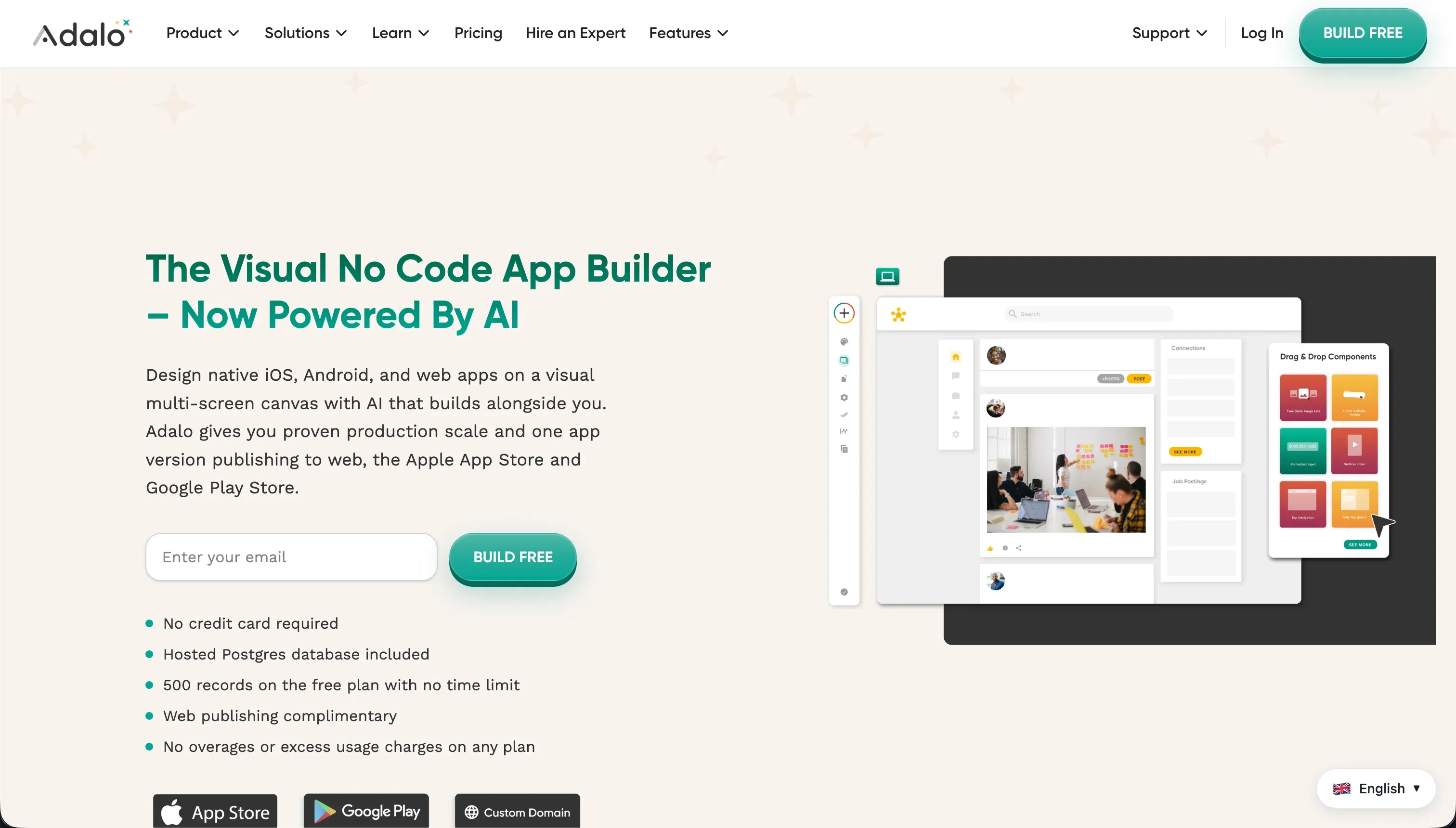
Adalo is a no-code visual builder that uses a free-form, drag-and-drop canvas to lay out screens and construct user interfaces. It relies on an integrated relational database to store data records, maps interactive operations through action workflows, and provides a platform to publish applications to custom web domains or package them for native mobile app stores.
Adalo is designed for creators, designers, and startup founders who look to deliver simple mobile app MVPs and basic web directories. Its primary features include a component marketplace for adding third-party plug-ins like Stripe, native database collection linking, and integrated mobile layout presets.
The core difference
The core divergence between these two platforms is the level of visual manipulation versus conversational automation.
- Base44 generates the entire application programmatically from a plain-text prompt, isolating the builder from layout configuration unless they use the click-to-tweak UI panel.
- Adalo requires the builder to manually position every element on a visual canvas and configure workflows and logic by hand.
Where the scores diverge
Ease of build: Base44 7.5, Adalo 6.0. Base44 scores 7.5/10 due to the rapid first-version speed of its prompt-to-app generator. The capability to spin up a fully functioning PostgreSQL database, hosting environment, and authentication system from single-sentence instructions removes the typical friction points of application building.
Adalo scores 6.0/10 because it forces builders to design and link every screen and action from scratch. While the initial canvas onboarding is highly intuitive, Capterra reviewers emphasize that basic utility tasks like setting up password recovery or uploading multiple images become unexpectedly tedious.
Design flexibility: Base44 6.5, Adalo 5.0. Base44 scores 6.5/10, leveraging rapid styling design tokens and a click-to-tweak panel that allows non-technical users to quickly adjust UI elements without writing CSS.
Adalo scores 5.0/10; while its absolute-positioning canvas allows builders to design bespoke layouts, its fixed-width model means desktop web apps feel like stretched phone screens, neglecting true responsive layouts across different device factors.
Production readiness: Base44 4.0, Adalo 3.5. Adalo scores a low 3.5/10, heavily impacted by customer reports of daily internal server errors, unacceptably slow Android native shell performance, and rare but catastrophic data loss incidents where large portions of database records disappeared.
Base44 settles at 4.0/10 due to widespread builder reports of weekly server and builder downtime. Users also flag that the AI-generation engine frequently breaks existing production builds during updates, meaning applications can suddenly become completely unusable after a feedback cycle.
Maintainability: Base44 3.5, Adalo 4.0. Adalo scores 4.0/10 because modifications to database collections are easy, but complex multi-step workflows, conditional branching, and approval sequences are highly fragile to maintain. Additionally, external API configurations often break and must be rebuilt from scratch after minor endpoint adjustments.
Base44 scores 3.5/10 because its conversational editing agent frequently triggers regression loops. Builders describe spending hours and draining hundreds of credits as the AI introduces several new bugs to resolve a single existing issue, often forcing a manual code rollback to escape the loop.
Data & integrations: Base44 5.5, Adalo 5.0. Base44 scores 5.5/10 because it provides a managed PostgreSQL database out of the box, although it relies on LiteLLM connections, which introduces API limits and noticeable performance lag on large tables or complex PDF workflows.
Adalo scores 5.0/10, featuring a relational database and basic connections to Airtable and REST APIs. However, Adalo’s internal database becomes a performance bottleneck as record count grows, and external data sources require fragile API workarounds due to the lack of native real-time two-way synchronization.
Security & access control: Base44 4.0, Adalo 4.0. Both platforms score a weak 4.0/10, indicating a serious mismatch for professional context requirements.
Adalo offers only basic user roles with no centralized access panel, demanding that builders manually configure complex visibility rules on every individual screen element, which makes multi-tenant portals highly insecure.
Base44 includes native auth, but registration and login templates are restricted to the default designs and cannot be branded, and the overall permissions model is not designed for granular field-level protection or per-user data isolation.
Cost comparison
Base44 manages pricing through a dual credit model.
Its monthly subscription tiers range from $20/month billed monthly (Starter) to $200/month (Elite), which allocate two currencies: message credits, which are consumed when you prompt the AI builder to construct or update features, and integration credits, which are drained whenever your end users trigger database updates, send emails, or run workflows.
Adalo uses a database record threshold model, starting at $45/month billed monthly (Starter) and climbing past $250/month (Business), with plans charging based on the number of published apps and database records.
The real cost of ownership on both platforms is unpredictable. On Base44, builders frequently burn through their message allowance trying to prompt out bugs in regresion loops, while Adalo’s rigid record caps create immediate cost spikes that penalize user adoption, requiring builders to pay premium overage rates or quickly migrate to third-party databases.
Lock-in and the exit path
Lock-in represents a significant pain point for both tools. While Base44 allows you to export your frontend layout code to GitHub, your backend resources, transactional data, and PostgreSQL database structure are hosted on their closed infrastructure, making developer migrations highly technical.
Adalo has no backend code export capacity; your screens, database, and logic workflows are tied entirely to Adalo’s visual editor. To leave either tool, a buyer must design, host, and refactor the entire application from the ground up, though Adalo has a slight advantage for retrieving legacy record data as CSV exports.
Who should pick Base44
Pick Base44 if:
- Founders who need a functional, prompt-scaffolded MVP in front of investors within 48 hours.
- Operations teams piloting simple, low-complexity internal workflows where role-based data isolation is not a priority.
- Builders looking for a managed PostgreSQL database with quick click-to-tweak frontend alignment.
Do not pick Base44 for any SaaS product or company application that requires per-user billing, granular field-level visibility rules, or stable weekly production uptime.
Who should pick Adalo
Pick Adalo if:
- Startups trying to validate a simple, mobile-first consumer application concept on test networks.
- Designers building flat, image-heavy visual directories or basic catalog layouts to publish on native app stores.
- Small teams with highly static datasets that fit comfortably below Adalo’s strict database record caps.
Do not pick Adalo if you are building enterprise internal tools, complex multi-user portals, or applications requiring responsive desktop layouts.
What neither platform answers
Both Base44 and Adalo assume your development goals revolve around building custom layout blocks and mobile shells. If you are actually looking to build operational business software - such as a secure client portal, an internal CRM, or a company intranet - neither tool makes procurement sense.
Base44 forces you to navigate fragile AI editing loops to manage basic permissions, while Adalo subjects paying users to server errors and limits your desktop web responsive controls.
For business-class applications, a focused platform like Softr scores 8.5 on production readiness and 9.0 on maintainability. Softr implements user authentication, secure role-based data isolation, and multi-tenant visibility controls as pre-built, visual configurations rather than elements you have to prompt or construct by hand.
For teams that strictly require fully customized, prompt-engineered software, an AI IDE like Replit provides superior code ownership and production control.
Analyst verdict
The scorecard awards Base44 the aggregate victory of 5.2/10 over Adalo’s 4.6/10. Base44 wins 3 of the 6 criteria: ease of build, design flexibility, and a slight edge in data and integrations, while Adalo takes the lead on maintainability. Both platforms tie with a score of 4.0/10 on security and access control.
However, this numeric victory is highly conditional. Base44 is the right choice only for lightning-fast, prompt-built web prototypes where the development cycle is short and the codebase is destined for an engineered handoff. If clean native mobile publishing is your driving priority, Adalo remains the default option despite its performance limitations.
For any production operational software or client portal, builders will find far better security and architectural stability on Softr, and code-first builders should rely on Replit instead.
Related reading: the Base44 scorecard, the Adalo scorecard, and our scoring methodology.