
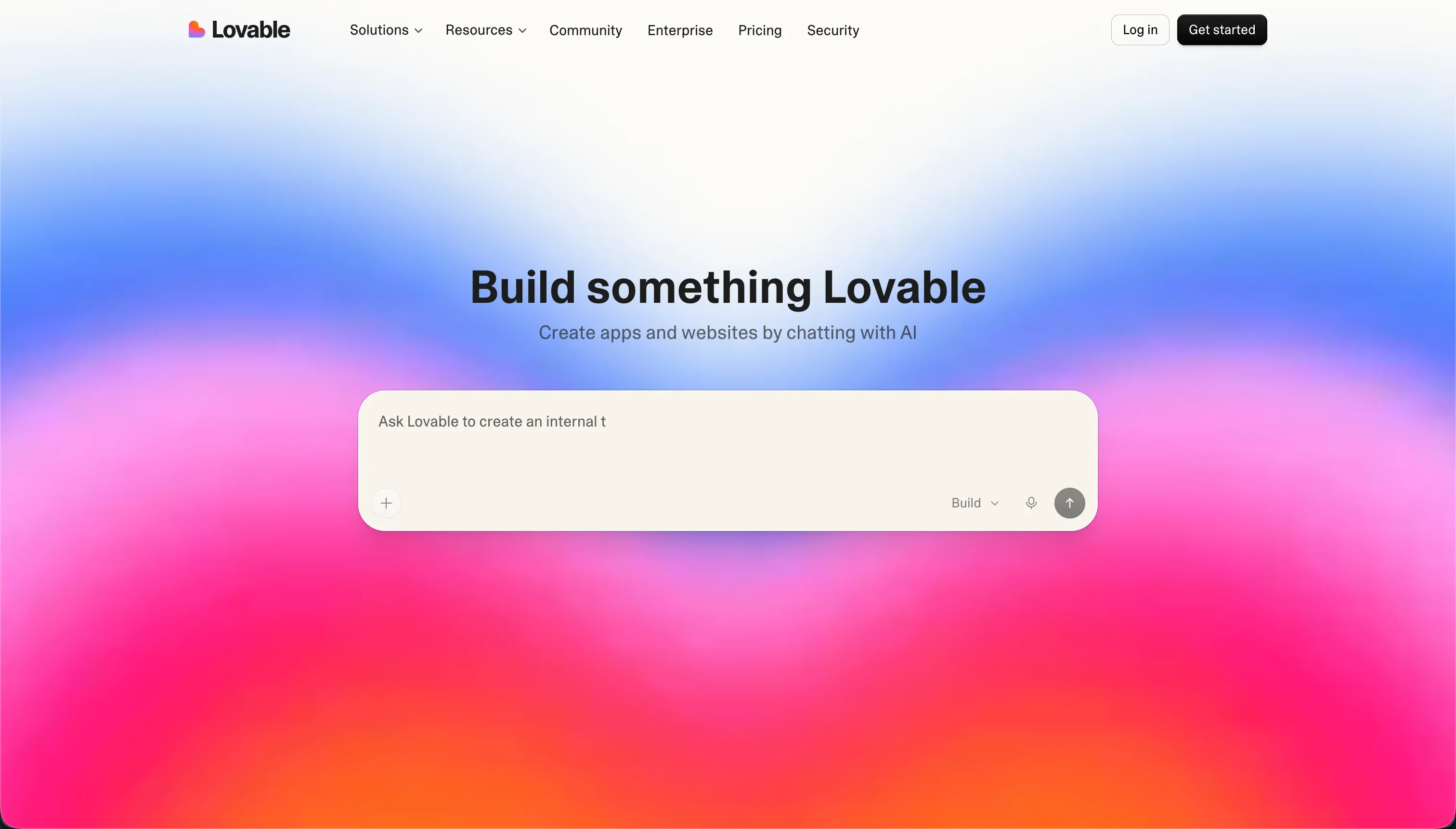
What Lovable is
Lovable is an AI-powered full-stack development platform designed to turn conversational prompts into complete web applications. The system automatically engineers the standard developer stack, outputting fully readable React and TypeScript on the frontend, a Node.js backend, and a PostgreSQL database powered by Supabase.
Rather than hiding code behind visual editors, it prioritizes real codebase ownership by executing continuous synchronization with GitHub, allowing teams to pull the generated code directly into local IDEs like VS Code or Cursor.
The build model is centered entirely on a conversation-driven interface, a paradigm often described as “vibe coding.” To construct or modify an application, you write natural language prompts describing your intent, and the AI agent coordinates multi-file code modifications automatically.
You can also import Figma design files to instantly generate React components or connect toolchains like Linear and Notion to feed the AI system-level context. For fast adjustments, you continue prompting the workspace model rather than dragging and dropping elements onto a visual canvas.
The core tradeoff is a stark fork in project durability. You receive an incredibly fast pipeline to a working prototype with clean exported code, but you lose the predictable guardrails of structured visual builders.
Because every minor UI tweak or database schema adjustment requires a new AI prompt, your development loop is at the mercy of credit consumption rates and potential agent regressions. For long-term projects, you are exchanging predictable platform configuration for a code maintenance pattern that can rapidly generate technical debt.
Where the scores come from
Lovable’s average score of 5.6 is highly polarized, reflecting a tool that is brilliantly optimized for rapid frontend prototyping but penalized heavily on the engineering realities of day-two operations. It is a credible choice for launching proof-of-concept software, alongside steep risks when asked to serve as a secure, long-term home for production data.
Ease of build: 7.5/10
Ease of build scores 7.5/10 because of the unparalleled speed of initial generation. Descending from a raw text prompt to an interactive, multi-page layout with working databases takes minutes, and features like Figma import and Linear integration bypass traditional setup bottlenecks. Non-developers can quickly see a visual representation of their ideas without writing code.
The score caps here due to the friction of iterative editing. Because the platform lacks direct-manipulation visual editing tools, fixing minor layout bugs requires conversational re-prompting. Reviewers report entering frustrating regression and debugging loops where the AI repeatedly claims to have resolved an issue but instead reintroduces past bugs, consuming daily credit allocations in the process.
Production readiness: 4.0/10
Production readiness scores a low 4.0/10 because the platform struggles to complete the transition from prototype to reliable software. While Lovable provisions modern infrastructure instantly on its cloud, users consistently report hitting a structural wall when tackling the final stretch of business logic.
Complex database relationships, custom triggers, and multi-step state management frequently cause the generator to stall or break.
Once live, the maintenance overhead presents an immediate challenge. Community feedback suggests that frequent platform updates can introduce regressions into existing client apps, requiring builders to continuously debug live projects. For business applications that need to run quietly and reliably for years, transitioning the codebase to a traditional development environment often becomes a necessity.
Maintainability: 3.5/10
Maintainability scores 3.5/10, representing one of the lowest marks on the card. Unlike visual builders like Softr, where layout settings are visually represented in menus, modifying a Lovable app requires interacting with code via an AI intermediary.
Over a six-to-nine-month horizon, letting an AI autonomously alter schemas and adjust dependencies creates massive database schema debt that makes simple updates increasingly difficult to ship.
Because the generated codebase lacks the modular visual boundaries of other low-code platforms, a single prompt can cause unintended side effects across unrelated views. Experienced builders note that complex apps built on Lovable have a practical shelf life of under two years before requiring a manual, code-first rebuild to clean up AI-generated architecture.
Security & access control: 3.5/10
Security & access control scores 3.5/10 because the platform inherits none of the automated, visual security guardrails of dedicated internal tool builders. Lovable relies on Supabase Row Level Security (RLS) policies to secure data table queries. However, the AI does not automatically install production-ready schemas, leaving the builder with unsecured database tables by default.
A non-technical builder has no visual, audited way to verify which API endpoints or database rows are exposed to the public internet since there are no secure configuration toggles on the platform. To ensure user data is protected, an explicit manual audit of the Supabase back-end code is required, rendering the secure deployment of sensitive operational tools highly unsafe without developer oversight.
Data & integrations: 6.5/10
Data & integrations scores 6.5/10. The platform’s greatest data asset is its native integration with Supabase, giving applications a scalable, real PostgreSQL database complete with user authentication and real-time synchronization right out of the box.
The integration is high-performing, and the presence of direct GitHub syncing means data and platform schemas can integrate elegantly with standard developer pipelines.
The score is moderated because other integrations are not native platform blocks. Connecting to external services like Stripe, Salesforce, or custom APIs requires prompting the AI to write custom integrations and middleware code. This makes the durability of external integrations highly vulnerable to API changes and code regressions, unlike visual platforms that expose native, maintained connectors.
Design flexibility: 8.0/10
Design flexibility scores an impressive 8.0/10. Because the final output is custom React code, there are virtually no visual limits or block-based restrictions like those found in traditional no-code tools. If you can describe a layout, color scheme, or animation sequence, the generator can write the styling to achieve it, making it ideal for creating highly customized consumer frontends.
The slight deduction is a practical one: getting a responsive layout pixel-perfect or tweaking specific CSS animations often requires multiple conversational iterations. Because direct visual manipulation of margins, padding, and alignments is unavailable, the user must possess clean design-prompting skills to guide the AI to the final visual specification.
What types of apps you can build with Lovable
Lovable is best suited for scenarios where speed-to-market is the primary objective and the application’s underlying code is destined to eventually be handed over to a professional development team.
Good-fit app types include SaaS MVPs and early prototypes, custom web landing pages, interactive product demos, and lightweight consumer-facing tools that benefit from unique layouts. It excels when you need a functional mockup to show investors or validate a concept with users before committing real capital to custom engineering.
Conversely, it is structurally ill-suited for core business databases, customer portals, or operations software. If you need to build secure client repositories or business hubs, a platform like Softr is the natural contrast.
While Lovable leaves database security and maintenance to code prompts, Softr enforces visual, server-side permissions and pre-built blocks that cannot be broken by model updates, ensuring core business operations stay online without constant engineering oversight.
- Best for SaaS MVPs and prototypes
- Landing pages and product demos
- Speed-to-market is the goal
- Security handled by code prompts
- Code handed to dev team later
- Built for client portals and business hubs
- Visual, server-side permissions
- Pre-built blocks resist model updates
- Keeps operations online
- No constant engineering oversight
Who should not use Lovable?
Do not use Lovable if your project consists of business apps that must run reliably for years with minimal maintenance. The platform’s tendency to introduce regressions during conversational updates, combined with unpredictable platform package breakages, makes keeping long-lived apps online without hands-on engineering intervention an expensive, credit-consuming chore.
Do not use Lovable if your organization lacks a developer to audit security rules and own the codebase. Because database security is dependent on Supabase Row Level Security configurations that must be audited manually, deploying a database with user-restricted views without technical validation poses a severe risk of data exposure.
Do not use Lovable if you require a stable, forecastable cost per feature shipped. The platform’s credit-scaling pricing models mean that complex debugging tasks can rapidly deplete your credit limits, creating volatile development costs when the AI agent enters repetitive code resolution loops.
Analyst verdict
With a average score, Lovable is a premium tool for teams that need to spin up a high-fidelity prototype in days, export the React and TypeScript source files, and exit the platform. If you intend to use it as a launchpad for a developer-led transition, the clean codebase handoff and GitHub synchronization are strong.
However, it represents significant operational risk if adopted as a permanent runtime for stable business machinery. The overhead of security configuration, vulnerability to regression bugs, and the accumulation of technical debt make it a poor fit compared to platforms scored under our /methodology.
For permanent, secure business tooling, platforms like Softr provide the visual governance that Lovable’s code-generation engine lacks.