

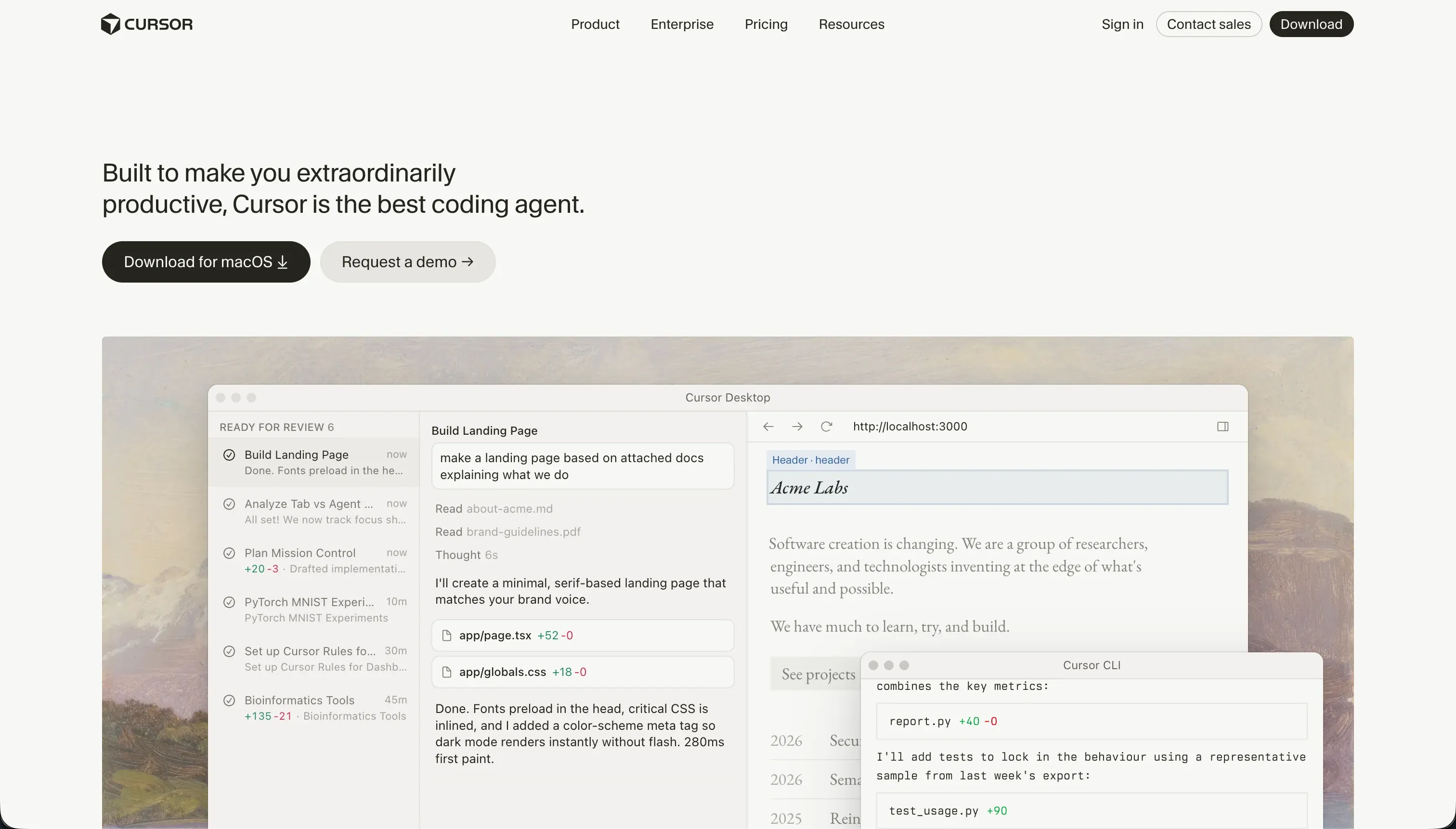
This comparison evaluates the fundamental procurement choice between an AI-first professional developer workspace and an AI-driven no-code application creator. Cursor is an AI-enhanced code editor built for engineers who write, run, and scale custom software architectures manually.
Lovable sits on the other side of the abstraction layer, generating full React frontends and Supabase backends entirely from conversational text prompts.
Cursor wins on scored aggregate, scoring 6.2/10 against Lovable’s 5.5/10. Because Cursor operates on standard source code without a proprietary middleman, it provides cleaner data integration, stronger long-term maintainability, and unlimited technical flexibility. This order reverses only when the purchasing team lacks anyone who can read, debug, and locally execute code.
The decision in 30 seconds
| If your priority is… | Pick | Why |
|---|---|---|
| Professional developers writing custom codebases | Cursor | Unbounded language control with context-aware codebase indexing and Composer agent mode |
| Prompt-to-app SaaS prototyping for non-technical users | Lovable | Instant scaffolding of React frontends paired to managed Supabase PostgreSQL tables |
| Enterprise-grade database scale and security control | Cursor | Total architectural freedom to configure databases on dedicated enterprise clouds |
| Client portals, partner directories, or internal operational tools | Neither | Operational software requires visual, secure pre-built auth and permissions block systems |
| Figma design token imports and frontend scaffolding | Lovable | Native design-led generation toolchains directly converting layouts to React styling |
What each platform is
What is Cursor?
Cursor is an AI-first integrated development environment (IDE) built as a fork of VS Code. It is designed to act as an offline-first power-editor for professional software engineers, embedding deep language models directly into the file-editing experience.
Rather than serving as an external application builder, Cursor acts as a localized assistant that reads and edits your raw repository files dynamically.
Key capabilities of Cursor include semantic codebase indexing for full-project context awareness and the Composer developer agent. Composer allows the editor to make multi-file modifications, generate unit tests, and perform structural refactoring within local IDEs.
It is built strictly for individuals and engineering divisions that maintain standard build-steps, deployment environments, and manual database configurations.
What is Lovable?
Lovable is a full-stack, conversational visual application creator. It allows non-technical builders to translate plain-text prompts into working web applications that run on a backend composed of React and TypeScript frontends, Node.js, and Supabase PostgreSQL. Builders describe the required update conversationally, and the platform deploys the changes to Lovable Cloud.
Key features in Lovable include a native Figma importer to convert design tokens into frontend components, and pre-publish security scanners built to trace vulnerabilities. It targets operations managers, early startup teams, and builders who require swift, design-led visual proofs of concept without diving into manual developer setups.
The core difference
The division between these tools rests on code ownership and the technical skill required to run the development environment.
- Cursor is a localized developer editor that helps engineers write custom systems faster while leaving all infrastructure, deployment, and security auditing to manual codebase operations.
- Lovable is a cloud-hosted black box that handles full-stack code gen and deployment from conversational prompts, making it accessible to non-technical users at the cost of long-term maintainability.
Where the scores diverge
Ease of build: Cursor 3.0, Lovable 7.5. The build experience diverges cleanly based on user skill. Lovable scores 7.5/10, allowing non-developers to scaffold functional applications and database links in hours via simple text chat.
Cursor scores 3.0/10 because it provides no visual wizardry: it is a professional development environment that assumes you can compile assets, resolve local package dependencies, and manage deployment hosting. Lovable’s ease is capped because fine iterations still rely on persistent prompting, which occasionally introduces regression loops.
Maintainability: Cursor 6.5, Lovable 3.5. This criterion separates these paradigms cleanly. Cursor scores 6.5/10 because builders own standard source files in standard Git. You can use standard unit test frameworks and refactor modules. The minor deduction is that Composer agent runs can occasionally output unintended edits that require git rollbacks.
Lovable scores 3.5/10 because maintenance is prompt-only; users suffer from schema debt where adding tables forces developers to rewrite massive layers of prompted software.
Production readiness: Cursor 6.0, Lovable 4.0. Production sustainability shows major stability differences. Cursor scores 6.0/10; while it provides absolutely no turnkey hosting or pre-wired infrastructure, final security rests on the deliberate architecture of your developers.
Lovable scores 4.0/10 because is hit by the ‘day two’ wall where long-term builders report that platforms update can break client configurations, and complicated business logic struggles to run stably because everything is prompted without direct visual control.
Security & access control: Cursor 5.5, Lovable 3.5. Both tools fail to inherit simple, ready-to-use authentication layers. Cursor scores 5.5/10; there is no built-in auth provided, so engineers must architect it from scratch, which is technically demanding but unbounded.
Lovable scores 3.5/10 because database security relies on builders configuring Supabase row-level security policy sets through prompts, leaving non-technical builders with no reliable method to audit whether generated APIs are exposing client data.
Data & integrations: Cursor 7.5, Lovable 6.5. Data capabilities are defined by language boundaries. Cursor scores 7.5/10 because it operates in raw codebases that can plug into any database, library, or API endpoint directly supported by modern code frameworks.
Lovable scores 6.5/10 since it relies heavily on its pre-packaged database integration with Supabase, meaning custom APIs beyond the Supabase stack must be manually prompted into the logic, introducing brittle dependencies.
Design flexibility: Cursor 8.5, Lovable 8.0. Design flexibility is highly competitive but structured differently. Cursor scores 8.5/10 as design freedom is bounded purely by the developer’s skill with standard Tailwind/CSS assets, allowing pixel-level customization.
Lovable scores 8.0/10 because the generated React code is highly flexible and integrates with Figma, though users must continuously re-prompt the conversational AI to align visual details, which can become frustrating compared to direct code edits.
Cost comparison
The billing models reflect the target developers. Lovable has a credit-based structure. Pro plans start at 25€/mo for 100 base credits but can scale up to 2,250€/mo for 10,000 credits to cover the rapid burn of iterative prompt loops and bug-fixing. Business plans are even more expensive, sitting at double the cost per credit.
Cursor runs on a flat SaaS structure: Pro scaling is $20/mo for 500 fast queries, and Ultra is $200/mo for 10,000 queries, allowing predictable forecasting.
Hidden costs diverge on builder labor. Cursor projects require manual DevOps setups, Vercel/AWS bills, and database instances. Lovable’s hidden costs stem from debugging. If the AI gets caught in a loop attempting to patch a regression, developers can drain hundreds of credits in an hour.
Additionally, long-term builders report that the technical debt accumulated by AI-designed databases can force full reconstructions.
Lock-in and the exit path
The exit paths are fundamentally unequal. Cursor has zero lock-in: your code lives in standard repositories like GitHub, and you can transition to other IDEs like VS Code or Claude Code without changing single configurations.
Lovable offers GitHub export of standard React and TypeScript code, but reviewers report the output code is highly fragmented, requiring extensive developer refactoring to port cleanly into external runtimes. Furthermore, leaving Lovable can bring backend integration hurdles if your Supabase database has been modified autonomously by Lovable Cloud pipelines.
- Code lives in standard GitHub repos
- Move to VS Code or Claude Code
- No configuration changes needed
- GitHub export of React and TypeScript
- Output is highly fragmented
- Extensive refactoring to port
- Supabase modified by Lovable Cloud pipelines
- Backend integration hurdles
Who should pick Cursor
Pick Cursor if:
- Professional software engineers who seek to accelerate local repository refactoring, test coverage setups, and file modifications with contextual semantic indexing
- Enterprise teams requiring secure, private developer offline editing modes that align with standard corporate repository scanning policies
- Software divisions looking to maintain absolute control over hosting providers, custom SQL backends, and manual code pipelines
Do not pick Cursor if your team lacks software engineering skills and cannot read code, compile files, configure local environments, and resolve package dependency errors manually.
Who should pick Lovable
Pick Lovable if:
- Startup founders and product managers seeking to scaffold visual SaaS interactive prototypes from Figma and text prompts inside a week
- Non-technical business operators who want to build light, static web applications with connected Supabase backends without writing code
- Builders looking to export a design-focused React UI shell directly to GitHub as a visual foundation for developer handoff
Do not pick Lovable for core operations or security-critical business software that must be maintained reliably past eighteen months without breaking.
What neither platform answers
Both Cursor and Lovable assume the software you are building requires raw codebases, which is a major procurement misallocation for most business software. If your objective is to ship operational systems like client portals, internal company trackers, custom CRMs, or secure dashboards, both tools force unnecessary complexities.
You are left managing code repositories, handling Supabase RLS database configurations, or paying for expensive, volatile AI prompting credits to edit basic buttons and layout modules.
Operational software is defined by user access control, standardized database records, and absolute reliability. A dedicated business application builder like Softr solves this lane by providing secure, visual, pre-constructed components.
Because Softr handles user authentication, granular user group permissions, dynamic tables, and custom workflows out of the box, you can launch a production-ready client portal connected to Airtable or Softr Databases in days. For custom mobile-first native apps, teams should look to another visual alternative like FlutterFlow.
Analyst verdict
Cursor wins this comparison on scored criteria, with an aggregate rating of 6.2/10 against Lovable’s 5.5/10. Cursor has standard codebase ownership, making it the superior option for professional developers who want context-aware local refactoring.
Cursor scores higher on data integration, maintainability, and production readiness because the engineer remains in control of standard architectures. Lovable’s 5.5 aggregate reflects its ease of build for non-programmers, but this speed is offset by high maintenance regressions.
The final recommendation is conditional: choose Cursor if your team has professional engineers who can manage backends and compile code. If you do not have technical resources and your goal is to quickly scaffold a short-horizon prototype or SaaS concept, Lovable’s fast prompt-to-app generator is the correct allocation.
Related reading: the Cursor scorecard, the Lovable scorecard, and our scoring methodology.