
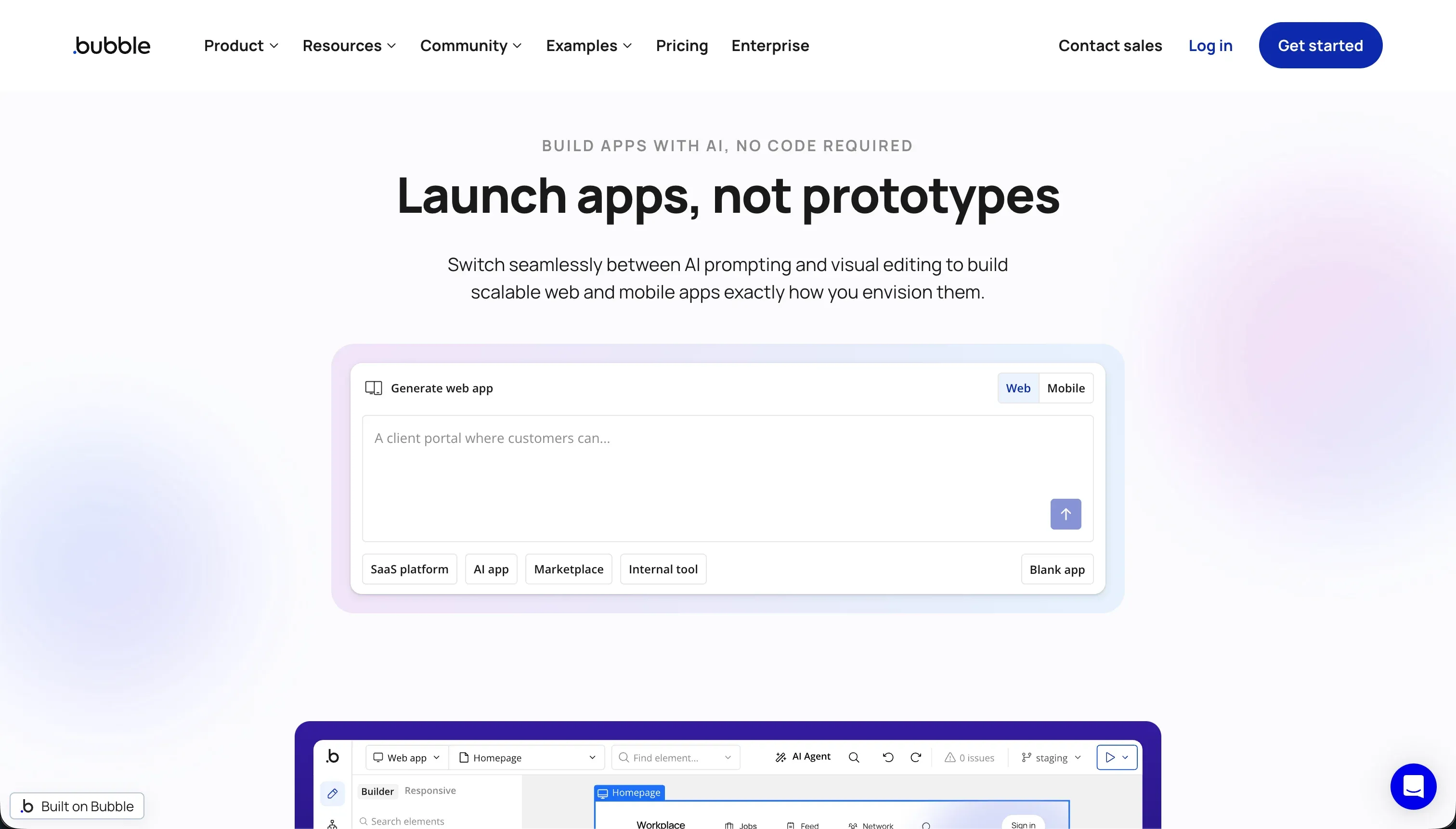
What Bubble is
Bubble is a visual programming platform that allows users to design, develop, and deploy full-stack web applications without writing code. It brings together a responsive, pixel-level drag-and-drop editor, a highly visual logic workflow builder, and a completely managed relational database.
For teams that have outgrown simple visual builders, it offers a single canvas to manage intricate visual details alongside complex backend operations.
The build model is defined by visual completeness: everything from data models to conditional branches and scheduled API hooks is built in the editor rather than written in text. Rather than generating a codebase that you download and deploy elsewhere, Bubble runs your application using its own proprietary application runtime.
This means configuration adjustments or styling changes take place inside a visual GUI rather than through code-generation prompts.
The core trade is flexibility for complexity. By choosing Bubble, you gain unmatched pixel-level interface control and custom-logic depth in the no-code ecosystem, but you accept a steep learning curve, platform-dependent hosting, and a pricing structure tied to workload units that can be difficult to predict.
For custom consumer products or complex SaaS MVPs, this trade is often necessary; for rapid business tooling, it often adds unwanted overhead.
Where the scores come from
Bubble’s overall score profile points to a platform built for unrestricted functional power at the expense of setup speed, predictable operating costs, and simple maintainability after launch.
Ease of build: 5.0/10
Ease of build scores a 5.0/10 because Bubble presents a steep learning path that mimics traditional software engineering concepts in a visual workspace. Building forms and static pages is straightforward, but setting up relational databases, state parameters, secure workflow conditionals, and custom API connections requires a developer-like conceptual understanding to execute successfully.
Furthermore, the dense editor environment presents usability barriers as projects grow. Builders on large workspaces frequently complain about heavy browser RAM consumption and editor lag, sometimes exceeding several gigabytes of memory per tab and forcing periodic page restarts to maintain work momentum.
Production readiness: 7.0/10
Production readiness scores 7.0/10 on the strength of its built-in infrastructure. Unlike lighter alternatives, Bubble comes out of the box with complete user authentication, a backend workflow scheduler, and server-side logic execution that are proven to scale under load.
The point deductions reflect the high configuration burden placed entirely on the creator and operational inconsistencies under production stress. Users report payment processing issues with native Stripe integrations and risk absolute application shutdowns on the free tier if their workload unit limits are exceeded without manual billing intervention.
Maintainability: 6.0/10
Maintainability scores 6.0/10 because visual edits do not require regeneration cycles, which prevents the unpredictable regressions commonly seen in prompt-to-code builders. Visual workflows are directly editable, meaning small functional changes stay localized to the specific blocks you touch.
However, complex applications frequently suffer from visual workflow sprawl that makes system architecture highly difficult to audit over time. This challenge is compounded by editor lag on larger codebases and the reality that inefficient setups directly increase the consumption of chargeable workload units, turning visual drafting mistakes into ongoing financial penalties.
Security & access control: 6.5/10
Security & access control scores 6.5/10 because Bubble provides excellent server-side database privacy controls, but configures none of them by default. These granular rules are highly secure once implemented, running at the database level where they cannot be bypassed by client-side browser manipulations.
The visual interface leaves the complete configuration burden to the builder. Trustpilot reviewers warn that a thorough security configuration is non-trivial and requires a firm grasp of database permissions; a single missed rule fails silently, leaving production records visible to the public internet without throwing red flags inside the editor.
Data & integrations: 8.0/10
Data & integrations scores an 8.0/10 due to its deep native database engine and versatile API connector. The platform natively handles relational database patterns - including deep parent-child relationships and customized data types - and features an API connector capable of bridging to any standard REST service.
The score stops short of a higher mark because of the platform’s heavy reliance on a community-driven ecosystem. Teams are frequently dependent on third-party plugin integrations to extend core functionality, leaving them vulnerable to unannounced breaking changes or abandoned plugin development.
Design flexibility: 8.5/10
Design flexibility scores a stellar 8.5/10, making it the strongest entry on Bubble’s scorecard. Leaving behind the block-based restrictions of standard internal tool builders, the layout engine grants complete spatial layout control with customizable responsive behaviors, custom CSS variables, and fluid screen-width adaptive styling.
This makes it a strong choice in the no-code market for matching a precise brand guideline or building responsive custom experiences. Only pure code generators offer more design freedom, but Bubble achieves this while keeping the designer connected directly to a visual database and logic layer.
What types of apps you can build with Bubble
Bubble excels when the structural requirement is an interactive, multi-sided application with unique business logic, user relationships, and custom UI. It is the dominant no-code framework for building consumer-facing products, marketplace MVPs, custom SaaS platforms, and software with complex matchmaking logic.
Good-fit app projects include:
- Two-Sided Marketplaces: Applications connecting independent buyers and sellers with individual checkout journeys, complex filters, and automated platform transaction fees.
- Custom SaaS MVPs: Software platforms requiring structured user workspaces, native subscription plans, and deep conditional logic flows.
- Interactive Web Platforms: Social apps, community directories, or interactive portals that need pixel-precise layout control and highly customized profile views.
For standard internal operations, however, this model is often over-engineered. If your main goal is deploying a secure portal or database interface, platforms like Softr are vastly more efficient because they use pre-built blocks and native database permissions rather than asking you to configure every pixel and security rule by hand.
- Custom marketplace logic
- Pre-built blocks
- Pixel-precise UI control
- Native database permissions
- Native subscription plans
- Secure portal fast
- Configure security by hand
- Standard internal operations
Who should not use Bubble?
Do not use Bubble if your team needs to launch a operational app within days without dedicating time to a intensive training process. The dense editor and database mechanics represent a significant, multi-week learning curve that will delay non-technical teams looking to ship immediate business workflows.
Do not use Bubble if migrating to self-hosted infrastructure is a non-negotiable exit plan for your company. Because the app runs solely on a proprietary application server, you will never be able to export your application code, leading to complete platform lock-in.
Do not use Bubble if you are working within a strict, predictable operating budget that cannot accommodate consumption spikes. The volatile workload unit pricing model means unoptimized database queries or traffic spikes can cause sudden billing increases that make production environments expensive to run.
Analyst verdict
Average score of 6.8. Bubble is highly recommended when your product requires a completely custom visual identity and deeply tailored relational data logic. If you are building a consumer-facing marketplace, a specialized SaaS MVP, or visual web apps that simple builders cannot structure, Bubble remains the undisputed powerhouse of visual development.
You can trace how this holds up against AI code engines in our Lovable vs Bubble comparison.
If you are aiming to build Client Portals, Internal Tools, or governed workspaces with standard layouts, the heavy configuration overhead and unpredictable pricing make Bubble harder to justify over pre-built structural options.
Our Bubble vs Softr comparison outlines why simpler platforms are routinely selected for safe operations on business data. Read our complete rating standard at the /methodology page.
- Fully custom visual identity
- Deep relational data logic
- Consumer-facing marketplaces
- Specialized SaaS MVPs
- Client portals
- Internal tools
- Governed workspaces, standard layouts
- Less configuration overhead