

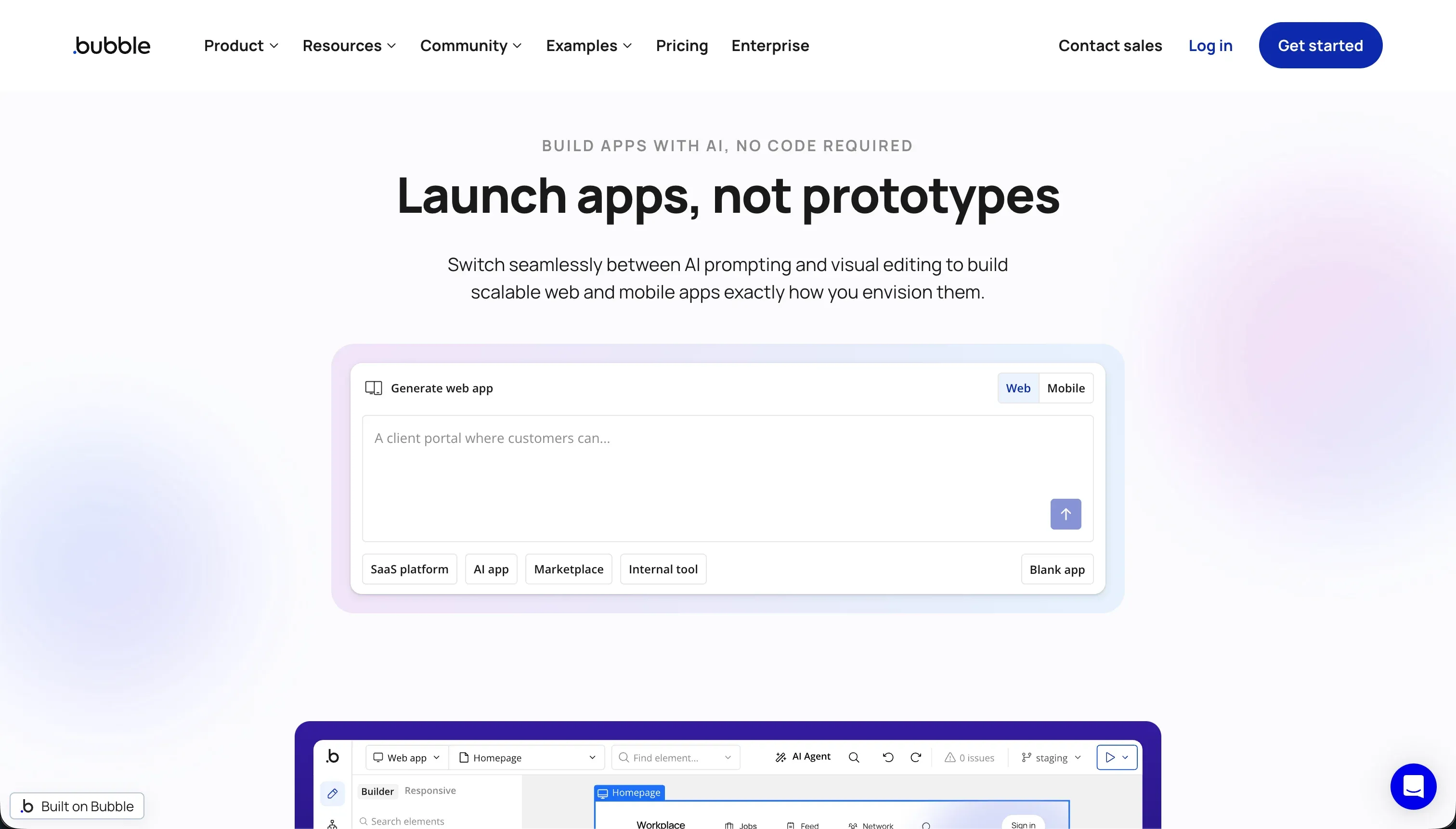

This comparison evaluates two divergent paradigms of software development: a visual visual-programming runtime against a terminal-based agentic code assistant. Bubble operates as a visual app creation platform where builders manually wire elements, while Claude Code is an agentic CLI tool that edits files and manages git directly within a local terminal environment.
Bubble wins the aggregate scorecard at 6.8/10 against Claude Code’s 6.6/10. Numbers before adjectives: the decision flips if your team relies on an existing code-based repository and has the engineering overhead required to configure local environments, run terminals, and read code syntax.
The decision in 30 seconds
| If your priority is… | Pick | Why |
|---|---|---|
| No-code business apps and client portals | Neither | Softr is the correct blueprint for portals, scoring much higher on out-of-the-box business infrastructure without visual sprawl or code setup |
| Direct terminal agent file manipulation | Claude Code | It runs autonomously inside local git repositories, managing commits and running tests directly |
| Pixel-level drag-and-drop custom design | Bubble | It delivers absolute visual formatting via an integrated editor without requiring styling code |
| Full codebase ownership and portability | Claude Code | Raw code output ensures zero vendor lock-in as everything is written to your own directory |
| Pre-built server-side authentication rules | Bubble | User systems and relational privacy constraints are natively integrated into the platform |
What each platform is
What is Bubble?
Bubble is a visual full-stack programming platform that compiles application interfaces, workflows, and database tables into a hosted environment without showing code. It operates under a visual configuration model: users place UI components on a canvas, link them to step-by-step logic paths, and design relational tables inside a centralized cloud runtime.
Bubble is built specifically for founders and operations teams who require complex multi-tenant application logic but do not want to manage standard deployment loops. Key native features include server-side privacy rules, an API Connector for linking external REST frameworks, and a backend scheduler to execute automated workflows directly on Bubble’s servers.
What is Claude Code?
Claude Code is an agentic command-line interface developed by Anthropic that acts as a resident developer inside your local machine. It functions wholly within a terminal window, interpreting natural language prompts to perform direct file modifications, coordinate shell tasks, run unit tests, and execute git version control actions.
This utility is built for technical teams and engineers who want an autonomous agent to execute programmatic changes directly within their existing technical stacks. Claude Code connects with local shell environments to handle the mechanical aspects of development, including linting error fixes, codebase refactoring, and draft pull request curation across local files.
- Visual canvas, no code shown
- Hosted environment included
- Server-side privacy rules
- API Connector for REST
- Backend workflow scheduler
- Agentic CLI in your terminal
- Natural language prompts
- Runs tests and git actions
- Refactors and fixes linting
- Curates draft pull requests
The core difference
The division between these two options is defined entirely by where the execution runtime and interface logic reside.
- Bubble is a visual visual-programming platform that hosts everything on its own proprietary cloud servers, removing local computer setups from the equation.
- Claude Code is an agentic terminal tool that manipulates raw code files directly on your local disk, requiring an existing environment to operate.
Where the scores diverge
Ease of build: Bubble 5.0, Claude Code 4.0. Bubble scores 5.0/10 because its drag-and-drop database mappings and logic structures demand weeks of study; Trustpilot reviewers consistently note that master builders must develop a programmer’s mental model to configure secure database rules.
Claude Code scores lower at 4.0/10 because it completely lacks a graphical interface. A non-engineer is blocked at startup; anyone without terminal literacy, directory management knowledge, and the ability to read code cannot even configure the local build environment to let the agent begin work.
Production readiness: Bubble 7.0, Claude Code 6.0. Bubble scores 7.0/10 because its custom authentication, user tables, and scheduler are fully built-in and secure if configured properly; deductions stem from editor RAM optimization limits and reports of inconsistent Stripe behavior.
Claude Code scores 6.0/10 because while it produces native codebase files on modern stacks, the tool struggles on larger repositories. Early context compaction causes the agent to discard system requirements, resulting in faulty logic outputs, while task latency slows development iteration.
Maintainability: Bubble 6.0, Claude Code 6.5. Claude Code scores 6.5/10 by keeping version history cleanly inside your own git history with structured code patterns.
However, early context compaction introduces maintainability gaps on large projects, meaning builders must closely supervise long agent sessions to prevent it from forgetting pre-defined rules. Bubble scores 6.0/10 because editing lives within visual workflows where revisions reflect instantly.
The deduction reflects visual workflow sprawl: complex apps turn into a tangled web of visual conditions that are difficult to write audits for, and the editor can suffer from performance sluggishness on large projects.
Security & access control: Bubble 6.5, Claude Code 6.0. Bubble scores 6.5/10 by offering native server-side privacy rules and custom user permissions out of the box, yet the burden of correct configuration relies entirely on the builder; if you miss a rule, it fails silently. Claude Code scores 6.0/10.
It features granular per-action prompts that request user consent before executing any shell utility, which is a key security measure. However, setting system-level write allowances to a terminal agent poses real local execution risks, and app-level auth must still be manually coded into the project.
Design flexibility: Bubble 8.5, Claude Code 9.0. Claude Code scores 9.0/10 because it produces unconstrained code; your frontend layout is limited only by CSS constructs and framework capacities. Bubble scores 8.5/10 with its comprehensive pixel-perfect layout builder, responsive design structures, and precise canvas controls.
It is highly flexible for a visual tool, but code-level styling will always hold the ultimate edge.
Data & integrations: Bubble 8.0, Claude Code 8.0. Both systems tie at 8.0/10, though they achieve this depth from different angles.
Bubble provides its own managed relational database, custom types, and an API Connector capable of communicating with any REST framework, alongside thousands of ecosystem plugins; the slight deduction reflects community plugin abandonment risks.
Claude Code, operating within raw code ecosystems, can utilize any database or API library the language supports, though it requires you to write the connection code from scratch instead of using visual, pre-verified connectors.
Cost comparison
Bubble utilizes a subscription model combined with usage tiering, running from $69/mo (Starter) up to $649/mo (Team). Bills are driven by Workload Units (WUs), meaning unoptimized search queries or bulky automated routines trigger sudden billing jumps. A builder’s bill is directly tied to runtime activity and cloud utilization.
Claude Code is billed strictly on a pay-as-you-go, usage-based model per million tokens. The risk is token burn during complex tasks; engineers report that debugging cycles can consume substantial API credits quickly because the agent repeatedly index-scans existing libraries to context-map files.
Buyers must also forecast local machine setups, potential environment maintenance hours, and developer oversight costs when evaluating total outlays.
Lock-in and the exit path
The exit path represents an absolute divergence. Bubble represents complete vendor lock-in: you cannot export source files or database schemas, meaning any migration off the platform requires a complete rewrite from scratch.
Claude Code writes standard, native code files straight to your directory; exiting the platform is as simple as turning off the terminal tool and managing the repository yourself. Claude Code provides the cleanest imaginable exit path in software development.
- No exported source files
- Standard native code files
- No exported database schema
- Repository you already own
- Exit requires a full rewrite
- Exit by closing the terminal
Who should pick Bubble
Pick Bubble if:
- Non-technical founders who want to build a fully customizable full-stack web application without coding
- Operations teams requiring custom visual database interfaces paired with pre-made logic blocks
- Solo makers who want user registration, payments, and page logic hosted entirely on a managed infrastructure
Do not pick Bubble if you need to export full application code to host on your own container systems or require a completely flat, predictable monthly hosting cost.
Who should pick Claude Code
Pick Claude Code if:
- Software engineering teams seeking an autonomous terminal assistant to accelerate file edits and git commands
- Developers building within custom technical stacks where direct control of code is a firm project guideline
- Technical architectures where database scaling, zero lock-in, and raw framework structures are mandatory
Do not pick Claude Code if you cannot read programming syntax, maintain local environments, or navigate a command-line terminal window.
What neither platform answers
Both options require buyers to adopt a builder’s engineering mindset. Bubble asks you to master complex visual visual-programming constraints, while Claude Code forces you to manage raw terminal codebases and local scripting.
If your true requirement of this review is to deploy a secure client portal, internal utility, or partner CRM, these options introduce unnecessary development hurdles. You are either managing visual workflow bloat or debugging code structures.
For operational software, Softr represents a much more rational allocation. Softr scores 8.5 on production readiness and 9.0 on maintainability because database schemas, roles, and auth rules are secure by default, rather than engineered.
Builders can quickly assemble responsive interfaces on popular databases like Airtable or the native Softr Database, or build highly customized interfaces using Softr’s Vibe Coding framework. For complex internal systems demanding dedicated programming teams, Retool is the sensible alternative.
Analyst verdict
Bubble wins this comparison under the analyst scorecard, scoring 6.8/10 on aggregate against Claude Code’s 6.6/10. Bubble takes four of the six evaluation criteria, outperforming the CLI agent on ease of build, production readiness, and out-of-the-box security setups because it holds structured visual templates and native user databases.
Claude Code commands the design flexibility and maintainability categories by outputting standard code directly to your repositories, allowing version control to persist in git. The choice remains conditional: buy Bubble if your team lacks engineering staff and needs full-stack applications built inside a managed cloud space.
Allocate budget to Claude Code only if you are a programmer working inside terminal-driven codebases.
Related reading: the Bubble scorecard, the Claude Code scorecard, and our scoring methodology.