

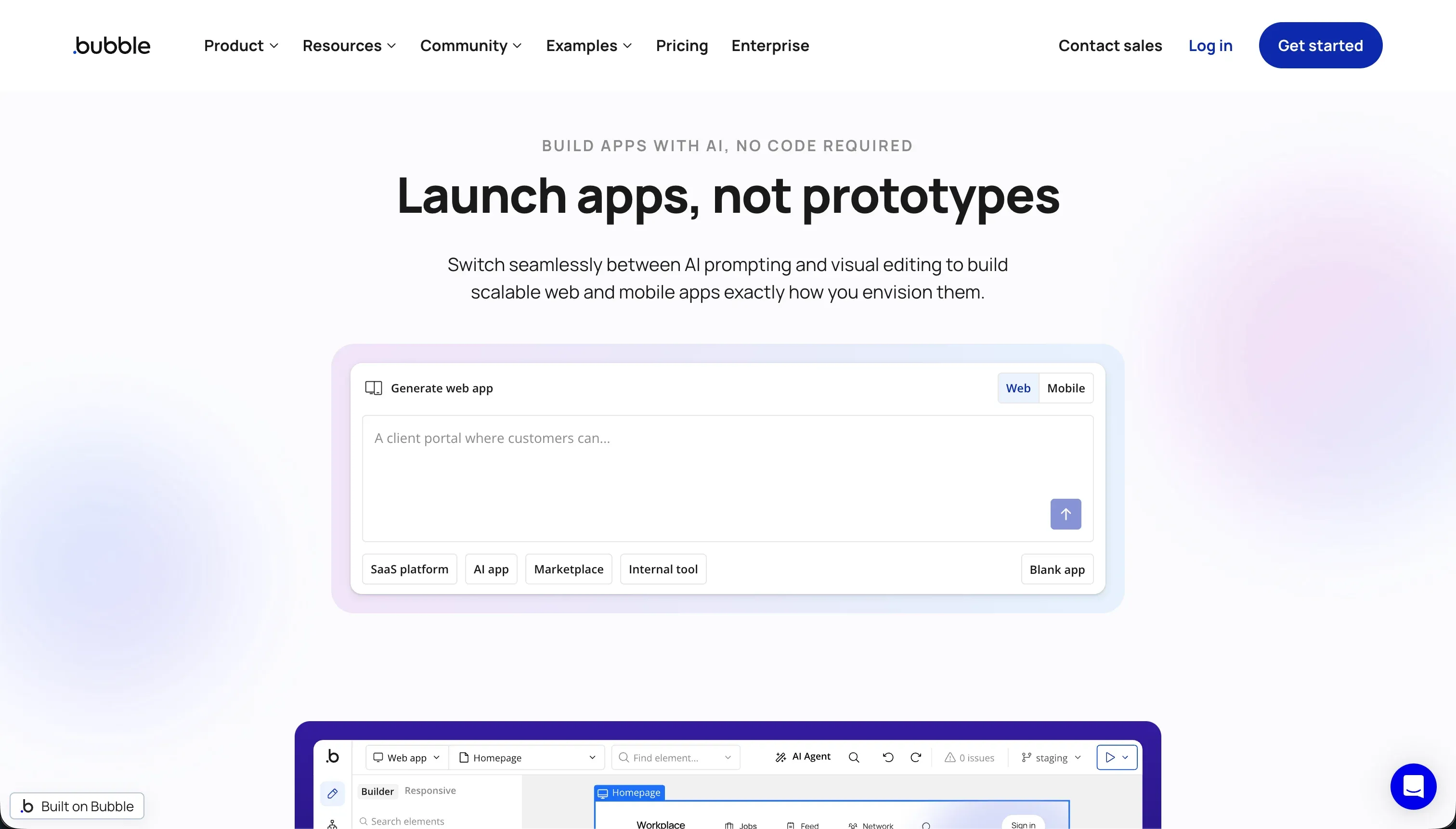

The procurement challenge here highlights two contrasting approaches to app creation: visual programming versus conversational AI scaffolding. Builders evaluating Bubble are looking at a mature visual full-stack editor with custom logic workflows, a built-in relational database, and an ecosystem of over 8,000 plugins.
Conversely, those shortlisting Emergent are buying into an AI-powered conversational platform designed to generate frontends, backends, databases, and hosting entirely from natural language prompts.
Bubble wins this decision with an aggregate score of 6.8/10 against Emergent’s 5.0/10. This outcome reflects the steep decline in predictability that occurs when moving from a configured no-code platform to a fully conversational code-generation system during production phases.
The choice only flips to Emergent if you prioritize speed to a first working skeleton and possess a low-risk environment where database container failures or debugging credit costs are minor concerns.
The decision in 30 seconds
| If your priority is… | Pick | Why |
|---|---|---|
| Rapid full-stack prototyping from one prompt | Emergent | Generates a working full-stack skeleton in minutes from a single prompt |
| Reliable data privacy and server-side logic | Bubble | Auth and server-side privacy rules are built in and proven at scale |
| Long-term maintainability without prompt loops | Bubble | Logic is visually edited directly meaning changes never face AI code regeneration errors |
| Finished mobile app experiences | Bubble | Bootstraps mobile configurations while Emergent’s mobile workouts remain unfinished |
| Client portals or internal operational tools | Neither | A platform with pre-built auth and flat pricing like Softr scores higher on these needs |
What each platform is
What is Bubble?
Bubble is a visual programming platform that abstracts away code development to run custom full-stack applications on its proprietary visual engine. Unlike tools that output readable code for export, Bubble compiles application interfaces, visual workflow logic, and managed database schemas into a closed runtime environment.
You build pixel by pixel in a custom visual editor, visually wire up conditional logical flows, and organize structured data in a built-on PostgreSQL database.
Key features include server-side privacy rules, an API Connector targeting REST services, and an extensive visual scheduling engine. Bubble is built for makers, startups, and operational teams willing to master a demanding, developer-equivalent framework in exchange for total visual and relational design control or custom marketplace logic.
What is Emergent?
Emergent is a conversational AI-driven development environment that turns single-prompt instructions into complete, functional application environments. Rather than requiring you to configure blocks or manage visual states manually, Emergent orchestrates an ‘edit agent’ to construct frontends, scaffold database routing, write backend schemas, and provision development containers on your behalf.
Key features include a browser revisions chat window, automated container hosting, and prompt-to-app schema scaffolding. Emergent is built for rapid software prototyping, non-technical founders seeking to validate a full-stack hypothesis over a weekend, and builders who prefer iterating on functional software conversational step by conversational step.
The core difference
The primary operational division between these two environments comes down to configuration versus conversational regeneration.
- Bubble requires the builder to configure and maintain every layout coordinate, database field, and logic chain manually in a dense visual environment.
- Emergent abstracts everything behind a conversational agent, generating and regenerating codebases within private cloud containers based on text prompts.
Where the scores diverge
Production readiness: Bubble 7.0, Emergent 3.5. Bubble takes a major lead scoring 7.0 against Emergent’s 3.5. Bubble offers native user authentication, server-side privacy rules, and a mature background scheduler that are proven at scale, though configuration is completely delegated to the builder. Emergent struggles in live scenarios.
Users report a gap where production code fails to match preview testing, alongside development container errors like ‘Error Waking Up Agent’. Furthermore, blocked backend access during deployment issues coupled with slow support lines presents notable long-term business risk.
Maintainability: Bubble 6.0, Emergent 3.5. Bubble scores 6.0 while Emergent drops to 3.5. Bubble logic lives in visual workflows that you manipulate directly, which ensures that updates are deterministic and never face code regeneration bugs. Deductions are due to complex apps accumulating workflow sprawl.
Emergent relies on an edit agent that fires on changes as small as two lines of code, and reviewers report falling into infinite debugging loops where the AI attempts to fix the same error five or more times. One user reported spending close to $10,000 AUD navigating these loops.
Data & integrations: Bubble 8.0, Emergent 5.5. Bubble scores 8.0, while Emergent scores 5.5. Bubble provides a robust, managed relational database with custom data types, an API Connector for any REST service, and a marketplace of over 8,000 plugins, only droping points for dependency risks on abandoned third-party integrations.
Emergent excels in generating database routing and full-stack wiring automatically under the hood, but reviewers report the system breaking down and code quality deteriorating once a codebase gets reasonably large.
Design flexibility: Bubble 8.5, Emergent 6.0. Bubble leads with an 8.5 against Emergent’s 6.0. Bubble’s pixel-level, drag-and-drop design editor supports absolute or responsive coordinate layout systems, rivaling specialized code-generation platforms in interface freedom.
Emergent produces standard custom web interfaces from prompts easily, but mobile app deployments are less mature and described by early builders as unfinished compared to the primary web browser experience.
Ease of build: Bubble 5.0, Emergent 7.0. Emergent leads here with a 7.0 score against Bubble’s 5.0. A single prompt on Emergent scaffolds a functional backend schema, database routing, and consumer interface in minutes, and changes run directly through an interactive revisions chat. On Bubble, the builder faces a steep learning curve.
Working out database design, workflow conditional logic, nested API keys, and privacy rules requires a significant time investment, with community reviewers describing a developer-like conceptual understanding as the baseline entry requirement.
Security & access control: Bubble 6.5, Emergent 4.5. Bubble scores 6.5, whereas Emergent scores 4.5. Bubble provides built-in server-side privacy rules and security frameworks, though a missed configuration fails silently. Trustpilot reviewers note that securing these rules requires deep understanding.
Emergent generates authentication details within its scaffolds, but permission logic is coded by the agent rather than configured visually. This, combined with reports of backend access being blocked during container failures, makes verifying security controls unreliable for a non-technical buyer.
Cost comparison
Bubble and Emergent utilize fundamentally different pricing models. Bubble operates on a subscription-and-compute framework, offering plans starting at $69/month (Starter) up to $649/month (Team), with prices scaling based on Workload Unit (WU) consumption. If your database queries or visual actions are unoptimized, your WU bills can spike unexpectedly.
Emergent is credit-based, offering plans starting at $20/month (billed annually) for 100 credits, climbing to $200/month for 750 credits. In this conversational engine, credits are consumed on every edit agent prompt and bug-fixing cycle.
Buyers must budget for hidden cost lines in both environments. For Bubble, this includes developer rates for debugging unoptimized workflows and purchasing essential third-party plugins. For Emergent, the financial drain occurs during debugging loops, where the AI consumes credits to fix errors it introduced.
Because credits do not roll over, repetitive changes can drain subscription and top-up allocations rapidly, with users reporting substantial credit consumption trying to fix regression bugs.
- Plans from $69 to $649 per month
- Scales with Workload Unit usage
- Unoptimized queries spike WU bills
- Plugin purchases add to cost
- Developer rates for debugging workflows
- Plans from $20 to $200 per month
- $20 tier billed annually, 100 credits
- Credits spent on every edit and bug fix
- Credits do not roll over
- Regression fixes drain credits fast
Lock-in and the exit path
Bubble enforces a strict proprietary lock-in. While you can export database rows as CSVs, you cannot export the application’s underlying code or runtime logic, making a total rewrite mandatory if you decide to leave the platform.
Emergent supports code sync to GitHub on paid plans, but builders report that the generated codebase requires extensive developer refactoring to run independently off their architecture. Bubble holds a slight advantage on data portability, but both platforms require substantial reconstruction to migrate completely.
Who should pick Bubble
Pick Bubble if:
- Builders looking to design complex SaaS databases with highly custom, multi-user relational configurations.
- Operations teams willing to invest weeks of learning to achieve deterministic control that does not rely on AI prompts.
- Marketplaces or applications with a multi-year road map that benefit from Bubble’s massive plugin ecosystem and proven scale.
Do not pick Bubble if you require an exportable codebase or a fully predictable, flat-rate monthly software bill.
Who should pick Emergent
Pick Emergent if:
- Founders needing a fast, full-stack prototype or MVP to show investors or early customers over a weekend.
- Non-technical builders who prefer interacting with software development through native conversational revisions.
- Product managers testing simple full-stack logic scenarios before allocating formal engineering resources.
Do not pick Emergent if you cannot afford credit consumption overages of several hundred dollars or need to run a stable, production-grade custom application.
What neither platform answers
Both tools assume your application requires uniquely custom logic or custom code generation. However, many business buyers reading this comparison are simply trying to build a client portal, a vendor portal, an internal tool, or an operational CRM. These applications are defined by secure logins, safe database connections, and granular user visibility rules rather than novel algorithms.
For this class of software, Bubble presents an unnecessarily steep visual learning curve, while Emergent introduces credit drain and buggy container deployments.
A dedicated portal platform like Softr scores 7.0+ on criteria like production readiness, maintainability, and security & access control because it composes pre-built visual blocks on top of a native, secure database, rather than asking you to generate code or master visual workflows.
If you need clean business operations instantly, pairing Softr with an Airtable or native database is a much safer procurement path.
Analyst verdict
Bubble wins this comparison with an aggregate score of 6.8 against Emergent’s 5.0. Bubble takes five of the six evaluation criteria: production readiness (7.0 vs 3.5), maintainability (6.0 vs 3.5), security & access control (6.5 vs 4.5), data & integrations (8.0 vs 5.5), and design flexibility (8.5 vs 6.0).
Emergent keeps its lead solely in ease of build (7.0 vs 5.0), illustrating the central tradeoff of modern code-generation engines: they are incredibly rapid at starting projects but highly fragile when maintaining them.
The decision only flips to Emergent if your project has a time horizon of weeks rather than years, and you require a quick, disposable frontend mock-up. For any application destined for live production usage with real user data, Bubble’s structured configuration is the only reliable choice between the two.
Related reading: the Bubble scorecard, the Emergent scorecard, and our scoring methodology.