
What Glide is
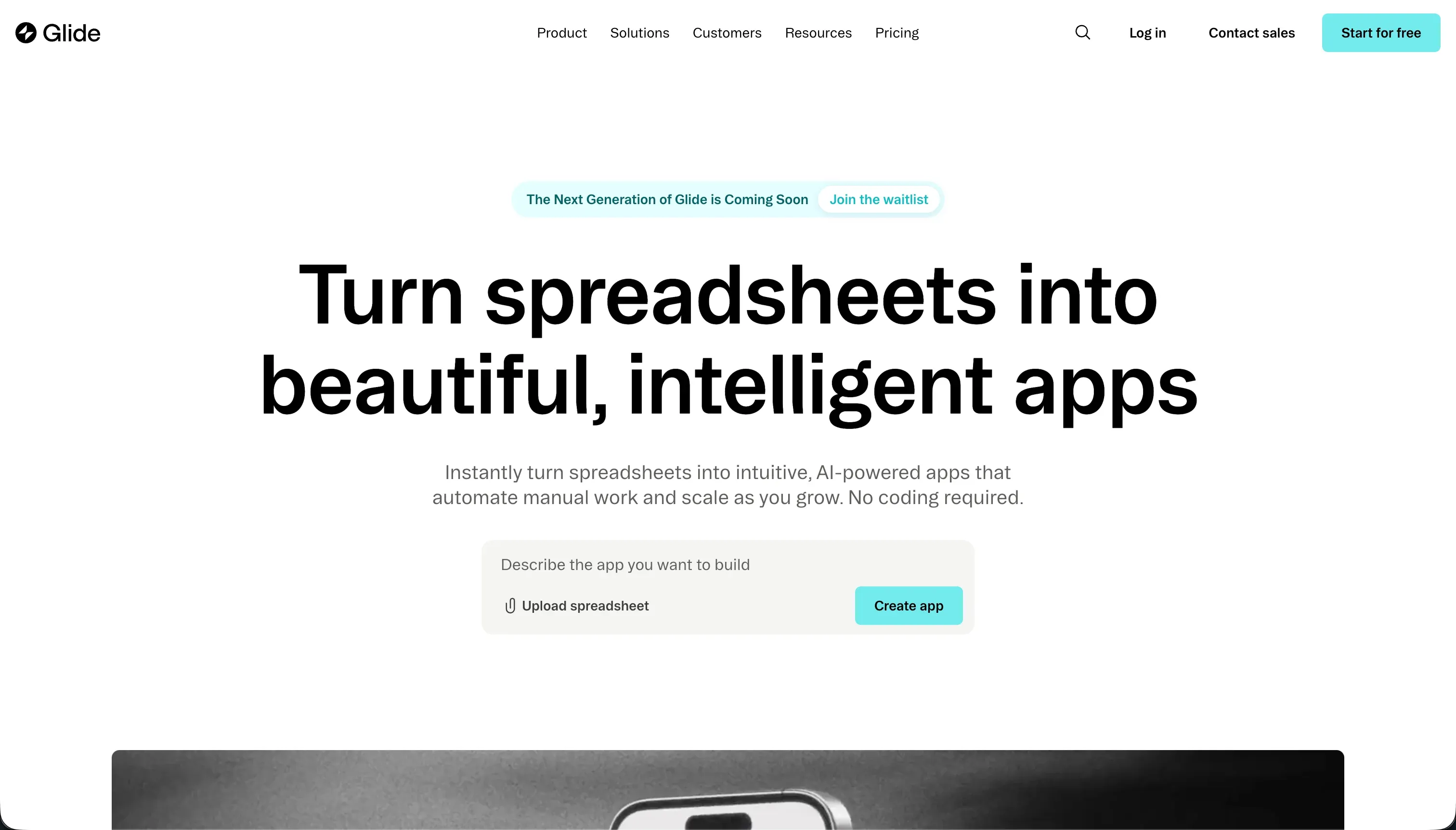
Glide is a visual development platform for turning spreadsheets and structured data into polished web and mobile apps. It began as a spreadsheet-to-app tool and is now commonly used by small businesses and operations teams to add interfaces on top of Google Sheets, Airtable, Excel, or Glide Tables without writing code.
Its build model is visual and schema-driven rather than fully freeform. Instead of designing from a blank canvas, you connect data and map it into pre-configured components like lists, forms, cards, and maps, which automatically adapt to the underlying columns. Glide also includes native database features such as AI-powered columns for tasks like translation and summarization.
The core tradeoff is speed and consistency over visual and workflow freedom. Glide’s opinionated layout system helps non-technical teams ship responsive apps quickly and safely, but it also limits branding control, advanced interface behavior, and more complex operational setups.
Where the scores come from
Glide’s scores show a platform with a strong front-loaded advantage: it is very fast to launch and easy to learn, but weaker when a project needs scale, governance, or deep customization limits become unavoidable.
Ease of build: 8.5/10
Ease of build scores 8.5/10 because Glide makes it unusually fast to turn an existing spreadsheet into a working app. Instead of starting from a blank UI and wiring everything manually, builders connect structured data and let Glide map columns into polished, mobile-responsive components that are easy for non-technical teams to understand.
The deduction comes from its opinionated build model. That same speed depends on accepting Glide’s predefined structures, so users can move quickly only as long as their app fits the patterns the platform already supports.
Production readiness: 6.5/10
Production readiness scores 6.5/10. Glide benefits from managed infrastructure and stable pre-built interface patterns, so teams do not need to provision servers or maintain front-end frameworks to get a live app running.
The deduction reflects reported sync and support gaps. Builders have noted occasional data-sync lag or service interruptions, and standard paid plans do not offer strong direct human support, which can be a real issue when a production workflow is blocked during business hours.
Maintainability: 6.5/10
Maintainability scores 6.5/10 because Glide apps are easy to update through the visual editor or the connected spreadsheet, which reduces code drift and keeps routine changes accessible to non-developers. For straightforward internal tools, that makes day-two edits relatively simple.
The deduction comes from vendor lock-in risk and plan volatility. Research notes that features can move to higher pricing tiers, and because there is no code export or local backup path, teams may have to absorb pricing or packaging changes to preserve existing app logic.
Security & access control: 5.5/10
Security & access control scores 5.5/10. Glide supports standard authentication and row-level visibility patterns that can work well for internal apps where a team needs basic access separation around operational data.
The score drops because of limited governance depth. More granular multi-tenant setups, sophisticated role models, and broader audit or enterprise control expectations are harder to implement cleanly, especially for external-facing apps with sensitive client data.
Data & integrations: 7.0/10
Data & integrations scores 7.0/10 because Glide is especially strong when the data already lives in spreadsheets or lightweight structured tables. It works well with Google Sheets, Airtable, Excel, and Glide Tables, and its native features such as AI columns in data make simple enrichment tasks easier inside the platform.
The deduction appears when teams outgrow that model. More advanced API work, relational database requirements, or complex external workflow integrations often require premium plans and added automation tooling, which reduces flexibility as systems become more sophisticated.
Design flexibility: 4.0/10
Design flexibility scores 4.0/10 and is Glide’s clearest weakness. The platform relies on pre-built layouts and structured component patterns, which helps apps look clean and responsive but limits precise control over spacing, composition, and custom interaction behavior.
The deduction is substantial because brand-level UI control is constrained. Advanced CSS access is restricted to higher tiers, and teams that need pixel-perfect interfaces or highly differentiated front-end design will usually find Glide too restrictive.
- Fast launch from a spreadsheet: 8.5 build
- Managed infra, no servers to run: 6.5
- Easy visual edits, low code drift: 6.5
- Strong fit for Sheets and Airtable: 7.0
- Clean pre-built layouts by default: 4.0
- Opinionated model, app must fit its patterns
- Sync lag and thin support on paid plans
- Lock-in: no code export or local backup
- Weak governance for sensitive external apps
- Advanced APIs and CSS need premium tiers
What types of apps you can build with Glide
Glide is strongest for apps that sit directly on top of structured business data and need to be useful quickly. It fits internal operations software especially well: inventory trackers, field service tools, team directories, approval flows, lightweight CRMs, scheduling systems, and other mobile-friendly workflows where the data already exists in spreadsheets or simple tables.
It is particularly effective for mobile operational apps. Field teams can log inspections, update asset status, submit forms, scan or review records, and work from clean phone-first interfaces, while office staff can use the same underlying system on desktop with little additional setup.
It also works well for smaller business portals and workflow apps such as booking tools, resource logs, sales support tools, and internal dashboards, especially when the main need is fast deployment rather than deep process engineering.
If business apps are central to your evaluation, Glide is generally better for spreadsheet-centric speed, while Softr is often a stronger fit for more scalable multi-user portals with more predictable permissions patterns.
Where Glide is less strong is in app classes that need dense relational logic, highly bespoke front ends, or complex external system orchestration. In those cases, its predefined interface system becomes a ceiling rather than an accelerator.
Who should not use Glide?
Do not use Glide if you are building a large external app with many active users and cost sensitivity, because its seat-based pricing model can become expensive as usage grows.
Do not use Glide if your product needs a highly customized interface, exact brand expression, or pixel-perfect responsive behavior, because the platform’s restricted layout system does not allow the same degree of visual control as more flexible tools.
Do not use Glide if your roadmap depends on deep relational databases, complex custom logic, or the ability to leave the platform later, since no code export path means you can hit structural limits and remain tied to Glide’s pricing and feature decisions.
Analyst verdict
With an average score of 6.3, Glide is best for small teams that want to launch internal tools or mobile operations apps quickly from spreadsheet-based data. Its standout advantage is fast spreadsheet-to-app delivery, making it a strong fit when speed, simplicity, and polished default UI matter more than deep customization.
It is a weaker choice for teams that need granular security, advanced design control, or long-term flexibility outside the platform. If those exclusions matter, review related options and our methodology overview before deciding, especially for external multi-user apps.