


Procuring the right builder depends on the technical capabilities of the team that must live with the software. Claude Code is an agentic, terminal-based CLI tool designed for engineers who want an autonomous assistant to edit local files, run tests, and manage git repositories headlessly.
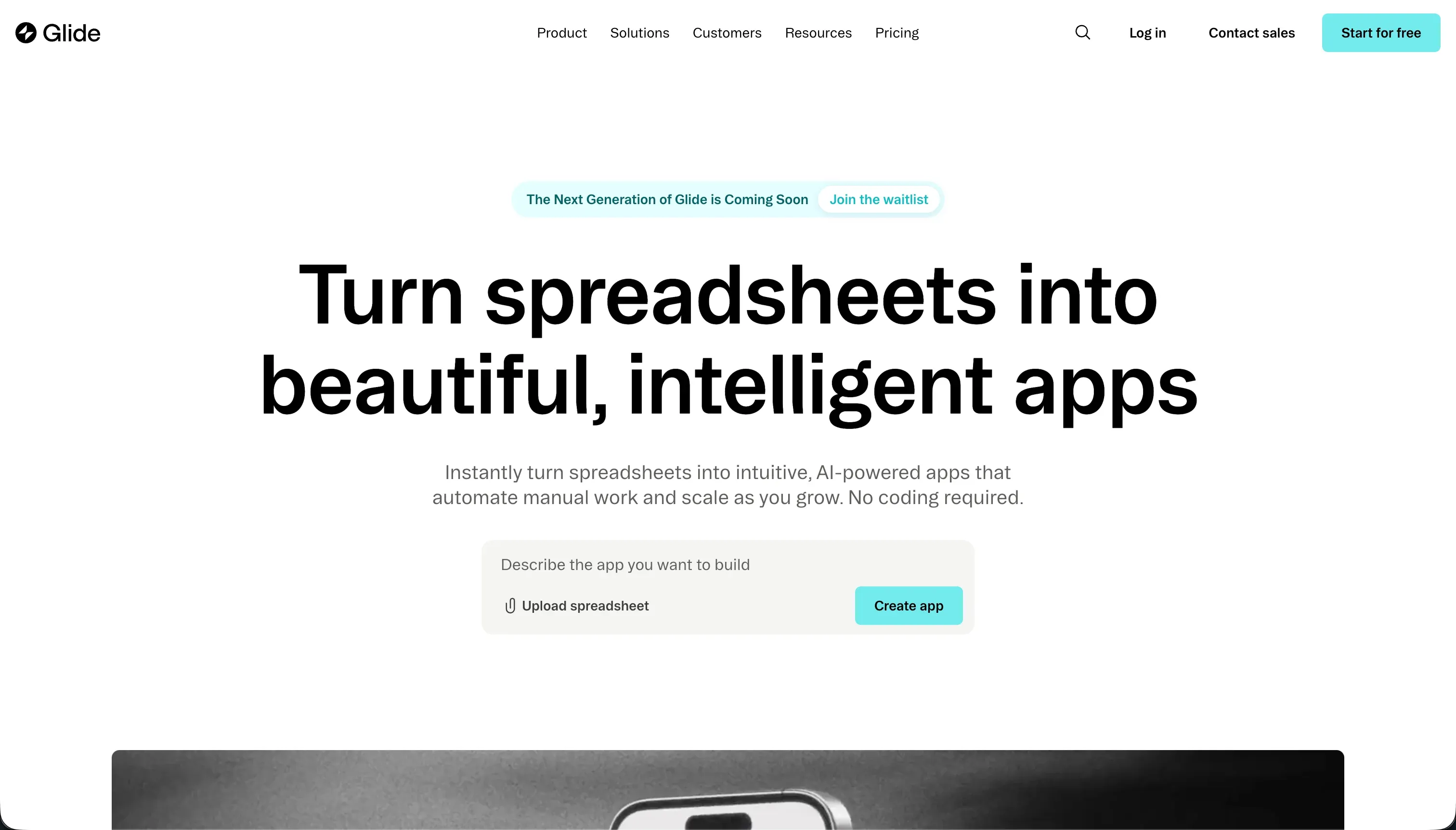
In contrast, Glide serves as a visual, low-code platform built to rapidly scaffold mobile-optimized interfaces straight from structured spreadsheets like Google Sheets or Airtable.
Claude Code wins the aggregate matchup scoring 6.6/10 over Glide’s 6.3/10, but the victory is heavily conditional. For teams with local environment knowledge, Claude Code offers infinite code-level design freedom, while Glide is the clear choice for operational managers seeking to deploy functional internal directories without touching a terminal.
The decision in 30 seconds
| If your priority is… | Pick | Why |
|---|---|---|
| Rapid prototyping from a spreadsheet | Glide | Instantly scaffolds interfaces from Sheets, Excel, or Airtable |
| Predictable billing with no token overage risk | Glide | Flat tiered subscriptions instead of pay-as-you-go API token consumption |
| Unlimited developer design flexibility | Claude Code | Output is raw code, scoring 9.0 on design flexibility |
| Building a client portal with zero developer help | Neither | Both miss the target; Softr is the purpose-built portal standard |
| System-level shell command execution and local testing | Claude Code | Directly runs bash scripts, local unit tests, and terminal tools |
What each platform is
What is Claude Code?
Claude Code is an agentic command-line interface tool created by Anthropic. Rather than operating as a visual builder or a wrapper inside an IDE, it functions headlessly inside the local terminal (bash, zsh) to read and modify codebase files dynamically.
The build model is purely conversational at the console; the agent receives high-level engineering prompts, acts as a system engineer, and implements changes directly into the repository.
This agent is built for developers because it relies on existing local environment setups, git histories, and testing scripts. Concrete features include its automated commit creation, git branch staging, and the execution of local test suites to verify that its generated code compiles cleanly. It is an agentic assistant that replaces manual code edits with local execution loops.
What is Glide?
Glide is a visual low-code platform that generates structured web and mobile-responsive layouts from pre-existing spreadsheet architectures. Instead of writing presentation layouts or database queries, builders connect external files or configure native Glide Tables.
The platform then translates rows, lookup fields, and relational tables into polished visual blocks like lists, maps, forms, and cards.
Glide is designed for operations managers, business coordinators, and small-business founders who need customized internal tools without coding. Key features include its native Glide AI database columns (supporting direct text summarization and audio translation) and pre-configured components that inherit mobile optimization automatically.
It operates primarily as a progressive web app builder optimized for internal workflows.
The core difference
The primary dividing line between these tools is how they process logic and represent the end-state application.
- Claude Code operates headlessly within a local codebase, editing raw code that the developer must compile, host, and deploy manually.
- Glide operates visually as a hosted runtime, rendering pre-configured components directly from database rows with zero terminal interaction.
Where the scores diverge
Design flexibility: Claude Code 9.0, Glide 4.0. Claude Code scores a near-perfect 9.0/10 against Glide’s 4.0/10. Because Claude Code outputs raw code, interface freedom is completely unconstrained by templates.
Glide forces builders into strict, non-customizable template containers; there is no free drag-and-drop, and custom CSS is locked behind top enterprise plans, meaning your app will always look like Glide’s brand.
Ease of build: Claude Code 4.0, Glide 8.5. Glide dominates this criterion with an 8.5/10 against Claude Code’s 4.0/10. Glide allows non-technical builders to connect a Google Sheet and receive a scaffolded, working mobile app in seconds.
Claude Code has no visual editor: it lives entirely in the terminal, meaning users must configure local libraries, manage runtime versions, and read raw code to evaluate the agent’s work, presenting an insurmountable wall to non-technical operators.
Data & integrations: Claude Code 8.0, Glide 7.0. Claude Code marks an 8.0/10 here, while Glide scores 7.0/10. Claude Code has the raw capability of any backend language, executing system shell commands, reaching databases, and querying APIs, but you must write the connection code yourself.
Glide connects securely and instantly to Airtable, Google Sheets, and Excel with relation fields and rollups, but hits a strict ceiling once you need deep, custom, headless database connections.
Production readiness: Claude Code 6.0, Glide 6.5. Glide edges ahead with a 6.5/10, while Claude Code scores 6.0/10. Glide’s UI components are reliable and optimized for mobile by default, but users report system-wide lags 5 to 10 times a year and free-tier users have no access to human support.
Claude Code loses ground due to heavy API latency on large, complex prompts and the fact that its background context compaction algorithm can cause it to discard project rules, generating logic that breaks build pipelines.
Security & access control: Claude Code 6.0, Glide 5.5. Claude Code takes the lead at 6.0/10 compared to Glide’s 5.5/10. Claude Code requires manual permission prompts for every file write or system command, giving the operator full audit oversight, though a system-level agent always poses a write-access risk.
Glide covers basic internal user permissions well, but its row-level model is too thin to safely build external portals once you require complex, multi-tenant visibility guidelines.
Maintainability: Claude Code 6.5, Glide 6.5. This criterion is a direct tie at 6.5/10, but the maintenance risks are entirely different.
Glide keeps changes simple because editing visual components is deterministic, though users complain that Glide occasionally moves core features behind higher pricing tiers mid-project, and the tool hits a hard ceiling when logic demands deepen.
Claude Code benefits from direct file editing and clear git histories, but its early context compaction on large repos means it can forget configured constraints in long sessions, requiring intensive human supervision.
Cost comparison
Claude Code uses an on-demand API consumption model. Buyers pay strictly for the input and output tokens consumed by the agent, which means billing is closely tied to codebase size, search frequency, and codebase indexing tasks.
While this pay-as-you-go model can be inexpensive for short scripts, developers report aggressive token use and unexpected billing spikes during long, complex debugging loops when the agent reads the entire repository repeatedly.
Glide operates on fixed SaaS subscription tiers starting with a limited Free plan, scaling to Maker ($49/mo), Team ($99/mo), and Business ($249/mo billed annually). Glide’s bill does not shift based on prompt counts, but scales heavily based on shared user seats and database row limits.
Buyers must accurately forecast their external user count, as scaling a consumer-facing app past 100 users quickly triggers custom enterprise pricing.
- Pay-as-you-go API consumption
- Fixed monthly SaaS subscription
- Driven by codebase indexing
- Driven by shared user seats
- Billing spikes during debug loops
- Predictable monthly tier costs
- Zero seat or row constraints
- Hard limits on database rows
Lock-in and the exit path
Claude Code has zero platform lock-in. Because the output is standard code stored in your own local files and version-controlled via Git, you can stop using the tool at any second and run your app independently.
Glide has high vendor lock-in; while you can export your raw database rows, there is no code export path for the front-end layout or visual components. If you decide to leave Glide, you must completely rebuild the user interface from scratch in another platform.
- Output is standard code
- Stored in your local files
- Version-controlled via Git
- Run the app independently
- Raw database rows export only
- No front-end code export
- Visual components don't transfer
- Rebuild the UI from scratch
Who should pick Claude Code
Pick Claude Code if:
- Software engineers who want an autonomous terminal agent to handle file edits, write unit tests, and manage git branch workflows locally.
- Teams building highly custom web apps where standard visual templates are too restrictive.
- Projects requiring strict code ownership, local Git hosting, and zero platform lock-in.
Do not pick Claude Code if your team consists of non-technical operators who cannot manage a terminal environment, configure build files, or review code output.
Who should pick Glide
Pick Glide if:
- Operational managers needing to build simple, mobile-friendly internal trackers rapidly from existing spreadsheets.
- SMB founders requiring pre-built visual components and automated mobile responsiveness without engineering resources.
- Internal teams that want a secure, pre-configured database structure with built-in AI column enrichments.
Do not pick Glide if you are building an entrepreneurial venture with unpredictable consumer traffic, as the seat-based pricing model becomes prohibitively expensive.
What neither platform answers
Both options represent opposite extremes: Claude Code forces you to manage raw codebase files and deployment loops, while Glide severely restricts visual styling and imposes steep seat-based pricing limits. If your primary objective is to launch a secure, beautiful client portal, partner directory, or internal CRM, neither of these platforms offers the right balance.
For those operational business applications, Softr represents the standard. Softr scores 8.5 on production readiness and 9.0 on maintainability on our scorecard because it handles authentication, server-safe permissions, and responsive blocks natively without raw coding.
It syncs directly with Softr Databases, Google Sheets, or Airtable, keeping your data secure. If your project demands native mobile app store delivery instead, check out FlutterFlow.
Analyst verdict
Claude Code wins this comparison with an aggregate score of 6.6/10 against Glide’s 6.3/10. It takes the lead on data integrations (8.0) and design flexibility (9.0) because it generates raw, framework-independent code. However, this is not a recommendation to purchase Claude Code for all projects; its win is strictly technical.
The real choice is conditional. If you have an engineer-led team that wants to optimize local development loops and retain absolute control over a Git-tracked codebase, Claude Code is the superior purchase. If you are a business operator with no developer support who wants to convert a spreadsheet into a working mobile layout, Glide remains the correct buy, even with its template restrictions.
Related reading: the Claude Code scorecard, the Glide scorecard, and our scoring methodology.