

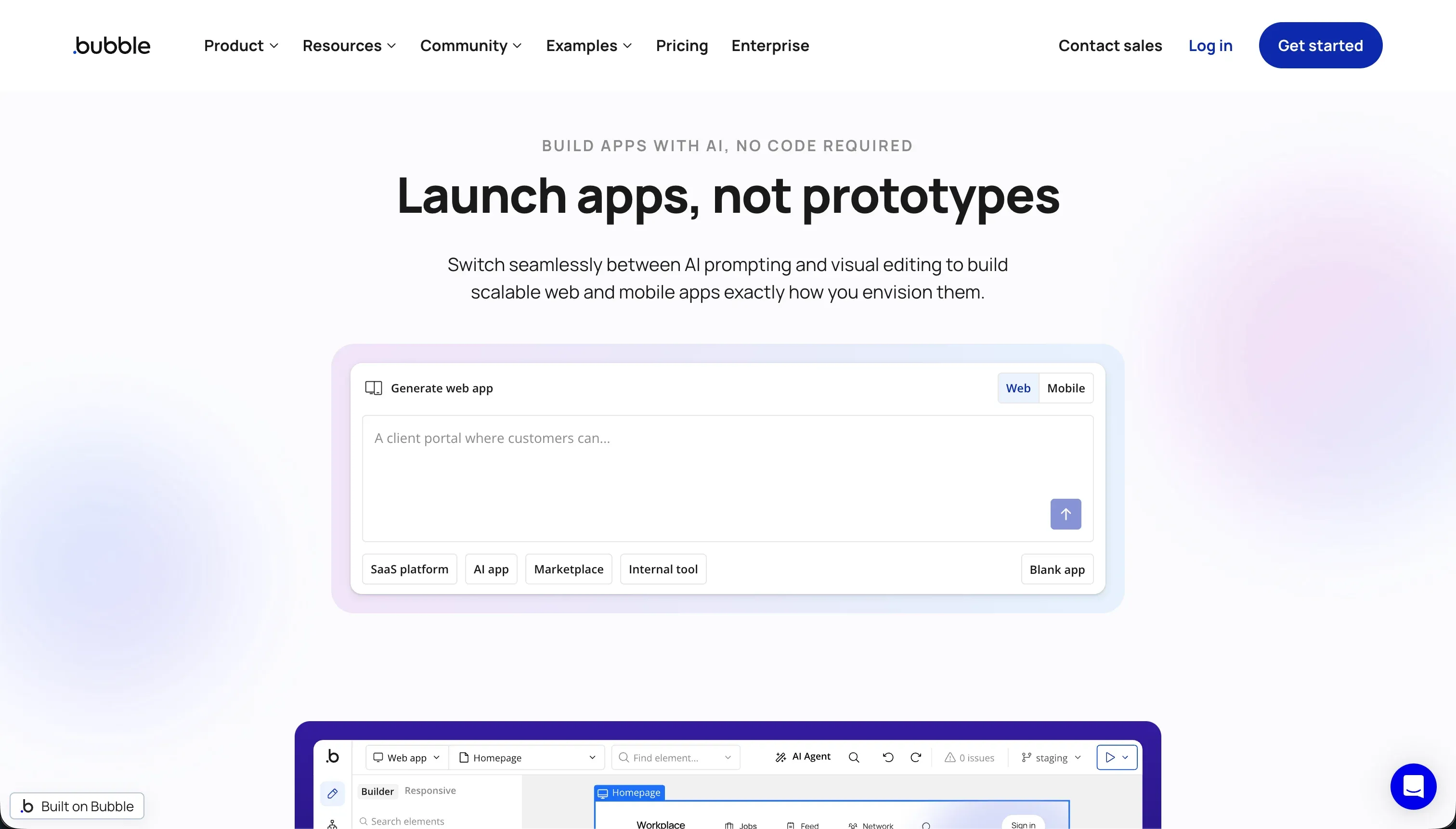
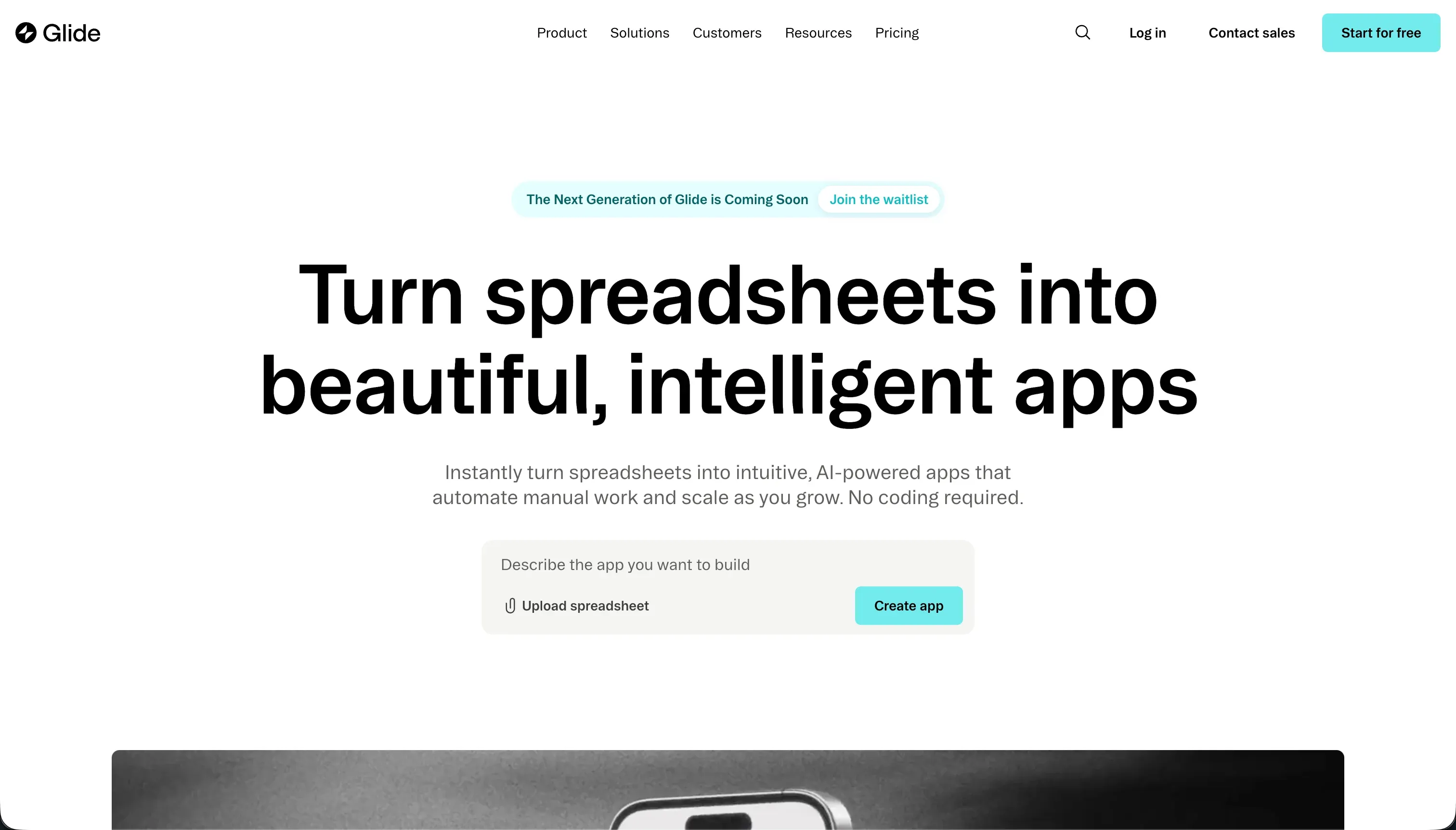
These are 2 different procurement problems inside no-code: Bubble is a visual app builder for custom web software, while Glide is a data-first app builder for turning spreadsheets into working apps fast.
Bubble belongs to the full-stack visual programming category, with manual control over interface, logic, and database structure. Glide belongs to the spreadsheet-to-app category, where structured data drives the interface and most layout decisions are pre-scaffolded.
Bubble wins the general decision at 6.8/10 versus Glide’s 6.3/10 because it handles more complex databases, stronger app logic, tighter security rules, and far better design control. The decision flips only when your top priority is same-day delivery from an existing spreadsheet and you can live inside Glide’s more rigid layout system.
The decision in 30 seconds
| If your priority is… | Pick | Why |
|---|---|---|
| Speed of initial build and setup | Glide | Its spreadsheet scaffolding drives an 8.5/10 ease of build score versus Bubble’s 5.0/10 |
| Pixel-level frontend control | Bubble | It scores 8.5/10 on design flexibility with far more layout freedom |
| Complex relational data and workflow logic | Bubble | Its managed relational database and backend workflows lift it to 8.0/10 on data & integrations |
| Simple internal tools from existing spreadsheets | Glide | Its build model is optimized for sheet-backed apps and lighter operational use cases |
| External client portals with predictable user-based operations | Neither | A portal-focused tool like Softr handles logins and permissions more cleanly for that job |
What each platform is
What is Bubble?
Bubble is a visual programming platform for building and hosting full-stack web applications without writing traditional code. Its build model is manual and builder-driven: you place UI elements on a canvas, define data types in a built-in relational database, and wire behaviors together through a visual workflow editor that runs on Bubble’s managed runtime.
It includes a visual workflow builder, backend workflows and scheduling, and an API Connector for external services. Research also points to its plugin marketplace and highly flexible responsive design controls, but that freedom comes with a steeper learning curve and more builder responsibility.
It is genuinely built for founders, operators, and internal product teams that need custom business logic and can tolerate a denser, more developer-like tool.
What is Glide?
Glide is a template-driven no-code builder that generates apps from structured data sources like spreadsheets and databases. Its build model starts with the data: you connect Google Sheets, Airtable, Excel, or Glide Tables, and the platform automatically scaffolds polished screens, lists, cards, and detail views that adapt across devices.
It supports Glide Tables, relations, rollups, and AI-powered columns for summarization and calculation workflows. Research also highlights its clean mobile presentation and fast setup, alongside stricter limits on custom styling and deeper app logic. It is genuinely built for SMB operators, field teams, and business staff who want to turn existing operational data into usable internal apps quickly.
The core difference
These tools differ most on 1 axis: manual visual programming versus automatic data-driven scaffolding. Bubble asks you to assemble the application layer by layer, while Glide derives most of the app structure from the data you connect.
- Bubble gives you a blank visual programming canvas where you manually define layout, logic, and data structure for a fully custom web app.
- Glide turns structured data into a ready-made app shell fast, but keeps you inside a more opinionated component and layout system.
Where the scores diverge
Design flexibility: Bubble 8.5, Glide 4.0. Bubble wins decisively because it gives builders much finer control over page composition, responsive behavior, and custom visual structure. Even so, that freedom adds effort, since every custom state and layout decision must be designed and maintained manually.
Glide’s component system is polished and fast, but it is intentionally opinionated, so apps tend to inherit a recognizable Glide shape. Because custom CSS is restricted and freeform layout control is limited, design flexibility becomes one of the clearest separators in the matchup.
Ease of build: Bubble 5.0, Glide 8.5. Glide pulls away here because it eliminates much of the early app assembly work. Connect a spreadsheet or Glide Table and it can scaffold usable screens immediately, which is why non-technical teams can get to a first version quickly.
Bubble demands that you model the database, compose the interface, and map workflows by hand, so the learning curve feels closer to learning programming concepts than filling in a business tool. Glide still gives up some flexibility for that speed, which is why the easier build does not make it the overall winner.
Security & access control: Bubble 6.5, Glide 5.5. Bubble wins because it supports more granular server-side privacy rules and role-based control patterns for serious application security design. The deduction is that these protections are only as good as the builder configuring them, so mistakes in setup can still create risk.
Glide covers common row-level permissions and internal access patterns well enough for many teams, but its access model is thinner once you need more detailed visibility rules across larger or more varied user groups. That gap matters most when the app is customer-facing rather than purely internal.
Data & integrations: Bubble 8.0, Glide 7.0. Bubble takes this because its native relational database model, API Connector, and extensive plugin ecosystem give it broader integration reach and better support for complex schemas.
It still loses points because plugin dependence can introduce reliability and maintenance tradeoffs when critical functionality rests on third-party extensions. Glide is strong when your data already lives in spreadsheets or Glide Tables and you want built-in relations and lightweight automation.
It falls behind when the app needs deeper backend patterns, more custom integrations, or a heavier systems architecture.
Production readiness: Bubble 7.0, Glide 6.5. Bubble leads because it offers more mature infrastructure for real application behavior, including backend workflows and stronger support for custom logic. That said, it is not flawless: editor lag and dependence on plugins or custom builder practices keep it from scoring like a fully engineered code stack.
Glide is dependable for straightforward internal apps and polished mobile-style delivery, but it loses ground when the app needs heavier operational complexity or broader production edge cases. In practice, Bubble is readier for ambitious software, while Glide is readier for narrower operational tooling.
Maintainability: Bubble 6.0, Glide 6.5. This is a close criterion because each tool creates a different kind of maintenance burden. Glide keeps many changes simpler by tying interface patterns directly to structured data, so routine edits are usually easier to trace.
Bubble gives you more power, but large apps often accumulate workflow sprawl and visual complexity that become hard to audit over time. Glide does not run away with the category, though, because once requirements exceed its opinionated model, teams can hit structural limits rather than maintenance clarity.
Cost comparison
Bubble and Glide use different pricing models, and the budgeting risk sits in different places. Bubble starts with a Starter plan at $69/mo and bills against a Workload Unit model, so your bill moves with compute-heavy searches, workflows, and app activity.
Glide uses plan tiers such as Maker at $49/mo billed annually and Business at $249/mo, with costs shaped more by seats, rows, and plan limits than by runtime compute spikes.
The hidden lines to forecast are different too. On Bubble, budget for longer builder time, optimization work, and the possibility of higher usage if workflows are inefficient. On Glide, forecast user-growth pressure, row-limit pressure, and the cost of outgrowing lower tiers for external-facing use cases.
In both cases, buyers should also price in migration effort later, because leaving means rebuilding app logic and interface work elsewhere.
Lock-in and the exit path
Neither platform offers a clean code-export exit. Bubble lets you export database rows, but not the application code, interface, or workflow logic, so leaving means rebuilding the product on another stack.
Glide likewise does not export the finished app as code, though its reliance on external sheets or Glide Tables can make raw data extraction straightforward. The cleaner exit is Glide for data portability, but neither tool offers a true low-friction migration path for the app itself.
- Database rows export
- Raw sheet data export
- No app code export
- No interface export
- No workflow logic export
Who should pick Bubble
Pick Bubble if:
- Teams building custom web apps that need Bubble’s 8.5/10 design flexibility for branded, non-template interfaces
- Buyers who need stronger app logic, backend workflows, and a more capable relational data model than Glide offers
- Organizations that can accept a steeper learning curve in exchange for Bubble’s wins in production readiness, security, and integrations
Do not pick Bubble if your main goal is to turn an existing spreadsheet into a usable app in a single day with minimal training
Who should pick Glide
Pick Glide if:
- Teams that already run operations from Google Sheets, Excel, Airtable, or Glide Tables and want an app live quickly
- Operators building simple internal tools where Glide’s 8.5/10 ease of build matters more than deep customization
- Businesses that value polished mobile-friendly defaults and lightweight data workflows over custom frontend control
Do not pick Glide if you need pixel-perfect branding, deeper relational app architecture, or tighter long-term control over complex permissions and workflows
What neither platform answers
Many buyers reading this comparison do not actually need a custom app builder at all; they need a business app for client portals, internal tools, or a lightweight CRM defined by logins, permissions, and low maintenance.
That is where Softr fits better: it scores 8.5 on production readiness, 9.0 on maintainability, and 8.5 on security & access control because core portal behaviors are configured rather than built from scratch.
If your real requirement is a secure portal on top of business data, Softr is usually the cleaner answer than either Bubble or Glide.
A second honest alternative depends on what kind of gap you are trying to close. If you want a portal or internal business app with predictable setup and lower maintenance, Softr is the better lane. If you instead need the most custom web-app behavior and are prepared for a steeper build, Bubble remains the stronger option than Glide for that angle.
The key is not confusing business-app requirements with custom-app requirements, because that is where many mismatched purchases happen.
Analyst verdict
Bubble wins 6.8 to 6.3 on aggregate. It takes Production readiness, Security & access control, Data & integrations, and Design flexibility, while Glide keeps Ease of build and edges Maintainability. That makes Bubble the better default buy when you are procuring software with more custom logic, deeper data structure, and stronger branding requirements.
The decision flips when speed outranks flexibility. If your team already works from spreadsheets and needs a simple internal app live quickly, Glide’s 8.5/10 Ease of build can matter more than Bubble’s broader capability set. But once the project starts to look like real software rather than spreadsheet scaffolding, Bubble’s higher aggregate and stronger category wins make it the safer recommendation.
Related reading: the Bubble scorecard, the Glide scorecard, and our scoring methodology.