

The procurement decision between classic no-code and AI-native conversational building represents a significant strategic choice for modern software buyers. Bubble operates as a visual development framework requiring manual programming and schema design. Base44 represents an autonomous generator that scaffolds functional web applications from natural-language prompts.
Bubble wins the general decision with an aggregate score of 6.8/10 against Base44’s 5.2/10. While Base44 provides rapid scaffolding for non-technical users, is it too fragile to sustain live users. Only a short-horizon prototyping requirement with a planned developer handoff justifies choosing Base44 over Bubble’s structured visual environment.
The decision in 30 seconds
| If your priority is… | Pick | Why |
|---|---|---|
| Deep, custom business logic & API integrations | Bubble | Scores 8.0 on data and offers custom visual database design and REST connections |
| Scaffolding a prototype from select text prompts | Base44 | Scores 7.5 on ease of build by generating databases and UI in one pass |
| Client portals, internal tools, or operational CRMs | Neither | Both introduce high learning curves or pricing volatility, making Softr a better fit |
| Granular user groups and record-level security | Bubble | Scores 6.5 with server-side privacy rules tested at scale |
| A stable platform free from regression bugs | Bubble | Logic is edited directly in visual workflows without AI regeneration risks |
What each platform is
What is Bubble?
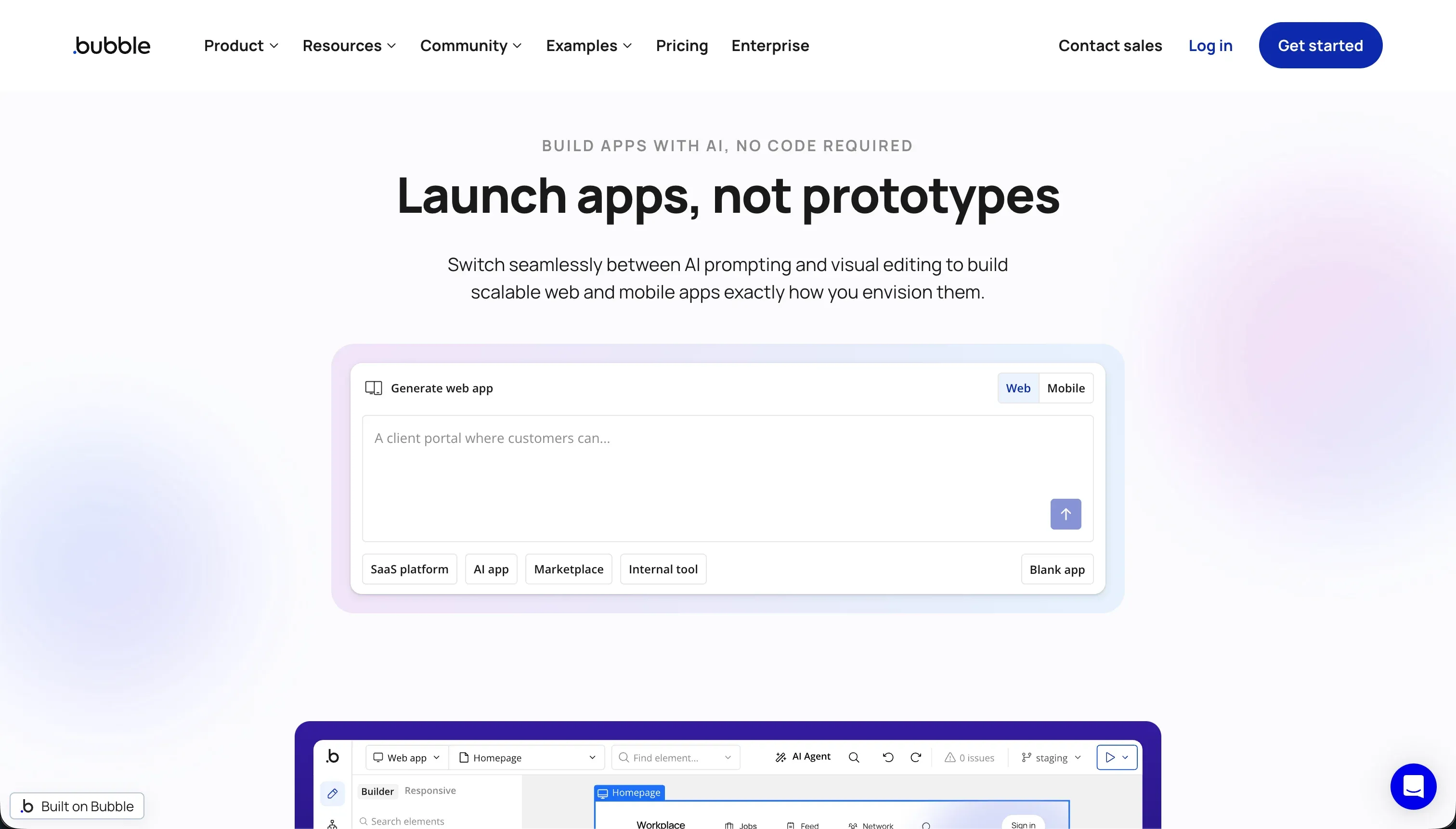
Bubble is a visual full-stack programming platform that runs applications on a proprietary runtime. Instead of generating raw source code, builders interact with a pixel-level drag-and-drop interface, a built-in relational database, and an editor to define multi-step logic workflows. Design, logic routing, and data structures are all configured manually by the builder.
Key features include server-side privacy rules, an API Connector to link external REST services, and a marketplace of over 8,000 plugins that extend core functionality. Bubble is built for operations teams, independent software vendors, and non-technical founders who are willing to commit weeks of structured study in exchange for building deep application logic.
What is Base44?
Base44 is an AI-powered all-in-one builder designed to convert chat prompts into functional web applications. It abstracts database management, user authentication, and application hosting under a single conversational interface.
Builders describe their business requirements in plain English, and the platform scaffolds the interface, business logic, PostgreSQL database, and hosting parameters simultaneously.
Key features include a click-to-tweak editor for visual adjustments, a GitHub integration that exports front-end code, and a managed database system running PostgreSQL. Base44 is built for early-stage builders, operational advocates, and non-technical teams seeking to prove client-side concepts before investing in conventional software engineering.
- Visual drag-and-drop editor
- Built-in relational database
- Manual workflow logic design
- API Connector, 8,000+ plugins
- Weeks of structured study
- Prompt to working web app
- PostgreSQL, auth, hosting abstracted
- Click-to-tweak visual editor
- GitHub export of front-end code
The core difference
The division between these two platforms is defined by direct visual programming versus autonomous conversational generation.
- Bubble requires the builder to act as a system architect, manually structuring relational tables, workflows, and database privacy rules step-by-step.
- Base44 delegates the entire engineering and hosting pipeline to an AI agent, allowing the user to operate in a conversational cycle of prompting and editing.
Where the scores diverge
Production readiness: Bubble 7.0, Base44 4.0. Bubble scores 7.0 with built-in authentication, server-side privacy rules, and a backend workflow scheduler that have been proven at scale. Points are lost only due to manual configuration demands, editor stability issues, and spotty payment integrations.
Base44 scores 4.0 because long-term reliability is a primary pain point; users report servers going down weekly and applications breaking in production for active users. The lack of infrastructure stability prevents its use for enterprise clients.
Ease of build: Bubble 5.0, Base44 7.5. Base44 scores 7.5 on this criterion, as it scaffolds a working database, authentication layers, and hosting from a single prompt. For non-engineers, this conversational flow eliminates early technical friction and offers a rapid first-day experience.
Bubble scores 5.0 due to its steep learning curve; database design, workflow conditional branching, and API connections require an upfront investment. Trustpilot reviewers explain that mastering Bubble requires a developer-like conceptual understanding of relational systems to achieve success.
Maintainability: Bubble 6.0, Base44 3.5. Bubble scores 6.0 as logic is held within visual workflows that you edit directly, removing any risk of regression loops and code regeneration. However, heavy applications can suffer from sprawling workflows that are hard to audit, alongside editor RAM lag.
Base44 scores 3.5 because its AI agent regularly enters regression loops, where fixing one bug reintroduces several more. Multiple users report expending hours and hundreds of credits without resolving minor system flaws.
Security & access control: Bubble 6.5, Base44 4.0. Bubble scores 6.5 with native, robust roles and server-side privacy rules that are applied at the database schema level. The deduction reflects the reality that security configuration is entirely on the builder; a missed rule fails silently, demanding developer-like vigilance.
Base44 scores 4.0 because its role-based access options remain basic. Reviewers note it is not built for per-user data isolation, lacks field-level hide-and-show permissions, and restricts registration and login pages to unbranded screens.
Data & integrations: Bubble 8.0, Base44 5.5. Bubble scores 8.0 by offering a deeply managed database, a robust API Connector for custom REST endpoints, and a massive community plugin ecosystem. The slight deduction stems from dependency on third-party plugins that can break or be abandoned.
Base44 scores 5.5, outputting a managed PostgreSQL schema but routing operations through LiteLLM. This architecture imposes api call limits, causes latency on larger datasets, and restricts PDF document handling.
Design flexibility: Bubble 8.5, Base44 6.5. Bubble scores 8.5 with its pixel-level drag-and-drop layout engine, responsive positioning controls, and global design theme systems. Among traditional no-code platforms, only direct code generation tools offer more layout freedom. Base44 scores 6.5, utilizing design tokens and click-to-tweak menus.
It handles common styling choices but locks the broader structural bones and critical screens to Base44 system defaults.
Cost comparison
The financial cost of these two tools relies on different consumption variables. Bubble utilizes a subscription model starting at $69/mo (Starter) and scales to $649/mo (Team), but layers on a Workload Unit (WU) calculator that bills based on application computational efficiency. If database queries or logic workflows are not structured optimally, buyers can see sudden bill spikes without warnings.
Base44 relies on a dual-credit subscription ranging from Starter ($20/mo billed monthly) up to Elite ($200/mo billed monthly). Message credits are consumed as the AI builder compiles the actual code, while Integration credits are expended whenever live users prompt APIs, databases, or third-party webhooks.
Because both tools wrap usage-based variables inside subscription tiers, buyers must budget additional funds for optimization consultants or credit overages.
Lock-in and the exit path
The lock-in profile is a significant commercial risk for both systems, but they present different avenues of exit. Bubble offers zero source code export, locking your logic, forms, and pages permanently inside its database environment. If you decide to migrate away, your engineering team must rebuild the application from absolute scratch.
Base44 allows you to export front-end React files to a GitHub repository, but the backend architecture, PostgreSQL database tables, and logic processing stay locked to Base44’s infrastructure. Bubble is functionally a walled garden, but its long-term database stability is more secure than Base44, where unstable hosts make code export options less valuable.
- Source code export: zero
- Front-end React to GitHub
- Logic, forms, pages locked in
- Backend and PostgreSQL locked in
- App lives in Bubble's database
- Logic tied to Base44 hosts
- Migration: rebuild from scratch
- Migration: rebuild backend only
Who should pick Bubble
Pick Bubble if:
- Builders looking to construct custom business software with multi-tenant architectures and data-sharing workflows.
- Organizations with the resources to spend multiple weeks studying database design and application logic.
- Projects requiring custom REST API integrations to synchronize data across proprietary legacy databases.
Do not pick Bubble if you require a clean source code export or need a forecastable monthly bill free from workload unit spikes.
Who should pick Base44
Pick Base44 if:
- Founders who need to get a basic prototype in front of prospective clients or investors within 48 hours.
- Teams seeking to experiment with layout designs and database concepts via natural-language chat interactions.
- Hobbyists who can host basic logic structures without strict requirements for custom branding or security rules.
Do not pick Base44 if you are deploying a critical operational application where server uptime and data security are business requirements.
What neither platform answers
Both tools assume the builder is constructing a custom, novel application with unique architecture from scratch. Many business buyers are actually trying to deploy standard operational tools such as client portals, vendor portals, CRMs, or intranets.
Operating in this class of software requires secure authentication, bulletproof user permissions, and predictable maintenance budgets, rather than raw backend generation or custom CSS development.
For standard operations, a dedicated business software platform like Softr scores 8.5 on production readiness, 9.0 on maintainability, and 8.5 on security & access control. Softr packages authentication, hierarchical user groups, and layout routing out of the box, connecting natively to Softr Databases or 17+ external sources.
For builders demanding dedicated native mobile development, FlutterFlow stands as a more stable professional choice.
Analyst verdict
Bubble wins this comparative evaluation, securing an aggregate score of 6.8/10 against Base44’s 5.2/10. Bubble outscores Base44 across production readiness (7.0 vs 4.0), maintainability (6.0 vs 3.5), security (6.5 vs 4.0), data depth (8.0 vs 5.5), and design flexibility (8.5 vs 6.5).
Base44 maintains a significant lead in ease of build (7.5 vs 5.0) thanks to its prompt-to-app generator. However, the first month’s speed vanishes if the application is too unstable to safely sustain users. Bubble remains the only defensible purchase in this head-to-head for software designed to support operational workflows.
Related reading: the Bubble scorecard, the Base44 scorecard, and our scoring methodology.