

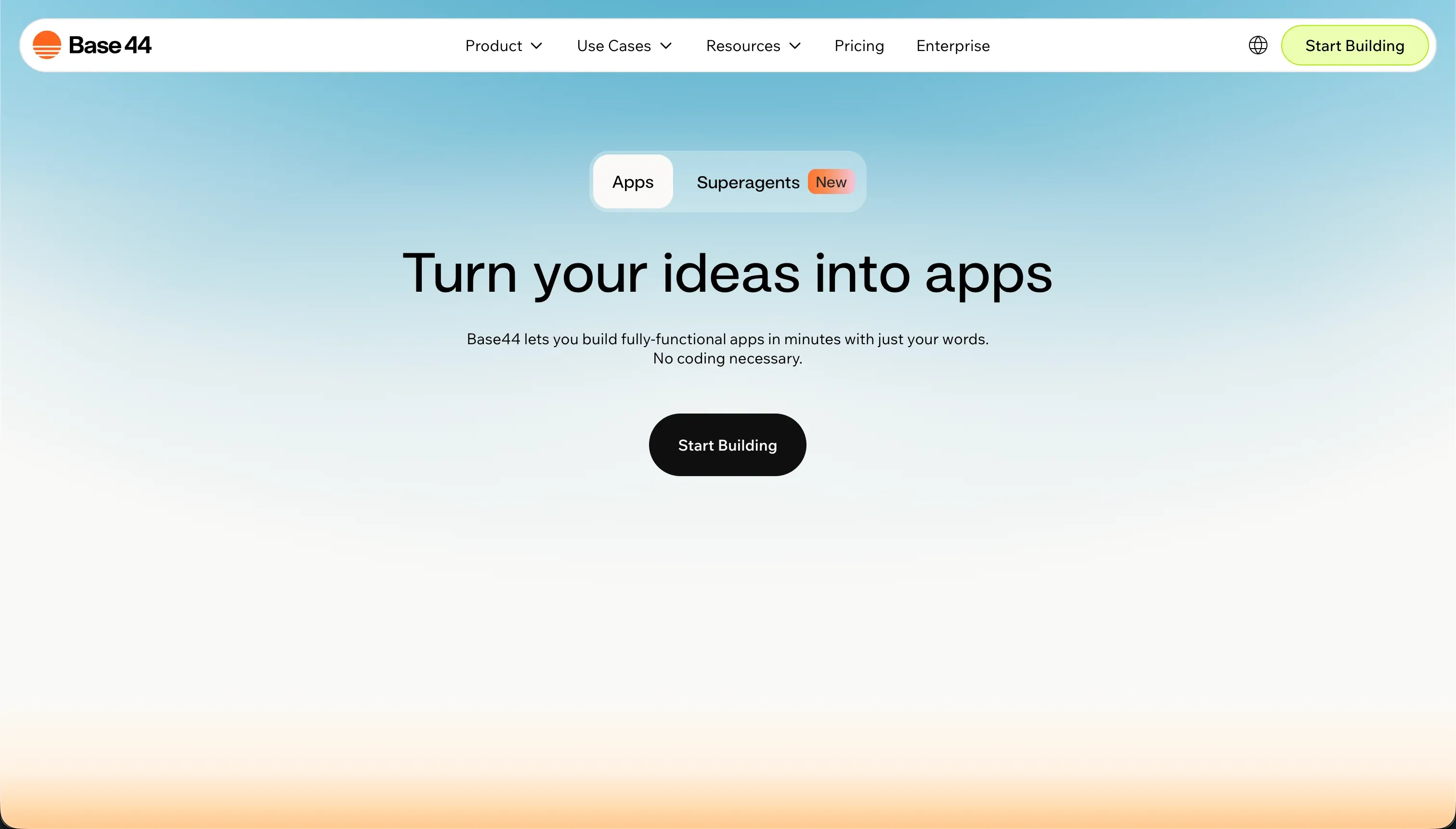
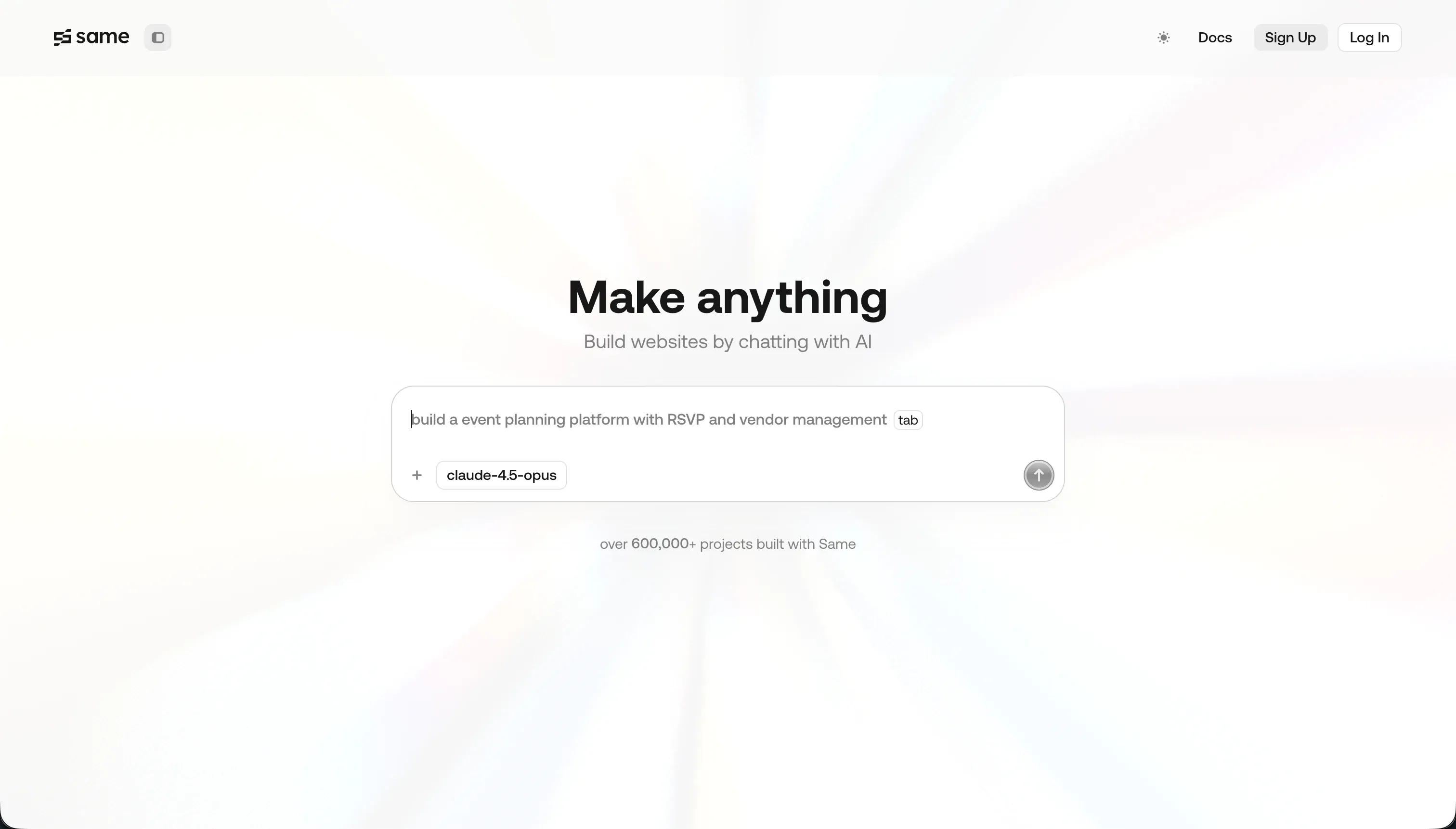
Choosing between Base44 and Same.new represents a choice between two distinct branches of conversational AI building. Base44 is an all-in-one conversational no-code platform that attempts to scaffold a full-stack PostgreSQL database, user authentication, and frontend in one pass.
Same.new is a frontend-centric visual cloning tool designed to convert any live website URL into stylized React code before modifying layout structures via textual prompts.
While Base44 scores higher with an aggregate of 5.2/10 compared to Same.new at 4.1/10, this is a head-to-head scorecard of high-fragility tools.
For a buyer with a strict deadline or a production workload, a third route like Replit is the more realistic investment because neither tool compared here can survive standard product evolution without severe regressions. The score discrepancies are clear, and they start on day two.
The decision in 30 seconds
| If your priority is… | Pick | Why |
|---|---|---|
| Fast visual layout cloning from a URL | Same.new | replicates live typography and Tailwind layouts natively |
| Out-of-the-box user authentication and DB | Base44 | scaffolds a managed PostgreSQL database from a single prompt |
| Clean front-end code export to GitHub | Base44 | ships with native GitHub synchronization on its Builder tier |
| A production-grade app with user permissions | Neither | both exhibit fragile access controls and structural instabilities |
| Complex interactive nested React states | Neither | both struggle with nested grids and require developer cleanup |
What each platform is
What is Base44?
Base44 is an AI-native workspace designed to generate full-stack web applications entirely from conversational prompts. Users describe what they need, and the platform automatically configures a user interface, registers a clean database schema, prepares a basic authentication flow, and assigns hosting.
Changes can be iterated using either a chat interface or a post-generation click-to-tweak editor.
Under the hood, the system is designed to provide immediate digital scaffolding for founders, builders, and operational teams spinning up internal MVPs. Its dual-credit infrastructure charges buyers for builder message inputs as well as integration executions (API calls, database queries, and email transmissions) generated by active users. It targets rapid layout generation with immediate host deployment.
What is Same.new?
Same.new, previously known as Same.dev and historically aligned with create.xyz, operates primarily as a frontend layout replicator. A buyer pastes a target website URL into the system, and the AI constructs a styled copy of the page using React and Tailwind CSS.
Once generated, modifications are done by instructing the AI assistant to reorder blocks, change design configurations, or swap fonts.
Rather than serving as an application suite, Same.new is explicitly a prototyping utility. It compiles the visual aspects of a landing page or UI draft into exportable source code. Because it contains no built-in database layer, user management, or server logic, it is built exclusively for UX designers and front-end developers who need a conceptual draft that they will later port to their own hosted stack.
The core difference
The primary axis of divergence between these two systems resides in full-stack compilation versus purely visual template replication.
- Base44 is designed to orchestrate database configurations, user permissions, and deployment environments simultaneously to deliver a functioning app from scratch.
- Same.new acts as a visual copier that renders React markup based on pre-existing web pages, leaving all backend logic to be hand-coded elsewhere.
Where the scores diverge
Ease of build: Base44 7.5, Same.new 5.0. Base44 wins this category with a score of 7.5/10, providing an incredibly fast path to a functional prototype because it sets up the database, authentication, and hosting out of the box from a single text prompt.
Same.new scores 5.0/10; while pasting a URL generates a visually styled prototype in seconds, configuring any actual user interactions or nested grids requires tedious prompt iteration and developer intervention to clean up complex React states.
Data & integrations: Base44 5.5, Same.new 4.0. Base44 earns a 5.5/10 because it provisions a managed PostgreSQL database automatically, though its Reliance on a LiteLLM translator layer enforces API limits and introduces performance bottlenecks on PDF ingestion or massive datasets.
Same.new scores 4.0/10, lacking any built-in database engines or native connectors to business apps, serving strictly as a frontend code exporter.
Production readiness: Base44 4.0, Same.new 3.0. Base44 scores 4.0/10, limited by severe hosting and system instabilities, with users reporting instances of workspaces and databases going down roughly once a week and breaking live deployments.
Same.new scores a lower 3.0/10 because it is entirely front-end and has no backend, and users have faced billing issues and broken, read-only projects during its transition from Same.dev.
Security & access control: Base44 4.0, Same.new 3.0. Base44 scores 4.0/10, offering built-in user logins out of the box, yet it remains hindered by basic role permissions, default login screen branding that cannot be altered, and a database structure not built for safe coordinate per-user data isolation.
Same.new scores a flat 3.0/10, offering zero native authentication, forcing buyers to code, secure, and manage any potential row-level permissions elsewhere.
Maintainability: Base44 3.5, Same.new 3.0. Base44 scores 3.5/10 due to editing agents that frequently trigger bug regression loops, draining user credits as they fix one issue only to introduce several more.
Same.new experiences similar failures, scoring 3.0/10 because simple reordering prompts have historically wiped 1500+ lines of valid code, and the tool’s duplicate or fork commands routinely crash on large application files.
Design flexibility: Base44 6.5, Same.new 6.5. This category is a tie at 6.5/10. Same.new clones existing websites excellently, yet struggles to reproduce nested grid layouts or complex visual logic. Base44 relies on design tokens and a click-to-tweak preview editor for aesthetic adjustments, but forces authentication pages and general application flow layouts to remain bound to strict platform presets.
Cost comparison
Base44 charges on a dual-credit structure, offering a Free option before starting at $16/mo (billed annually) for its Starter plan, rising to $40/mo for its Builder, and $80/mo for its Pro tier.
Buyers must monitor message credits, which scale from 100 to 500 per month, alongside integration credits that are consumed programmatically when users access databases or run workflows. Same.new operates a paid Pro tier at $10/mo for 2 million tokens, using a pay-as-you-go top-up model for extra token generation.
The hidden cost of ownership on both platforms is highly volatile. For Base44, the primary cost drain is the edit-regression loop, where multiple prompt attempts are required to resolve bugs, exhausting monthly credit allowances on troubleshooting rather than features.
For Same.new, the total cost of ownership must include the engineering fees required to wire the generated frontend mockup into a real database, host it, and keep it secure on external cloud servers.
Lock-in and the exit path
Base44 allows developers to sync their visual drafts and frontend repositories directly to GitHub on its Builder plan, though the relational PostgreSQL architecture and backend workflows remain trapped inside Base44’s infrastructure, making full application migration impossible without rebuilds.
Same.new provides a standard frontend code download of modern React and Tailwind CSS, presenting a clean exit path for visual structures. However, since Same.new provides no data structures, there is no database to migrate, and the exit path is cleaner only because the tool does not manage core business information.
Base44 has the messy reality of backend lock-in.
- Frontend repos sync to GitHub
- Needs the Builder plan
- PostgreSQL stays locked in
- Backend workflows trapped too
- Full migration means rebuilds
- Downloads React and Tailwind
- Standard frontend code
- No data structures held
- No database to migrate
- Core business info stays elsewhere
Who should pick Base44
Pick Base44 if:
- Founders attempting to build a database-connected MVP inside a single afternoon with zero cloud configuration setup.
- Operations managers looking for simple internal forms connected directly to dedicated PostgreSQL database tables.
- Rapid prototypers who want a click-to-edit canvas to visually adjust colors and sizing without diving directly into raw CSS code.
Do not pick Base44 if you are deploying a customer-facing SaaS product that requires per-user billing, granular data isolation, and a stable, glitch-free server uptime guarantee.
Who should pick Same.new
Pick Same.new if:
- Web designers who want to clone the visual grid layout of an existing website to jumpstart their mockups.
- Front-end developers looking to quickly scaffold styled Tailwind React structures before hosting them locally.
- Prototypers who need a fast visual draft of landing pages with low budget and minimal backend engineering needs.
Do not pick Same.new if you require user logins, secure user profiles, database integrations, or a tool that will not delete your workspace layout when reordering simple sections.
What neither platform answers
Both Base44 and Same.new approach application building from a conversational playground. While this is fast for a visual mockup, it assumes the operator has the patience to handle code regressions, prompt fatigue, and unexplained server drops.
Real-world business applications (including client portals, vendor directories, CRM suites, and team trackers) require secure database relationships, granular role permissions, and structured maintenance that stays predictable.
For those operational requirements, Softr scores 8.5 on production readiness, 9.0 on maintainability, and 8.5 on security & access control. This is because Softr secures your pages, user groups, and authentication flows on pre-built, visual no-code infrastructure.
Builders can construct portals directly using Softr, or opt for Replit if they have developers who require raw code ownership and full software control, avoiding the high-risk fragility of single-prompt AI generators.
Analyst verdict
The scorecard aggregate places Base44 ahead of Same.new by 5.2 to 4.1. This gap is decided by Base44’s native PostgreSQL database, pre-built user logins, and conversational dashboard workspace. Same.new is purely a frontend cloning system that outputs React templates; it struggles to manage user data, verify user sessions, or securely scale complex states.
However, both aggregate scores highlight platforms with severe bugs. Base44 struggles with maintainability and production readiness, causing deployed apps to regress or crash. Same.new’s prompt mechanics have historically resulted in severe, destructive code loss, and its platform transitions have disrupted active projects.
To build a robust operational tool with stable databases and granular security tables, we recommend choosing Replit for custom code setups, or using a visual no-code platform like Softr for client-facing software.
Related reading: the Base44 scorecard, the Same.new scorecard, and our scoring methodology.