

This comparison evaluates two distinct operational philosophies: a structured, spreadsheet-first database translator and a fully conversational, prompt-driven application generator.
Operative teams searching for an accessible builder must choose between Glide, a low-code platform that scaffolds structured layouts on top of spreadsheets, and Base44, an AI-native all-in-one builder that generates full-stack web applications from text prompts.
Glide wins the head-to-head scorecard with an aggregate score of 6.3/10 against Base44’s 5.2/10. Five of the six criteria fall to Glide, which relies on a deterministic database and pre-configured visual blocks. This aggregate decision only flips if your priority is highly customized conversational design layouts on a tight initial budget, where Base44’s higher design flexibility score becomes the deciding factor.
The decision in 30 seconds
| If your priority is… | Pick | Why |
|---|---|---|
| Rapidly scaffolding an app from Google Sheets | Glide | scores 8.5 on ease of build by instantly translating structured spreadsheets into polished interfaces |
| Prompt-to-app conversational generation | Base44 | scores 7.5 on ease of build by generating databases, authentication, and layouts from a text prompt |
| Stable long-term hosting and uptime | Glide | pre-configured native components are reliable, whereas Base44 users report weekly server downtime |
| Granular user groups and permissions | Neither | both platforms score poorly on advanced access rules; Softr scores higher for secure client portals |
| Predictable flat monthly software spend | Glide | uses flat seat tiers, whereas Base44 uses a variable dual credit model for code edits and runtime integration |
What each platform is
What is Glide?
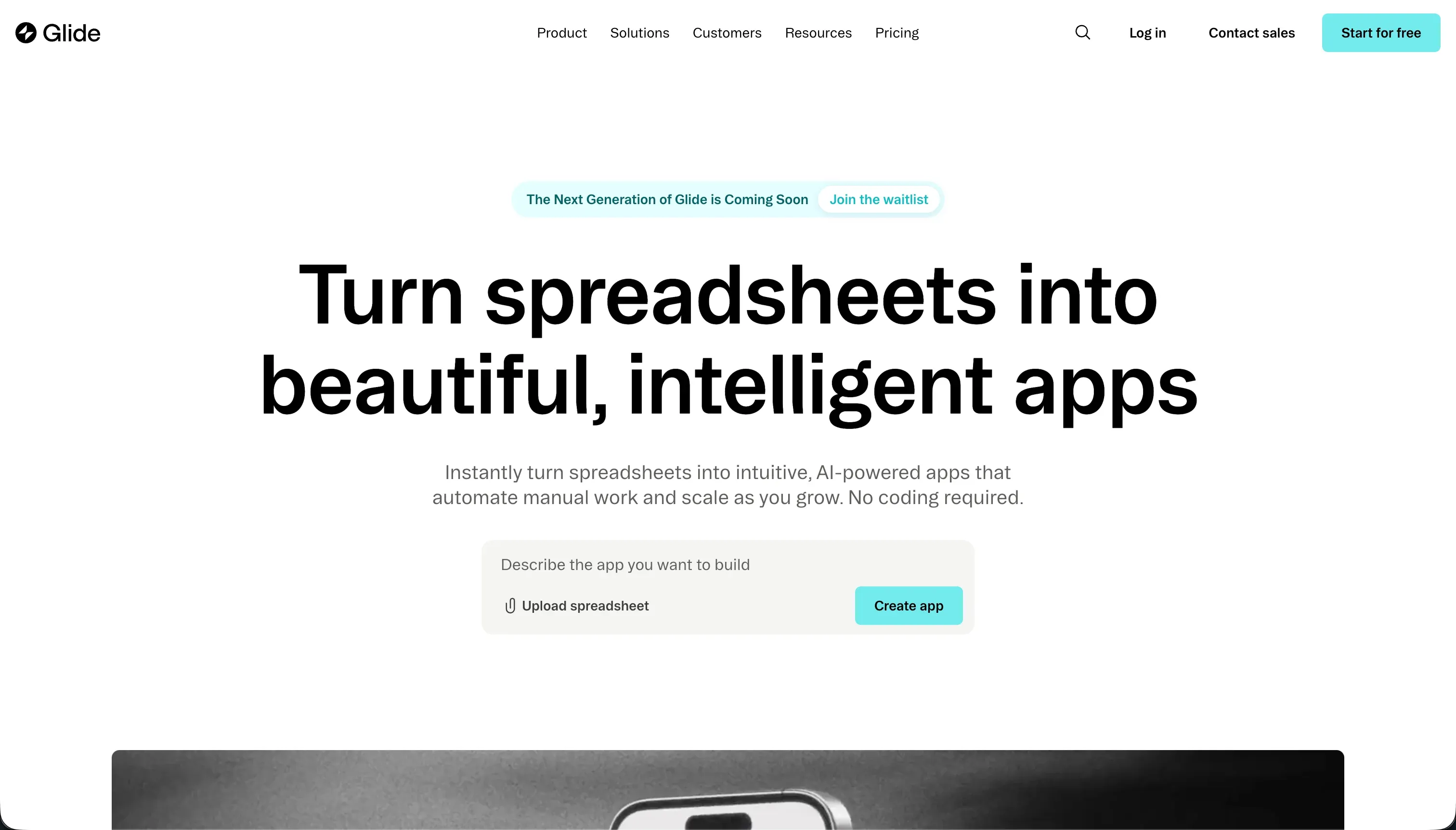
Glide is a data-centric, low-code application builder that creates web and mobile interfaces directly on top of spreadsheets and structured tables. By connecting to Google Sheets, Airtable, Microsoft Excel, or its own Glide Tables, the platform automatically scaffolds an interactive frontend.
The builder modifies layout styling, links data relationships, and configures basic action buttons visually rather than writing custom code.
Concrete features include Glide Tables for high-speed local data, built-in formulas, lookup fields, and Glide AI columns that automate audio transcription, text summaries, and translations directly inside the database.
It is explicitly designed for operations managers, SMB owners, and logistics teams who need to transform administrative spreadsheets into clean, mobile-reponsive field apps, inventory trackers, and internal team pipelines.
What is Base44?
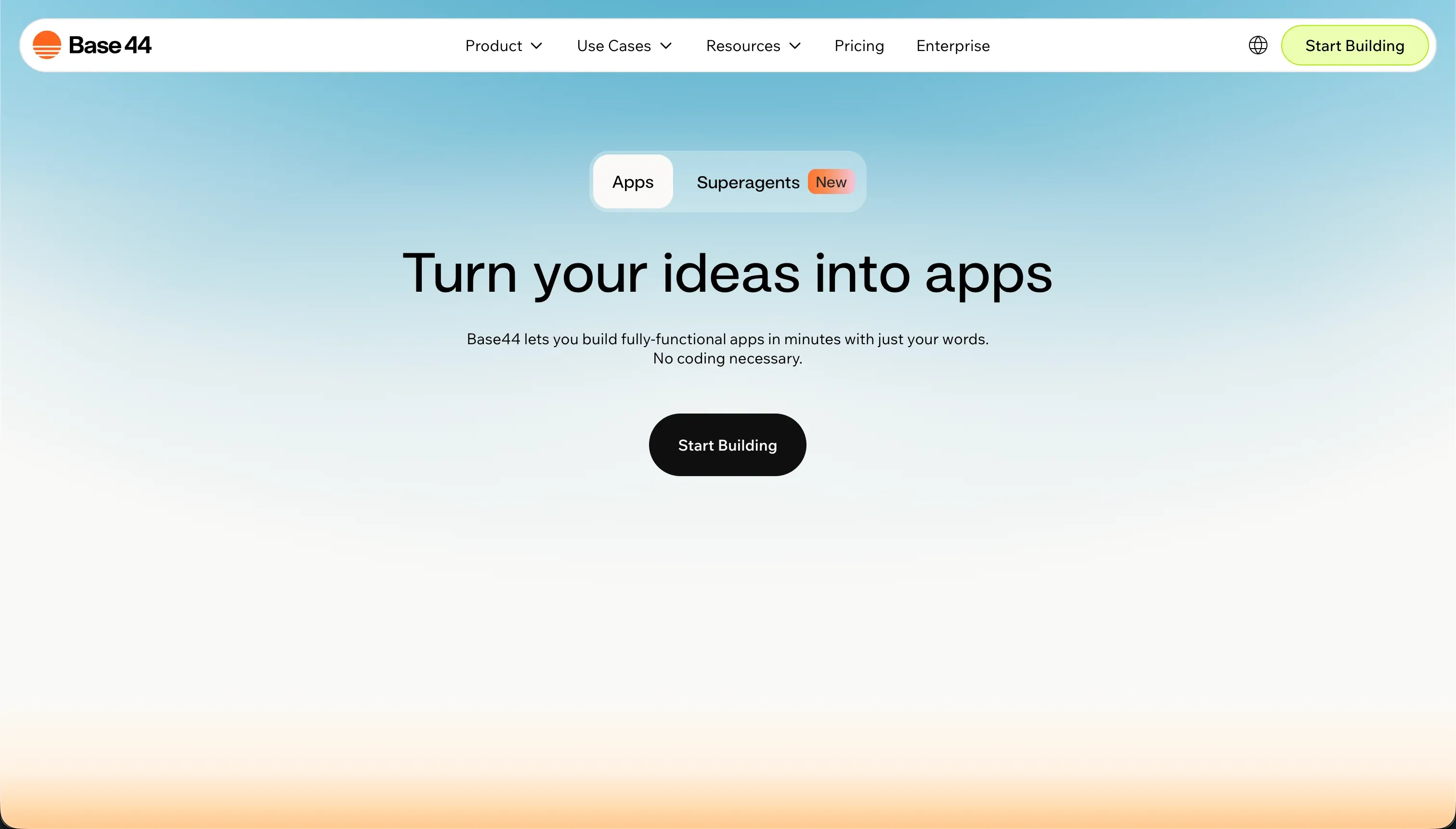
Base44 is an AI-powered conversational application builder that generates frontend interfaces, managed databases, security, and hosting from plain-English prompts.
Instead of structuring data tables manually, a builder describes their target workflows to an AI agent, which generates the relational PostgreSQL schema and user authentication screens in a single pass. Developers can then refine UI layouts conversationaly or use a click-to-tweak design panel.
Key features include built-in user authentication out of the box, direct GitHub syncing, code exporting, and design system tokens to instantly apply complex visual styles. The platform aims to serve non-technical founders, operations teams, and product managers who require rapid prototyping or early-stage SaaS MVPs without deploying complex cloud infrastructure.
The core difference
The division between these platforms lies in the distinction between structured assembly and unconstrained AI code-generation.
- Glide compiles deterministic, pre-built components directly to structured database sheets with no generated code or maintenance regression risks.
- Base44 generates code files and database models dynamically from plain-text conversations, risking iterative build bugs and platform lock-in.
Where the scores diverge
Maintainability: Glide 6.5, Base44 3.5. Glide outpaces Base44 with a 6.5/10 against 3.5/10. Glide apps are updated by adjusting pre-built visual blocks or modifying spreadsheet data directly, keeping day-two maintenance highly predictable.
The deduction for Glide comes from users reporting features moving behind higher pricing tiers mid-project and a hard functional ceiling once logic needs deepen. Base44 scores poorly here because its AI editing agent suffers from extreme regression loops where fixing one bug introduces several more, leading to wasted hours and consumed credits.
Production readiness: Glide 6.5, Base44 4.0. Glide excels with a 6.5/10, whereas Base44 drops to a 4.0/10. Glide’s pre-configured components are reliable and optimized for mobile screens, though researchers note that free-plan users get no human support and some long-term builders report backend lag several times a year.
Under Base44, production readiness is a major liability. Builders report the platform’s servers going down roughly once a week and apps breaking for live, active users. These systemic instabilities make Base44 unsuitable for client-facing or mission-critical workflows.
Design flexibility: Glide 4.0, Base44 6.5. Base44 takes this single criterion with a 6.5/10 against Glide’s 4.0/10. Glide restricts styling explicitly to structured, template-driven templates to enforce mobile responsiveness. You cannot drag and drop elements freely, adjust fine spacing, or use custom CSS unless you are on expensive pricing tiers.
Base44 uses design tokens and a click-to-tweak visual styling editor that gives builders significant layout and alignment freedom, although authentication screens and main layouts must keep Base44 defaults.
Security & access control: Glide 5.5, Base44 4.0. Glide scores 5.5/10, with Base44 sitting at 4.0/10. Glide handles basic user logins and row-level access rules for internal team members quite fluidly, though its permission model is too thin to build secure external portals with complex group visibility guidelines.
Base44 offers basic authentication visually, but registration screens cannot be styled or whitelabeled. Furthermore, role permissions are kept basic, lacking row-level, field-level, or button-level visibility controls. Real estate and SaaS builders report Base44 is not natively built for secure per-user data isolation.
Data & integrations: Glide 7.0, Base44 5.5. Glide wins with a 7.0/10, while Base44 scores 5.5/10. Glide connects natively to major spreadsheets, Airtable, and Glide Tables with rapid math, rollups, and local AI columns. Its score is only limited by a lack of deeper headless database support.
Base44 ships with a managed PostgreSQL DB, but all API connections flow through LiteLLM, introducing strict vendor limits and latency. Reviewers also flag severe limitations when executing PDF handling scripts and slow queries on larger datasets.
Ease of build: Glide 8.5, Base44 7.5. Glide takes the lead with an 8.5/10 against Base44 at 7.5/10. Glide excels because it instantly translates structured Google Sheets or Airtable data into modern, functioning layouts with zero onboarding friction.
Inside Glide’s visual studio, linking a list view to a data sheet remains straightforward and immediately readable.
Base44’s conversational prompt-to-app approach is phenomenally fast for a raw draft, but the initial magic thins out quickly because maintaining or tweaking the AI’s generated logic requires constant conversation, which can easily trigger regression errors.
Cost comparison
Glide and Base44 offer completely different cost paradigms. Glide operates on a user-tier model, starting with a Free plan (100 row limits) and scaling through Maker ($49/mobilled annually, up to 25 users), Team ($99/mo), and Business ($249/mo, 100,000 row limits).
This deterministic pricing makes planning predictable, although scaling high volumes of external portal users can quickly push organizations into custom enterprise contracts.
Base44 relies on a dual-credit billing style. It offers a Starter tier ($16/mo billed annually) scaling up to Elite ($160/mo).
However, builders must budget carefully around message credits (spent prompting the AI to alter layouts or edit code) and integration credits (spent when end-users perform app actions like querying databases, uploading PDFs, or sending automated emails).
When an app falls into regression loops, builders can consume hundreds of premium message credits without resolving core bugs, leading to highly unpredictable bills.
- Free plan, 100 row limit
- Maker $49/mo, up to 25 users
- Team $99/mo, Business $249/mo
- Business caps at 100,000 rows
- High portal volumes push to enterprise contracts
- Starter $16/mo to Elite $160/mo
- Message credits spent on AI edits
- Integration credits spent by end-users
- Regression loops burn hundreds of credits
Lock-in and the exit path
The exit paths for both platforms represent significant vendor lock-in, with Base44 having a minor portability advantage. Base44 allows builders to sync and export their React frontend code directly to GitHub.
However, the application’s PostgreSQL database schema, data tables, and backend functions are hosted entirely in Base44’s closed infrastructure, preventing a complete, clean migration. Glide enforces total lock-in, offering absolutely no code export option.
If you decide to leave Glide, you must export your CSV database rows and rebuild your entire user interface and operational workflows from scratch on another platform.
- React frontend exported to GitHub
- No code export at all
- PostgreSQL schema stays locked in
- CSV rows exported only
- Backend functions stay locked in
- Rebuild UI from scratch
- Rebuild needed: partial
- Rebuild workflows from scratch
Who should pick Glide
Pick Glide if:
- Operations teams who want to build internal team tools, inventory monitors, or CRM pipelines on top of existing spreadsheets.
- Builders looking for reliable, mobile-optimized PWA interfaces that do not risk weekly server downtime or runtime breakages.
- Teams that prefer predictable, user-based monthly pricing plans over highly variable credit consumption bills.
Do not pick Glide if you need pixel-perfect consumer styling, absolute layout control, custom CSS on budget plans, or a clean codebase export.
Who should pick Base44
Pick Base44 if:
- Product managers and founders building simple SaaS MVPs or mockups to quickly validate a product layout with investors.
- Builders who want to export a clean React frontend directly to GitHub to jumpstart a developer-led custom project.
- Operations teams who do not require granular, field-level security permissions or strict user data isolation boundaries.
Do not pick Base44 if your team requires a stable, high-uptime production business app with clients interacting with live transactional data.
What neither platform answers
Both Glide and Base44 focus on generating novel layouts, yet many businesses are simply looking to launch stable portals, internal tools, or client spaces. For these operational applications, security, user groups, and maintenance ease are much more valuable than constant prompting or rigid spreadsheet templates.
Forcing Glide’s look or risking Base44’s platform instability ignores your need for reliable infrastructure.
We recommend Softr as the leading choice for this workflow class. Softr scores higher on production readiness, maintainability, and security & access control. It allows builders to create secure client portals, internal intranets, and directories using a secure visual block builder with granular group visibility.
Unlike Base44’s credit drain, Softr offers robust visual editing alongside its AI Co-Builder, providing the speed of AI with the certainty of hands-on control. If you require native, downloadable mobile apps, FlutterFlow remains the appropriate alternative.
Analyst verdict
The scorecard is decisive: Glide wins this head-to-head comparison, finishing with an aggregate score of 6.3/10 against Base44’s 5.2/10.
Glide takes five out of the six evaluation criteria, outperforming Base44 on ease of build (8.5 vs 7.5), production readiness (6.5 vs 4.0), maintainability (6.5 vs 3.5), security (5.5 vs 4.0), and data integrations (7.0 vs 5.5). Base44 wins only on design flexibility (6.5 vs 4.0) due to its conversational tokens and click-to-tweak styling.
For any long-term business app, Glide’s structured spreadsheet scaffolding and predictable runtime stability make it the far safer investment. Base44’s severe production vulnerabilities, weekly server outtages, and costly regression loops make it a high-risk sandbox, useful only for rapid frontend prototyping with GitHub code-export plans. For standard business applications, we recommend choosing Glide.
Related reading: the Glide scorecard, the Base44 scorecard, and our scoring methodology.