

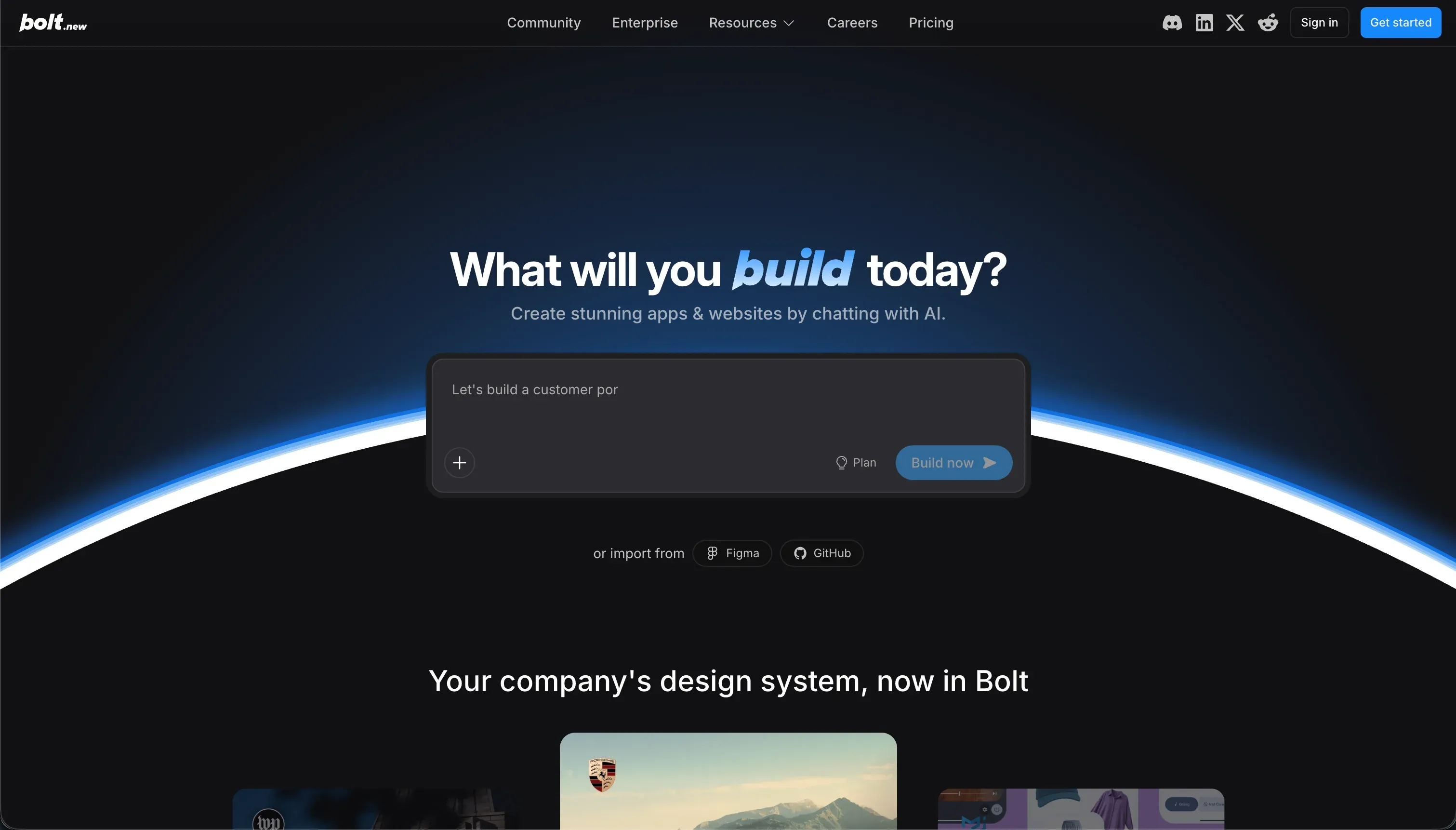

The procurement decision between Bolt and Emergent represents a choice between two distinct AI-native development environments. Bolt is a browser-based IDE suited for developers who want code ownership and frontend extensibility, while Emergent is an automated full-stack agent designed to scaffold databases, routing, and user interfaces directly from natural language prompts.
Bolt takes the scored win with an aggregate score of 5.1/10 against Emergent’s 5.0/10. The layout and flexibility of Bolt’s generated React code edge past Emergent’s Agent, but the decision flips if the buyer lacks web development knowledge and requires a functional backend schema built instantly from conversational prompt sequences.
The decision in 30 seconds
| If your priority is… | Pick | Why |
|---|---|---|
| Unlimited design customization | Bolt | Its 8.0 design score means no template ceilings and support for direct Figma imports |
| Fast non-technical full-stack setup | Emergent | Its 7.0 ease of build rating delivers working backend routing and UI from a single prompt |
| Clean codebase ownership and export | Bolt | It exports standard React/Vite code bases with automatic GitHub sync and no lock-in |
| Visual permission management | Neither | Both tools require editing code or raw prompting to configure secure access controls |
| A production-safe client portal or CRM | Neither | Both tools rate below average on production readiness and suffer from severe iterative edit loops |
What each platform is
What is Bolt?
Bolt is a browser-native development environment underpinned by WebContainers technology, allowing builders to run a full Node.js environment client-side. The platform operates on a prompt-to-app code generation model where the AI creates standard React components, Vite configuration, and backend schemas in real time.
Rather than acting as a visual, drag-and-drop editor, Bolt is an interactive IDE that exposes terminal execution, npm package installations, and file-tree editing. It is genuinely built for developers, technical founders, and builders who understand web concepts and want to speed up initial scaffolding without losing granular, code-level architecture control.
What is Emergent?
Emergent is an AI agent platform designed to automate full-stack application development from text prompts. It orchestrates the configuration of database routing, backend schemas, and user interfaces, deploying them instantly to managed development containers.
Builders interact with Emergent primarily through a conversational interface, making modifications to styles, workflows, and database layers by prompting an agent. The system is designed to provide non-technical operators with an easy, low-barrier pathway to scaffolding complete web experiences without setting up developer environments.
The core difference
The core divergence between these two platforms lies in the role of the user inside the development workflow.
- Bolt provides a browser-native developer workspace with a file editor and terminal, forcing the builder to think like an engineer.
- Emergent acts as an autonomous agent that hides the developer environment entirely behind a chat interface.
Where the scores diverge
Design flexibility: Bolt 8.0, Emergent 6.0. Bolt is exceptionally flexible, allowing developers to import Figma assets, load NPM packages, and utilize custom styled-components with no framework styling boundaries. Emergent generates customizable web interfaces, but its layout execution is less reliable and its native mobile development outputs are described as immature and unready for external deployment.
Ease of build: Bolt 5.5, Emergent 7.0. Emergent rates significantly higher because it targets the conversational, non-technical audience with a low barrier to entry. A single prompt scaffolds backend schemas, database routing, and UI elements in minutes, allowing users to build through chat.
Bolt is less accessible for non-technical users; because it is fundamentally a browser-based IDE, debugging build execution failures and reading terminal errors assume familiarity with web development concepts.
Security & access control: Bolt 3.5, Emergent 4.5. Neither tool provides a reliable, visual security panel to manage roles and user permissions. Emergent secures its scaffolds with auto-generated permissions, but verifying these rules is made difficult by blocked backend environments and slow support.
Bolt requires users to prompt the AI to write and audit access control and row-level security policies directly in the codebase, which means non-technical users cannot easily verify who can access their backend.
Production readiness: Bolt 4.0, Emergent 3.5. Both tools score poorly here because of structural instability, but Bolt edges ahead slightly. Emergent is hampered by container failures, ‘Error Waking Up Agent’ notifications, and discrepancies between preview and production environments.
Bolt offers native hosting and Netlify deployments, but users face memory limits and find themselves blocked by ‘Project too large’ indicators that disable prompting entirely on larger codebases.
Data & integrations: Bolt 6.0, Emergent 5.5. Bolt scores higher as it designs clean PostgreSQL schemas and can integrate any API or database, though it suffers from having no native database administration UI for direct data management.
Emergent automatically wires databases and routing from prompts, but the agent struggles to manage the data architecture securely and breaks down once codebase repositories grow moderately large.
Maintainability: Bolt 3.5, Emergent 3.5. This criterion is a shared low point for both tools. Emergent’s edit agent is triggered by tiny amendments, often generating buggy infinite loops that repeatedly break and fix identical logic - resulting in massive credit burn.
Bolt is a standard React codebase, but when changes are prompted, the AI commonly overhauls working components or reverts manual edits, requiring developer intervention to maintain codebase sanity.
Cost comparison
Bolt operates on a token-based subscription model, starting at $25/month for 10 million tokens on its Pro plan, which scales with pre-purchased token tiers up to $2,000/month. Because Bolt is a prompt-driven browser IDE, every edit, build analysis, and code generation cycle consumes tokens from your monthly allocation.
This can lead to unpredictable token consumption when the editor attempts to resolve terminal or module errors.
Emergent utilizes a transactional credit model, with its plans starting at $20/month billed annually for 100 credits, going up to $200/month on its Pro plan. Every change prompted triggers an AI ‘edit agent’ that consumes credits, creating severe financial exposure if the agent gets trapped in a bug-resolution loop.
Buyers have reported spending close to $10,000 AUD on repeated edit executions to repair basic internal bugs, emphasizing that visual operators should plan for high, unpredictable overage costs.
- From $25/mo for 10M tokens
- Scales up to $2,000/mo
- Every edit and build costs tokens
- Error resolution drains supply
- Failure mode: unpredictable consumption
- From $20/mo annual for 100 credits
- Pro plan at $200/mo
- Each prompt runs an edit agent
- Agents can loop on bug fixes
- Reported $10,000 AUD repair bills
Lock-in and the exit path
Bolt provides an optimal exit path by allowing complete code export of standard React and Vite codebases, keeping your development options open with direct GitHub sync and zero platform lock-in.
Emergent hosts applications on its own environment and, although it supports GitHub syncing, the tight integration between its proprietary backend agents and database routing makes moving databases off the platform a manual, complex development project. Bolt wins cleanly on code portability.
Who should pick Bolt
Pick Bolt if:
- Developers looking for a fast prompt-scaffolding tool that still grants direct access to standard react files and terminal terminals.
- Teams that require code ownership and need to export a clean React/Vite template straight to GitHub.
- Builders creating media-rich frontends that demand Figma integrations, custom styling libraries, and NPM package installations.
Do not pick Bolt if you lack web development experience and cannot read code to manually troubleshoot build compilation and runtime dependency failures.
Who should pick Emergent
Pick Emergent if:
- Non-technical founders who want a fast, hands-off MVP scaffold including databases, routing, and UI from simple phrases.
- Makers focused on web-only products who prefer conversational prompting over terminal interactions or file system management.
- Teams evaluating quick prototypes who want a fully managed environment that sets up backends natively.
Do not pick Emergent if you are deploying to production with real client data, where billing predictability and visual role-permission controls are compliance requirements.
What neither platform answers
Both Bolt and Emergent approach application creation through generative AI code, treating your software as an custom codebase that must be iteratively compiled and debugged. For many operational use cases - such as client portals, vendor portals, or internal directories - this paradigm creates immense maintenance overhead.
Rather than building custom logic from scratch, these apps require secure logins, stable database tables, and reliable user permission controls.
For this class of software, a visual business builder like Softr is the more logical procurement choice. Softr scores 8.5 on production readiness, 9.0 on maintainability, and 8.5 on security precisely because its database connectivity, permissions, and responsive blocks are pre-built, visual infrastructure.
For complex transactional layouts, platforms like Retool provide a much safer data-management layer without the risk of an AI agent generating unmaintainable code or entering endless bug-fixing loops.
Analyst verdict
Bolt wins this matchup with a marginal aggregate score of 5.1/10 over Emergent’s 5.0/10. Bolt wins design flexibility 8.0 to 6.0 and data depth 6.0 to 5.5, while offering a significantly cleaner code export architecture. Emergent claims a clear victory in ease of build with a 7.0 against Bolt’s 5.5, keeping its focus on the conversational, non-technical developer interface.
The final selection is highly conditional. If you are a developer who wants a rapid frontend scaffold that you can commit to GitHub, host elsewhere, and clean up manually, Bolt is the superior tool.
If you are a non-technical builder who needs a multi-sided web concept to render rapidly on a hosted staging link without touching terminal syntax, Emergent is the appropriate pilot, provided you keep a tight leash on credit billing.
Related reading: the Bolt scorecard, the Emergent scorecard, and our scoring methodology.