


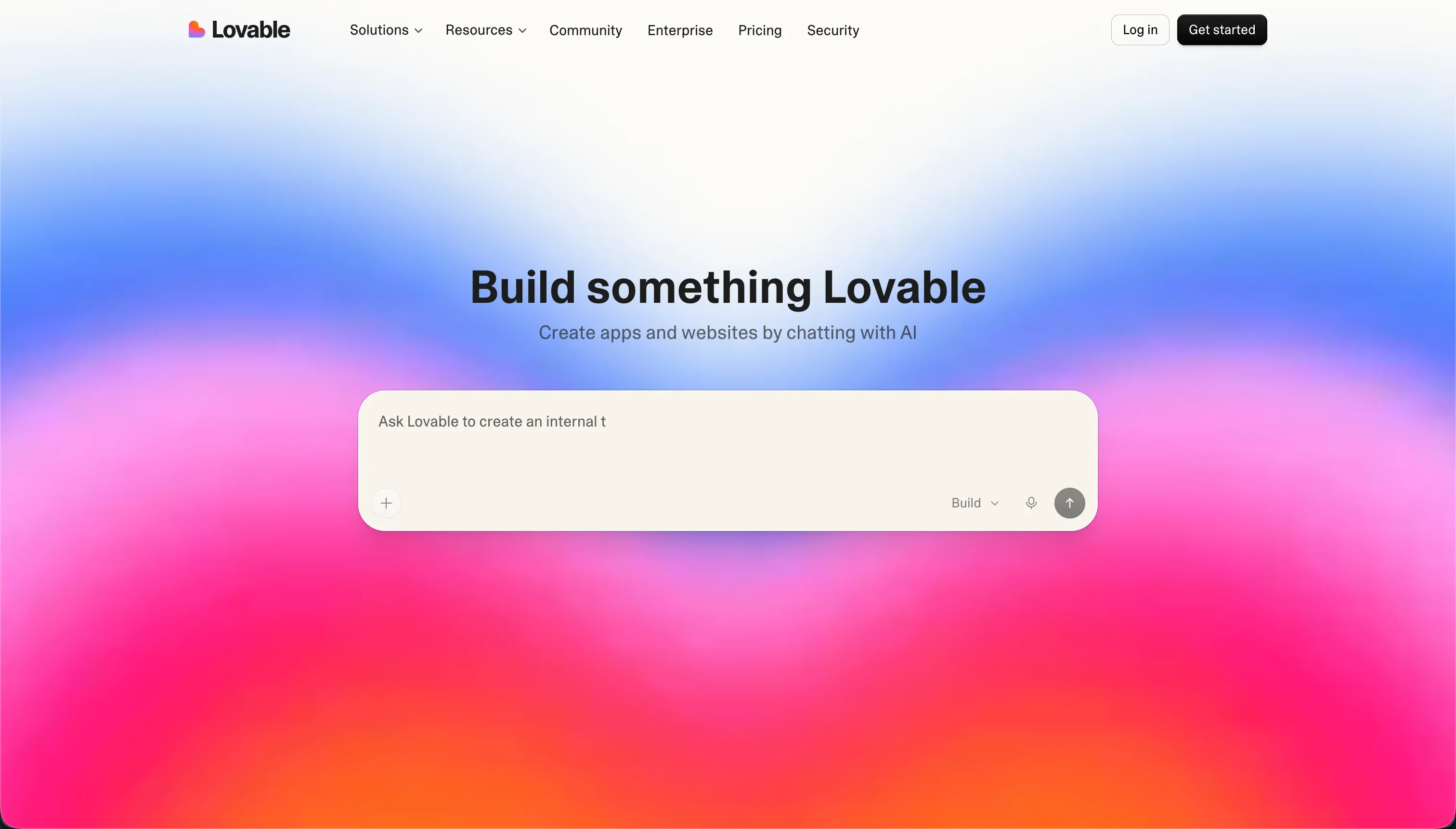
Choosing between Claude Code and Lovable is a choice between two entirely different developer environments. Claude Code is a terminal-based, agentic command-line assistant designed for developers working inside their local codebases. Lovable is a visual, prompt-to-app workspace that generates React frontends and Supabase backends for rapid application prototyping.
Claude Code wins this head-to-head comparison with an aggregate score of 6.6/10 against Lovable’s 5.5/10. Because Claude Code integrates directly with real files, local test frameworks, and existing deployment pipelines, it avoids the systemic maintenance walls and regression loops that frequently stall Lovable builds.
The decision flips only if the builder cannot read code, in which case the terminal-based winner is unusable.
The decision in 30 seconds
| If your priority is… | Pick | Why |
|---|---|---|
| Visual prompt-to-app prototyping | Lovable | Scores 7.5 on ease of build with fast initial React and Supabase generation |
| Direct terminal and local file control | Claude Code | Allows local file editing, test execution, and Git actions headlessly |
| Reliable long-term app maintenance | Claude Code | Maintains changes via standard Git history rather than prompt-only updates |
| Pixel-level UI adjustments without code | Neither | Lovable requires prompt loops for fine details and Claude Code has no UI |
| Turnkey relational database out of the box | Lovable | Bootstraps a structured PostgreSQL backend with Supabase sync in minutes |
| Secure client portals and internal business tools | Neither | Both leave authentication and row-level security configuration up to the builder |
What each platform is
What is Claude Code?
Claude Code is an agentic command-line interface tool created by Anthropic that runs locally inside a developer’s terminal.
Unlike assistive editors that wait for manual copy-pasting, this CLI agent operates autonomously in local directories, executing system shell commands, running test scripts, editing source files directly, and executing git version control changes based on natural language interaction.
This terminal-first tool is specifically built for engineers who already have a local development environment configured. It is designed to run deep integration tasks, edit codebases headlessly, and generate pull request descriptions, freeing developers from navigating complex IDE interfaces for standard refactoring or Git staging operations.
What is Lovable?
Lovable is an AI-powered full-stack application creator that transforms natural language text prompts into interactive React frontends, Node backends, and Supabase databases. It is a visual web-based playground where builders type instructions to generate multi-file updates, utilize Figma import to scaffold frontend layouts, and deploy applications directly to the cloud.
This platform target builders, operations teams, and startups who need to go from a blank canvas to a working MVP in hours. It abstracts standard hosting and database provisioning, offering standard React and TypeScript code synced to GitHub, paired with a managed PostgreSQL backend via its built-in Supabase integration.
The core difference
These tools diverge completely on how they interact with source code and where that code lives during the build loop.
- Claude Code edits local files and executes tests directly inside your native terminal environment with zero graphic interface.
- Lovable operates inside a visual, web-based playground that generates cloud hosting, frontend React components, and database schemas from conversational prompts.
Where the scores diverge
Ease of build: Claude Code 4.0, Lovable 7.5. Lovable leads with a score of 7.5, creating fully designed React interfaces and PostgreSQL tables in Supabase from text prompts, making first versions fast to publish.
Claude Code scores 4.0 because it has no visual preview engine or GUI, living entirely in the command line; non-engineers who cannot set up environments or debug local stacks will struggle to construct an app. However, Lovable’s score is capped because ongoing iterations require prompt-dependent edits that can trigger frustrating regression loops.
Maintainability: Claude Code 6.5, Lovable 3.5. Claude Code scores 6.5, leveraging standard local version control, automatic commits, and your own repository structure to keep codebases manageable, though early context compaction requires developers to closely monitor long sessions. Lovable scores 3.5 due to severe long-term maintenance overhead.
Because updates are prompt-only, builders face constant regression loops, schema debt from AI-created databases after a few months, and platform shifts that can break living, production web applications.
Security & access control: Claude Code 6.0, Lovable 3.5. Claude Code scores 6.0, deploying a secure granular permission prompt system where every file write or terminal execution requires explicit user authorization, although running a system-level terminal agent still carries inherent script risks.
Lovable drops to 3.5 because user authentication and data access depend on manual Supabase Row Level Security configurations. Non-technical users have no visual, bulletproof way to audit what database endpoints their generated frontend exposes.
Production readiness: Claude Code 6.0, Lovable 4.0. Claude Code scores 6.0 because it runs on standard, local codebases and verifies logic using your existing testing suites, but context compaction can cause it to drop project requirements in complex codebases.
Lovable drops to a 4.0 because its database security policies are not inherited natively, forcing builders to configure their own rules. Users also report that the final 30% of business logic acts as a developer wall, and platform updates occasionally break existing client deployments.
Data & integrations: Claude Code 8.0, Lovable 6.5. Claude Code runs at an 8.0 since it operates within standard language codebases to call any database, API, or shell utility, with the only ceiling being that every single connection must be hardcoded by the developer.
Lovable scores 6.5, offering instant Postgres integration through Supabase and GitHub repository sync, but any third-party business API integration beyond that standardized stack relies entirely on what you prompt the model to manually script.
Design flexibility: Claude Code 9.0, Lovable 8.0. Claude Code scores a 9.0 because it produces raw code directly within your choice of framework, placing visual boundaries solely in the hands of the developer.
Lovable receives an 8.0, outputting custom-described React frontends and supporting Figma design file ingestion, though getting exact pixel-level layouts right requires tedious re-prompting loops rather than direct visual canvas manipulation.
Cost comparison
Claude Code is a pay-as-you-go, usage-based tool billed strictly on API input and output tokens, offering no standard monthly subscription tier. While this offers low entry barrier pricing, developers report that debugging loops on larger projects can trigger aggressive token burn, consuming substantial budget in short sessions as the agent repeatedly indexes codebase directories.
Lovable operates on a standard subscription pricing structure, with the Pro plan starting at 25€/mo for 100 base credits and scaling up to 2,250€/mo for 10,000 credits. The Business plan runs at roughly double the cost per credit of the Pro plan for identical volume tiers.
Buyers must assume that credit usage is highly non-linear, as debugging loops and fixing compiler regressions often consume multiple tokens per prompt, turning simple additions into expensive cost centers.
Lock-in and the exit path
The exit path differs dramatically based on code portability. Lovable generates real React and TypeScript files synced to GitHub, meaning you can pull the codebase into a local IDE and host it, though developers warn that the exported output is often messy and hard to structure without manual rewrites.
Claude Code has zero vendor lock-in because it edits your files directly on your local system from day one, letting you swap command line tools instantly without needing code migration.
- Real React and TypeScript files
- Synced to GitHub
- Pull into a local IDE and host it
- Export is often messy
- Needs manual rewrites to structure
- Edits your local files directly
- No vendor lock-in from day one
- Swap command line tools instantly
- No code migration needed
Who should pick Claude Code
Pick Claude Code if:
- Software developers who want an autonomous terminal agent to handle test suites, Git actions, and refactories on existing local repositories.
- Engineering teams that require a tool operating within standard version control pipelines without any proprietary hosting overhead.
- Builders looking for zero platform lock-in who want to maintain absolute ownership of their native codebases on their local disk.
Do not pick Claude Code if you are a non-technical builder who cannot configure command-line environments, set up local developer repositories, or read raw programming code.
Who should pick Lovable
Pick Lovable if:
- Startup founders looking to generate a rapid React and Supabase prototype in a single day via natural language prompting.
- Design-led product teams wanting to convert existing Figma design files into interactive web application interfaces.
- Makers who want a guided full-stack cloud workspace that provisions hosting, databases, and deployment pipelines in one click.
Do not pick Lovable if you are building an operational business application intended to run securely in production for multiple years without substantial code maintenance overhead.
What neither platform answers
Both Claude Code and Lovable approach software under the assumption that you want to write or generate code. For many business buyers, this introduces unnecessary technical debt. If you are building a client portal, an internal operations dashboard, or a CRM, you do not need raw code; you need reliable login gates, secure visual permissions, and predictable software maintenance.
For these operational use cases, Softr offers a highly reliable, no-code alternative.
Softr scores 8.5 on production readiness, 9.0 on maintainability, and 8.5 on security & access control on our evaluation board because its authentication, database structures, and client permissions are structured as visual configurations rather than generated code.
For teams seeking a structured, no-code database with native MCP support to connect external AI agents safely, Softr provides an integrated option that removes hosting fragmentation completely.
Analyst verdict
Claude Code wins this comparison with an aggregate score of 6.6 to Lovable’s 5.5. The decisive factor is code sustainability and version maintainability: Claude Code integrates version-controlled modifications directly into standard, native repositories. Lovable remains restricted to prompt-dependent iterations, which often results in database schema debt and regression errors that break living apps.
The choice is ultimately decided by terminal experience. If you are a developer looking to accelerate refactoring loops on a local setup, Claude Code is the superior workspace tool. If you are a non-technical builder looking to quickly manifest an initial prototype web interface to validate a product concept with buyers, Lovable is the only viable path between the two.
Related reading: the Claude Code scorecard, the Lovable scorecard, and our scoring methodology.