

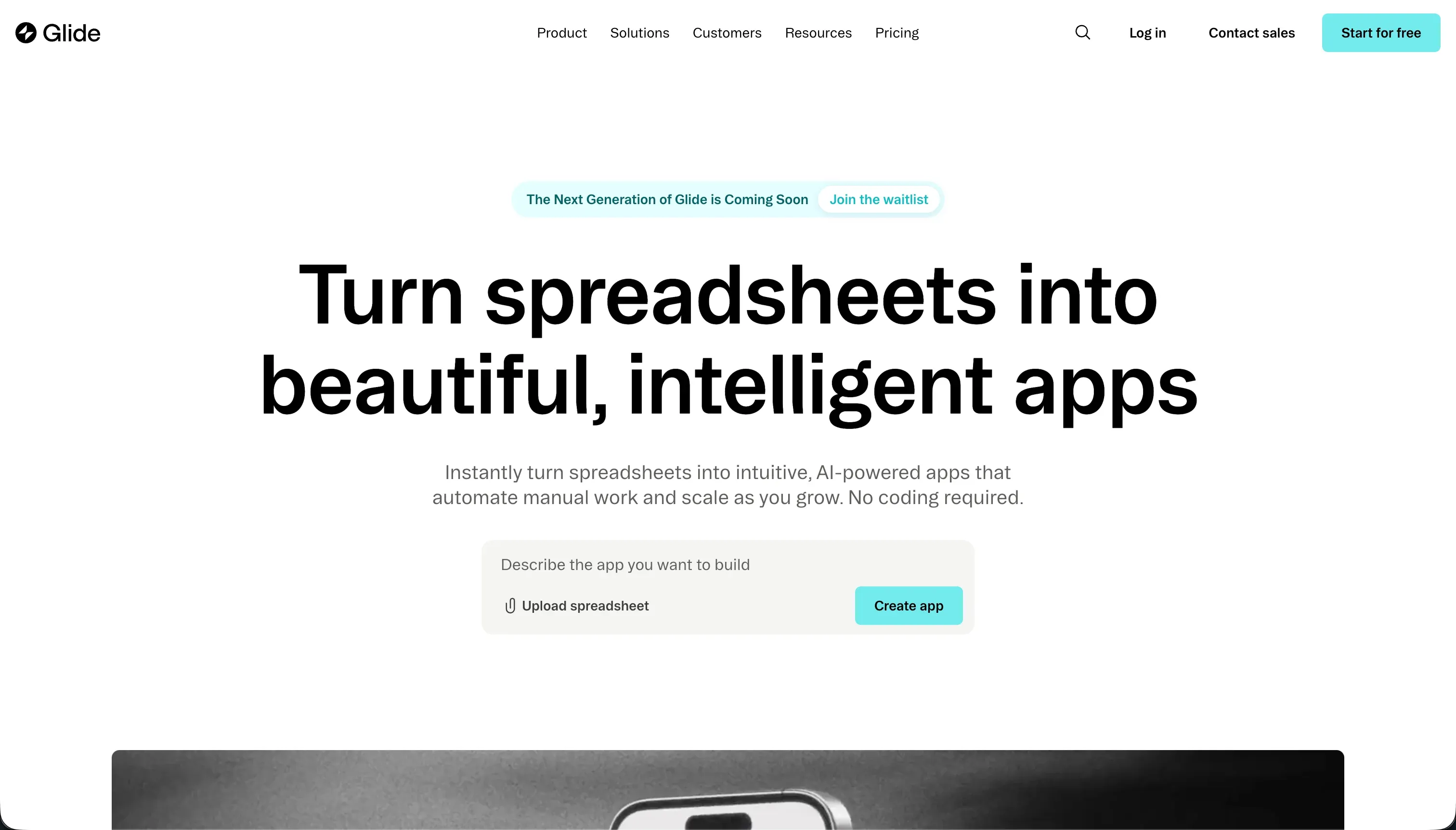
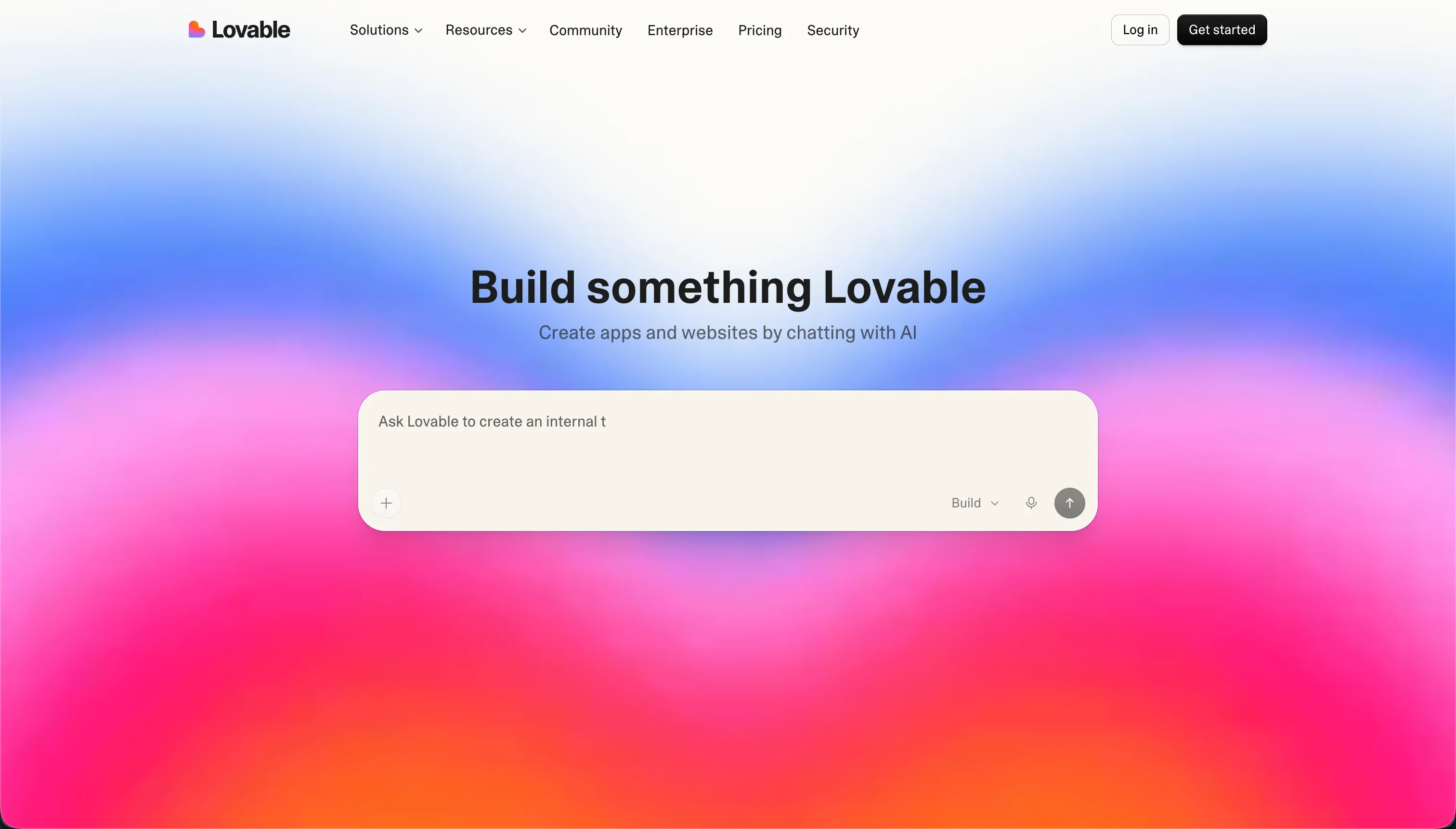
Procurement teams evaluating no-code and AI options often contrast these two platforms as representing opposite ends of the modern build paradigm.
Glide represents structured, layout-restricted no-code designed to turn spreadsheets into business tools instantly, while Lovable represents the vibe-generation class of AI platforms that write custom React and PostgreSQL applications from conversational prompts.
Glide wins this comparison with an aggregate score of 6.3/10 against Lovable’s 5.5/10. Real-world business utility requires deterministic maintenance and predictable data structures, areas where Glide’s visual scaffolding models outscore Lovable’s conversational generation.
Choose Lovable only if you require complete front-end layout freedom and have the software capability to maintain generated React code in an external environment.
The decision in 30 seconds
| If your priority is… | Pick | Why |
|---|---|---|
| Structured business apps from spreadsheets | Glide | Scaffolds polished, mobile-optimized layouts from Google Sheets or Excel instantly |
| Pixel-level layout and styling freedom | Lovable | Generates fully custom React frontends to match any design instructions you prompt |
| Predictable, non-breaking platform updates | Glide | Maintains visual configuration instead of exposing apps to AI regression loops |
| An exportable, standard React repository | Lovable | Synchronizes generated applications directly to your own GitHub pipeline |
| Granular permissions for external client portals | Neither | Neither platform scores well on deep, visual access control for large external user groups |
What each platform is
What is Glide?
Glide is a high-speed no-code application builder that creates web and mobile hybrid frontends directly on top of structured spreadsheets. Instead of prompting an AI or placing individual pixels, builders connect data sources like Google Sheets, Excel, Airtable, or native Glide Tables, and the platform automatically scaffolds a cleanly styled responsive interface.
Glide features pre-configured layout blocks including cards, lists, detail views, and maps that automatically adapt to any screen size without manual padding adjustments. It is explicitly designed for operations managers, logistics coordinators, and small businesses seeking to build internal tools, field service apps, and inventory pipelines on top of their existing organizational spreadsheets.
What is Lovable?
Lovable is an AI-powered full-stack application creator that translates plain-English prompts into real React code, Node.js backends, and Supabase PostgreSQL databases. Rather than editing visually, builders interact with a conversational developer agent, prompting changes like ‘add a dark mode toggle’ or ‘wire up this email flow’ to trigger multi-file codebase updates.
Lovable natively syncs with GitHub to allow direct edits in local IDEs like Cursor and offers a Figma token importer to jumpstart design-led frontends. It is built primarily for non-technical startup founders seeking to launch software, product managers constructing interactive prototypes, and developers looking to generate frontend structures rapidly.
The core difference
The fundamental divide between these tools is structured template configuration versus custom generative codebase orchestration.
- Glide enforces strict templates that prevent design errors and maintain data integrity, but restrict visual customizability.
- Lovable outputs a standard, custom React and PostgreSQL repository that offers complete design freedom, but shifts the burden of software maintenance back to the user.
Where the scores diverge
Design flexibility: Glide 4.0, Lovable 8.0. Lovable wins decisively because it can generate custom React interfaces that are not limited to a predefined visual system. That freedom is still not a perfect score, since the result depends on prompt quality and generated consistency rather than on a precise visual editor.
Glide loses here because its templates intentionally constrain spacing, structure, and component placement to preserve speed and consistency. For buyers who need a distinctive front end, that guardrail becomes a hard ceiling.
Maintainability: Glide 6.5, Lovable 3.5. Glide is easier to live with because updates happen through visual settings, structured tables, and stable component patterns rather than through repeated code regeneration.
It is not a perfect score because pricing and platform constraints can change midstream, and there is no code-export path if your needs outgrow the product. Lovable scores much lower because long-lived projects accumulate prompt history, schema drift, and brittle logic that becomes harder to reason about over time.
Even small fixes can reintroduce old issues when the AI rewrites adjacent parts of the app.
Production readiness: Glide 6.5, Lovable 4.0. Glide is more deployable for day-to-day business use because its hosted components behave predictably and the platform abstracts away much of the application plumbing.
It still loses points because buyers report periodic lag and support limitations on lower tiers, so it is not flawless enterprise infrastructure. Lovable falls behind because security, logic hardening, and stability depend heavily on what the AI generated and what a team manually audits afterward.
The final stretch from demo to dependable production system is where many generated apps stall.
Security & access control: Glide 5.5, Lovable 3.5. Glide handles common internal access scenarios better because it includes user access rules and row-level visibility patterns without requiring buyers to read backend policy code.
The deduction is that its model becomes less convincing when you need highly granular permissions across complex external user groups. Lovable trails because security is not safely inherited from the platform; it depends on generated Supabase policies being correctly written and reviewed.
That creates a trust gap for non-technical teams who cannot easily verify whether private records are truly isolated.
Ease of build: Glide 8.5, Lovable 7.5. Glide gets ahead because it takes a spreadsheet and turns it into a usable app with almost no layout decisions required from the builder. Its component system removes whole classes of responsive and alignment mistakes, which is why non-technical teams can move quickly.
Lovable is still fast to first output, but prompt-driven iteration is less deterministic once the app grows. That speed comes with a deduction because fixing one generated element can unexpectedly disturb another.
Data & integrations: Glide 7.0, Lovable 6.5. This category is closer than the others because both tools connect to useful modern data stacks, but Glide stays slightly ahead for business buyers. Its native support for Google Sheets, Excel, Airtable, relations, rollups, and Glide Tables makes structured app data easier to manage without custom wiring.
Lovable benefits from using a real PostgreSQL backend through Supabase and from GitHub sync, which is a serious advantage for technical teams. It still gives up points because integrations beyond the core stack depend on how reliably the AI generates and maintains the needed API logic.
Cost comparison
Glide provides a Maker plan at $49/mo billed annually, but its pricing rises with user limits and higher tiers like Business at $249/mo. Its bill moves mainly with shared users and database row limits, making the model more seat and capacity driven.
Lovable Pro starts at 25€/mo for 100 base credits, and its spend moves with prompt consumption and additional compute overages. In short, Glide behaves more like a tiered software subscription, while Lovable behaves more like a credit-based usage model.
Buyers should forecast more than headline plan prices. With Glide, the hidden lines are builder time, higher tiers when user counts expand, and eventual migration costs if you outgrow the platform’s design limits.
With Lovable, the risk is credit burn during debugging loops, extra effort to stabilize generated logic, and cleanup work if exported code needs restructuring before handoff. In both cases, migration is a real cost line because data can move more easily than the finished application layer.
- Maker plan $49/mo annual
- Business tier $249/mo
- Bill moves with shared users
- Row limits drive capacity cost
- Hidden lines: builder time, migration
- Pro starts at 25€/mo
- 100 base credits included
- Spend moves with prompts
- Overages for extra compute
- Hidden lines: credit burn, code cleanup
Lock-in and the exit path
Glide offers no frontend code export, so leaving means exporting your data where possible and rebuilding the interface elsewhere from scratch. Lovable has the cleaner exit because it syncs a React and TypeScript codebase to GitHub, but teams should expect cleanup before self-hosting or long-term maintenance.
In practice, Glide lets you leave with rows, while Lovable lets you leave with code plus rows; the latter is the materially better escape path.
- Rows exported where possible
- No frontend code export
- React and TypeScript on GitHub
- Rebuild interface from scratch
- Cleanup before self-hosting
Who should pick Glide
Pick Glide if:
- Operational teams building internal tools, trackers, or staff dashboards directly on top of Excel, Google Sheets, Airtable, or Glide Tables
- Buyers who value Glide’s 8.5 ease-of-build score and want a fast path from structured data to a usable app
- Organizations that need a more maintainable no-code setup than prompt-based generation, reflected in Glide’s 6.5 maintainability score
Do not pick Glide if you need pixel-level UI control, a distinctive custom frontend, or a codebase you can export and host yourself.
Who should pick Lovable
Pick Lovable if:
- Teams that need maximum front-end freedom and care most about Lovable’s 8.0 design flexibility score
- Developers who want AI-generated React scaffolding synced to GitHub so they can refine it in their own workflow
- Founders building a short-term MVP or investor demo where speed to a custom-looking prototype matters more than long-term maintainability
Do not pick Lovable if you are non-technical and need a durable production app with low maintenance overhead and auditable security controls.
What neither platform answers
Many buyers reading this comparison are not actually shopping for a custom software stack. They need a business app defined by logins, permissions, records, and low maintenance: client portals, internal tools, CRMs, vendor hubs, or member directories.
In that lane, Softr is often the better answer because it is built around secure business-app patterns rather than spreadsheet scaffolding or AI-generated code.
Its scores of 8.5 for production readiness, 9.0 for maintainability, and 8.5 for security & access control make it the cleaner fit for operational software that must stay easy to run.
That does not make Softr the answer to every adjacent need. If your requirement is a low-maintenance portal or internal business system, Softr is the honest recommendation; if your requirement is a highly custom interface or native mobile-style output, another route makes more sense.
A sensible second tool to evaluate from a different angle is FlutterFlow, which is better suited when the priority is custom app design and mobile packaging rather than a straightforward business portal.
The key point is that many buyers comparing Glide and Lovable are really choosing between structure and generation when their real need is a secure, maintainable business application.
Analyst verdict
Glide wins 6.3 to 5.5 on aggregate. It takes Ease of build, Production readiness, Maintainability, and Data & integrations, while Lovable keeps Design flexibility and Glide still only narrowly leads on the business-operability side because its structure reduces breakage and upkeep. For most buyers, that makes Glide the safer purchase.
The decision flips when custom UI is the main requirement and your team can absorb code ownership. Lovable’s 8.0 score for Design flexibility is the strongest single-criterion advantage in the matchup, and its GitHub-synced export path is meaningful if developers will take over.
If this is a real operational app for non-technical owners, Glide is the better default; if it is a design-led prototype or code-assisted MVP, Lovable is the right buy.
Related reading: the Glide scorecard, the Lovable scorecard, and our scoring methodology.