

Procuring the right development platform requires isolating whether your application is a cross-platform mobile app destined for App Store deployment or a temporary web-based prototype.
For visual mobile development, FlutterFlow operates as a visual IDE compiling to native code widgets, while Lovable represents the conversational code-generation class that produces full-stack React and Supabase code from plain-text prompts.
FlutterFlow wins the aggregate decision with a score of 6.3/10 against Lovable’s 5.5/10. The scorecards diverge on day-two maintenance and security verification, making FlutterFlow the safer strategic investment for production software. Only when your priority is immediate prompt-to-app scaffolding with an explicit plan to hand the code to a developer does Lovable’s conversational speed justify the purchase.
The decision in 30 seconds
| If your priority is… | Pick | Why |
|---|---|---|
| Genuinely native iOS and Android packages | FlutterFlow | Its visual widget tree compiles directly to App Store ready Dart code |
| Rapid prototype generation from text | Lovable | Prompt-to-app generator outputs React and Supabase setups in hours |
| Client portals, internal tools, or CRMs | Neither | Both systems require complex backend setup, where Softr runs on pre-built infrastructure |
| Predictable software bills without credit worries | FlutterFlow | Features flat tier subscriptions without multi-fold credit usage inflation |
| Pixel-perfect visual manipulation of layout controls | FlutterFlow | Widget-level design controls prevent the need to re-prompt the interface |
What each platform is
What is FlutterFlow?
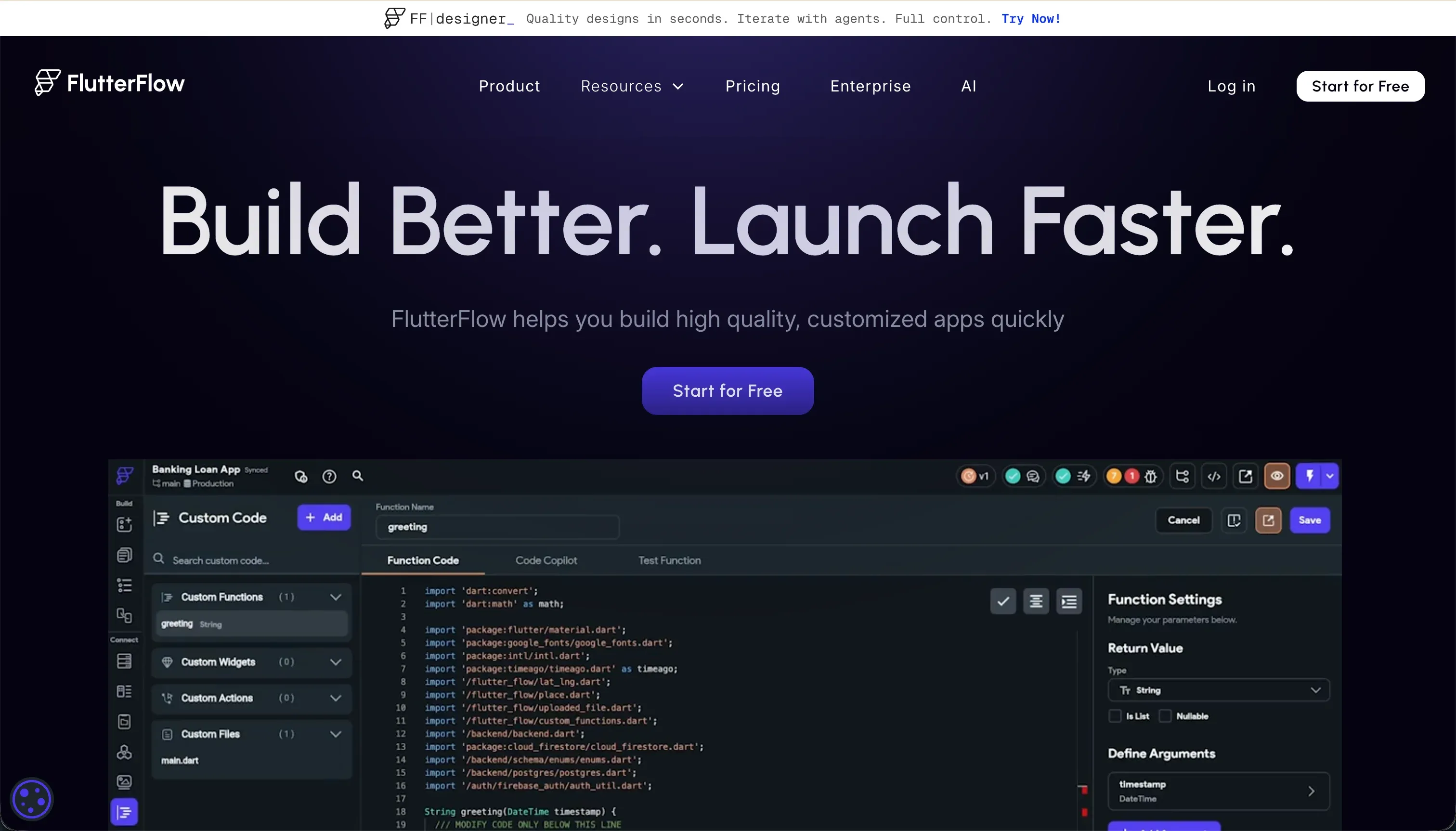
FlutterFlow is a visual programming environment built to compile native cross-platform mobile and web applications. Utilizing Google’s Flutter framework and Dart runtime, it functions by letting designers and developers map visual widget trees visually, managing application state and database queries through a graphical workspace rather than typing code manually.
Concrete capabilities include native compilation for Google Play and Apple TestFlight, automatic translation, and complete source code export. It is genuinely built for design-led founders, mobile product teams, and freelancers who need native mobile performance but want to bypass structural boilerplate code.
What is Lovable?
Lovable is a conversational full-stack application builder that translates plain text natural language instructions into functional software. Rather than executing code on a proprietary runtime, Lovable writes a standard codebase consisting of a React.js and TypeScript frontend, a PostgreSQL database managed via Supabase, and a standard Node.js backend.
Key features include Figma layout imports, direct GitHub synchronization, and pre-publish security scanning of row-level security (RLS) policies. It is designed for non-technical founders seeking validation, agency builders executing rapid front-end scaffolding, and developers who want to skip early-stage database routing setup.
The core difference
The core architectural division is a visual development IDE versus conversational codebase generation.
- FlutterFlow acts as a visual interface editor where you compile and directly manipulate Dart layout trees manually without AI dependencies.
- Lovable acts as an AI conversational agent that translates prompts into an unmanaged code repository that you edit via chat.
Where the scores diverge
Ease of build: FlutterFlow 4.5, Lovable 7.5. Lovable scores 7.5/10 by compiling a working first version in hours from standard prompts and imports. Builders can mock up dynamic pages instantly, whereas FlutterFlow’s 4.5/10 reflects a exceptionally steep learning curve.
FlutterFlow forces non-engineers to understand widget constraints, complex state parameters, and database rules. However, Lovable’s ease caps because subsequent iterations are prompt-only, frequently resulting in regression loops where the AI introduces new layout bugs while attempting to patch previous edits.
Production readiness: FlutterFlow 7.0, Lovable 4.0. FlutterFlow scores 7.0/10 because it compiles to authentic iOS and Android binaries with deployment pipelines tailored to Google Play and TestFlight. It relies on established platform infrastructure, though builders must still set up database schemas manually.
Lovable scores 4.0/10 due to persistent long-term deployment concerns. Its database security must be manually validated in a Supabase environment, and community report logs consistently show system changes breaking existing applications, presenting a production ceiling for apps intended to run for several years.
Maintainability: FlutterFlow 5.5, Lovable 3.5. FlutterFlow scores 5.5/10, dropping points because the web-based visual editor experiences lag on large-scale applications with more than a dozen screens. However, because layout trees are directly edited, updates are predictable.
Lovable’s 3.5/10 is the lowest in its scorecard due to severe prompt-dependency. Because iteration occurs solely via the AI chat interface, complex applications accumulate massive database schema debt, obsolete functions, and recursive bug patches that increase development fragility beyond month six.
Security & access control: FlutterFlow 5.0, Lovable 3.5. FlutterFlow’s 5.0/10 reflects that while the editor delivers the integration hooks for user roles and visibility rules, builders must construct and audit backend security rules manually within a separate Firebase or Supabase console. Lovable scores 3.5/10 because security is prompt-dependent.
The builder must write perfect prompts to implement Supabase Row-Level Security rules. For a non-technical builder, there is a total inability to audit what the generated frontend code exposes, presenting an invisible database intrusion risk.
Design flexibility: FlutterFlow 9.0, Lovable 8.0. FlutterFlow scores 9.0/10, representing the premium visual design engine for native mobile screens. Builders modify widgets down to padding values, with the single drawback that its compiled web-form performance lags on search-indexed sites.
Lovable’s 8.0/10 offers unlimited potential through generated React frontends and Figma assets, but getting fine details right depends entirely on the accuracy of ongoing conversational prompts rather than direct manipulation.
Data & integrations: FlutterFlow 6.5, Lovable 6.5. Both platforms tie with a score of 6.5/10, but the workflow demands differ. Lovable automates database structural design by instantly bootstrapping Supabase tables and PostgreSQL environments during prompting.
FlutterFlow requires the builder to construct structures manually but offsets this with highly predictable REST API endpoints and native hooks. The deductions on both reflect the significant database management knowledge required once applications expand past basic data reads.
Cost comparison
The billing models divide predictable fees from prompt-driven consumption. FlutterFlow bills on simple flat tiers: a Free plan, a $30/mo Standard tier containing code downloads, and a $70/mo Pro tier with codeless App Store deployment pipelines. Once subscribed, the developer’s bill is completely stable, regardless of how many visual modifications are executed inside the builder canvas.
Lovable operates on a variable credit allocation starting on a $25/mo Pro tier for 100 base monthly credits, rising to 2,250 euros/mo for 10,000 credits. Because every conversational update, error check, and generation step consumes your monthly credit pool, cost forecasting is highly unpredictable.
During recursive bug debugging loops, buyers report rapid credit depletion and are forced to buy overage packages to maintain platform momentum.
Lock-in and the exit path
Lovable features a cleaner codebase exit path than FlutterFlow, syncing standard React and TypeScript code directly to personal GitHub accounts. However, this exported code is often highly nested and requires a developer to refactor it before it is running outside Lovable’s build container.
FlutterFlow provides complete Dart and Flutter code exports on and above its Pro and Standard plans. While it is fully open-source and free from visual framework locks, exiting requires a developer with deep Flutter knowledge to compile and host future builds manually.
- Standard React and TypeScript to your GitHub
- Needs refactoring before it runs outside Lovable
- Highly nested exported code
- Complete Dart and Flutter code export
- Included on Pro and Standard plans
- Needs a developer with deep Flutter knowledge
- You compile and host future builds manually
Who should pick FlutterFlow
Pick FlutterFlow if:
- Teams building native mobile applications targeting the Apple App Store and Google Play platforms.
- Professional developers who want a visual layout model but require clean Dart source code export.
- Product managers demanding stable software subscriptions and predictable development expenses.
Do not pick FlutterFlow if your project requires a quick text-to-app web landing page and nobody on your team has a developer’s mindset to manage state logic.
Who should pick Lovable
Pick Lovable if:
- Founders needing to showcase a high-fidelity web prototype to investors within a few days.
- Organizations with a developer on standby to intercept the exported codebase and complete the backend logic.
- Teams seeking standard React frontends instantiated directly from Figma design assets without manual coding.
Do not pick Lovable if you are building an application intended to live past two years with ongoing business iterations, or if database information security is your primary metric.
What neither platform answers
If your primary procurement goal is to deploy an internal dashboard, Client Portal, CRM, or vendor-facing utility, shortlisting visual app developers or AI code-generators represents a severe waste of resources.
Both FlutterFlow and Lovable force the non-technical builder to manually construct backend access rules, navigate hosting spaghetti, and manage relational database setups from scratch, turning a simple portal into a multi-month engineering problem.
For operational software, Softr is the higher-scoring platform, offering a 7.0/10 on production readiness and 5.5/10 on maintainability. Softr provides native authentication, User Groups, and database structures completely pre-configured out of the box, letting you build secure web applications in under a day.
If mobile-ready business workflows are your design shape, pairing Softr’s flat pricing with Glide provides an enterprise-ready alternative to developer IDEs.
Analyst verdict
FlutterFlow wins this comparison with an aggregate score of 6.3/10 against Lovable’s 5.5/10, taking four of the six evaluation criteria.
While Lovable secures a substantial win on ease of build (7.5 vs 4.5), FlutterFlow’s structural superiority in production readiness (7.0 vs 4.0), maintainability (5.5 vs 3.5), and security (5.0 vs 3.5) makes it the only viable choice for long-term software deployments in this head-to-head.
Choose Lovable ONLY if you are executing a two-week prototype check and have an explicit developer handoff planned where the generated React files serve as a starting template. For all business applications, native mobile store distribution, and projects requiring direct visual control, FlutterFlow’s visual compiler is the only safe allocation.
Related reading: the FlutterFlow scorecard, the Lovable scorecard, and our scoring methodology.