

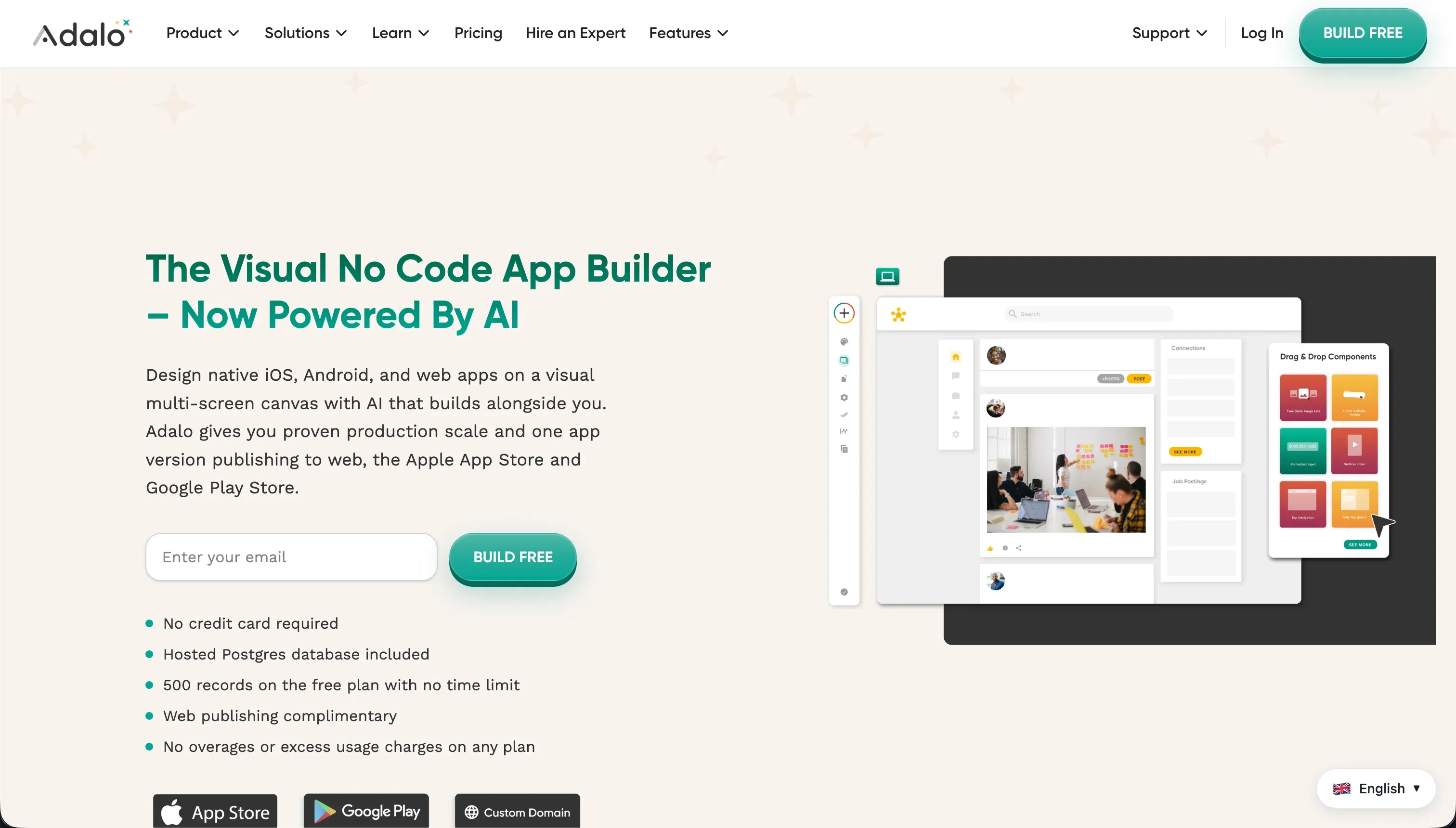
Adalo and Softr represent two fundamentally different approaches to the no-code market. Adalo is a mobile-first visual canvas builder that allows creators to drag and drop interfaces freely and package native mobile applications for public app stores.
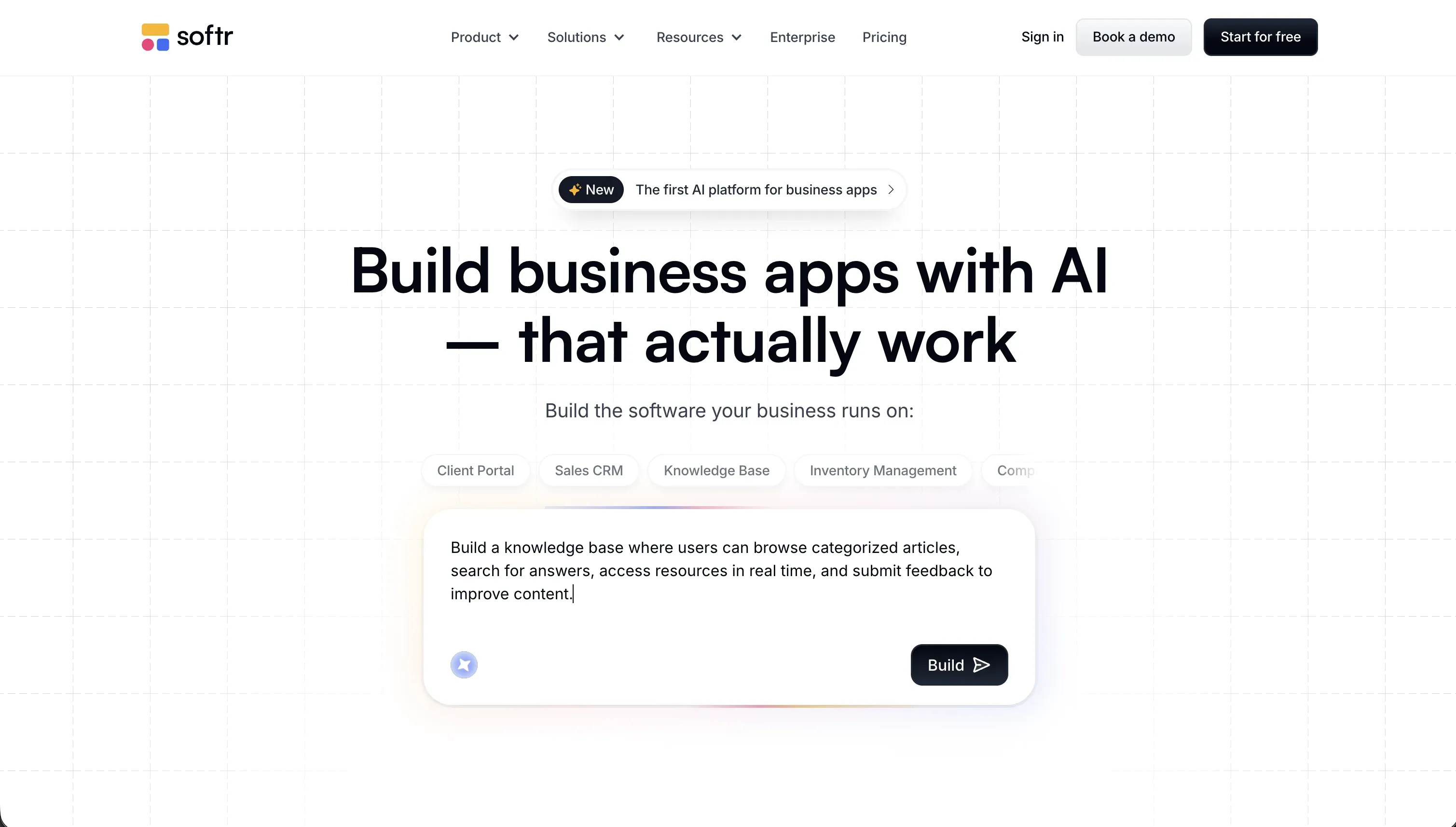
Softr is an AI app builder designed explicitly for secure, scalable business applications like customer portals, internal directories, and workflows.
Softr wins this general evaluation with an 8.1 aggregate score against Adalo’s 4.6. This scored gap of 3.5 points is driven by stark differences in operational reliability, role-based security, database scalability, and day-two maintenance. Adalo should be shortlisted only when native mobile app store distribution for a basic mockup is preferred over production-grade business tool architecture.
The decision in 30 seconds
| If your priority is… | Pick | Why |
|---|---|---|
| Client portals, secure CRMs, or partner apps | Softr | Roles, row-level database security, and SOC 2 compliance are native platform infrastructure |
| Native iOS and Android app store submission | Adalo | Built-in mobile packaging engine is its defining native strength |
| Desktop web layouts and dashboards | Softr | Adalo relies on a fixed-width screen model that stretches on desktop screens |
| Highest speed of build via conversational AI | Softr | AI Co-Builder generates databases and interfaces from one plain-language description |
| Completely predictable software spend | Softr | Offers flat-rate subscription tiers with clearly stated app-user limits |
| Self-hosted codebase and local deployment | Neither | Both tools are fully managed web platforms that do not support codebase export |
What each platform is
What is Adalo?
Adalo is a visual drag-and-drop builder designed primarily to compile simple mobile applications. It replaces coding with an open digital canvas where you place buttons, texts, forms, and image containers, drawing physical lines between screens to establish visual app navigation.
Adalo uses a built-in relational database to store records and supports minor custom integrations via its marketplace or manual REST API links. It is explicitly suited for creators, startup founders, and design-centric teams who need to assemble lightweight mobile MVPs and deploy them to the Apple and Google Play stores without setting up a traditional development environment.
What is Softr?
Softr is an AI-first, block-based platform built to assemble reliable business applications. Rather than manual coordinates, builders use a structured visual editor and an AI Co-Builder to generate working databases, screens, user permissions, and navigation routes in minutes from a text prompt.
Softr features responsive dynamic blocks like tables, kanban boards, calendars, and forms that connect natively to Softr Databases as well as external platforms like Airtable and HubSpot. It is engineered for operations managers, founders, and IT departments who need to deliver secure, production-ready systems such as client portals, company intranets, and custom ERPs.
The core difference
The primary operational division between these two visual environments lies in interface construction and infrastructure layout.
- Adalo focuses on a free-positioning canvas model aimed at native mobile compiling where security and database size are treated as secondary details.
- Softr focuses on a block-based visual assembly model supported by pre-built user authentication, database security, and AI generation.
Where the scores diverge
Production readiness: Adalo 3.5, Softr 8.5. Softr scores 8.5 because its core infrastructure, hosting, and relational database connections are prepackaged and enterprise-compliant out of the box.
Adalo scores 3.5 due to significant performance vulnerabilities reported in Capterra reviews, where paying users describe daily internal server errors, unacceptable native Android performance, and data integrity failures, including one case where roughly 70 percent of an active database disappeared.
Maintainability: Adalo 4.0, Softr 9.0. Softr scores 9.0 because apps are composed of native, battle-tested visual blocks that do not accumulate hidden code bugs or prompt dependencies. Adalo scores 4.0 as complex multi-step automation, conditional approvals, and external API mappings are fragile and must often be rebuilt from scratch if an integrated partner modifies their endpoint or table structure.
Security & access control: Adalo 4.0, Softr 8.5. Softr scores 8.5 owing to click-to-configure user groups, global row-level data restrictions, and server-side database CRUD operations. SSO is reserved for the enterprise Custom tier, which costs the half-point.
Adalo scores 4.0 because its security model is limited to cosmetic visibility filters constructed screen by screen. Adalo has no centralized role-based access control, making it highly vulnerable to accidental data exposure in multi-user applications.
Ease of build: Adalo 6.0, Softr 9.0. Softr scores 9.0 on ease of build, leveraging its context-aware AI Co-Builder that generates a complete, working system of databases, pages, and user groups in minutes. Builders can switch freely between conversational prompt changes and manual visual edits.
Adalo scores 6.0 because while its visual drag-and-drop layout has a low initial barrier, Capterra reviewers report that building fundamental utility operations like password recovery or multiple-image uploads is tediously complex and slow.
Data & integrations: Adalo 5.0, Softr 8.0. Softr scores 8.0 for its high-limit native Softr Databases and pre-verified connectors to 17 external sources like Airtable, Google Sheets, and Notion. Storing REST API and SQL database options behind the Business tier costs the half-point.
Adalo scores 5.0; its native database bottlenecks at scale, it does not support native two-way sync with external databases, and developers find its manual API integration clunky.
Design flexibility: Adalo 5.0, Softr 5.5. Adalo scores 5.0 because its freeform canvas lacks responsive design, relying instead on a fixed-width screen engine that stretches phone layouts into awkward desktop views. Softr scores 5.5 because builders are confined to structured, responsive dynamic layout blocks under a global theme engine.
However, Softr mitigates this limitation via custom CSS injection and an AI Vibe Coding block that safely generates highly specific, custom UI components.
Cost comparison
The billing models display different architectural motives. Softr uses a predictable tier subscription starting at $19 per month billed annually ($25 monthly) for the Basic plan, scaling to $99 per month billed annually ($119 monthly) for Pro, which includes 10 Team and 50 Client app users, 500,000 database records, and custom user groups.
Software spend stays flat and predictable, as costs are tied strictly to fixed plans rather than API queries or page clicks.
Adalo starts its paid plans at $36 per month billed annually ($45 monthly) but locks critical professional features and native publishing limits behind more expensive tiers. Crucially, Adalo enforces database record limits on every plan, meaning as a builder’s customer base or catalog expands, they must pay steep premium tier penalties to house that data.
Hidden costs in Adalo center heavily around builder labor spent debugging buggy API configurations, while Softr’s hidden costs are limited to AI credit usage for programmatic workflows and database generation.
Lock-in and the exit path
Both environments are managed cloud platforms, meaning you cannot export an independent application codebase from either Tool. However, the data portability options differ significantly.
Softr has a much cleaner exit path, especially when used over external data sources like Airtable, Notion, or SQL databases, where your active business records exist uncompromised outside of the interface.
While Adalo allows CSV database exports, its restrictive API integrations and tightly bound database and screen configurations often require a complete application rebuild if you decide to migrate away.
- Records stay in Airtable, Notion or SQL
- Business data uncompromised outside the interface
- Cleaner exit path when leaving the platform
- CSV database export only
- Restrictive API integrations
- Database tightly bound to screen configurations
- Migration often means a complete rebuild
Who should pick Adalo
Pick Adalo if:
- Creators who need to compile interactive phone mockups for rapid validation or user testing under a low learning curve
- Builders whose absolute launch requirement is native packaging and publishing to the Apple App Store or Google Play storefronts
- Designers who need open visual freedom to place UI elements on mobile screens without being constrained by structured blocks
Do not pick Adalo if you are deploying secure, production-grade business tools where database speed, role permissions, and active server reliability are non-negotiable.
Who should pick Softr
Pick Softr if:
- Operations teams and COOs building multi-role client portals, secure customer CRMs, and partner trackers
- Large organizations requiring SOC 2 Type II data safety compliance and native European data hosting solutions
- Businesses seeking an AI-first builder with near-parity between natural language prompts and hand-configured visual editor controls
Do not pick Softr if your business demands a pixel-perfect, completely unconstrained canvas layout or compile-ready native code packages for Apple and Google app store distribution.
Where neither platform fits
Neither Adalo nor Softr will suit a business team that requires complete code ownership, local database hosting, or physical development files. Both platforms maintain private containerized engines, which makes leaving either layout a complete interface reconstruction task.
If your organization requires compiled native mobile apps along with exportable code files, look instead to FlutterFlow. If your engineering department demands a generative development environment with real code synchronization to GitHub, look at Replit, which offers complete infrastructure control at the cost of a developer-level programming requirement.
Analyst verdict
Softr wins this head-to-head comparison 8.1 to 4.6, taking ease of build, production readiness, maintainability, data integration, and security. Because a business application has no value if its client-facing data is exposed or if users face daily loading downtime, Softr represents the safer procurement choice for professional ecosystems.
Adalo remains a contender only when your target application is a consumer mobile prototype. Its aggregate score suffers because its gentle visual onboarding ceiling does not hold through real production builds. For client portals, custom internal tools, and operational CRMs, choose Softr to guarantee stable, visual, role-secured infrastructure.
Related reading: the Adalo scorecard, the Softr scorecard, and our scoring methodology.