

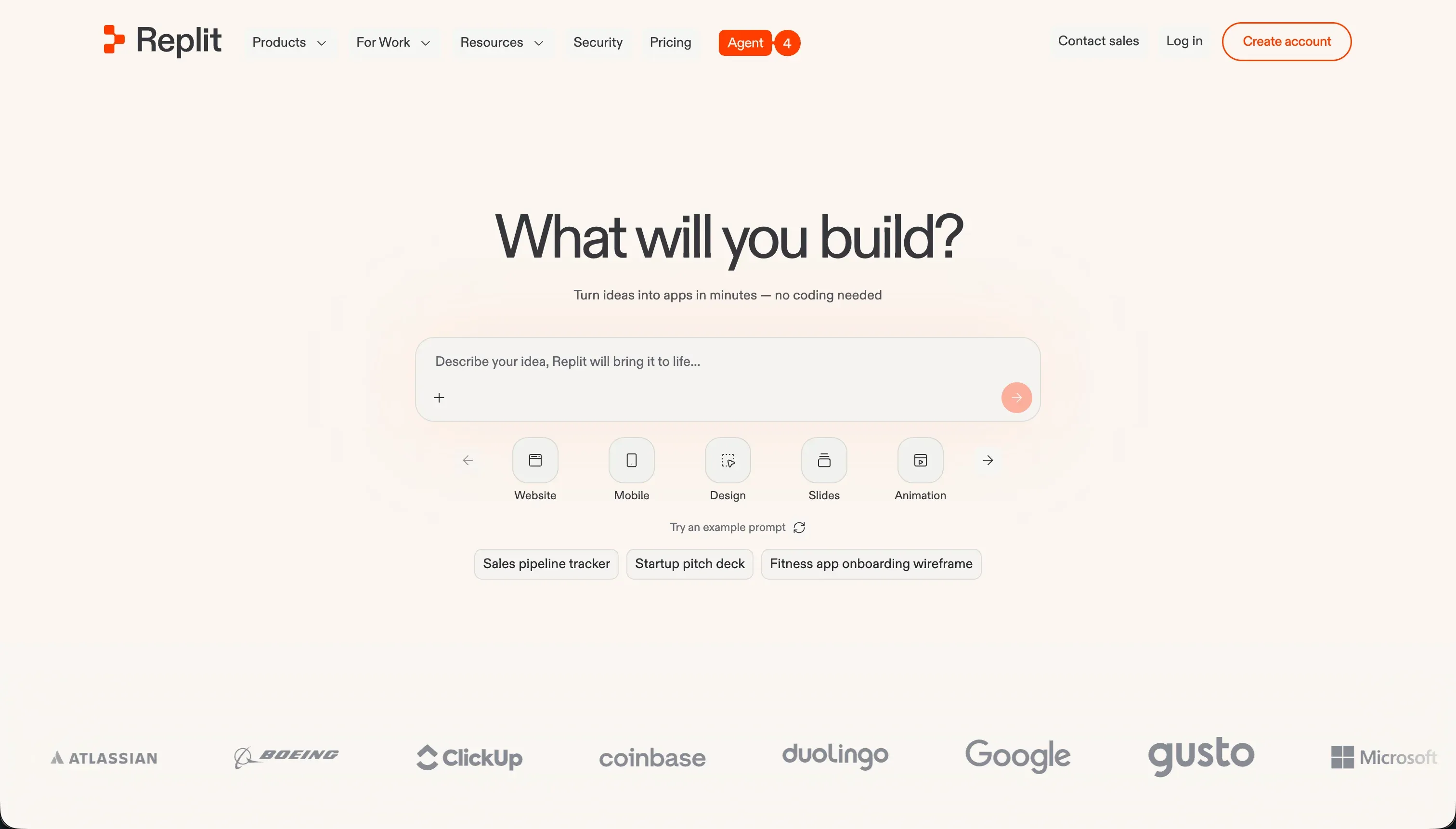
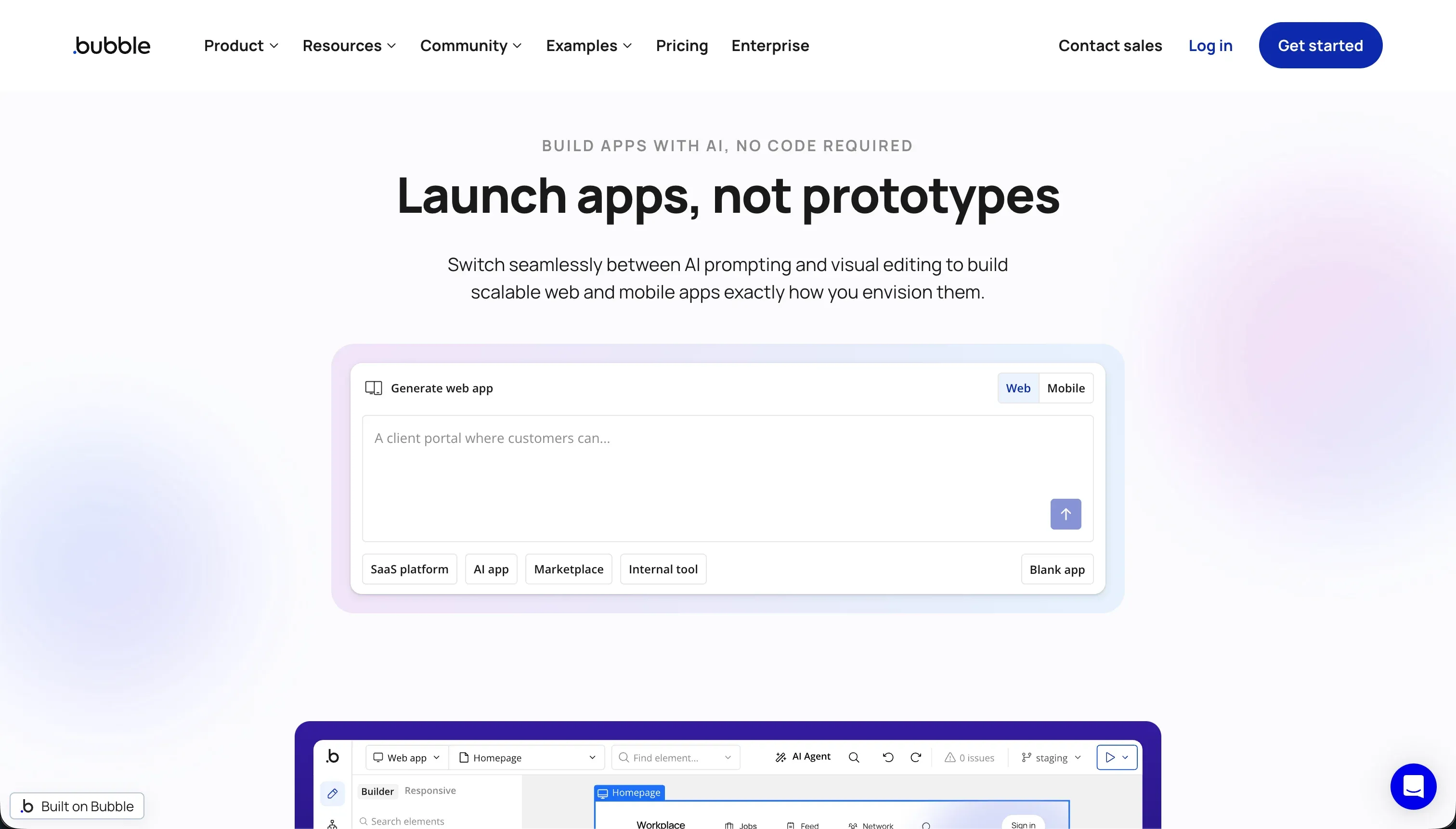
The procurement choice between Replit and Bubble is a clear choice between two different application architecture models. Replit is a collaborative, cloud-based development environment that relies on an autonomous AI agent to generate readable, standard code.
Bubble is a visual programming runtime that runs custom logic and database schemas entirely within a proprietary, closed environment.
Replit wins the aggregate scoring 7.4 to 6.8. Replit is the correct allocation for teams with a technical baseline that demand a standard code exit path, custom integrations, or complex multi-language execution. Bubble is the correct allocation for builders who require server-side security, visual workflow builders, and zero code management, but who can tolerate vendor lock-in and steep learning curves.
The decision in 30 seconds
| If your priority is… | Pick | Why |
|---|---|---|
| Readable, exportable application code | Replit | The output is human-editable React and Python synchronized with GitHub |
| Logins, client portals, and CRM layouts with flat pricing | Neither | Both tools demand custom infrastructure setup, where a business tool like Softr handles auth and database connections natively and predictably |
| Secure, server-side role and privacy rule configuration | Bubble | Server-side privacy rules and roles are visually configurable and proven at scale |
| Autonomous scaffolding and rapid AI generation loops | Replit | The Agent builds workspace file structures and deploys applications directly from natural language prompts |
| Pixel-precise, visual drag-and-drop frontends | Bubble | The responsive design editor does not rely on text prompts for layout fine-tuning |
What each platform is
What is Replit?
Replit is a cloud-based development studio designed to make software creation accessible through an autonomous AI Agent alongside an advanced browser IDE. Rather than outputting visual workflows, Replit writes, test-runs, debugs, and deploys real code across more than 50 programming languages.
A builder inputs text requests, and Replit’s Agent configures standard file structures, manages database schemas, and deploys the app to the cloud.
The platform’s workspace provides developers with direct container command-line control, a visual editor, package management, and multiplayer collaboration. Replit integrates standard open-source tools, PostgreSQL databases, and standard hosting controls, which makes it ideal for builders, operations teams, and non-technical founders seeking zero-setup development paths with a real development stack behind them.
What is Bubble?
Bubble is a visual web development environment that runs on a proprietary visual programming language. Builders construct applications by styling individual components, mapping visual workflows to event triggers, and structuring a built-in relational database. There is no code generation; the application logic is stored in visual definitions and run on Bubble’s web servers.
The system includes built-in user authentication, server-side data privacy rules, a backend workflow scheduler, and an API Connector to link external systems. Bubble also hosts a plugin marketplace containing over 8,000 community-built packages, targeting founders and operations managers who want to build custom multi-sided platforms without writing syntax.
The core difference
The core divergence is code execution vs proprietary engine configuration.
- Replit acts as an AI developer that writes, maintains, and deploys standard, exportable programming code in real time.
- Bubble is a closed, visual interface that stores logic in visual workflows and runs applications within its own managed runtime.
Where the scores diverge
Ease of build: Replit 6.5, Bubble 5.0. Replit scores 6.5, leading Bubble’s 5.0. Replit Agent generates full workspace architectures, deploys running previews, and applies fixes from plain language prompts in seconds, turning complex setups into simple conversations. Bubble takes substantial time to master.
Database mapping, visual condition variables, and custom APIs require a developer-like logic structure that keeps its learning curve exceptionally steep.
Maintainability: Replit 7.5, Bubble 6.0. Replit’s 7.5 beats Bubble’s 6.0. Replit’s application output is pure code synchronized to version control, which means developers can edit it manually or hand it off cleanly to avoid code-lock. The remaining deduction is the risk of AI-led iteration breaking existing code.
Bubble uses visual workflows instead of text, which avoids compilation bugs, but complex applications generate workflow sprawl that is very hard to audit, and the heavy browser interface lags during massive project changes.
Production readiness: Replit 8.0, Bubble 7.0. Replit scores 8.0, while Bubble lands at 7.0. Replit provides professional operations infrastructure, managing PostgreSQL with database rollbacks, custom domains, and automatic scaling containers out of the box. However, it requires technical baselines to prevent the AI from creating bug-generation loops.
Bubble is reliable in hosting and scheduler features, but point deductions stem from unoptimized database latency, editor RAM leaks on large containers, and reported payment integration inconsistencies.
Security & access control: Replit 6.0, Bubble 6.5. Bubble scores 6.5, winning over Replit’s 6.0. Bubble features server-side data privacy protections and role-based permissions natively inside the visual editor, though setup is entirely the builder’s responsibility.
Replit includes managed databases and secret storage panels, but roles and access permissions reside inside agent-written code. Verifying who can access which data objects requires reading code blocks directly rather than checking a visual interface settings panel.
Data & integrations: Replit 8.0, Bubble 8.0. Both tools tie at 8.0, but the integration architectures are entirely different. Replit connects to any service that standard developer code can reach, supporting 50+ languages with full PostgreSQL control; schema modifications require standard database language familiarity.
Bubble provides a solid relational database with visual types, a flexible REST API Connector, and thousands of plugins, but relies on community plugins that carry broken-dependency and abandonment risks.
Design flexibility: Replit 8.5, Bubble 8.5. Both platforms score 8.5 on design freedom. Replit allows unlimited front-end flexibility because developers can implement any UI library, framework, or custom interface code they can describe.
Bubble uses a pixel-precise, visual editor with absolute or coordinate positioning, leaving builders with total front-end control, which is the platform’s absolute strongest feature.
Cost comparison
Replit operates a subscription tier starting with Replit Core at $25/mo up to Replit Pro at $100/mo, coupled with a dynamic, usage-based credit system to run AI Agent commands. Every code revision, translation loop, and server container migration spends workspace credit balances.
In contrast, Bubble begins at $69/mo for Starter, up to Growth ($249) and Team ($649), with subscription tiers restricted by Workload Units (WUs). Inefficient logical workflows, unoptimized database queries, or user growth can trigger massive Workload Unit surges and scale costs rapidly.
Buyers must calculate the total cost of ownership carefully. For Replit, the risk is debugging loops where the AI consumes credits repeatedly to solve bugs it created. For Bubble, the vulnerability lies in unoptimized background tasks and heavy database schemas that require technical redesigns to prevent high Workload Unit overages.
For both tools, pricing is highly variable and depends on computation and resource configuration.
- Core $25/mo to Pro $100/mo
- Usage-based credits run AI Agent commands
- Every code revision and loop spends credit
- Risk: AI burns credits fixing bugs it created
- Starter $69/mo to Team $649/mo
- Workload Units cap each plan tier
- Inefficient workflows or queries spike WUs
- Risk: overages force technical redesigns
Lock-in and the exit path
Bubble has severe vendor lock-in. Because applications are built on a proprietary visual programming language, neither the code nor database architecture can be exported, meaning that leaving Bubble requires a complete rewrite of logic and frontends.
Replit provides a direct exit path: all outputs are readable React, Python, or standard language files that can be exported, hosted elsewhere, or synchronized directly to GitHub, making Replit the clean winner for long-term IP preservation.
- Proprietary visual programming language
- No code or database export
- Code and database architecture locked in
- Leaving requires a complete rewrite
- App runs on Bubble's runtime
- Logic and frontends rebuilt from scratch
Who should pick Replit
Pick Replit if:
- Technical teams and founders who require full ownership of the underlying custom code
- Builders looking to iterate quickly from natural language prompts while retaining IDE files
- Projects needing custom programming packages, standard databases, and custom backends
Do not pick Replit your team has no technical experience to handle code debugging, secret variables, and container deployment errors manually.
Who should pick Bubble
Pick Bubble if:
- Non-technical founders who want visually mapped logic flows and pixel-precise frontends
- Applications that require built-in, server-side data privacy controls and database role structures
- Software projects leveraging pre-built integrations from an ecosystem of over 8,000 plugins
Do not pick Bubble you need an exportable codebase to avoid vendor lock-in or require a flat, predictable monthly hosting cost.
What neither platform answers
Both Replit and Bubble assume the application is the product, forcing the builder to design logic, interfaces, database rules, and authentication from a blank slate.
Many buyers are actually trying to deploy standard business software - such as client portals, vendor dashboards, CRMs, or intranets - that rely on secure logins, clear user permissions, and minimal infrastructure upkeep.
For these operational tools, Replit hands you container configurations to manage, and Bubble introduces steep learning curves and high design maintenance.
For business workflows, Softr scores higher, specifically with an 8.0 on production readiness, 7.5 on maintainability, and 6.0 on security, by mapping interfaces to your data natively.
Softr provides secure user authentication, visual roles and user groups, and prebuilt dynamic blocks (like lists, tables, and calendars) that connect directly to Softr Databases or other tools like Airtable and HubSpot. You gain visual certainty and predictable software spend, while custom UI elements are kept isolated in secure Vibe Coding blocks.
If you require a native mobile application, FlutterFlow remains the better alternative.
Analyst verdict
Replit wins this matchup on aggregate score, landing a 7.4/10 against Bubble’s 6.8/10. Replit takes four of the six criteria, delivering faster initial builds with Agent 4 scaffolding, clean database structures, and superior code maintainability.
The final choice depends on whether you have technical expertise on your team. If you want readable, standard code and have developers to guide the AI, Replit is the superior pick. If you lack coding skills and require a visual system with built-in server permissions, and can accept the vendor lock-in, Bubble’s visual runtime is the safer decision.
Related reading: the Replit scorecard, the Bubble scorecard, and our scoring methodology.