

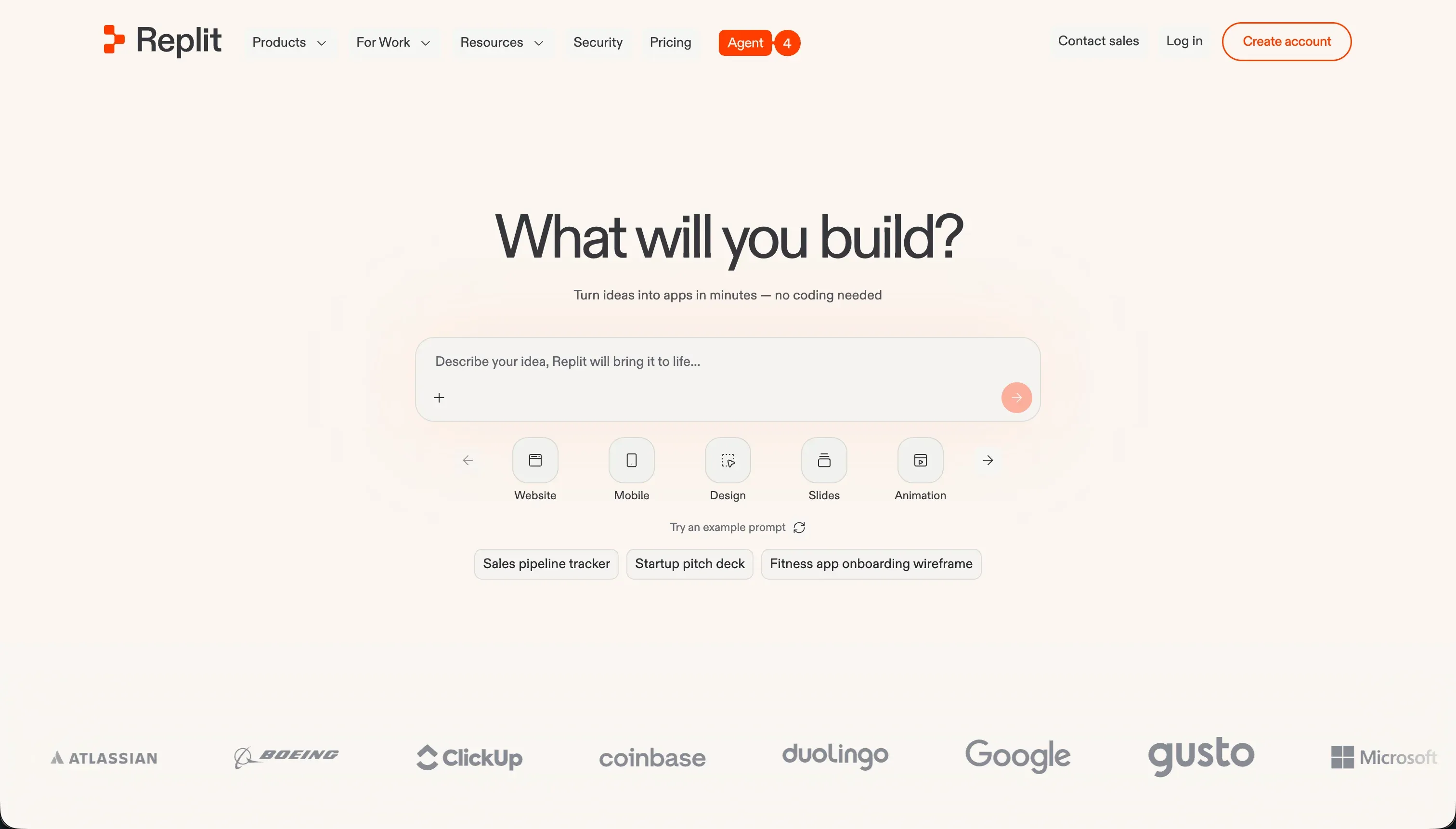

The shift toward agentic software creation presents buyers with two fundamentally different delivery models. Replit packages its autonomous agent inside a fully hosted, browser-based integrated development environment.
Claude Code dispenses with graphical environments entirely, running as an agentic command-line interface tool that executes actions directly in your local terminal.
Replit wins this matchup with an aggregate score of 7.4 against Claude Code’s 6.6. It secures the majority of the criteria by bundling deployment infrastructure, managed databases, and hosting alongside its generation agent. The decision flips to Claude Code only when the buyer is a professional engineer who demands local file control, git integration, and zero external IDE overhead.
The decision in 30 seconds
| If your priority is… | Pick | Why |
|---|---|---|
| Rapid prototyping with instant cloud hosting | Replit | It provisions and deploys to autoscaling infra with a single click, scoring 8.0 on production readiness |
| Refactoring local codebases via terminal CLI | Claude Code | Lives headlessly inside any bash or zsh terminal with direct shell write capabilities |
| Unlocking project scale without early memory loss | Replit | Avoids Claude Code’s early context compaction which drops large codebase constraints |
| Securing web endpoints via no-code permissions | Neither | Both tools require you to manually write or read agent-written code to manage role security |
| Pre-configured visual layouts without custom frontend code | Neither | Both systems output raw code, requiring frameworks like React or manual CSS editing |
What each platform is
What is Replit?
Replit is a cloud-native development platform that supports collaborative coding across dozens of programming languages. Its core agentic offering, Replit Agent, acts as an autonomous co-developer that can scaffold complete application architectures, install files, manage package dependencies, and run iterative self-correction loops to debug its own output from simple text prompts.
The platform integrates a full development workspace, providing shared multi-user editors, managed PostgreSQL databases with 28-day rollbacks, secrets management, and instant cloud deployments. It is designed for founders, prototyping teams, and developers who want to bypass local environment setup and deploy functional applications to web endpoints directly from a browser tab.
What is Claude Code?
Claude Code is an agentic command-line interface tool created by Anthropic that brings LLM-driven actions directly to the local terminal. Operating entirely headlessly, the agent reads, writes, and refactors local files in place while autonomously executing compile scripts, running automated testing suites, and orchestrating git version control commands.
The tool is designed exclusively for software engineers who require close alignment with their local development stacks, custom testing pipelines, and terminal utilities. Rather than running in a siloed sandbox, it uses granular permission prompts to gain system-level access, allowing it to evaluate terminal feedback and run complex development cycles on-disk.
The core difference
The primary dividing line is the packaging of the runtime environment and state management.
- Replit delivers a completely managed, sandboxed cloud IDE complete with automated hosting, managed SQL layers, and live public previews.
- Claude Code is a local terminal command utility that acts upon your existing local desktop directory and uses your system resources.
Where the scores diverge
Ease of build: Replit 6.5, Claude Code 4.0. Replit secures a 6.5 because its agent operates inside a visual workspace with a built-in preview pane, allowing builders to see their application render in real time and edit simple values directly. Claude Code drops to a 4.0 because it has no visual interface.
A non-engineer who cannot set up local directories, parse terminal logs, or configure build configurations will fail to construct anything with Claude Code, whereas Replit abstracts the initial workspace creation.
Production readiness: Replit 8.0, Claude Code 6.0. Replit scores an 8.0, offering autoscaling infrastructure, PostgreSQL, and custom domains straight out of the box with zero configuration spaghetti.
Claude Code scores 6.0 due to a critical technical constraint: on larger codebases, its context compaction drops project memory, leading to incorrect programming logic. Additionally, latency on complex tasks slows down the developer review loop, and buyers must handle all deployment, hosting, and SSL pipelines externally.
Maintainability: Replit 7.5, Claude Code 6.5. Replit’s 7.5 score is anchored by the fact that it yields real, exportable, version-controlled code. However, it is held back by the agent’s tendency to enter infinite debugging loops, re-introducing old bugs while consuming platform credits.
Claude Code scores 6.5 because while its local git commits are highly maintainable, its context limits require close human supervision during long editing sessions to prevent the agent from violating project-wide architecture rules.
Design flexibility: Replit 8.5, Claude Code 9.0. Claude Code captures a 9.0 design flexibility score because the developer controls the local framework files and can compile any visual library, utility, or layout structure. Replit follows closely at 8.5, as its browser-hosted code-editor similarly imposes no rigid workspace templates.
The slight advantage goes to Claude Code because local build systems give programmers direct control over asset pipelines without cloud container latency.
Security & access control: Replit 6.0, Claude Code 6.0. Both tools tie at 6.0. Replit provides proven secrets panels and database setups, but user permissions and roles are written entirely in code, forcing developers to audit raw scripts to verify access.
Claude Code features precise, per-action terminal permission prompts, but running an agent with system-level terminal execution permissions is inherently risky, and application-level authentication is still code that the user must write from scratch.
Data & integrations: Replit 8.0, Claude Code 8.0. Both platforms score an 8.0. Because both output raw code, there are no artificial limits: your application can connect to any database, webhook, or external API on the planet. The ceiling is the entire software ecosystem.
Replit sits slightly short of perfect because schema adjustments require database knowledge, while Claude Code loses its edge because every adapter, connection, and API integration is code you have to write yourself rather than utilizing pre-wired configurations.
Cost comparison
Replit runs on a hybrid subscription-and-credit model. The Replit Pro tier costs $100.00 per month (or $95.00 dynamically billed on annual plans) and includes $100.00 of dynamic monthly compute and agent credits.
Additional dynamic compute blocks must be purchased, and users report that complex debugging runs and automatic database checkpoints can deplete credits rapidly, sometimes resulting in unexpected overage bills.
Claude Code operates on a pure pay-as-you-go, usage-based token consumption model, billing directly for input and output API tokens processed during execution. Because its terminal agent frequently reads entire project indices and runs complex code summaries to locate files, debugging sessions can consume tokens aggressively.
Users report running up significant bills in short windows of intense iteration, meaning both platforms require precise financial forecasting.
Lock-in and the exit path
Both platforms score exceptionally well on exit ease because they produce standard codebases. Replit allows you to export your directory files and database rows directly, though moving off <app>.replit.app requires you to reconstruct your deployment parameters elsewhere.
Claude Code has zero vendor lock-in because it acts directly on your local disk inside your own git repository; leaving Claude Code means simply closing your local terminal window. Claude Code is the absolute winner for exit parity.
- Codebase: export directory files
- Codebase: already in local git
- Data: export database rows
- Data: already on your disk
- Deployment: rebuild parameters elsewhere
- Deployment: nothing to rebuild
- Domain: migrate off replit.app
- Domain: never existed
Who should pick Replit
Pick Replit if:
- Founders who want to build, preview, and host an application in a single visual tab without managing local runtimes.
- Teams that require real-time collaborative code editing alongside autonomous agent generation within a unified workspace.
- Prototypers who need an instant, managed PostgreSQL database with 28-day point-in-time recovery points built in.
Do not pick Replit if you have an existing local development architecture and want to avoid migrating project assets into a proprietary cloud-managed container.
Who should pick Claude Code
Pick Claude Code if:
- Professional software engineers who live in the local terminal and already have a preferred suite of testing and deployment tools.
- Teams working on highly confidential hardware or specialized networks who need local execution without uploading raw source code to external sandbox clouds.
- Organizations with existing, complex git-driven pipelines who need an AI collaborator to edit files locally.
Do not pick Claude Code if you are not a developer, as it provides no visual editing, database hosting, or web preview panels.
What neither platform answers
Both Replit and Claude Code are code-first platforms designed to produce raw codebases. If your actual objective is to deploy a secure business interface - such as a client portal, internal operations tracker, or partner CRM - both these tools will force you to manage frameworks, debug logic errors, and write complex authentication rules.
Every update requires reviewing code syntax, and the total cost of ownership scales with the developer resources required.
For operational business apps, a dedicated platform like Softr delivers a superior option, scoring 8.5 on production readiness and 9.0 on maintainability. Softr pre-builds core application infrastructure (such as secure user groups, visual granular visibility rules, and instant login configurations) on top of a relational database.
It can be paired with Retool for heavy internal developer logic, saving thousands of dollars in technical debt while ensuring that non-technical operators can safely edit layouts and logic without ever touching a command-line interface.
Analyst verdict
Replit wins this matchup with a scored aggregate of 7.4 to 6.6. It takes five of the six criteria, led by its ease of build and production readiness. By pairing its autonomous agent with managed autoscaling servers, pre-configured databases, and an accessible browser-based workspace, Replit provides a functional hosting ecosystem that abstracts away the overhead of local machine environments.
Claude Code is a specialized, terminal-only tool that excels on design flexibility but demands a professional engineering baseline. It is the correct procurement choice only if you are an experienced programmer who wishes to edit local files, runs tests on a machine with native system access, and manages version control in place.
For all other application trajectories, Replit provides a more complete product framework.
Related reading: the Replit scorecard, the Claude Code scorecard, and our scoring methodology.