

Codex and Softgen solve 2 different procurement problems. Codex is an AI coding agent for developer-led software delivery, while Softgen is a conversational no-code app builder for prompt-led MVP creation. One belongs in an engineering workflow; the other belongs in a founder-friendly prototyping stack.
Codex wins the general decision with a 7.1 aggregate score versus Softgen’s 5.1. It is the stronger choice for production readiness, maintainability, security, integrations, and design control. Softgen only flips the decision when a non-technical team needs the fastest path to a simple early product without standing up a real engineering environment.
The decision in 30 seconds
| If your priority is… | Pick | Why |
|---|---|---|
| Autonomous terminal work inside a real codebase | Codex | Built as a CLI coding agent that edits local repos, runs scripts, and works through git branches |
| Fast MVP generation without writing code | Softgen | Wins ease of build 7.0 to 4.0 through conversational app generation |
| Long-term maintainability with normal git workflows | Codex | Scores 8.0 on maintainability with version-controlled code and reviewable branch-based changes |
| Granular roles, permissions, and SSO for a business app | Neither | Codex leaves auth to engineers and Softgen’s access control remains basic |
| Custom frontend behavior and precise UI control | Codex | Leads design flexibility 9.0 to 5.0 because teams can edit raw frontend code |
What each platform is
What is Codex?
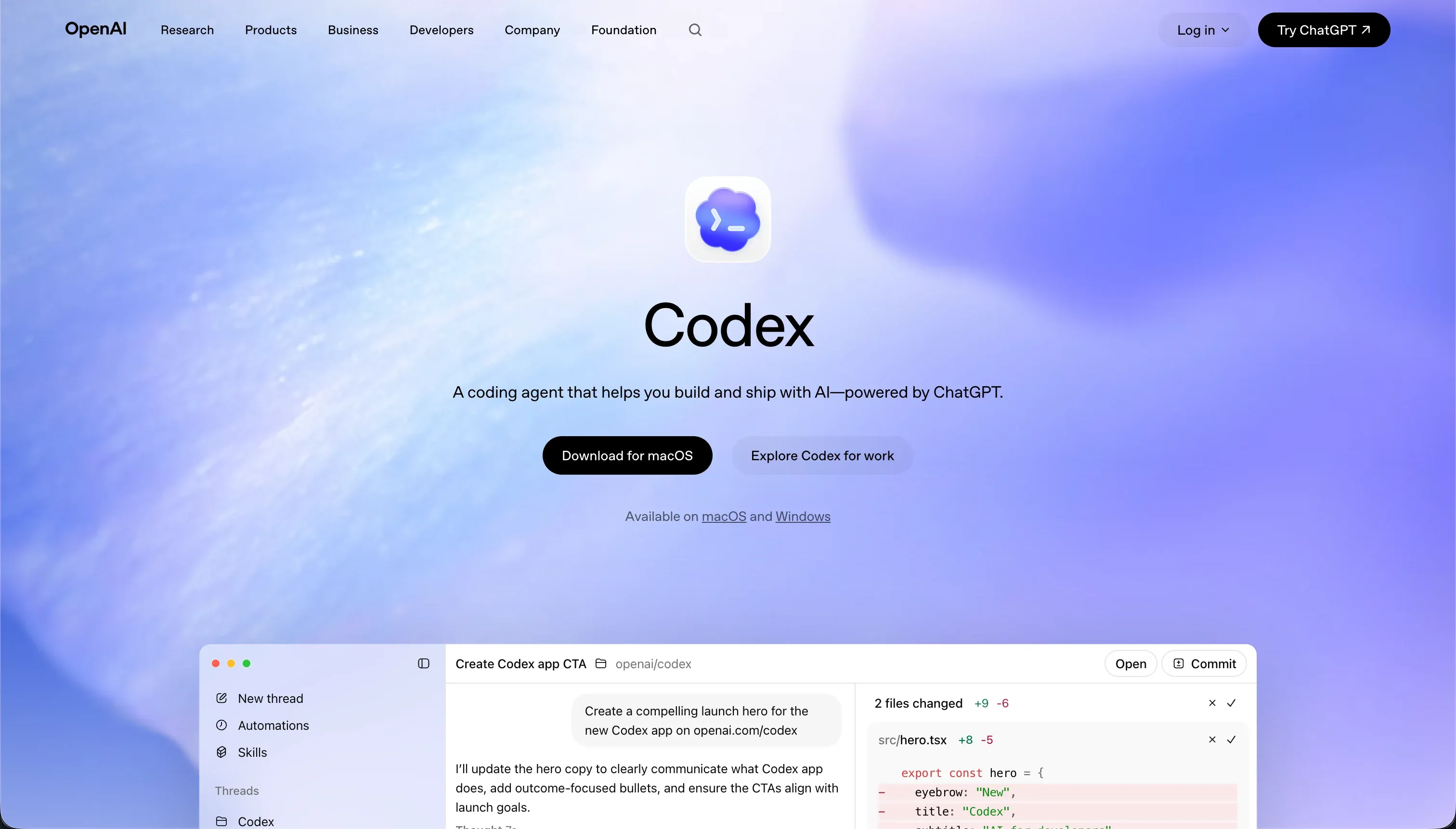
Codex is a terminal-based AI coding agent that works directly inside a developer’s local repository. Instead of giving you a visual builder or managed runtime, it reads project files, writes code, runs shell commands, and helps execute changes through normal development workflows.
Its documented behaviors center on local repo access, git branch or worktree handling, command execution, and code generation that developers can review before shipping. Research notes also point to parallel task handling and desktop log visibility for tracking what the agent changed.
It is genuinely built for technical teams, especially senior engineers who already manage hosting, testing, deployment, and code review themselves.
What is Softgen?
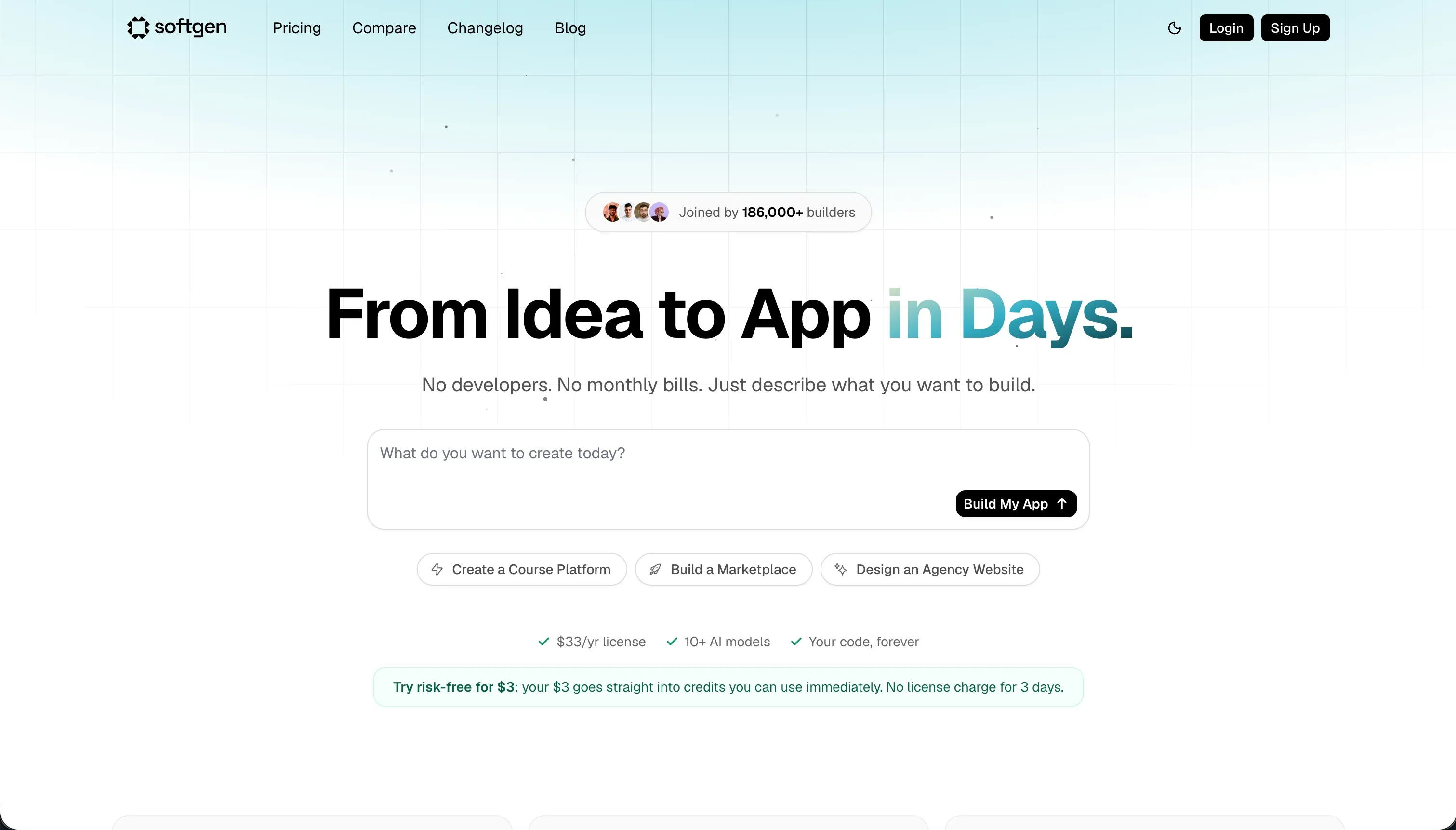
Softgen is a browser-based conversational app builder that creates web apps from chat prompts. Rather than exposing a drag-and-drop canvas or local code workflow first, it asks users to describe the app, then generates the interface, schema, and hosted app experience inside its own platform.
The research highlights generated relational database schemas, basic authentication flows, one-click deployment, custom domain support, and starter integrations such as Stripe pages. It also offers code export for teams that outgrow the platform. Softgen is genuinely built for non-technical founders, creators, and indie hackers who want to validate a concept quickly without configuring local tooling or servers.
The core difference
These tools diverge most on where the application actually lives and changes: inside your own codebase or inside a hosted conversational builder. That single difference drives nearly every score gap in this matchup.
- Codex works by generating and modifying code in a developer-controlled environment that your team must own, review, host, and operate.
- Softgen works by turning prompts into a hosted web app experience inside its own runtime, with the platform handling the application shell for you.
Where the scores diverge
Maintainability: Codex 8.0, Softgen 4.0. Codex wins here because the output lives in a standard repository with git history, reviewable diffs, and branch-based collaboration. Those are durable maintenance primitives that survive well past launch.
It still takes a deduction because maintainability depends on the engineers supervising the generated code and keeping architecture disciplined. Softgen falls behind since ongoing edits depend heavily on prompting the assistant, which raises the risk of regressions and messy iteration over time.
Design flexibility: Codex 9.0, Softgen 5.0. Codex wins decisively because the team can change raw frontend code, CSS, and framework logic without waiting on template boundaries. That means exact UI behavior and pixel-level decisions are still possible if the developers are capable.
The deduction is simply that design freedom is only as good as the frontend talent applying it. Softgen loses ground because its generated layouts sit inside more rigid pre-configured structures, so fine adjustments can become frustrating prompt iteration instead of direct editing.
Ease of build: Codex 4.0, Softgen 7.0. Softgen pulls ahead because a non-technical user can describe an app in chat and get pages, schema, and deployment scaffolding without touching a terminal. That lowers the startup burden dramatically for MVP work.
The deduction is that prompt-led iteration still becomes clumsy when you need exact changes, since layout refinement can turn into repeated chat loops. Codex trails because it assumes comfort with repositories, command lines, and code review from the first minute.
Data & integrations: Codex 8.5, Softgen 5.5. Codex leads because a developer-owned codebase can connect to virtually any database, API, library, or external system your team can implement. That gives it a much higher ceiling than a managed prompt builder.
The deduction is that nothing is pre-wired, so teams pay with engineering time instead of getting ready-made connectors. Softgen covers the basics with generated schemas and a few standard integrations, but that narrower integration surface is better for validation than for complex operational software.
Production readiness: Codex 7.0, Softgen 4.5. Codex scores better because it produces normal code artifacts that engineers can test, review, deploy, and scale through established software practices. That makes it far easier to fit into a serious delivery lifecycle than a prompt-only builder.
The deduction is that AI-generated code still needs human review, especially for edge cases and architecture choices. Softgen loses ground because the research frames it as better suited to early validation than hardened production software.
Security & access control: Codex 6.0, Softgen 4.5. Codex comes out ahead mostly because it does not cap what a technical team can implement for auth and access control in code. If your engineers need custom policies, they can build them against whatever stack they choose.
The deduction is that Codex does not provide those protections for you; local command execution and custom auth both require careful oversight. Softgen includes basic sign-in flows, but the research notes weaker granularity around roles and permission depth, which limits confidence for serious multi-user apps.
Cost comparison
The pricing models are fundamentally different. Codex is bundled into ChatGPT subscriptions rather than sold as a standalone builder, with research citing tiers from Plus at $20/mo to Pro at $200/mo, and the practical bill movement tied to model usage and how heavily teams run coding sessions.
Softgen uses a low annual access fee of $33/year, then charges separately for AI generation through pay-as-you-go credits, so the bill moves when teams keep prompting, revising, and regenerating app output.
Buyers should forecast more than the sticker price. With Codex, the hidden lines are developer time for reviewing generated diffs, your own hosting and infrastructure spend, and the maintenance burden that comes with owning the full stack.
With Softgen, the hidden lines are credit burn during iteration, cleanup work if generated layouts or logic need repeated fixes, and migration effort if you eventually export the code and move to a self-managed stack.
Lock-in and the exit path
Codex has the cleaner exit because it works directly in your local environment and leaves you with the codebase you already own; there is no platform runtime you must keep using after generation.
Softgen does offer code export, which is a real exit path, but leaving still means rebuilding the operating setup around that exported code and giving up the conversational builder that powered ongoing edits.
In plain terms, Codex exports everything by default because it never held the app for you, while Softgen lets you leave but not without extra rebuilding work around hosting and future maintenance.
- Works in your local environment
- You already own the codebase
- No platform runtime to keep
- Everything exports by default
- Code export is real
- Rebuild the operating setup
- Give up the conversational builder
- Hosting and maintenance to redo
Who should pick Codex
Pick Codex if:
- Developer-led teams that want AI help inside existing repos, branches, and review workflows, reflected in Codex’s 8.0 maintainability score
- Products that need custom integrations or unusual backend logic, where Codex’s 8.5 data & integrations score matters
- Teams that care about exact frontend control and can exploit Codex’s 9.0 design flexibility with real engineering talent
Do not pick Codex if you do not have engineers who can manage repositories, review generated code, and own hosting, security, and deployment themselves.
Who should pick Softgen
Pick Softgen if:
- Non-technical founders who need the fastest route to a simple MVP and benefit from Softgen’s 7.0 ease of build score
- Indie hackers testing a concept with generated pages, simple relational data, and basic hosted deployment
- Small teams that value low entry cost and are comfortable trading long-term flexibility for short-term speed
Do not pick Softgen if your app needs deep role logic, complex integrations, or highly custom interface control that must hold up over multiple years.
What neither platform answers
Many buyers reading this matchup do not actually need an AI coding agent or a prompt-first web app generator. They need a business app: a client portal, internal tool, CRM, or partner workspace defined by logins, permissions, structured data, and low maintenance after launch.
In that lane, Softr is the better recommendation because it is purpose-built for operational business apps and scores 8.5 on production readiness, 9.0 on maintainability, and 8.5 on security & access control.
Softr is the honest fit when the app’s core requirement is controlled access to data with minimal engineering overhead, not open-ended code generation.
For buyers who instead want a more code-forward environment and mandatory ownership of the stack, Replit is the better alternative because it is built around developer-controlled coding and deployment rather than business-app primitives.
That split keeps the recommendation honest: Softr for managed business software, Replit for builder-led code ownership.
Analyst verdict
Codex wins 7.1 to 5.1 overall. It takes production readiness, maintainability, security & access control, data & integrations, and design flexibility, while Softgen keeps only ease of build. That pattern makes the headline simple: one tool is stronger for software you expect to operate seriously, and the other is stronger for getting something visible on screen fast.
The reason the result is not closer is that Codex works in the same environment professional teams already use to build and maintain products. Git-based changes, local execution, and unrestricted integration depth create a far better long-term path, even after deducting for the review burden that AI-written code still brings.
Softgen’s strengths are real, but they are concentrated in startup speed rather than operational durability.
The decision flips only when speed for a non-technical team matters more than long-run control. If your goal is a simple MVP and Softgen’s 7.0 ease-of-build advantage is the deciding factor, buy Softgen. If you expect the app to become a maintained product with custom logic, Codex is the better buy.
Related reading: the Codex scorecard, the Softgen scorecard, and our scoring methodology.