


This comparison evaluates two highly divergent approaches to building applications with artificial intelligence. Claude Code is an agentic command-line tool designed for engineers who want an autonomous assistant directly inside their local terminal and version-controlled repository.
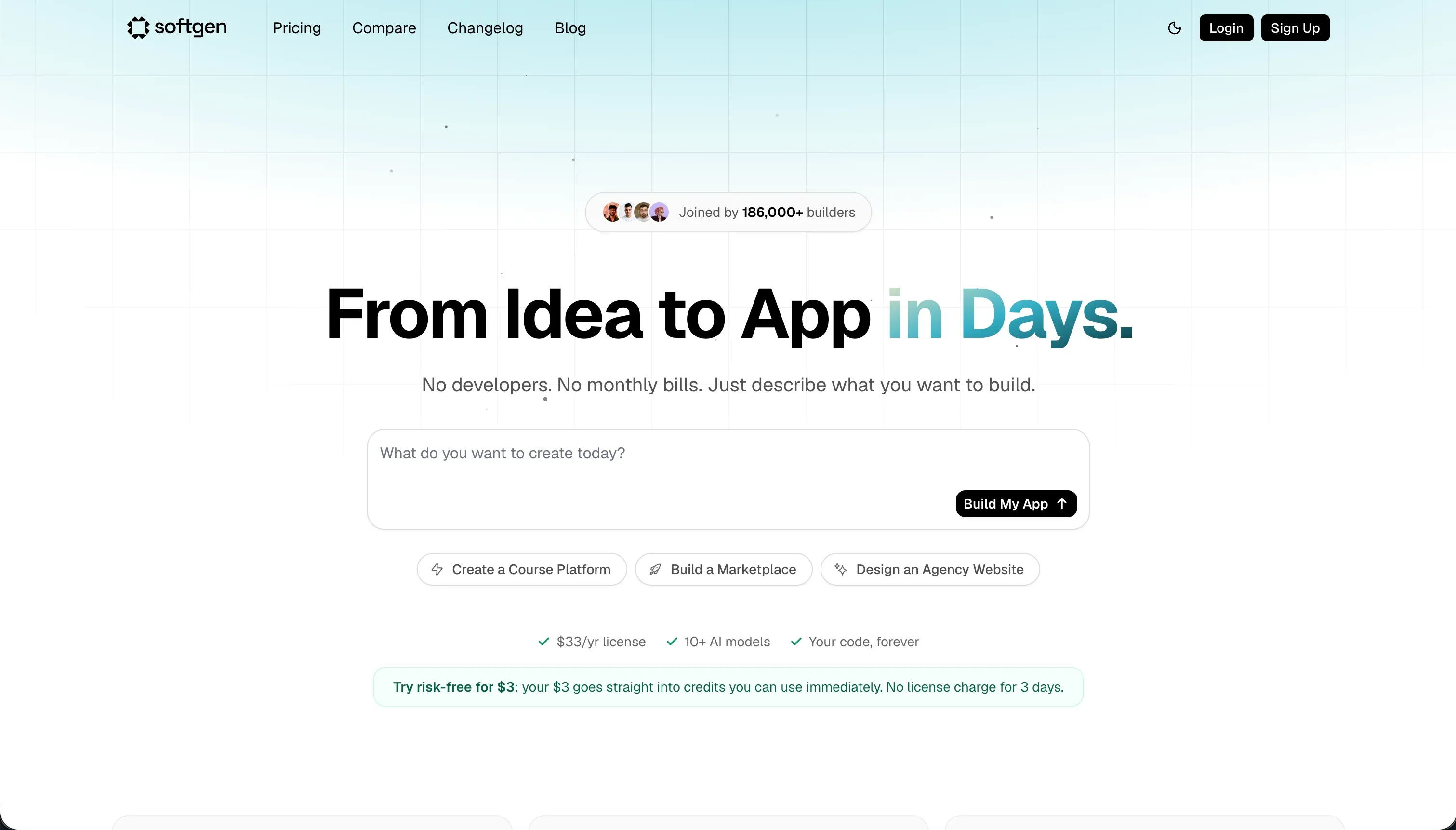
Softgen is a chat-based visual application builder engineered to generate basic web application mockups, relational databases, and standard layouts within a hosted cloud platform.
Numbers before adjectives decide this matchup. Claude Code wins on aggregate, scoring 6.6/10 against Softgen’s 5.1/10. Because Claude Code operates on raw code within your own environment, it delivers structural advantages in data, maintainability, and visual customization that Softgen’s early-stage hosting platform cannot match.
The decision flips only if your team lacks any engineering capacity and needs a fast, plain-language prototype built from scratch.
The decision in 30 seconds
| If your priority is… | Pick | Why |
|---|---|---|
| Pixel-level interface customization | Claude Code | raw code output provides bounded-only-by-framework layout freedom scoring 9.0 |
| Fast MVP creation for non-technical users | Softgen | Cascade agent scaffolds basic relational layouts using chat prompts scoring 7.0 |
| Deep backend terminal and shell execution | Claude Code | agent runs tests and executes local bash commands autonomously |
| Evolving an app without prompting fatigue | Neither | Softgen lacks a visual drag-and-drop editor and Claude Code lacks a graphic interface |
| Secure row-level access control for business data | Neither | both platforms score poorly as security is either completely hand-written or extremely basic |
What each platform is
What is Claude Code?
Claude Code is an agentic, terminal-based companion developed by Anthropic that acts as a local developer. It executes as a command-line interface directly within local environments like bash or zsh, reading and editing local directories without relying on a browser-based graphic interface.
This agent is built to handle the mechanical overhead of software engineering. It automatically edits workspace files, runs test suites, queries shell configurations, stages changes, and writes git commit messages. It is genuinely built for engineers and technical leads who want to accelerate their development loop within their existing IDEs and local environments.
What is Softgen?
Softgen is a conversational application builder that generates hosted web applications from chats. It uses its conversational Cascade agent to help users outline, architect, and assemble web pages, link basic relational databases, and configure simple authentication forms.
The platform operates purely in a cloud-hosted canvas, allowing users to modify copy, adjust pre-coded schemas, and hook up basic Stripe payment gateways through prompts. It is primarily built for non-technical creators, indie hackers, and early-stage startup founders searching for a low-cost subscription to deploy visual prototypes instantly.
- Terminal-based agent from Anthropic
- Runs locally in bash or zsh
- Edits files, runs tests, stages git changes
- Built for engineers and technical leads
- Conversational Cascade agent
- Cloud-hosted canvas, no terminal
- Generates pages, schemas, auth, Stripe
- Built for non-technical founders
The core difference
The core divergence is a complete paradigm split: editing local raw code directly within a terminal versus prompting a locked-down, visual container in the cloud.
- Claude Code functions as a headless local developer with full shell execution permissions, requiring a prepared local development environment and deep architectural knowledge.
- Softgen acts as a guided constructor that generates web layouts inside pre-packaged blocks, keeping code compilation and hosting entirely hidden from the user.
Where the scores diverge
Design flexibility: Claude Code 9.0, Softgen 5.0. Claude Code scores an exceptional 9.0, whereas Softgen scores a flat 5.0. Claude Code generates raw frontend files, leaving visual styling and layout decisions bounded only by the capabilities of the team’s chosen visual framework. Softgen locks users into web modules with predefined styles.
Fine visual alignment via prompts frequently triggers repetitive loops, consuming design credits without producing the exact visual customization required.
Ease of build: Claude Code 4.0, Softgen 7.0. Softgen takes this criterion with a score of 7.0 compared to Claude Code’s 4.0. The Cascade agent guides non-technical users through a structured planning workflow, mapping out simple backend schemas and generating page structures in plain language.
Claude Code offers zero graphic assistance; it lives in the terminal, meaning non-engineers who cannot manage environments, write syntax, or manage local build dependencies cannot get the tool to output anything useful.
Maintainability: Claude Code 6.5, Softgen 4.0. Claude Code scores 6.5, whereas Softgen scores 4.0. Claude Code edits your files locally, generating clean change steps, staging commits, and committing directly to your repository’s history, although developers must watch for early compaction where the agent forgets project memory rules.
Softgen features no visual drag-and-drop editor, forcing builders to return to the chat interface for every single iteration. This conversational loop increases prompting fatigue, creates versioning headaches, and risks introducing unmanageable technical debt.
Data & integrations: Claude Code 8.0, Softgen 5.5. Claude Code scores 8.0 while Softgen scores 5.5. Because Claude Code acts on real codebases, it can implement any API, custom database query, or library supported by your framework without platform constraints.
Softgen relies on pre-configured blocks, limiting integrations to a narrow surface of standard utilities like basic Stripe payment gateways, though it does generate clean initial SQL schemas for its hosted Postgres databases.
Production readiness: Claude Code 6.0, Softgen 4.5. Claude Code scores 6.0 while Softgen lands at 4.5. Claude Code produces standard, testable production code on whatever stack your team currently maintains, though its score is dragged down by high latency on complex prompts and context-compaction limits on large codebases.
Softgen is limited by its early product state; reviewers highlight that the platform lacks polish, forcing teams to navigate major trade-offs between rapid prototyping speed and the long-term structural scaling needed for performance.
Security & access control: Claude Code 6.0, Softgen 4.5. Claude Code holds 6.0 against Softgen’s 4.5. Claude Code utilizes a strict permission verification protocol, prompting the user before executing any command or editing a file to prevent rogue scripts. However, any app-level authentication logic must still be written by hand by the developer.
Softgen packages standard authentication templates and sign-in modules out of the box, but its internal access controls are extremely basic, lacking granular row-level, field-level, or button-level visibility logic.
Cost comparison
The pricing models are structurally mismatched. Claude Code uses a pure usage-based, pay-as-you-go API model, charging strictly for the input and output tokens consumed per run. This model offers high flexibility but creates token cost uncertainty, particularly during long debugging runs where the CLI agent may repeatedly parse project directories.
Softgen avoids monthly plan fees, choosing an alternative configuration: a low $33/year membership fee coupled with pay-as-you-go AI credit packages to fund design and database generations.
The secondary cost lines represent where buyers must allocate capital. With Claude Code, the real expense is developer latency and engineering talent as technical staff must verify every action prompt and manage the local environment.
For Softgen, the hidden costs lie in credit burn during failed layout generations and the long-term engineering cost of rewriting or refactoring exported projects once the application scale breaks the simple chat container.
Lock-in and the exit path
The exit paths are highly distinct, with Claude Code providing complete freedom. Because Claude Code edits local files directly in your environment, there is zero platform lock-in; you own the codebase and can disable the tool instantly without changing your build.
Softgen hosts your application on their environment, but they provide code export as a clean exit ramp if your project outgrows their platform. However, porting and maintaining that exported code on external hosting usually requires significant manual engineering setup.
Who should pick Claude Code
Pick Claude Code if:
- Software teams with pre-existing, locally configured codebases who need an autonomous agent to refactor files and write unit tests.
- Developers who prioritize complete codebase ownership, native git version control, and zero hosting lock-in.
- Engineers building complex web systems requiring direct terminal, shell, and build-tool pipeline access.
Do not pick Claude Code if you are a non-technical operator who cannot set up local terminal environments, execute build scripts, or manually troubleshoot compiled code.
Who should pick Softgen
Pick Softgen if:
- Non-technical founders looking to scaffold a visual web mockup or basic software prototype in a few days.
- Indie hackers seeking a low-cost tool with basic database and Stripe integrations to validate simple SaaS layouts.
- Creators who prefer a conversational planning assistant to map database tables without writing any SQL.
Do not pick Softgen if you need to scale custom interfaces, avoid prompting fatigue, or implement granular access security on database rows.
What neither platform answers
Both Claude Code and Softgen approach application development from extreme angles. One demands terminal-level developer fluency to operate, while the other locks you into a rigid chat-prompting container that lacks visual precision and fine scalability.
If you are trying to deploy standard business software, such as client portals, vendor dashboards, or internal operations tools, neither platform offers the correct baseline.
For these operational use cases, Softr represents a much more reliable approach. Softr scores 8.5 on production readiness, 9.0 on maintainability, and 8.5 on security & access control because it uses a visual drag-and-drop block interface connected to stable database structures.
It establishes pre-built, secure authentication, client-safe CRM integrations, and granular user visibility rules visually instead of relying on fragile code generation. For teams who want absolute code-first control without terminal boundaries, Replit remains a stronger alternative.
Analyst verdict
Claude Code wins this comparison, scoring 6.6/10 against Softgen’s 5.1/10 on the aggregate scorecard. While Softgen holds a distinct lead on ease of build (7.0 vs. 4.0) for non-developers, Claude Code sweeps the remaining five criteria, winning on maintainability, production readiness, and design flexibility by substantial margins.
Choose Claude Code if you have the engineering expertise to manage a local code repository and need an autonomous agent to handle manual terminal modifications. Select Softgen only if you are non-technical, want to test a visual concept under a tight timeline, and do not need to scale performance past a basic structural baseline.
Related reading: the Claude Code scorecard, the Softgen scorecard, and our scoring methodology.