

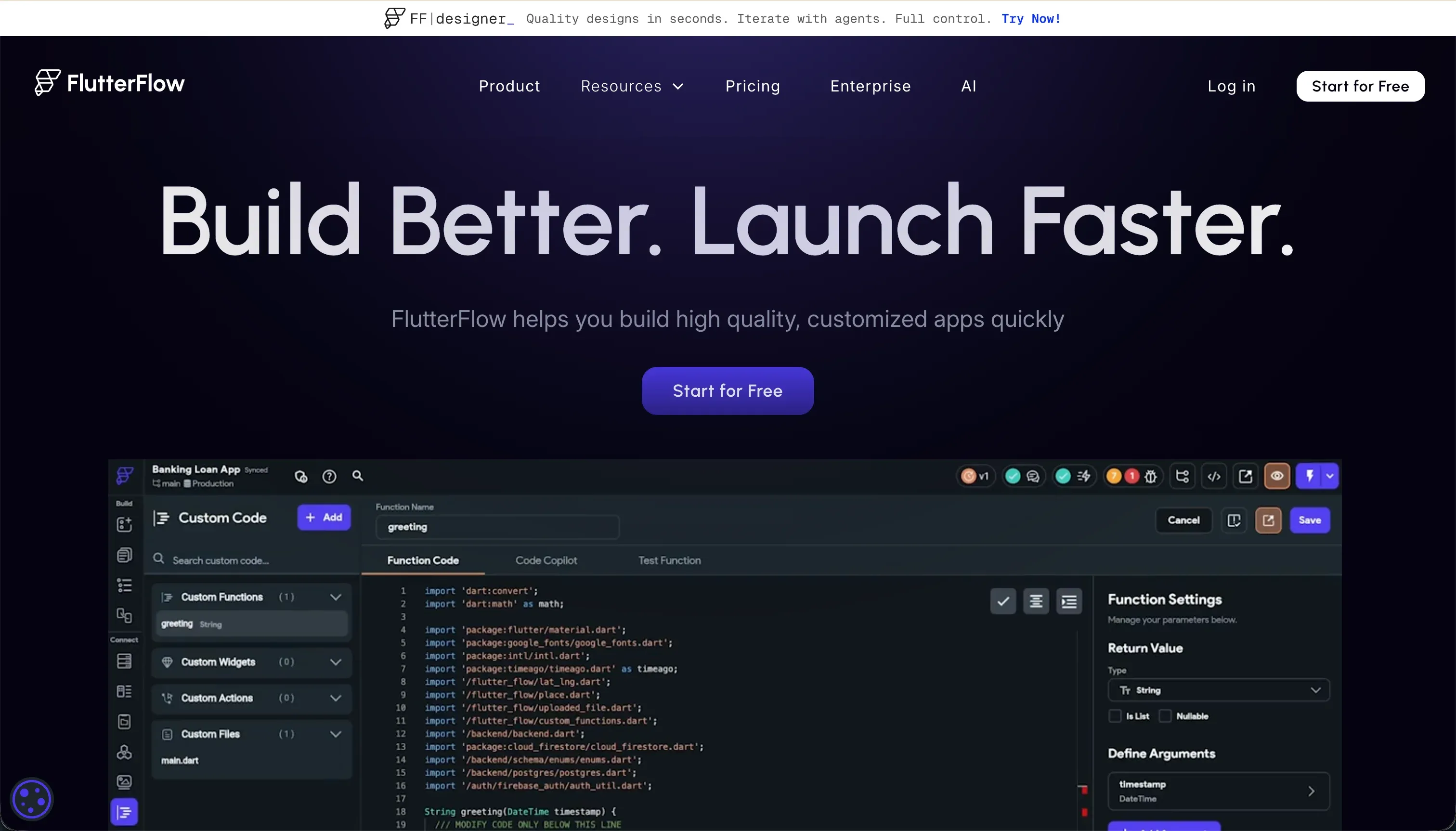
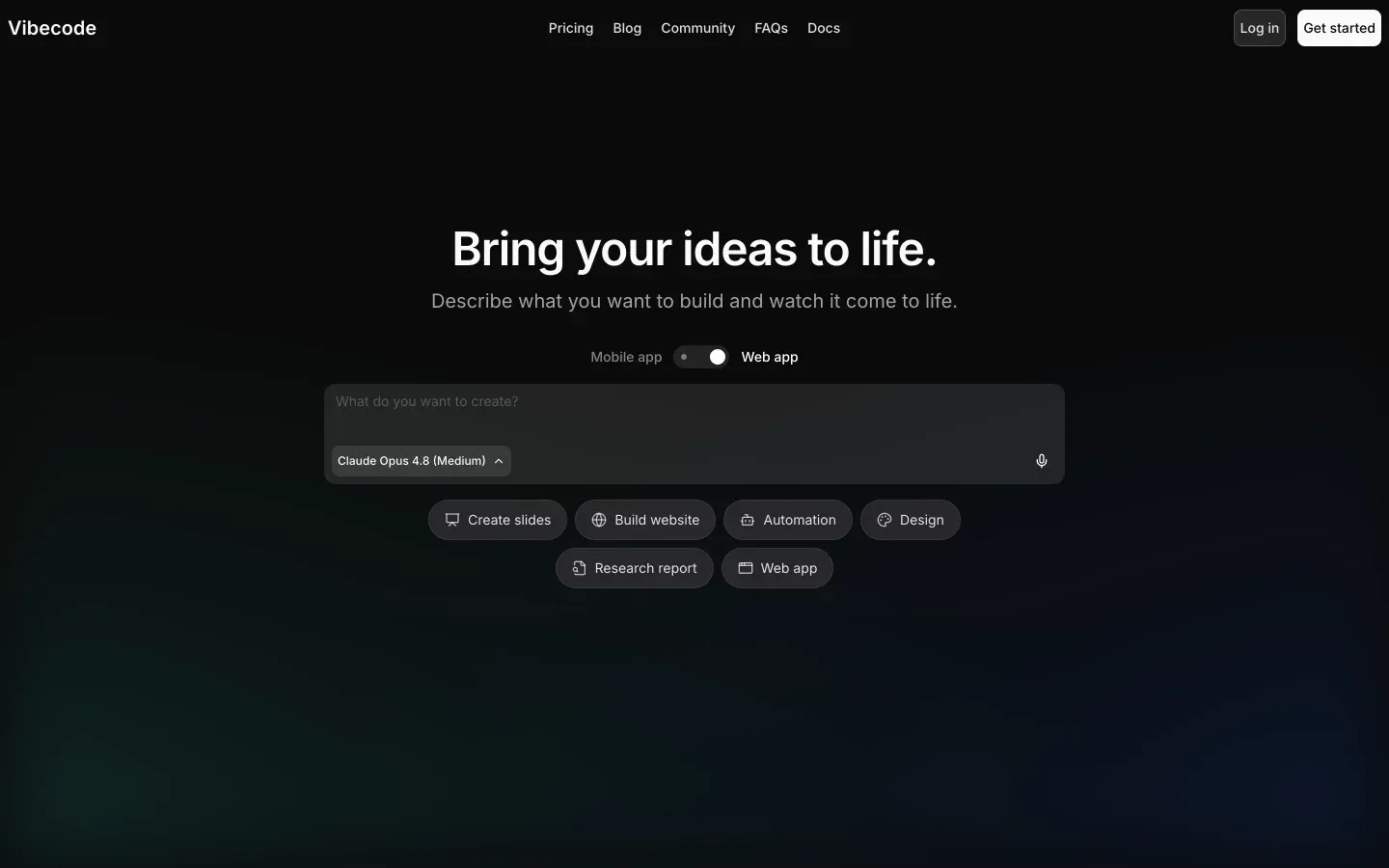
The procurement decision between FlutterFlow and VibeCode represents a fundamental choice between visual engineering and conversational vibe-coding. FlutterFlow compiles native iOS and Android apps through a visual interface representing Flutter widget trees.
VibeCode builds mobile-first applications directly from plain-English prompts, acting as an AI developer that provisions backend infrastructure and packages store-ready applications.
FlutterFlow wins the aggregate decision with a score of 6.3/10 against VibeCode’s 6.1/10. VibeCode keeps the advantage on immediate ease of build, but FlutterFlow offers a more stable visual framework and the highest mobile design ceiling in this roster. This aggregate scorecard flips only if the buyer lacks a developer mindset and wants to iterate entirely through conversational AI prompts.
The decision in 30 seconds
| If your priority is… | Pick | Why |
|---|---|---|
| Pixel-level native mobile interface control | FlutterFlow | Scores 9.0 on design flexibility with widget-level layout trees |
| Building without a developer layout mindset | VibeCode | Generates complete native layouts from plain-English prompts |
| Out-of-the-box business portals and CRMs | Neither | A dedicated business tool like Softr handles security and permissions natively |
| Compiling clean, readable code with Git integration | FlutterFlow | Exports robust, standardized Dart code and integrates with Git |
| Zero-configuration backend with built-in storage | VibeCode | Provisions database, auth, and cloud storage on its native cloud setup |
What each platform is
What is FlutterFlow?
FlutterFlow is a visual development platform built for compiling native iOS and Android applications. Powered by Flutter, the platform converts visual drag-and-drop actions into developer-grade Dart source code that can be exported or pushed to app stores at any time.
The platform provides a visual widget tree editor mapping directly to Flutter’s layout engine of containers, columns, rows, and stacks. It features native Firebase and Supabase integration, codeless deployment to Google Play and Apple TestFlight, and an AI generation panel that produces UI screens, custom functions, and schemas locally.
What is VibeCode?
VibeCode is an AI-powered, mobile-first app builder designed to let users create and publish native applications using plain-English prompts. Operating strictly on the vibe-coding model, it treats the builder as an executive director who describes features while the AI generates and deploys the code.
The tool natively provisions a backend database, user authentication, and cloud storage while offering instant mobile-layout previews on your device. For developer teams, it features built-in SSH access to code editors like Cursor and raw code export on its professional tiers, avoiding hard lock-in.
The core difference
The primary axis of divergence between these platforms is how they map the translation from idea to native code.
- FlutterFlow acts as a visual IDE where the builder manually constructs, edits, and debugs a structured Flutter widget tree.
- VibeCode removes the visual editor canvas entirely, generating code iteratively through natural-language prompts behind a mobile-first preview.
Where the scores diverge
Ease of build: FlutterFlow 4.5, VibeCode 7.0. VibeCode scores 7.0, outperforming FlutterFlow’s 4.5 by removing layout structures entirely in favor of plain-English prompts. A buyer can go from a description to an on-device layout in a single conversational pass.
FlutterFlow requires an understanding of Flutter layout constraints, state management, and database relations from day one. Buyers complain of a steep learning curve and a visual interface buried in menus with unhelpful error messages during local debugging.
Design flexibility: FlutterFlow 9.0, VibeCode 7.0. FlutterFlow scores 9.0, representing the gold standard for mobile layouts. You have pixel-level visual control over genuinely native iOS and Android interfaces, though compiling to Flutter Web remains heavy for public, SEO-indexed sites.
VibeCode scores a respectable 7.0; it quickly formats designs to native smartphone dimensions from natural language, but lacks a visual canvas for direct drag-and-drop pixel customization.
Production readiness: FlutterFlow 7.0, VibeCode 5.5. FlutterFlow scores 7.0 against VibeCode’s 5.5 due to compiled stability. FlutterFlow produces standard, predictable Flutter code with direct pipeline deployments to Apple and Google stores, meaning your application runs on proven runtime architectures.
VibeCode handles backend provisioning automatically, but generating a complex application purely through conversational code risks unseen runtime crashes, silent logic breaks, and code patterns that fail store review without a thorough manual audit.
Maintainability: FlutterFlow 5.5, VibeCode 5.5. Both platforms score 5.5, indicating shared difficulties in long-term app evolution. FlutterFlow is structured because you edit the widget tree directly, but its browser-based editor is known to lag heavily once your application scales past a dozen screens.
VibeCode keeps a clean exit path with SSH and code export, but its conversational engine can lose architectural context inside larger, complex codebases, producing messy, unoptimized code that is hard to manage over time.
Security & access control: FlutterFlow 5.0, VibeCode 5.0. The platforms tie at a mediocre 5.0, as neither offers out-of-the-box role constraints for data storage. FlutterFlow provides the interface hooks for Firebase and Supabase, but the security rules and authentication must be configured manually inside those external backends.
VibeCode generates user authentication, but its row-level permissions rely entirely on AI-generated code. Both platforms require technical, manual reviews to prevent data exposure to end users.
Data & integrations: FlutterFlow 6.5, VibeCode 6.5. Both platforms score 6.5, showing equal utility wrapped in different mechanics. FlutterFlow features native, visual panels for Supabase, Firebase, and customizable REST APIs, though setting them up requires a manual integration loop.
VibeCode hosts your data on its native cloud database and includes built-in integrations to GPT, Gemini, and general APIs; however, these API requests are directly metered through your plan’s AI credits.
Cost comparison
FlutterFlow charges on standard software subscriptions, with a Free tier scaling to Standard at $22/mo (allowing code export) and Pro at $50/mo (enabling store deployment). VibeCode operates on a credit-based model wrapped inside subscription tiers.
Its Plus tier is $20/mo with $20 in AI credits, Pro starts at $50/mo with $55 in credits, and Max runs $200/mo. VibeCode meters your prompts, preview updates, and API calls dollar-for-dollar through the raw cost of LLMs.
FlutterFlow’s total cost is predictably flat, meaning your bill will not spike during high-frequency iteration cycles or error debugging. VibeCode’s variable cost model means your burn rate is dependent on prompting frequency. Buyers should budget for debugger-loop overages on VibeCode, where fixing conversational regression loops can consume plan credits rapidly before you reach a stable deployment.
Lock-in and the exit path
Both systems offer strong exit strategies. FlutterFlow allows complete Dart source code downloads on standard plans and above, letting any Flutter developer take over hosting and maintenance. VibeCode provides full code export and direct SSH access to Cursor and VS Code on its Pro and Max plans, making it easy to migrate away.
FlutterFlow has the cleaner exit path, as its visually engineered widget tree produces predictable code structures compared to the potentially tangled code blocks generated by conversational AI iterations.
- Full Dart source download
- Standard plans and above
- Widget tree yields predictable code
- Any Flutter dev can take over hosting
- Full code export
- SSH access to Cursor and VS Code
- Pro and Max plans
- Conversational AI can tangle code blocks
Who should pick FlutterFlow
Pick FlutterFlow if:
- Custom mobile designs that require granular workspace layout parameters and exact widget trees.
- Professional developer teams who need a visual IDE combined with native Git integration and code-export controls.
- Mobile products aiming for long-term store lifespan where backend safety relies on manual Supabase or Firebase configurations.
Do not pick FlutterFlow if you are a non-technical builder who wants to avoid learning developers’ layout logic, parent-child inheritance, or manual backend environment setup.
Who should pick VibeCode
Pick VibeCode if:
- Lightweight, native mobile utilities or consumer-first MVPs that need to be generated and tested on device over a weekend.
- Creators who want to build mobile apps strictly via conversational prompts without using a complex designer workspace.
- Prototypers who use Cursor or VS Code and want to utilize conversational setups before taking over the code via SSH controls.
Do not pick VibeCode if you are building an enterprise-grade mobile application that requires audited, standardized code structures to survive security reviews or complex multi-tenant workflows.
What neither platform answers
Both FlutterFlow and VibeCode operate on mobile-first, store-packaged paradigms. However, many business requirements actually focus on client portals, internal company tools, and CRMs. These operational systems do not belong in the App Store; they need secure databases, robust web interfaces, and permission-based user routing.
For those operational applications, Softr represents a superior choice. Softr scores 8.5 on production readiness, 9.0 on maintainability, and 8.5 on security & access control because its user groups, logins, and database integrations are built directly into its hosted, visual infrastructure.
Softr isolates custom AI generations strictly within individual user interface elements, combining visual simplicity with enterprise reliability. Users who need dedicated desktop internal tools may also consider Retool, while those seeking consumer mobile layouts from scratch are better served looking back at FlutterFlow.
Analyst verdict
FlutterFlow wins the scorecard comparison with an aggregate score of 6.3/10 against VibeCode’s 6.1/10. FlutterFlow earns its margin by winning the design flexibility (9.0 vs 7.0) and production readiness (7.0 vs 5.5) criteria, giving builders structured, predictable software files that run standard Flutter patterns in production.
VibeCode takes ease of build (7.0 vs 4.5) by removing the visual IDE entirely, but the conversational paradigm creates long-term maintainability risks for production apps.
The procurement recommendation is conditional. If your objective is a developer-grade native mobile application with high design complexity and standard database backends, choose FlutterFlow. If you are prototyping a lightweight mobile utility and want to construct its logic entirely through conversational prose with instant device preview and no layout learning curve, VibeCode is the correct purchase.
Related reading: the FlutterFlow scorecard, the VibeCode scorecard, and our scoring methodology.