


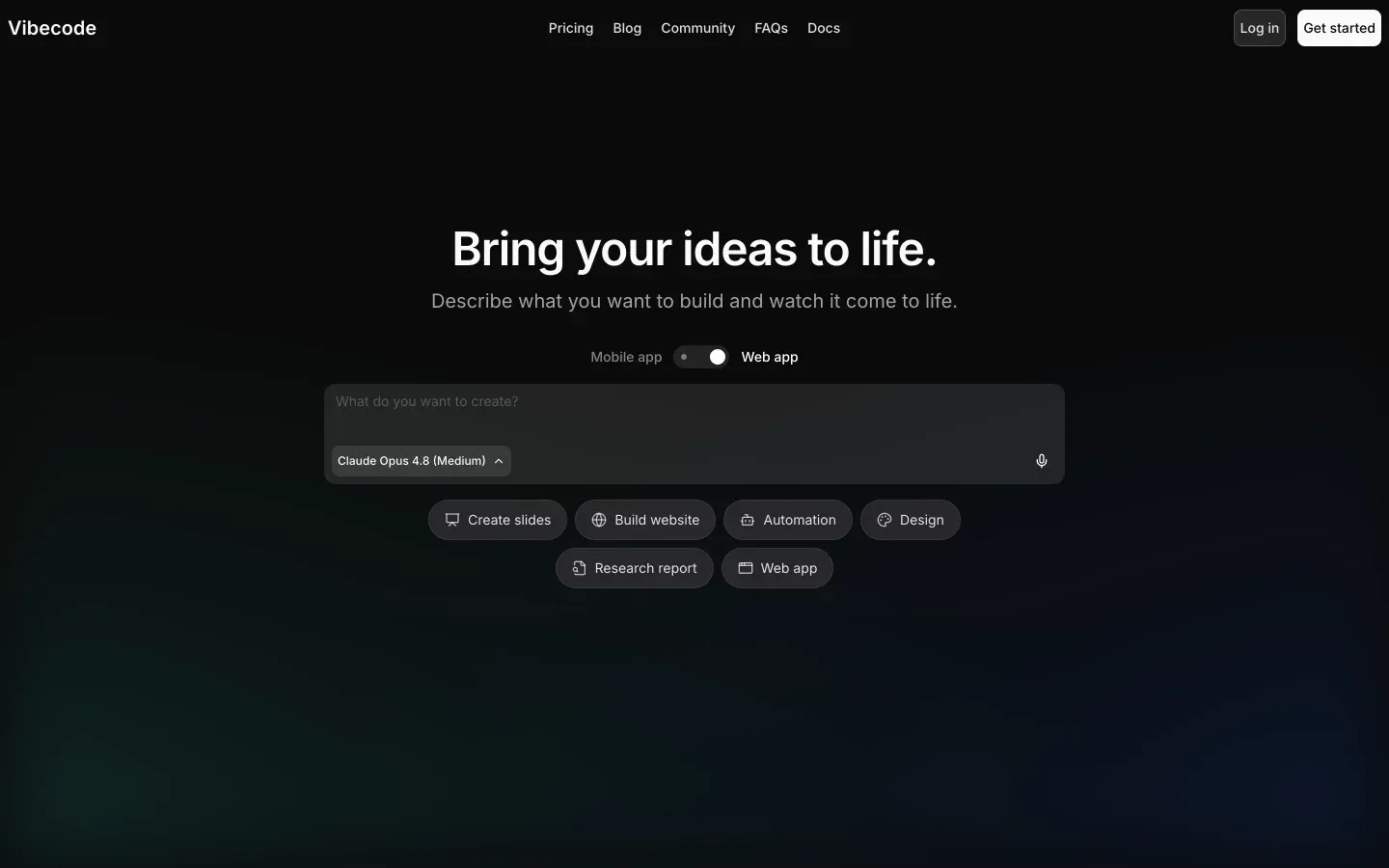
This comparison evaluates two highly distinct approaches within the agentic and generative software space: a headless command-line developer agent against a prompt-driven mobile app creator.
Claude Code operates as an engineer’s terminal companion that directly manipulates files and executes local test suites, whereas VibeCode delivers a visual, mobile-first canvas optimized for compiling native applications from conversational English.
Claude Code wins this head-to-head comparison with an aggregate score of 6.6/10 against VibeCode’s 6.1/10. The aggregate scores are close, but the procurement division remains simple: engineers working in real repositories will find Claude Code’s shell execution superior, while non-technical builders looking to ship quick mobile layouts should opt for VibeCode.
The decision in 30 seconds
| If your priority is… | Pick | Why |
|---|---|---|
| Engineers with local codebases | Claude Code | Direct local terminal execution and git history management |
| Non-technical mobile layouts | VibeCode | Prompt-to-native layouts with instant mobile previewing |
| Deep backend database limits | Claude Code | Direct integration with any language-supported database |
| Direct App Store deployment | VibeCode | Built-in packaging pipelines for Apple and Google stores |
| Enterprise client portals | Neither | A visual business-app builder like Softr is required |
What each platform is
What is Claude Code?
Claude Code is an agentic, command-line interface tool created by Anthropic. Rather than operating as an isolated chat interface or IDE extension, it functions headlessly inside the local terminal (including bash and zsh) where it runs bash commands, modifies code files, checks git history, and runs tests autonomously.
It represents a hands-on developer companion designed to keep engineers fast without forcing them into a complex graphic interface.
To make building safe, Claude Code asks permissions on granular write actions and system command executions, meaning nothing runs unless the developer confirms. It is primarily built for software engineers, operations teams, and technically proficient builders who already have a local development environment configured and are comfortable interpreting terminal outputs.
What is VibeCode?
VibeCode is an AI-powered, mobile-first app building platform designed to allow non-technical creators to build native iOS and Android mobile apps from plain English commands. It leverages a conversational “vibe coding” paradigm to design mobile-optimized layouts, manage state, and provision simple backend configurations in the cloud.
It features instant on-device testing and visual smartphone templates.
On higher plans, VibeCode builds and packages apps directly for deployment on the Apple App Store and Google Play, while also providing professional escape hatches like complete code export and SSH access. It is built explicitly for mobile prototypers and non-technical entrepreneurs seeking to slide past Swift or Kotlin constraints to deploy lightweight mobile utility apps.
- Headless CLI in your local terminal
- Runs bash, edits files, checks git, runs tests
- Permission prompts on writes and commands
- For engineers and ops teams
- Keeps developers fast without a GUI
- Mobile-first, plain English commands
- Designs layouts, state, simple cloud backend
- Instant on-device testing and templates
- App Store and Play packaging on higher plans
- Code export and SSH as escape hatches
The core difference
The core divergence between these two platforms centers on where they position the builder in the development lifecycle.
- Claude Code functions entirely in the terminal to modify local code and execute test suites, requiring an existing environment and engineering knowledge.
- VibeCode operates as a managed visual environment that wraps raw code generation inside conversational layouts and automated cloud hosting.
Where the scores diverge
Ease of build: Claude Code 4.0, VibeCode 7.0. VibeCode scores 7.0 whereas Claude Code is limited to a 4.0. VibeCode lets a non-engineer generate mobile layouts and interactive utility buttons entirely from a plain-English conversation, offering immediate visual validation on an interactive smartphone simulator.
In contrast, Claude Code lives entirely inside the terminal, meaning a builder who cannot configure dependencies, manage environment variables, or read language-specific errors will make zero progress.
Design flexibility: Claude Code 9.0, VibeCode 7.0. Claude Code wins with a 9.0 over VibeCode’s 7.0. Because Claude Code edits the raw codebase of your chosen framework directly, design freedom is completely boundless, limited only by what the language allows and what the developer can conceptualize.
VibeCode generates smartphone-optimized screens from prompts with instant previews, but it lacks the visual visual-tree controls or drag-and-drop alignment editors that platforms like FlutterFlow provide, making pixel-level visual adjustments highly difficult.
Data & integrations: Claude Code 8.0, VibeCode 6.5. Claude Code leads with an 8.0 against VibeCode’s 6.5. Because Claude Code acts on raw files within your stack, it can call any language-supported library, database driver, or external SDK and execute shell queries.
The deduction stems from the ecosystem: there are no pre-wired widgets, meaning every connection must be manually programmed. VibeCode provides cloud database storage and basic API integrations for weather and maps, but these are metered directly through raw billing credits.
Maintainability: Claude Code 6.5, VibeCode 5.5. Claude Code holds the advantage here at 6.5 against VibeCode’s 5.5. Claude Code works with version-controlled code in your own local repository, committing changes, staging files, and generating pull requests natively.
However, its background context compaction algorithm occasionally discards project instructions in large repos, requiring close engineer supervision. VibeCode provides code exports on Pro and Max plans, but its prompt-driven iterations on large codebases can lead to disorganized, unoptimized architecture that becomes a massive challenge to refactor manually.
Security & access control: Claude Code 6.0, VibeCode 5.0. Claude Code scores 6.0 while VibeCode scores 5.0.
Claude Code’s strength is its granular permission prompt model, ensuring no terminal command or file modification executes without explicit authorization, though a local CLI agent with system write permissions introduces risk if a destructive command slips through.
VibeCode includes native user authentication, but securing app data depends on generative logic, forcing builders to manually audit and verify that client secrets or database schemas are not exposed to the public.
Production readiness: Claude Code 6.0, VibeCode 5.5. Claude Code scores 6.0 and VibeCode lands at 5.5.
Claude Code produces real, production-ready logic within an actual engineering stack and runs local test suites to prove that logic works before deployment, though it suffers from heavy latency on complex tasks and early context compaction that can drop project constraints.
VibeCode provisions a managed cloud backend with authentication, but generating entire native apps via prompts risks introducing silent edge-case crashes and insecure patterns that can fail official app store reviews without a developer manually auditing the generated package.
Cost comparison
Claude Code runs on a usage-based, pay-as-you-go model directly tied to Anthropic token consumption. This means pricing is completely unpredictable: simple directories can be indexed iteratively, and users report aggressive token consumption that can run up bills of twenty dollars in short debugging sessions.
VibeCode uses structured monthly tiers: Free, Plus ($20/mo), Pro ($50/mo), and Max ($200/mo). Each tier comes with flat-rate AI billing credits that match raw model usage with zero markup. Buyers must plan for credit overages during intense debugging cycles or invest in manual code reviews to ensure these prompt-generated apps do not require costly developer interventions to survive.
Lock-in and the exit path
Claude Code features zero platform lock-in, as it edits local raw code and leaves your repo completely portable. VibeCode restricts code export and SSH terminal access to its Pro and Max plans; if you are on the Free or Plus tiers, you are locked into their managed hosting and would have to rebuild your mobile app from scratch to leave.
Who should pick Claude Code
Pick Claude Code if:
- Software engineers who want an autonomous terminal voice to edit files, run testing commands, and manage git commits.
- Teams demanding zero vendor lock-on with complete, raw code portability on local machines.
- Organizations building complex web logic that sits inside real, pre-existing repositories.
Do not pick Claude Code if you do not know how to open a command-line terminal, configure local development runtime dependencies, or read code.
Who should pick VibeCode
Pick VibeCode if:
- Non-technical founders looking to prototype lightweight mobile-first tools with instant simulated testing.
- Makers aiming to ship simple utility mobile programs directly to the App Store or Google Play from natural language.
- Prototypers who appreciate predictable AI credits paired with developer SSH access on top-tier plans.
Do not pick VibeCode if you are constructing long-term enterprise software that requires robust backend schemas and complex, strict data security.
What neither platform answers
Both platforms represent heavy code-generation paradigms, assuming your development goals lie in compiling raw software files or managing native store deployment cycles. If you are actually looking to build a structured internal tool, a modern CRM, or a client portal, both options introduce severe overheads.
Claude Code demands terminal fluency, while VibeCode’s mobile focus leaves you without a dependable back-office database desktop experience.
For professional client-facing software or operations dashboards, Softr represents a more reliable path. Softr scores 8.5 on production readiness and 9.0 on maintainability precisely because core operations - such as Google login, row-level data security, and dynamic block tables - are built into its visual host infrastructure.
You can pair it with Retool for highly sophisticated SQL internal tools, avoiding generative code debt completely.
Analyst verdict
Claude Code wins on scored criteria with a 6.6/10 aggregate score compared to VibeCode’s 6.1/10. It takes maintainability, security & access control, data integration depth, and design flexibility, because raw code managed through local version control sits entirely in the buyer’s hands.
VibeCode is the correct choice if you are a non-technical entrepreneur who must ship a native mobile layout directly to smartphone users and needs a structured, prompt-to-app editor wrapper. For all standard repositories and command-line environments, Claude Code is the higher-scoring procurement choice.
Related reading: the Claude Code scorecard, the VibeCode scorecard, and our scoring methodology.