
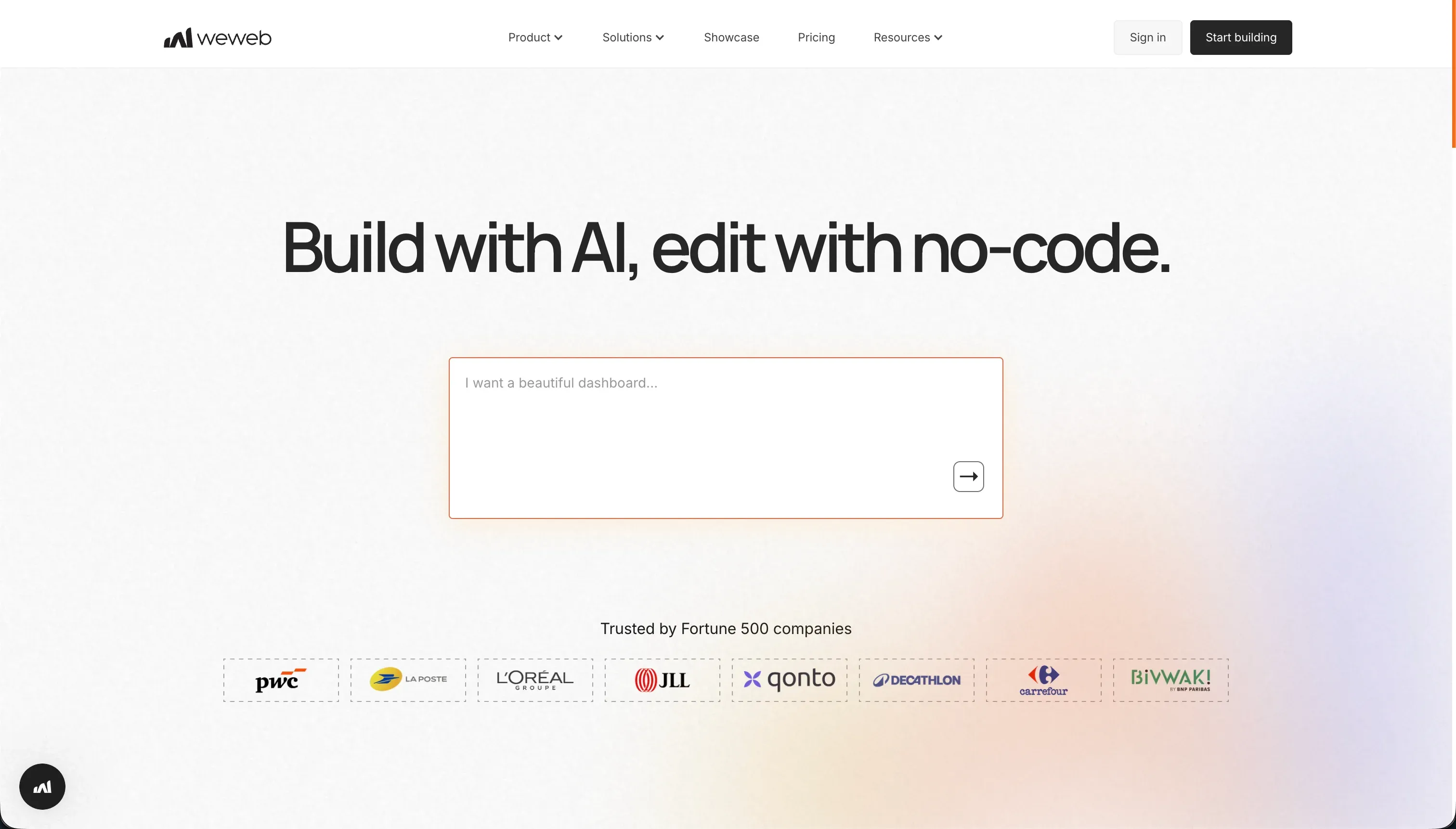
What WeWeb is
WeWeb is a visual frontend builder for web applications constructed on a decoupled structural model. The editor gives builders page layout controls including CSS flexbox, CSS grid, and absolute positioning, while managing application state via visual variables and conditional data routing.
It targets a distinct layer of the modern development stack, rendering fast single-page applications (SPAs) that stay SEO-indexable.
The build model is built entirely around separate layers. Unlike unified no-code systems, WeWeb builds only the user interface, meaning user tables, transactional logic, and authentication live in an external backend that the builder has to connect manually. An AI assistant is built into the editor to generate custom JavaScript code snippets and CSS classes when standard elements fall short.
The trade-off is clear: you get fine-grained visual control and Vue.js/Nuxt.js code export. The downside is that you have no native database or authentication, making the setup process complex and requiring the procurement of several developer platforms just to launch a basic functional web app.
Where the scores come from
Looking at WeWeb’s score profile, the platform has a very specific shape: it scores strongly high on custom visual configuration but suffers on overall setup simplicity and the initial production cost because of its decoupled architecture dependency.
Ease of build: 4.0/10
Ease of build scores a 4.0/10 because WeWeb features no built-in database or user table structure. Before any layout functions as a real app, the builder must manually wire up and pay for a separate backend service like Xano or Supabase.
Additionally, the setup process has a steep learning curve that requires a solid grasp of web standards. Configuring CSS properties, absolute positioning, conditional visual state variables, token-based authentication, and API request payloads means this tool is designed for developers rather than business operators looking for simple builders.
Production readiness: 6.0/10
Production readiness scores a 6.0/10. On the positive side, WeWeb uses a hybrid rendering system that compiles fast, single-page SEO-friendly apps and supports staging environments on the Scale tier. However, because production relies entirely on independent third-party backends, the overall stability of your stack is only as strong as your custom integrations.
Reviewers have also flagged mobile performance issues on Product Hunt, noting that despite PWA support and fluid responsive design tools, rendering performance on mobile devices sometimes lags behind the desktop experience.
Maintainability: 6.0/10
Maintainability lands at a 6.0/10 because the decoupled model introduces split logic. While UI state can be tracked inside WeWeb’s visual editor, updates to an application’s database schema or data policies require managing changes across both WeWeb and your external API endpoints, increasing the chances of team coordination errors.
Furthermore, users point out documentation gaps as a maintainability hurdle. As features are updated, official tutorials and guides do not always keep pace, forcing developers to dig deeper into the system’s underlying code or forums to fix bugs.
Security & access control: 5.5/10
Security & access control scores a 5.5/10. Because WeWeb does not feature a native authentication manager, developers must configure token-based authentication flows and permissions manually against their external databases. This means secure data isolation relies completely on the correctness of your connection setups and APIs.
Row-level security and data filters must be strictly maintained on the server side to prevent exposing API keys or data payloads in the client browser. Additionally, advanced compliance standards like SSO setup controls are restricted to the Enterprise tier.
Data & integrations: 7.0/10
Data & integrations scores a 7.0/10. The platform’s entire design is built to connect seamlessly to any major external database, SQL/no-SQL engine, or custom REST API. This flexibility is a major plus for development teams with pre-existing architecture.
However, the score is held back because there is no native storage, meaning every integration requires separate active management. Some users have also noted that integrations with headless CMS platforms are not as turn-key or reliable as standard database connections.
Design flexibility: 8.5/10
Design flexibility is WeWeb’s strongest rating at an 8.5/10. Unlike layout engines built on simple block columns, WeWeb exposes an advanced CSS layout engine containing flexbox, grid, and absolute positioning options, giving you pixel-perfect canvas control.
The built-in AI assistant helps developers quickly write custom JavaScript variables or create CSS overrides directly inside the editor. This degree of design control is the core reason seasoned frontend engineers choose WeWeb.
What types of apps you can build with WeWeb
WeWeb is built for projects where the main requirement is a custom, complex digital canvas. It does not excel at simple business apps, but rather serves as a specialized platform for bespoke web interfaces.
Good-fit app types include:
- Custom Client Portals: Complex frontends that require premium layouts and animations built over a secure database like Supabase.
- SaaS Frontends: Web applications that require an independent SPA layout which can be downloaded and self-hosted as clean Vue.js code.
- Agile Agency Mockups: Dynamic, data-rich interactive frontends initialized by professional agences for systems they plan to export.
If you are building classic internal business databases, client management dashboards, or intranets, an all-in-one visual developer tool like Softr is much faster. Softr handles database, user permissions, and interfaces out of the box without requiring a multi-tool collection of separate paid platforms.
Who should not use WeWeb?
Do not use WeWeb if you are a non-technical builder who does not want to stand up and pay for a separate backend service. Setting up data tables, secure routing, and database integrations requires understanding standard frontend engineering patterns, making it a bad option for non-technical business teams.
Do not use WeWeb if your budget is tight and you cannot justify a starter price of $59/month for a single published custom-domain app. Because of its modular architecture, you also have to factor in the additional subscription costs of external databases, APIs, or authentication platforms.
Do not use WeWeb if you need to quickly launch native mobile apps in the Apple App Store or Google Play Store. While it can produce PWAs, its rendering engine is heavily optimized for desktop browsers, making native mobile layouts a better fit for tools like FlutterFlow.
Analyst verdict
With an average score of 6.2, WeWeb is a design-first frontend engine built specifically for frontend developers and agencies who want pixel-level CSS styling combined with clean Vue.js code export. If you already have your own backends like Airtable or Supabase, WeWeb provides the frontend flexibility that simpler block editors limit.
However, if you are looking for an all-in-one business environment with secure, native user accounts, Softr offers a much faster path to production without the complexity of a decoupled system. Check out our methodology page to see how we weigh each rating category.