


The decision between Claude Code and WeWeb represents a fundamental choice between a headless, agentic developer tool and a decoupled visual frontend builder. Claude Code operates entirely in the terminal as an agentic command-line interface, writing raw code across local directories.
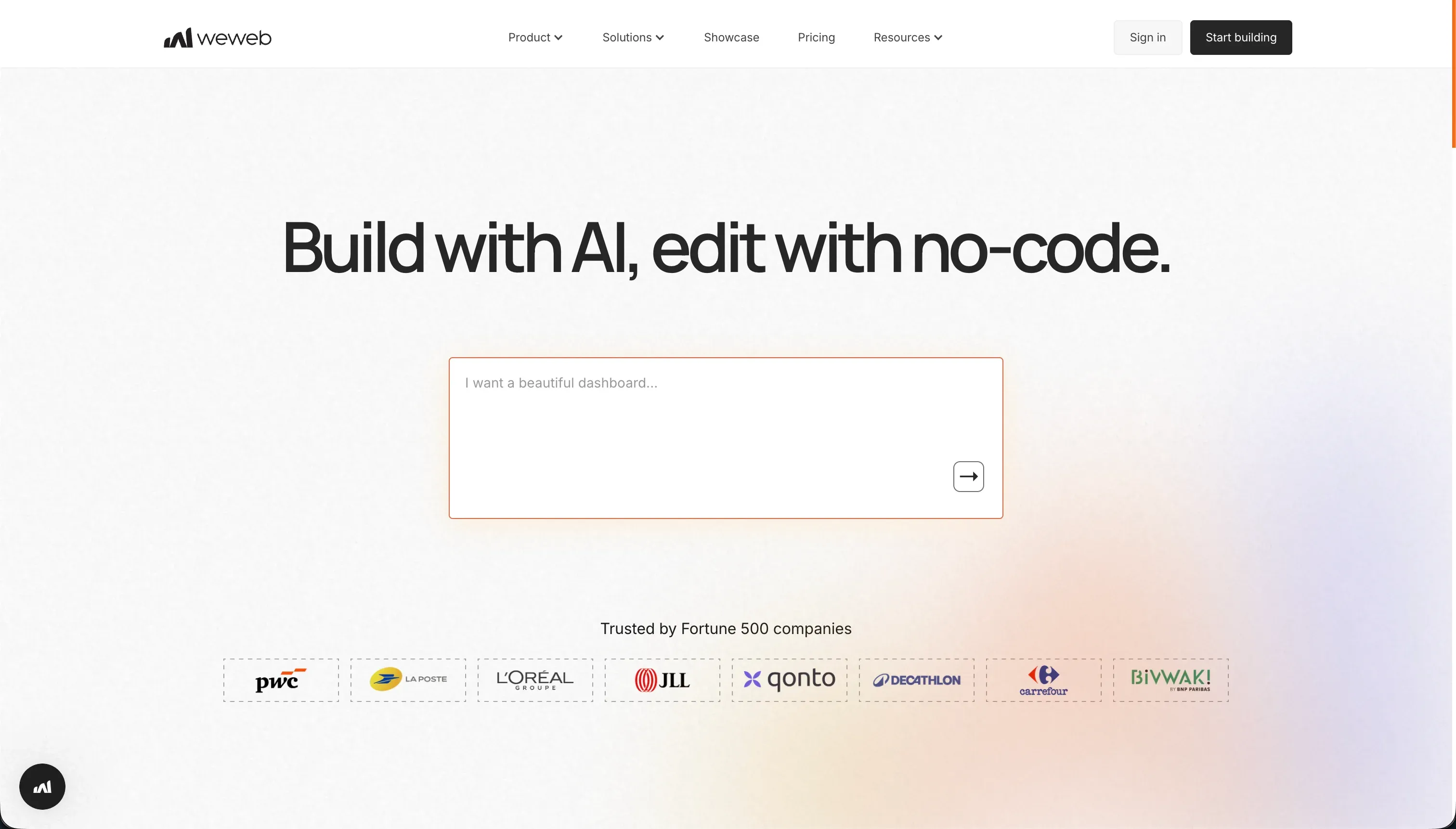
WeWeb, by contrast, is a browser-based layout engine built specifically to construct visual interfaces that connect to external backends via APIs.
Claude Code wins the aggregate comparison with a score of 6.6/10 compared to WeWeb’s 6.2/10, though this choice splits cleanly along the developer-editor divide. For non-technical teams, Claude Code’s lack of a visual interface makes it a non-starter. This decision only flips in WeWeb’s favor if you are building an interface that requires pixel-perfect visual styling without maintaining a local development stack.
The decision in 30 seconds
| If your priority is… | Pick | Why |
|---|---|---|
| Visual layout and pixel-perfect design | WeWeb | Its visual layout engine supports CSS flexbox, grids, and absolute positioning visually |
| Deep terminal and local test execution | Claude Code | It runs bash commands, edits local files, and executes tests natively |
| Standard business portal or internal tool | Neither | Stitching a separate backend in WeWeb is high-overhead, and Claude Code lacks a pre-built auth UI |
| Full stack codebase control with zero visual design constraints | Claude Code | Outputs raw code with 9.0 design flexibility limited only by your framework |
| No local development environment setup | WeWeb | Operates completely in a browser-based visual state editor with no CLI requirements |
What each platform is
What is Claude Code?
Claude Code is an agentic command-line interface tool developed by Anthropic. It allows developers to collaborate with Claude directly inside the local terminal to edit files, execute commands, run tests, and manage git repositories. Instead of writing code in an IDE extension, users prompt a shell-based assistant to modify local file trees directly.
Specifically, Claude Code can stage files, create git commits, run tests, and query shell configurations autonomously. It is built explicitly for software engineers looking for systemic code edits, test-driven refactoring, and headless file generation within their existing terminal environments.
What is WeWeb?
WeWeb is a visual frontend builder designed for creating web applications on a decoupled stack. It does not store user data or host backend databases natively, requiring builders to connect their frontend layouts to external databases and APIs such as Xano, Supabase, or Airtable. Layouts are assembled visually using a drag-and-drop UI editor.
WeWeb features visual state management, dynamic variables, token-based authentication configurations, and an integrated AI assistant that generates custom CSS and JavaScript. It is designed for agencies and frontend builders seeking to build single-page applications with high styling requirements.
The core difference
The defining divide between these tools is how they approach the application’s underlying code and layout layers.
- Claude Code edits raw repository code directly in your local terminal without providing any native visual interface or hosting infrastructure.
- WeWeb compiles a visual Vue.js frontend in a drag-and-drop browser editor that must map back to an external backend database via API workflows.
Where the scores diverge
Data & integrations: Claude Code 8.0, WeWeb 7.0. Claude Code scores 8.0/10 here. Operating in raw local code, it can call any API, connect to any database, or load any library native to the application’s technical stack.
WeWeb scores 7.0/10 because while it has visual connectors to standard SQL/NoSQL databases and REST APIs, nothing is cached or housed natively on WeWeb itself, and users have reported weak headless CMS integrations.
Maintainability: Claude Code 6.5, WeWeb 6.0. Claude Code edges ahead at 6.5/10 against WeWeb’s 6.0/10.
Because Claude Code edits local files directly and schedules git updates, the application’s true source of truth remains standard version-controlled code, though early context compaction requires developers to closely monitor project rules during long sessions.
WeWeb keeps logic in a visual state editor, which means complex updates can require matching edits in both WeWeb and your external database backend, and documentation gaps make troubleshooting outdated tutorials difficult.
Security & access control: Claude Code 6.0, WeWeb 5.5. Claude Code scores 6.0/10 by implementing granular per-action prompts that ensure no script executes without manual approval, although granting write access to system terminal files introduces local security risks.
WeWeb scores 5.5/10 because it lacks built-in authentication or access control layers, forcing builders to configure token-based access manually against their separate API service, which is only as secure as that behind-the-scenes configuration. Advanced Single Sign-On (SSO) on WeWeb is gated behind high-cost Enterprise tiers.
Design flexibility: Claude Code 9.0, WeWeb 8.5. Claude Code scores 9.0/10 because it produces unmodified frontends where design limit limits are purely bound by your engineering talent and framework.
WeWeb scores 8.5/10 with an outstanding visual engine supporting flexbox, custom grid structures, absolute positioning, custom JS code block generations, and an AI helper. WeWeb is the preferred home for designers seeking direct and visual workspace control.
Ease of build: Claude Code 4.0, WeWeb 4.0. Both platforms score a low 4.0/10 because they present dense, expert-level interfaces with distinct learning curves. Claude Code delivers no visual interface, meaning that non-engineers cannot set up local environments or read the generated code files.
WeWeb has no built-in database, meaning that before a single page functions, builders must configure a separate backend like Xano or Supabase and master complex visual state variables and token-based API routing. Neither is designed for quick, lightweight visual builds by business operators.
Production readiness: Claude Code 6.0, WeWeb 6.0. Claude Code and WeWeb tie at a 6.0/10, though for entirely different operational reasons. WeWeb relies heavily on an external backend to function, and reviewers have flagged lag in mobile performance relative to desktop.
Claude Code produces real, production-grade code directly inside your framework, but it suffers from documented context compaction on large repositories, which can make the agent discard constraints and output faulty logic during extended debugging loops. Additionally, latency on complex tasks can slow the developer loop.
Cost comparison
Claude Code operates on an opaque, token-based pay-as-you-go architecture. Users consume input and output tokens directly from their Anthropic API allowances, which means complex debugging and repeated directory searches can burn credits rapidly, making software execution budgets highly unpredictable.
WeWeb uses a tiered subscription pricing model starting at $59/month (Billed Monthly) or $39/month (Billed Annually) for its Starter tier, which only covers single-app custom domain use. Scale tiers jump to $249/month to gain access to staging environments and code export. Buyers must also factor in separate, recurring monthly subscriptions for their external backend and database hosts like Xano or Supabase.
- Token-based pay-as-you-go
- Draws from Anthropic API allowance
- Debugging and repeated searches burn credits fast
- Budgets hard to predict
- Starter $59/month or $39/month annual
- Starter covers single-app custom domain
- Scale tier $249/month adds staging and code export
- Backend hosts like Xano or Supabase billed separately
Lock-in and the exit path
WeWeb operates with transparent exit options on Scale and Enterprise plans, where builders can export complete Visual Vue.js/Nuxt.js application code to host on their own infrastructure, though database logic is decoupled. Claude Code generates raw code directly inside your own local directory, which means there is zero platform lock-in.
Claude Code has the absolute cleanest exit path because you already own the codebase from day one.
Who should pick Claude Code
Pick Claude Code if:
- Software engineers looking to speed up repetitive code generation, unit test creation, and git commits directly within their command line.
- Development teams seeking to build full-stack web applications using their own frameworks without visual builder constraints or vendor hosting dependencies.
- Organizations that require complete platform portability and direct raw file ownership in their git histories.
Do not pick Claude Code if your team lacks engineering experience and cannot set up local developer environments, configure terminal paths, and read raw code structures.
Who should pick WeWeb
Pick WeWeb if:
- Visual design agencies that need pixel-perfect frontend layouts utilizing flexbox and grids without writing raw CSS from scratch.
- Teams already using a dedicated backend service like Xano or Supabase who need a robust frontend visual builder.
- Builders looking to export a clean Vue.js app to host on their own servers.
Do not pick WeWeb if you are looking for an all-in-one app creator that includes a built-in hosting database and visual user management out of the box.
What neither platform answers
Both Claude Code and WeWeb assume a high degree of technical orchestration. WeWeb forces you to become a systems architect to connect external backends, manage complex API payloads, and configure token authentication security. Claude Code abandons visual design entirely, requiring a developer to babysit a terminal and manage a local environment from scratch.
For businesses that need to deliver portals, internal tools, and client CRMs quickly, this creates unnecessary complexity.
If you want your database, security, and responsive UI components securely integrated from day one, Softr is the higher-scoring path.
Softr scores 8.5 on production readiness, 9.0 on maintainability, and 8.5 on security & access control because essential operations are native infrastructure instead of things you generate or wire together manually. Alternatively, teams that must rely on custom database scripts often prefer Retool for heavy SQL developer integration.
Analyst verdict
Claude Code wins on aggregate scoring 6.6/10 against WeWeb’s 6.2/10. It wins because it works straight inside a native local codebase with system-level terminal power, yielding maximum data accessibility and raw framework flexibility. WeWeb keeps the upper hand exclusively on visual frontend control, where its absolute positioning and CSS visual panels outclass terminal generation.
However, the aggregate victory is highly conditional. If your team does not contain professional software engineers, Claude Code is entirely unusable. For styling-centric projects that require a decoupled visual layer, buy WeWeb. For full-stack developers looking to automate refactoring, choose Claude Code.
Related reading: the Claude Code scorecard, the WeWeb scorecard, and our scoring methodology.