

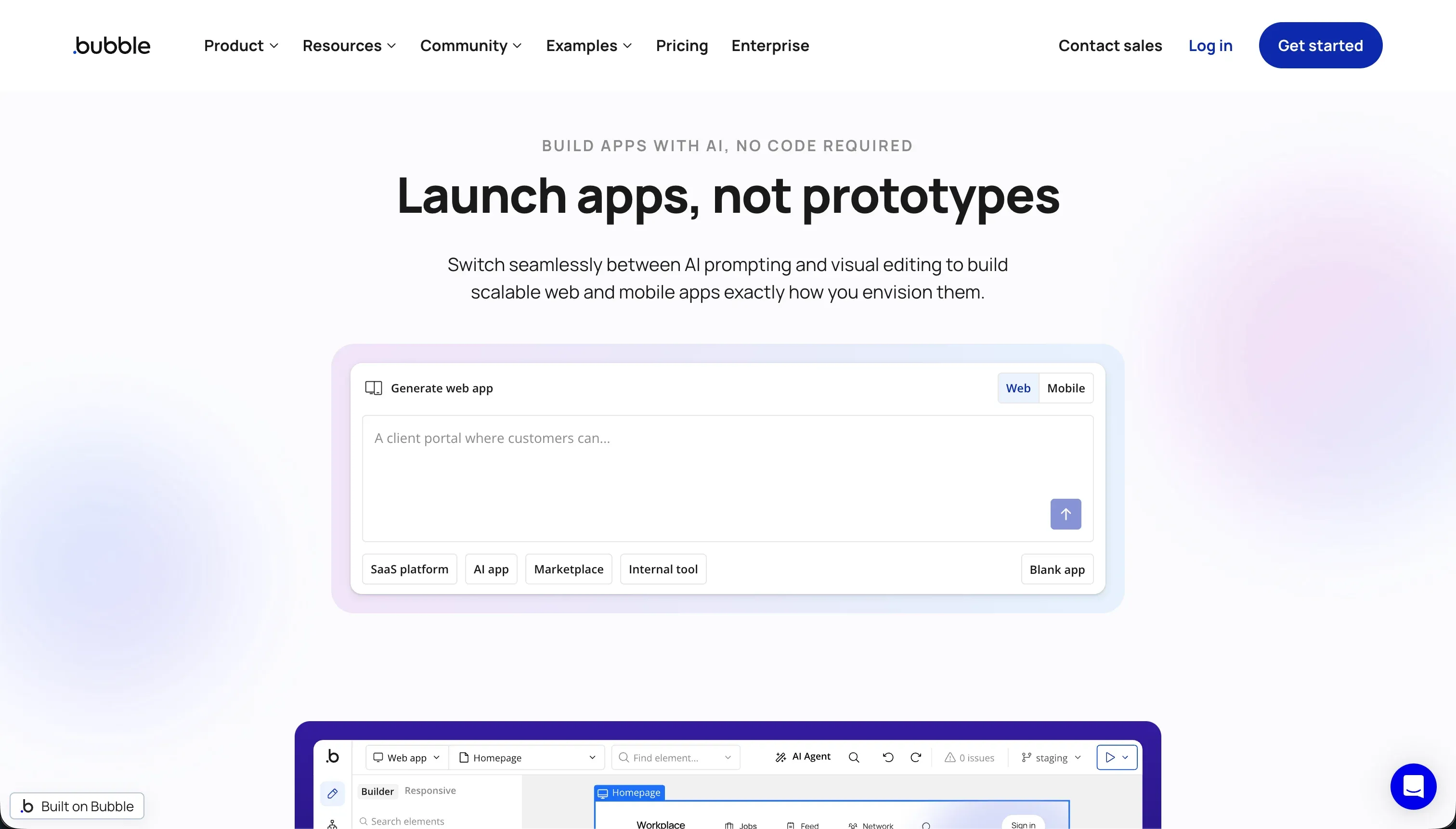
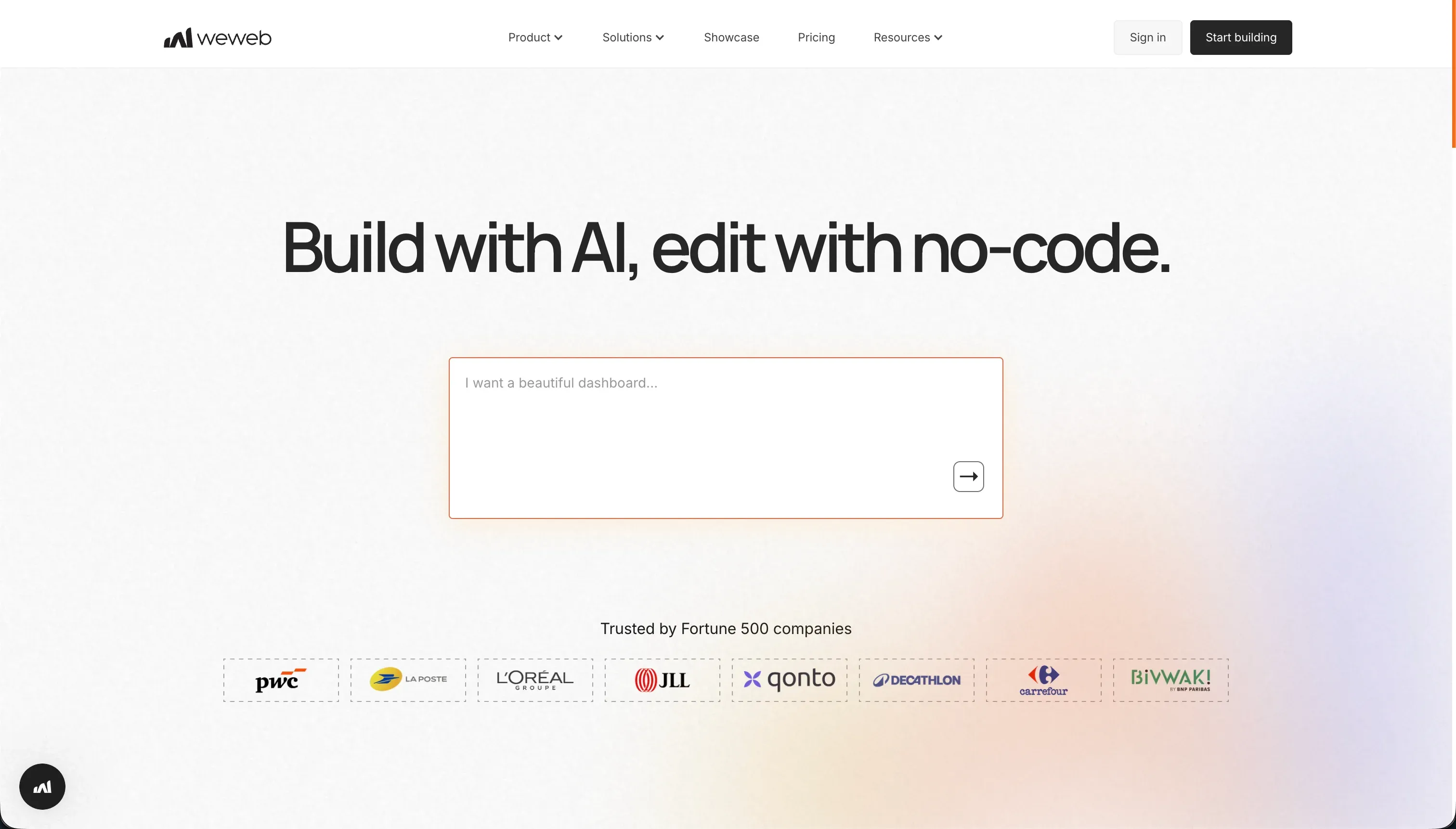
The procurement decision between Bubble and WeWeb is a choice between two distinct software architectures. Bubble represents the classic visual programming category, bundling the database, user authorization, logic builder, and hosting within a single unified engine.
WeWeb represents the decoupled frontend category, focusing entirely on visual layouts and state management while delegating all data storage and back-end logic to an external service of your choice.
Bubble wins the aggregate scored decision with a 6.8/10 over WeWeb’s 6.2/10. The higher aggregate represents Bubble’s native, server-side infrastructure and ready-to-run database. However, this decision flips entirely if your engineering team has already chosen a modern backend stack like Supabase or Xano, where WeWeb’s design flexibility and code-export options become the decisive elements.
The decision in 30 seconds
| If your priority is… | Pick | Why |
|---|---|---|
| All-in-one database and app interface | Bubble | It provides a fully managed SQL database built into the platform without external api overhead |
| Pre-existing Supabase, Xano, or Airtable backend | WeWeb | Its decoupled engine connects securely to standard external SQL or API backends |
| Custom CSS grids, flexbox, and manual code export | WeWeb | It scores 8.5/10 on design flexibility and permits Vue.js source exports on Scale plans |
| Ready-to-use user authentication and server privacy rules | Bubble | It secures data natively without needing to write custom token middleware |
| Rapidly built portals or internal tools on a flat price | Neither | Both require significant web-dev conceptual learning; Softr handles this class of app with flat pricing |
What each platform is
What is Bubble?
What is Bubble? It is a visual programming platform designed to construct full-stack web applications without writing code. Builders define visual interfaces pixel by pixel on a drag-and-drop canvas, orchestrate conditional workflows through a visual logic editor, and manage data within a proprietary relational engine.
The entire application runs on Bubble’s hosted runtime, meaning no separate web servers or deployment loops are managed.
Bubble features a highly robust server-side workflow scheduler, customizable privacy rules to protect database entries, and a massive community plugin ecosystem hosting over 8,000 integrations. It is genuinely built for operations teams, startup founders, and no-code builders who need to scale transactional logic (such as marketplaces, booking systems, or SaaS MVPs) without maintaining fragmented deployment setups.
What is WeWeb?
What is WeWeb? It is a visual frontend builder tailored to connect with any external API or database. It operates on a decoupled architecture, indicating that we-web does not store data or execute server-side database logic natively.
Instead, the visual editor builds responsive single page applications (SPAs) that compile on Vue.js and bind to independent backends such as Xano, Supabase, Airtable, or custom REST APIs.
WeWeb features an advanced visual layout engine supporting CSS flexbox, CSS grids, and absolute positioning, alongside an AI assistant that generates custom JavaScript and CSS snippets. This platform is genuinely built for frontend teams, agencies, and enterprise developers who want complete design authority over their presentation layer while keeping their database secured behind their own API bounds.
The core difference
The primary dividing line between these two tools is their relationship with data.
- Bubble is an all-in-one, integrated visual database and portal engine where logic, authentication, and data records coexist inside a single closed system.
- WeWeb is a decoupled visual layer that requires you to procure, connect, and pay for an external backend before any application can go live.
Where the scores diverge
Ease of build: Bubble 5.0, WeWeb 4.0. The tools diverge on ease because of setup dependencies. Bubble scores a 5.0/10; the learning curve is notoriously steep due to its dense, proprietary editor, database rules, and workflow conditional systems. However, WeWeb scores lower at 4.0/10 because it lacks any built-in database or user auth layer.
Builders cannot simply design a UI; they must first learn to architect a separate database in Supabase or Xano, configure API headers, map payload responses, and handle token-based variables before standard form submissions or user sign-ups function.
Production readiness: Bubble 7.0, WeWeb 6.0. Bubble takes the lead here with a 7.0/10, providing built-in user authentication, server-managed privacy settings, and background schedulers proven to scale. The primary deductions reflect common editor lag, RAM bloat on large builds, and payment integration complaints.
WeWeb scores a 6.0/10 because its live reliability is bound to an external backend that the builder must wire securely. Additionally, early mobile performance has been reported to lag behind desktop layouts.
Security & access control: Bubble 6.5, WeWeb 5.5. Bubble manages a 6.5/10 by hosting built-in, server-side privacy rules and programmatic user group permissions, though configuring them correctly requires developer-level care and a missed rule fails silently. WeWeb scores a 5.5/10.
It lacks a native identity layer; instead, security relies entirely on OAuth or token-based authorization flows that you must configure against Supabase or Xano, meaning your app’s access control is only as safe as the backend configuration you establish.
Data & integrations: Bubble 8.0, WeWeb 7.0. Bubble’s 8.0/10 reflects its native relational database engine, custom data mapping, robust API Connector, and an extensive catalog of over 8,000 third-party plugins. The slight deduction stems from dependency risks on community-managed plugins that may become abandoned.
WeWeb scores a 7.0/10 because it operates solely via API connections; it carries zero native storage, and reviewers have noted weak headless-CMS capabilities.
Maintainability: Bubble 6.0, WeWeb 6.0. This criterion is a direct tie at 6.0/10, though for distinct reasons. Bubble allows builders to make deterministic edits inside visual workflows without ever regenerating code, though complex projects frequently accumulate workflow sprawl that is difficult to visually audit.
WeWeb maintains logic in a visual state editor, but the decoupled model implies that a single database field modification requires coordinated changes across both WeWeb and your external backend, and standard platform documentation has occasionally lagged behind platform updates.
Design flexibility: Bubble 8.5, WeWeb 8.5. This is a tie at 8.5/10. Both platforms provide elite visual flexibility. Bubble offers a pixel-level drag-and-drop builder with responsive positioning.
WeWeb matches this score with an advanced design system implementing CSS grids, flexbox, global fonts, custom styling controls, and an AI assistant that writes clean JavaScript and CSS for custom components. It is the premier visual choice for frontend styling.
Cost comparison
The billing models diverge sharply. Bubble charges on a subscription model starting at $69/mo (Starter) or $249/mo (Growth). However, Bubble bills on ‘Workload Units’ (WUs) - a metric tracking cloud execution - which means inefficient database setups or sudden user spikes can cause bills to rise without prior warning.
WeWeb charges on a flat subscription starting at $59/mo (Starter, monthly) or $249/mo (Scale). Since WeWeb is only hosting your frontend, your bill is predictable based on page views. However, a buyer must factor in the external backend costs: you will need to pay for a separate database (such as a $59/mo Xano tier or $25/mo Supabase tier) alongside your WeWeb subscription to achieve a functional app scenario.
- $69/mo Starter, $249/mo Growth
- Billed on Workload Units (cloud execution)
- Inefficient database setups raise costs
- User spikes raise bills without warning
- $59/mo Starter, $249/mo Scale
- Flat fee, predictable on page views
- Hosts frontend only
- Backend extra: $59/mo Xano or $25/mo Supabase
Lock-in and the exit path
The exit path reveals a stark contrast. Bubble holds severe vendor lock-in; you can export your database rows, but you cannot export the visual logic, meaning migrating away requires a complete rebuild from scratch. WeWeb provides a clean exit path: on Scale and Enterprise plans, you can export your entire frontend compiled as Vue.js/Nuxt.js code, allowing you to self-host your app anywhere independently.
- Database rows: exportable
- Visual logic: locked in
- Frontend exports as Vue.js/Nuxt code
- Exit requires a full rebuild
- Compiled code you own
- Self-hosting: not available
- Self-host anywhere, Scale and Enterprise plans
Who should pick Bubble
Pick Bubble if:
- Startup founders and solo builders seeking a fast path to a full-stack MVP without managing separate backend fees or database hosting API keys.
- Operations teams requiring an all-in-one platform where visual pages, user directories, structured relational tables, and server security settings are configured together.
- Builders looking to leverage a massive community marketplace of over 8,000 plugins to rapidly append Stripe subscriptions, maps, and external integrations.
Do not pick Bubble if you require direct source code extraction or need to self-host your database inside your company’s own secure infrastructure.
Who should pick WeWeb
Pick WeWeb if:
- Agencies and professional design agencies who demand advanced CSS controls, absolute layout flexibility, and exact brand aesthetics.
- Frontend developers who have already deployed their application backend on Supabase or an internal corporate PostgreSQL hub.
- Enterprise teams on Scale or Enterprise tiers who require clear source-code exports or want to host compiled VueJS files on their own private servers.
Do not pick WeWeb if you are a non-technical builder looking for a simple, single-subscription database and user portal that works out of the box.
What neither platform answers
Both platforms assume you are building software from scratch. To succeed on either Bubble or WeWeb, your team must invest weeks in mastering developer-level concepts: REST APIs, payload schemas, state management, or token variables.
If your business is actually trying to solve a ‘day-two’ operational problem - such as launching an internal tool, a customer portal, an onboarding hub, or a membership directory - these platforms introduce unnecessary developer complexity.
For enterprise portals and operational applications, Softr is the higher-scoring alternative. It secures an 8.5 on production readiness, a 9.0 on maintainability, and an 8.5 on security and access control.
Instead of forcing you to configure APIs, Softr connects directly to pre-styled, mobile-responsive layouts, providing native user authentication, group-based visibility rules, and secure data routing out of the box. For teams who prefer a lightweight tracker, Glide serves as another secure, predictable candidate.
Analyst verdict
Bubble wins this comparative evaluation, taking four of six criteria and posting an aggregate score of 6.8/10 against WeWeb’s 6.2/10. Bubble takes the aggregate win because its built-in database layer, server-side privacy rules, and native user authentication provide a more secure, cohesive framework for non-developers who need to launch fully hosted apps under one roof.
WeWeb secures an equal 8.5/10 on design flexibility and maintains the enormous advantage of code exports on its Scale plans. The conditional verdict: pick WeWeb if you have a developer on hand and have already decided on Supabase or an internal SQL database. For all solo builders and non-technical teams who accept proprietary runtime lock-in in exchange for an all-in-one visual engine, Bubble is the scored winner.
Related reading: the Bubble scorecard, the WeWeb scorecard, and our scoring methodology.