

This head-to-head compares two distinct visual development models designed for different technical capabilities.
Glide operates as a structured, low-code interface builder that turns existing spreadsheets and tables into ready-to-use software instantly, while WeWeb is a decoupled visual frontend builder designed to construct intricate web layouts on top of external databases or APIs.
Glide wins the aggregate matchup 6.3 to 6.2 on our card, proving to be the more practical purchase for operations teams needing speed and built-in data handling. However, the decision flips entirely if you are an agency developer demanding custom CSS, absolute placement, or a database-independent codebase, in which case WeWeb is the correct buy. 6.3 and 6.2 are the numbers that define this comparison.
The decision in 30 seconds
| If your priority is… | Pick | Why |
|---|---|---|
| Rapid spreadsheet-to-app generation | Glide | Scaffolds structured interfaces from Google Sheets or Excel instantly, scoring 8.5 on ease of build |
| Pixel-level frontend customization | WeWeb | Offers absolute visual positioning, CSS flexbox/grid control, and custom JS/CSS generation |
| An all-in-one platform with built-in database | Glide | Features built-in Glide Tables with relations and rollups, whereas WeWeb has no native data storage |
| Genuinely granular external user visibility rules | Neither | Both platforms score 5.5 on security and access control, lacking the native permission depth of portal-dedicated builders |
| Code export and self-hosting capabilities | WeWeb | Allows downloading visual frontend code as Vue.js or Nuxt.js files on Scale and Enterprise tiers |
What each platform is
What is Glide?
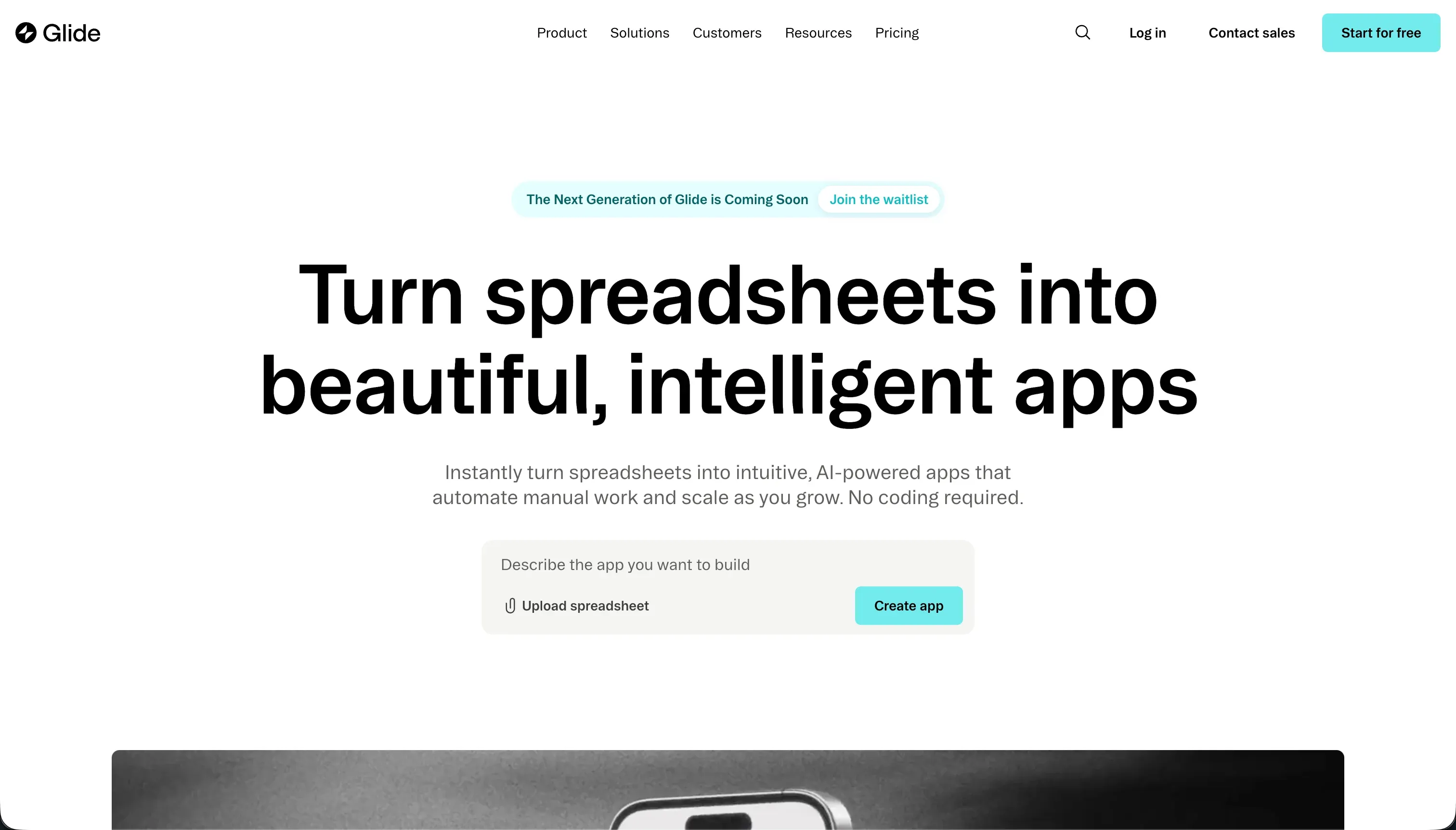
Glide is a highly structured database-to-app generator that compiles spreadsheets and native tables into responsive apps. It handles the user interface layer automatically by mapping columns to polished, pre-configured component layouts, completely eliminating manual element positioning.
Glide features native Glide Tables, pre-built functional modules (details screens, search bars, list views), and columns that can trigger direct OpenAI API queries such as translations or text summarization. It is built explicitly for operations leaders, internal product champions, and logistics teams seeking to digitize spreadsheet workflows into operational web views or PWAs without technical design overhead.
What is WeWeb?
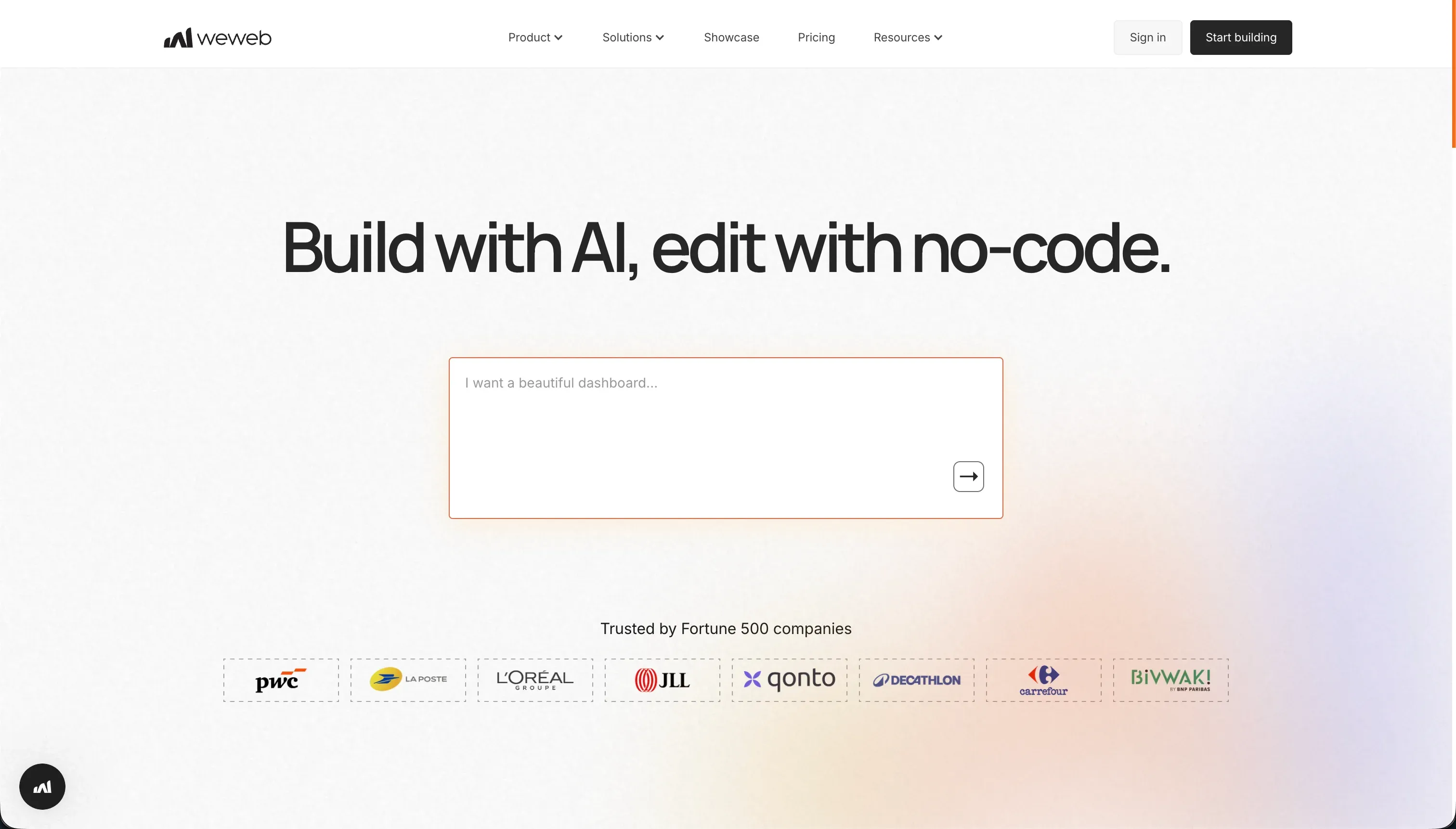
WeWeb is a frontendvisual editor designed to build web applications on a decoupled stack. It does not provide any native data storage, operating instead as a visual layer that binds dynamically to separate backends such as Supabase, Xano, or Airtable.
WeWeb features an engine that supports CSS flexbox, grid layouts, custom variables, and conditional routing, supported by an editor-level AI assistant that writes custom JavaScript and CSS. It is built for agencies, technical designers, and frontend engineers who want to build a highly optimized Single Page Application (SPA) without losing visual layout control.
- Compiles spreadsheets and native tables into apps
- UI mapped automatically, no manual positioning
- Glide Tables plus pre-built modules
- Columns can trigger OpenAI API queries
- For ops leaders digitizing spreadsheet workflows
- Visual editor with no native data storage
- Binds to Supabase, Xano or Airtable
- Flexbox, grid, variables, conditional routing
- AI assistant writes custom JavaScript and CSS
- For agencies and frontend engineers building SPAs
The core difference
The fundamental divide between these tools lies in how they handle design and data architecture.
- Glide packages frontend layouts and data into a single, tightly controlled ecosystem where the interface is generated automatically from your spreadsheets.
- WeWeb acts exclusively as a visual representation layer, requiring the builder to source, connect, and pay for an independent database and logic backend.
Where the scores diverge
Ease of build: Glide 8.5, WeWeb 4.0. The gap here is enormous. Glide scores 8.5 because it requires no preparatory infrastructure: you connect an Airtable base or Google Sheet, and a working app immediately scaffolds with fully functional search, navigation, and detail pages.
WeWeb scores a low 4.0 because it does not have a native database; you cannot make a single component work until you have manually configured and paid for an external backend, set up API connections, and mapped data parameters.
WeWeb demands a solid understanding of frontend variables, APIs, and routing concepts, making the setup steep for non-technical creators.
Design flexibility: Glide 4.0, WeWeb 8.5. This indicates a total role reversal. WeWeb scores an exceptional 8.5 because of its direct visual layout controls, grid alignment, absolute element positioning, and AI helper that generates custom CSS. In stark contrast, Glide scores a low 4.0.
Glide layout rules enforce strict template structures; builders cannot drag and drop elements, modify specific padding, or use custom CSS unless they purchase the highest tier. You build our layout, but you are forced to match Glide’s pre-packaged template appearance, making pixel-perfect white-labeling impossible.
Production readiness: Glide 6.5, WeWeb 6.0. Both platforms encounter production hurdles, but they fail in different environments. Glide scores 6.5, providing reliable, mobile-optimized modules out of the box, though long-term users report system lags multiple times a year, and free-plan users are shut out of human customer support.
WeWeb scores 6.0, suffering from documented mobile performance lag compared to desktop. Furthermore, because WeWeb relies entirely on an external backend you must configure yourself, its production reliability is only as stable as the connection, routing logic, and database plans you combine.
Maintainability: Glide 6.5, WeWeb 6.0. Glide scores 6.5, allowing builders to edit tables and elements in a single system, keeping day-two modifications simple until logic needs deepen and hit a ceiling. However, users complain that Glide occasionally moves features behind higher price plans mid-project.
WeWeb scores 6.0 because its decoupled structure means a single operational change often requires dual maintenance across both WeWeb and the separate backend. Some users also report that WeWeb’s documentation and academy tutorials fail to keep pace with platform updates, escalating the maintenance burden.
Security & access control: Glide 5.5, WeWeb 5.5. Both tools tie on 5.5, but for different structural reasons. Glide handles internal team visibility well, but its row-level permissions are too thin for large external groups.
WeWeb doesn’t have native authentication; instead, builders must map token-based flows against external databases like Xano or Supabase. This means your application’s security is only as secure as the database security rules you manually configure.
Advanced SSO stands gated on WeWeb’s Enterprise plan, while Glide restricts standard permission flexibility to higher pricing tiers.
Data & integrations: Glide 7.0, WeWeb 7.0. With identical scores of 7.0, both engines handle data robustly but target different paradigms. Glide integrates with Google Sheets, Excel, and its own Glide Tables, supporting relations, lookup rollups, and basic formulas natively, but it thins out when forced into headless CMS setups.
WeWeb is built entirely for external data connections, effortlessly mapping REST APIs and SQL databases. The deduction for WeWeb is a structural penalty: it holds no data natively, meaning simple projects require paying for and linking a separate database.
Cost comparison
Glide scales aggressively based on user volume and row limits. While the Maker plan sits at $49/mo billed annually (up to 25 users), scaling an app to hundreds of external portal users or clients requires moving into the Team or Business tiers ($99 to $249/mo billed annually), with seat count limits that can quickly push small operations toward enterprise-tier pricing.
WeWeb’s Starter plan is $39/mo billed annually, but this cost only covers the visual frontend. Because there is no native database, a buyer must also factor in the subscriptions for backends like Xano or Supabase and auth tools. WeWeb’s staging environments also require upgrading to the Scale tier ($199/mo billed annually), making the baseline development stack expensive for small operations.
Lock-in and the exit path
WeWeb provides a clean exit path compared to most no-code tools: on its Scale and Enterprise tiers, it allows you to download and export your visual application’s source code as a Vue.js or Nuxt.js project to host on separate infrastructure. You will still need to manage the external backend separately.
Glide does not offer any code export under any plan; if you decide to leave Glide’s ecosystem, you must rebuild the entire portal and logic layout from scratch, though your underlying Google Sheets or external Airtable data remains intact.
- WeWeb: app runs on WeWeb
- WeWeb: export Vue.js or Nuxt code, Scale tier up
- Glide: portal runs in Glide
- Glide: no export, rebuild the whole portal
- Data lives in Sheets or Airtable
Who should pick Glide
Pick Glide if:
- Operations managers wanting to quickly digitize manual spreadsheet workflows into working web and mobile apps in under a day.
- Internal teams needing pre-built component structures that automatically optimize for desktop and mobile displays with zero styling input.
- Teams leveraging standard data structures like Google Sheets, Excel, or Glide Tables with a low external user count.
Do not pick Glide when you need custom typography, absolute-position layouts, custom CSS, or complete brand alignment.
Who should pick WeWeb
Pick WeWeb if:
- Frontend developers and visual designers who require precise control over CSS layouts, grid positioning, and margins.
- Development teams already committed to an existing backend (like Supabase, Xano, or a PostgreSQL API) who need a visual frontend layer.
- Enterprise teams requiring code export and the option to self-host their web applications on separate servers.
Do not pick WeWeb if you need a fast, single-platform setup that includes an out-of-the-box user database and auth layer without configuration.
What neither platform answers
If your procurement goal is to launch a clean, secure business application like a client portal, partner directory, or custom CRM, both Glide and WeWeb create unnecessary trade-offs.
Glide forces you into rigid layout templates where you cannot match your corporate branding; WeWeb forces you to buy, configure, and maintain separate backend and security infrastructure, turning a simple app into a multi-head development project.
For business-grade client portals and internal operational software, Softr scores significantly higher. Softr scores 6.5 on production readiness and 6.5 on maintainability by delivering complete user registration, visual permissions, and native databases on a single hosted platform.
Rather than stitching multiple tools together or compromising your design, you can construct secure workflows with flat, scalable user billing.
Analyst verdict
Glide wins on paper with an aggregate score of 6.3 compared to WeWeb’s 6.2, but the decision is highly conditional. Glide takes ease of build, maintainability, and production readiness precisely because its design limits keep things simple, while its native tables make database setups instant.
WeWeb dominates on design flexibility, and is the superior match for agency developers, but its high setup complexity and the requirement of a separate database hold back its ease-of-build scores.
Purchase Glide if your primary priority is speed and you want user-ready operational tools compiled from spreadsheets without a complex setup. Purchase WeWeb only if you run a decoupled developer stack and require pixel-level layout formatting and custom code generation.
Related reading: the Glide scorecard, the WeWeb scorecard, and our scoring methodology.