

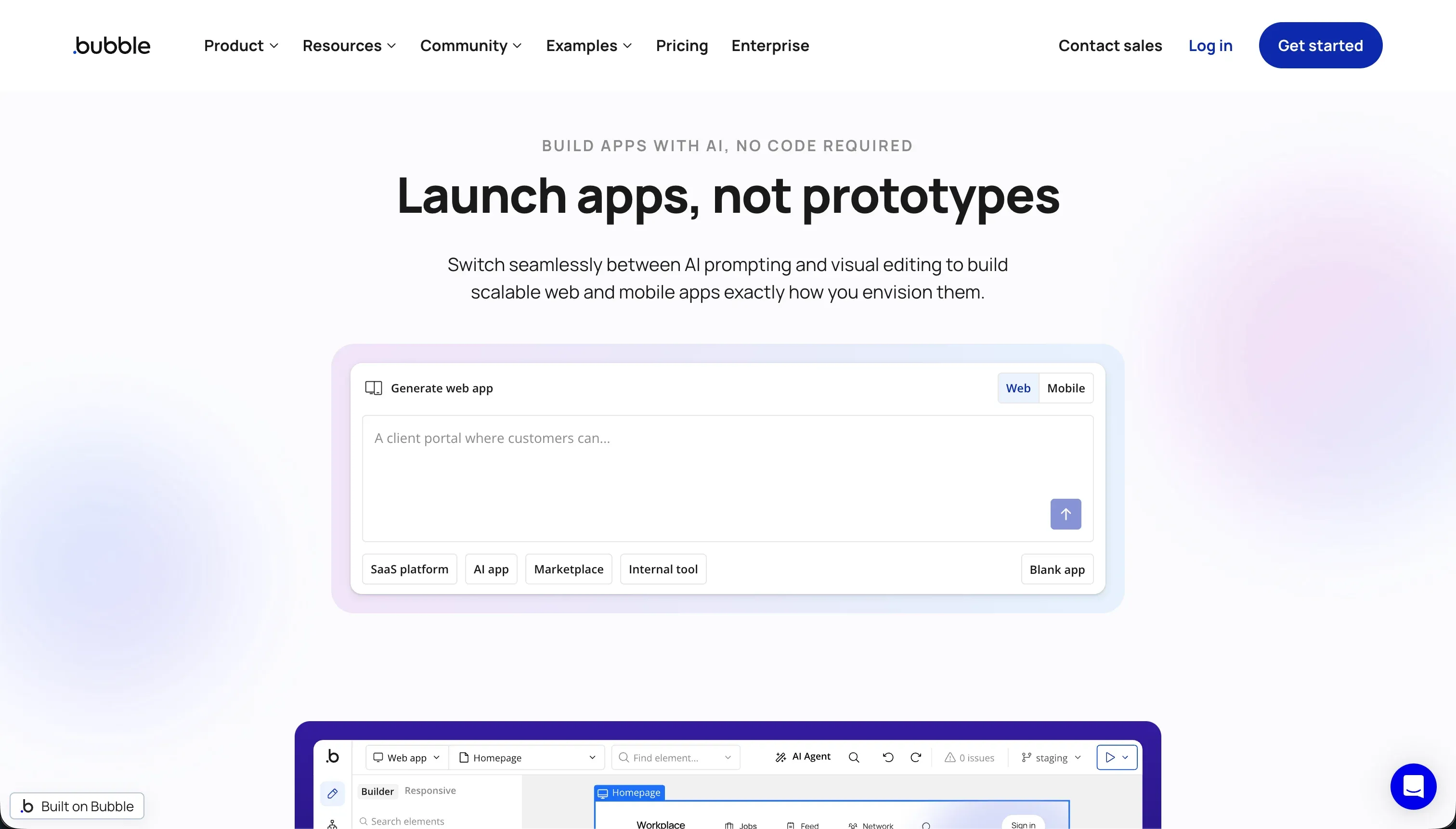
Developing custom web applications requires choosing between classic visual programmatic runtimes and modern, prompt-driven frontend cloning agents. Bubble operates as a visual development environment with its own database, workflow engine, and server-side privacy rules.
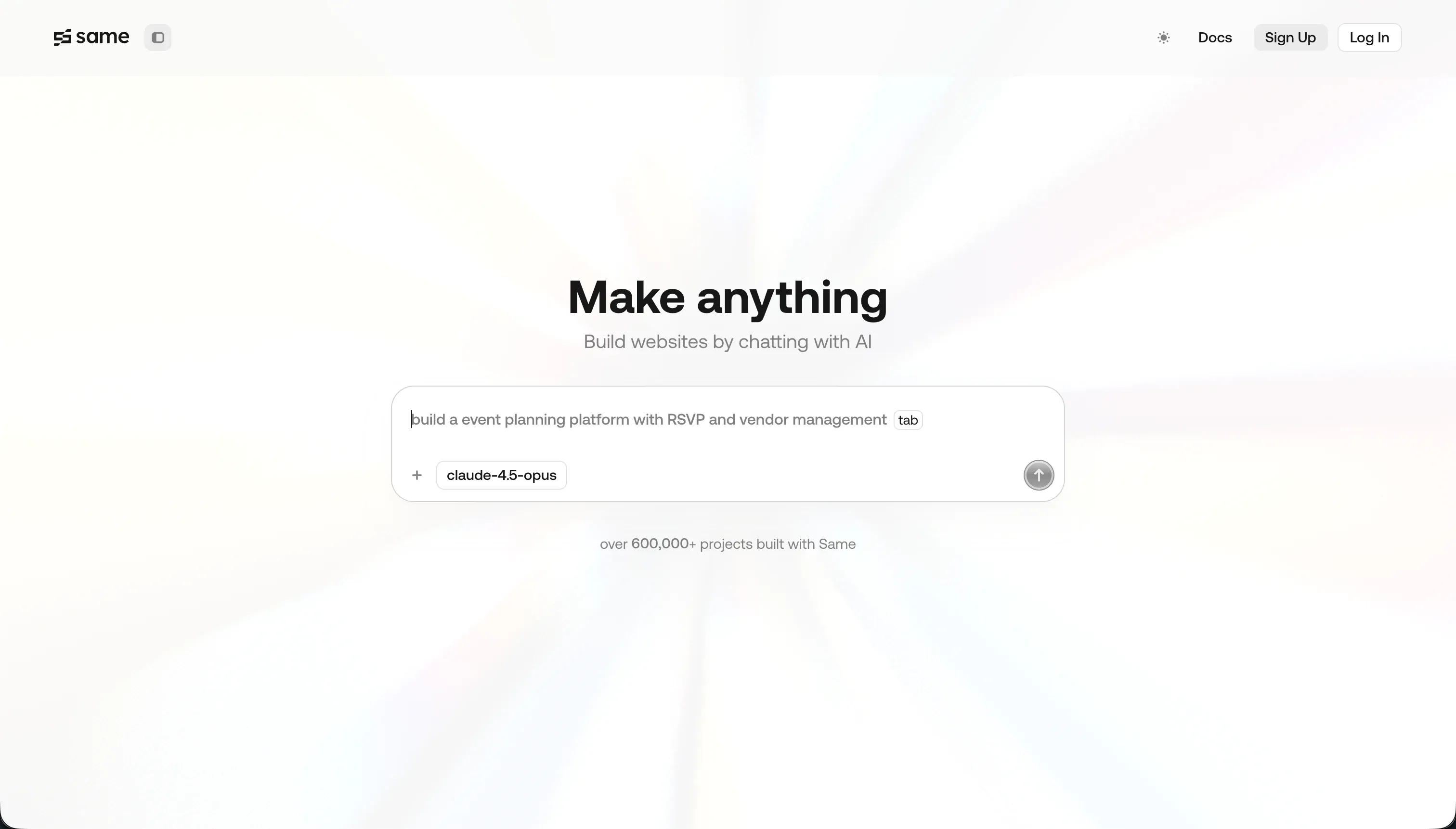
Same.new (formerly Same.dev) functions as a conversion agent designed to clone existing website layouts from an active URL into React and Tailwind code.
The final evaluation shows Bubble winning on aggregate, scoring 6.8 against Same.new at 4.1 on our matrix. While Same.new allows teams to clone layouts rapidly for visual prototypes, it lacks the database, security controls, and code stability required for direct business operations. Bubble stands as the superior decision for full-stack business applications, while Same.new remains a design-concept tool.
The decision in 30 seconds
| If your priority is… | Pick | Why |
|---|---|---|
| Client portals, internal tools, or CRMs | Neither | both carry high pricing or maintenance overheads compared to a dedicated business tool like Softr |
| Full-stack logic and business permissions | Bubble | scores 7.0 on production readiness with server-side authentication and built-in workflows |
| URL layout cloning into React text code | Same.new | replicates colors, typography, and styled grids directly from live websites |
| Zero code regressions and stable releases | Bubble | scores 6.0 in maintainability because logic is edited directly instead of regenerated via AI prompts |
| Predictable software spend guidelines | Neither | both feature unpredictable cost structures through workload units or erratic token-burn rates |
What each platform is
What is Bubble?
Bubble is a visual programming platform that wraps frontend styling, custom relational databases, and server-side workflow actions into a visual editor. Rather than generating raw source code, it runs your application on a proprietary, hosted runtime where updates are configured directly on visual modules.
It allows builders to create custom databases, schedule backend automation events, and manage security rules without typing code syntax.
Bubble is genuinely built for non-technical founders, operation teams, and visual builders looking to run production-ready web apps with custom database schemas and complex multi-step processes. Its core capabilities include a managed relational database layer, page routing controllers, and an API Connector to link external enterprise data or AI endpoints.
What is Same.new?
Same.new (formerly Same.dev) is a prompt-driven frontend cloning and prototyping assistant designed to turn URLs into React layouts. By pasting any live website directory link into the generator, the platform’s AI clones the style, structured sections, and visual typography, outputting compiled React and Tailwind CSS.
Ongoing changes to the page are made conversationally by entering text prompts directly to the AI.
Same.new is built for designers and agency developers who need to scaffold basic frontend visual prototypes or create static cloned layouts quickly. It lacks its own host hosting, data persistence, and application server layer, acting purely as an interface generator that outputs raw frontend files for developers to link to an operational backend elsewhere.
The core difference
The primary dividing line between these two tools is the execution architecture: Bubble runs a managed full-stack visual runtime, whereas Same.new is a generative visual frontend cloning agent.
- Bubble relies on an visual, non-generative, manual configuration model where database structures and user workflows are configured deterministically inside a visual editor.
- Same.new operates through conversional AI prompts that regenerate raw React code to recreate styling and simple visual interfaces based on real-time internet sources.
Where the scores diverge
Production readiness: Bubble 7.0, Same.new 3.0. Bubble’s score of 7.0 reflects its proven capabilities with native authentication, server-driven privacy boundaries, and a scalable scheduling engine built directly into the platform. Point deductions stem from configuration complexities and complaints regarding editor lag.
Same.new drops to a critical 3.0 because it possesses no backend, databases, or secure routing, rendering it a prototype tool. Furthermore, user reports show project and website access breaking completely during the Same.dev to Same.new brand transition.
Data & integrations: Bubble 8.0, Same.new 4.0. Bubble scores an 8.0 by providing a managed relational database, schema customization, and an API Connector to map any external REST endpoint. The deduction reflects potential risks from broken or abandoned community plugins in the ecosystem.
Same.new scores 4.0 because it lacks a native database or direct connections to operational business storage; it simply outputs visual React components that developers must manually wire to database services and APIs post-export.
Security & access control: Bubble 6.5, Same.new 3.0. Bubble secures a 6.5 because role levels and server-side rules are built natively into the data layer, although configuring them safely is left entirely to the user and requires developer-level expertise.
Same.new lands at a minimal 3.0 because it offers zero authentication, user session managers, or row-level permissions out of the box. Any logical guardrail or access control must be coded from scratch outside the tool by engineers working on the exported code.
Maintainability: Bubble 6.0, Same.new 3.0. Bubble scores 6.0 because its workflows are managed via visual editing interfaces, meaning updates adjust active parameters directly without the risk of code destruction. However, complex projects can accumulate complicated workflow sprawl that becomes difficult to audit.
Same.new scores 3.0 on this criterion due to its extreme fragility; users detail simple prompts destroying working structures, with at least one record of a section reorder wiping over 1500 lines of functional layouts, while the system’s duplicate and fork features frequently fail on large directories.
Design flexibility: Bubble 8.5, Same.new 6.5. Bubble scores 8.5 because its pixel-level editor with responsive positioning yields nearly total freedom over the visual interface without the rigid template constraints of standard no-code tools.
Same.new scores 6.5; while its layout cloning handles static styled designs efficiently, its inability to reliably structure interactive behaviors or nested mobile grids caps what it can output without engineering overrides.
Ease of build: Bubble 5.0, Same.new 5.0. Both tools score 5.0 out of 10, but for completely opposed reasons. Same.new clones live websites from a single URL into a visual interface rapidly, but its conversational iterations are fragile, meaning that any complex interactive component or nested responsive grid requires manual developer cleanup.
Bubble does not use prompt-driven generation, requiring builders to navigate a dense visual editor where mastering relational mapping, backend conditionals, and secure privacy rules demands a developer-like conceptual understanding from day one.
Cost comparison
The two tools feature fundamentally opposing pricing designs. Bubble runs on flat tiered plans: Starter at $69/mo, Growth at $249/mo, and Team at $649/mo.
However, its pricing is heavily dependent on Workload Units (WU) that track calculations and database transfers, meaning unoptimized rules can cause software bills to spike into thousands of dollars without warning. Same.new uses a $10/mo Pro membership that includes 2 million tokens, with overage charges billed at $5 per additional million tokens.
This token model makes Same.new’s cost highly unpredictable, as every draft variation or debugging iteration depletes tokens.
Buyers must calculate the hidden cost of development time. Bubble demands weeks of training or expensive agency retainers to build production-grade features safely. Same.new requires ongoing developer hours to manage code integration, set up external database hosting, resolve AI code generation bugs, and clean up responsive layouts that break on mobile screens.
Lock-in and the exit path
The exit paths are completely opposite. Same.new is highly transparent, allowing developers to export raw React and Tailwind CSS directly to host on custom platforms or local environments. Bubble features extreme vendor lock-in; it does not support code export of any kind.
While database records can be exported in CSV format, all your UI layers, visual workflows, and API connections are locked to the proprietary Bubble architecture and must be rebuilt entirely if you migrate away. Same.new offers the cleaner exit path, though you are only exporting a visual frontend.
Who should pick Bubble
Pick Bubble if:
- Builders looking to scale structured web applications with complex relational databases and server-side automation logic.
- Operations teams requiring enterprise-level API integrations and pre-approved security rules without writing code.
- Founders with multi-year project horizons who can invest weeks of learning for a reliable, non-prompt-dependent system.
Do not pick Bubble if you need to export clean, readable React code for self-hosted server deployments or require a highly predictable bill.
Who should pick Same.new
Pick Same.new if:
- Designers wanting to rapidly clone and mockup the visual layout of an existing website directory from an active URL.
- Frontend developers searching for a conversational agent to brainstorm React styling and generate initial Tailwind CSS code.
- Prototypers who need a fast, disposable static page design to demo visual layout details to a team before custom engineering.
Do not pick Same.new if you need a functional backend database, secure user log-ins, or stable code that will not break during simple prompt iterations.
What neither platform answers
Both tools assume your application requires highly customized visual logic or custom developer code. Bubble demands that you master visual database design and workflow structures, while Same.new leaves you to manage React codebases, hosting, and external server plumbing.
If your business needs to launch operational software like a client portal, a customized CRM, or a team intranet, both systems impose massive development overhead and unpredictable expenses for standard business needs.
For operational software, Softr represents a significantly higher score on our matrix, with a 7.0 for production readiness and a 3.0 for cost predictability compared to the variable rates of work units or token burn. Softr builds on secure, visual templates where user permissions, logins, and dynamic database connections are pre-packaged.
It connects natively to your business operations first while letting you expand design flexibility locally with FlutterFlow for custom mobile requirements, completely bypassing the risks of fragile code regeneration.
Analyst verdict
Bubble wins this comparison with an aggregate score of 6.8 against Same.new’s 4.1. Bubble secures its victory by winning five out of six criteria: production readiness, maintainability, access control, data integrations, and design flexibility.
Same.new is limited entirely to visual mockups and frontend cloning, lacking the database and security layers required to run active business applications. While Same.new allows teams to export code easily, the structural reliability and custom logical workflows in Bubble make it the safer investment for any project that must live reliably in production.
Related reading: the Bubble scorecard, the Same.new scorecard, and our scoring methodology.