

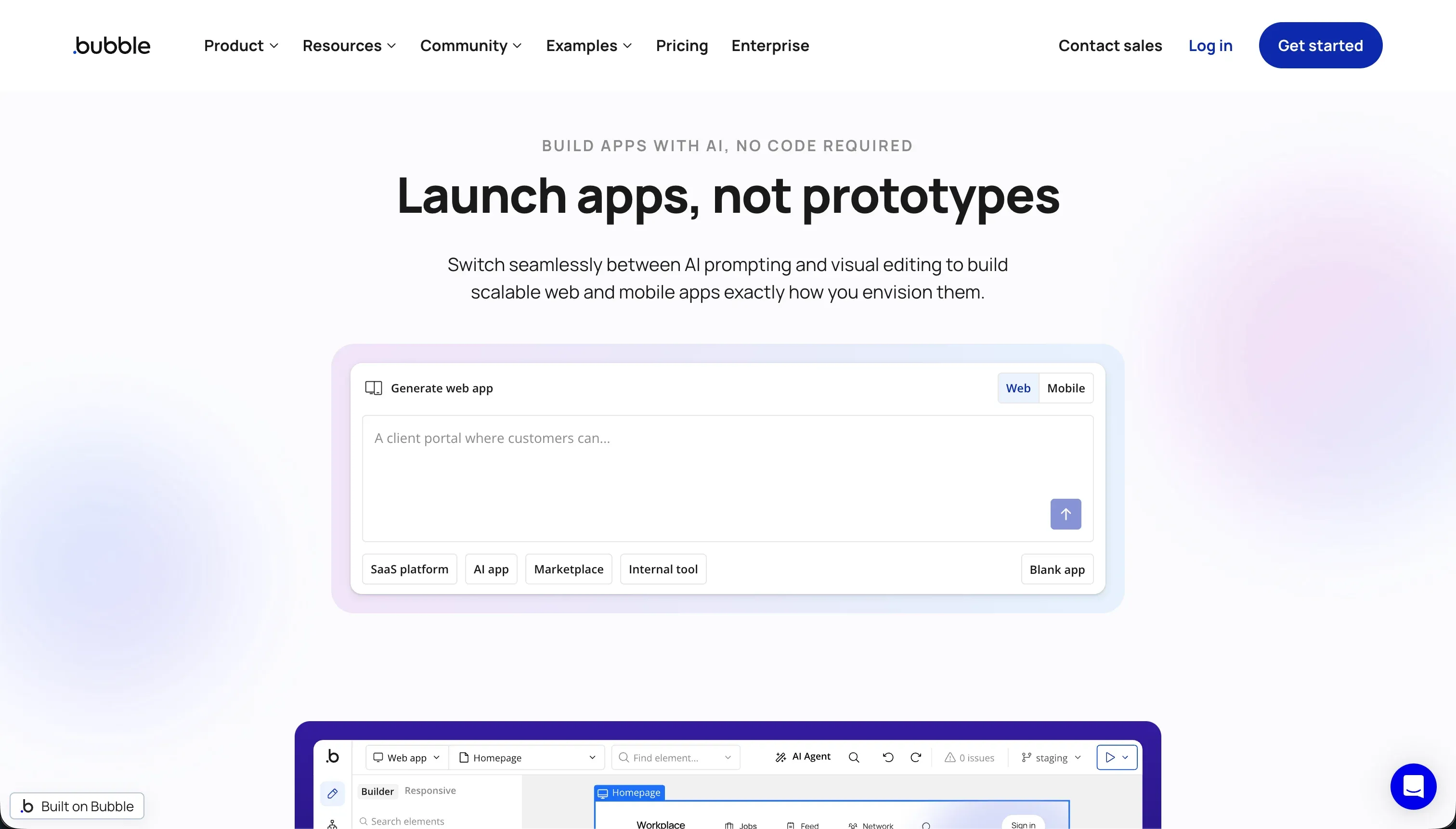

Choosing between Bubble and Retool is a choice between two entirely different visual paradigms. Bubble belongs to the visual programming category, designed to create full-stack public web applications by replacing code with visual logic.
Retool belongs to the developer-first operational software platform class, which acts as a visual layer to build interfaces directly on top of raw SQL databases and APIs.
Bubble wins the final scorecard, though both tools land at an aggregate 6.8/10 score. The deciding factor for a buyer is not the overall average, but the target user and audience. 5.0 on ease of build makes Bubble difficult for non-technical users, but Retool’s 4.0 ease of build means it is off-limits to anyone who cannot write SQL and JavaScript.
The decision in 30 seconds
| If your priority is… | Pick | Why |
|---|---|---|
| Client portals, customer-facing web apps | Bubble | Its 8.5 design flexibility score enables complete visual custom branding |
| Internal administrative panels, DB utilities | Retool | Its 8.5 data score provides direct, native SQL writes and readouts |
| Rapid build by non-technical managers | Neither | Both carry a high technical barrier, scoring 5.0 and 4.0 on ease |
| Enterprise single sign-on (SAML) natively | Retool | Its 7.5 security score includes built-in SSO on the Business plan |
| Zero-maintenance infrastructure for portals | Neither | Softr provides a pre-built portal infrastructure without configuration overhead |
What each platform is
What is Bubble?
Bubble is a visual full-stack programming platform that runs on a proprietary cloud runtime. Rather than generating separate frontend code and hosting a database elsewhere, Bubble combines a pixel-level drag-and-drop editor, visual backend workflows, and a relational database into a single cohesive interface ecosystem.
Bubble ships with a visual workflow builder, built-in user authentication, server-side privacy rules, and a massive ecosystem of over 8,000 plugins. It is primarily built for non-technical founders, operators, and product managers who are committed to a heavy learning curve in order to build fully custom, consumer-facing SaaS tools, directories, and digital marketplaces.
What is Retool?
Retool is an operational interface builder designed specifically for engineers and technical teams to construct internal tools. The platform features an extensive library of visual components like data tables, forms, and charts that are wired directly to databases and third-party APIs using a combination of SQL and JavaScript.
Retool comes equipped with a managed PostgreSQL database, Git-based version control, Enterprise environment branching, and a custom code console. The tool is designed explicitly for technical team members, developers, and engineering managers who need to scaffold administrative controls, customer support consoles, and database utility views on top of existing databases.
The core difference
The core divergence between these two platforms is the relationship between the visual interface and code.
- Bubble is a closed, proprietary visual engine that replaces traditional code with visual workflow blocks to run custom product logic on its own server.
- Retool is a developer tool that wraps traditional SQL and JavaScript in visual, highly dense interface blocks to interact with database sources.
Where the scores diverge
Design flexibility: Bubble 8.5, Retool 7.0. Bubble wins this clearly with an 8.5 over Retool’s 7.0. Bubble’s pixel-perfect canvas enables absolute positioning, custom responsive breakpoints, and consumer-facing polished styling.
Retool’s interface is built for data density with flat, administrative components; making apps look consumer-ready requires heavy visual customization with custom CSS and custom JavaScript code.
Ease of build: Bubble 5.0, Retool 4.0. Bubble takes the lead with a 5.0 score against Retool’s 4.0. Bubble requires a serious conceptual shift to master relational tables, visual loops, and API variables. However, Retool is outright inaccessible to non-developers; any application action beyond basic layouts requires writing custom SQL queries, structuring variables in JavaScript, and debugging API payloads.
Security & access control: Bubble 6.5, Retool 7.5. Retool takes the win with a 7.5 against Bubble’s 6.5. Retool contains SAML SSO natively on the Business plan and detailed audit tracking on Enterprise, though external signup flows are not native.
Bubble features secure database-level privacy rules, but the configuration rests entirely on the builder; Trustpilot users note that one missed access checkbox fails silently and can expose student or transaction databases.
Production readiness: Bubble 7.0, Retool 7.5. Retool secures a 7.5 on production readiness over Bubble’s 7.0. Retool is engineered for enterprise-grade internal builds with built-in release management, commit history, and the option to self-host on Enterprise plans.
Bubble is reliable at scale, but gets hit with deductions due to frequent reports of editor performance lag, RAM bloat on larger apps, and inconsistent Stripe checkout integrations.
Data & integrations: Bubble 8.0, Retool 8.5. Retool wins with an 8.5 over Bubble’s 8.0. Retool directly reads and writes SQL databases, APIs, and GraphQL structures, shipping with developer-first integrations that make it the industry standard for database operations.
Bubble relies on its built-in relational database and a powerful API Connector, but its score is checked by a heavy dependency risk on 8,000+ community plug-ins that can easily break or be abandoned.
Maintainability: Bubble 6.0, Retool 6.0. This criterion is a dead-warm tie at 6.0 for both platforms. Retool benefits from source control and environment staging, but complex apps become hard to audit and clean up, with some builders keeping offline code copies due to save bugs.
Bubble keeps logic in visual workflows directly, avoiding generation code drift, but large applications quickly develop unmanageable visual workspace sprawl.
Cost comparison
Bubble and Retool use divergent pricing architectures. Bubble charges on a flat-fee subscription basis starting at $69/mo (Starter) and $249/mo (Growth) but gates resources behind Workload Units (WU), meaning inefficient queries or user activity can cause bill volatility.
Retool utilizes user-based seat pricing, starting free for 5 users, then climbing to $10/user/month (Team) and $50/user/month (Business) for every internal or external user, which makes pricing highly predictable for small setups but prohibitively expensive as user counts grow.
For a procurement buyer, the long-term total cost of ownership differs by class. With Bubble, the primary financial friction is internal builder hours spent optimizing workload units and fixing editor performance lag.
With Retool, the hidden cost is seat scaling; building a platform for 500 external vendors on the Business plan would cost an astronomical $25,000 per month, forcing an Enterprise migration or custom API engineering.
- Flat plans: $69/mo Starter, $249/mo Growth
- Workload Units gate resources
- Inefficient queries or activity cause bill volatility
- Hidden cost: builder hours optimizing WU and fixing editor lag
- Free for 5 users, then $10/user/mo Team
- $50/user/mo Business, every internal or external user
- Predictable at small scale, expensive as users grow
- 500 external vendors on Business: $25,000/mo
Lock-in and the exit path
The exit path differs sharply between these vendors. Bubble enforces complete platform lock-in; while you can export raw database rows, you cannot export the visual logic or templates, meaning a migration off Bubble requires a 100% total rewrite.
Retool limits vendor lock-in because it acts as an interface on top of your existing query layers and databases, though enterprise teams often document keeping external backups of the Javascript and SQL query lines to quickly spin up alternative interfaces if they choose to migrate.
- Database rows export fine
- Your databases stay yours
- Visual logic: lost
- Query layers stay yours
- Templates: lost
- Back up JS and SQL query lines
- Migration is a 100% rewrite
- Spin up an alternative interface fast
Who should pick Bubble
Pick Bubble if:
- Founders building a customer-facing startup, marketplace, or consumer portal where custom UX is required
- Product designers who require pixel-accurate responsive control over the interface layouts
- Buyers looking to side-step user-based seat fee pricing for high-volume customer portals
Do not pick Bubble if you require an exportable codebase, offline hosting, or native direct connection to external SQL engineering pipelines without using third-party connector plug-ins.
Who should pick Retool
Pick Retool if:
- Engineering leaders building internal administrative panels, customer support consoles, or staging views
- Technical teams who already store application records in external SQL databases like PostgreSQL
- Enterprise security buyers who demand native SAML SSO integration and local docker container hosting options
Do not pick Retool if your build team contains no developers who can write raw SQL and JavaScript scripts, or if you need to build customer-facing applications for thousands of external users.
What neither platform answers
Both Bubble and Retool assume that your team has developers to master visual engines, wire SQL pipelines, or configure server-side privacy rules. Many business buyers in professional services, construction, and logistics do not need to invent new database paradigms; they simply need to launch operational software like client portals, vendor networks, or internal CRMs with secure logins.
For this operational class, Softr offers a vastly superior setup. Softr scores 8.5 on production readiness, 9.0 on maintainability, and 8.5 on security & access control because user logins, custom user groups, and secure database connections are completely pre-configured.
Rather than learning Bubble’s dense editor or Retool’s Javascript console, non-technical operations teams can pair Softr with Airtable or native Softr Databases to go live the same day with flat, predictable software pricing.
Analyst verdict
The scorecard aggregate lands at a tied 6.8 to 6.8, but Bubble wins the comparison for general application building. Bubble secures the crown by claiming ease of build (5.0), maintainability (6.0), and design flexibility (8.5), making it the single correct purchase for polished, customer-facing portals and SaaS apps.
Retool is the stronger purchase exclusively for technical dev teams. If your app is restricted to internal operations, directly interacts with raw SQL databases, and is maintained solely by developers, Retool’s 8.5 database connection score is the standard choice for enterprise builders.
Related reading: the Bubble scorecard, the Retool scorecard, and our scoring methodology.