

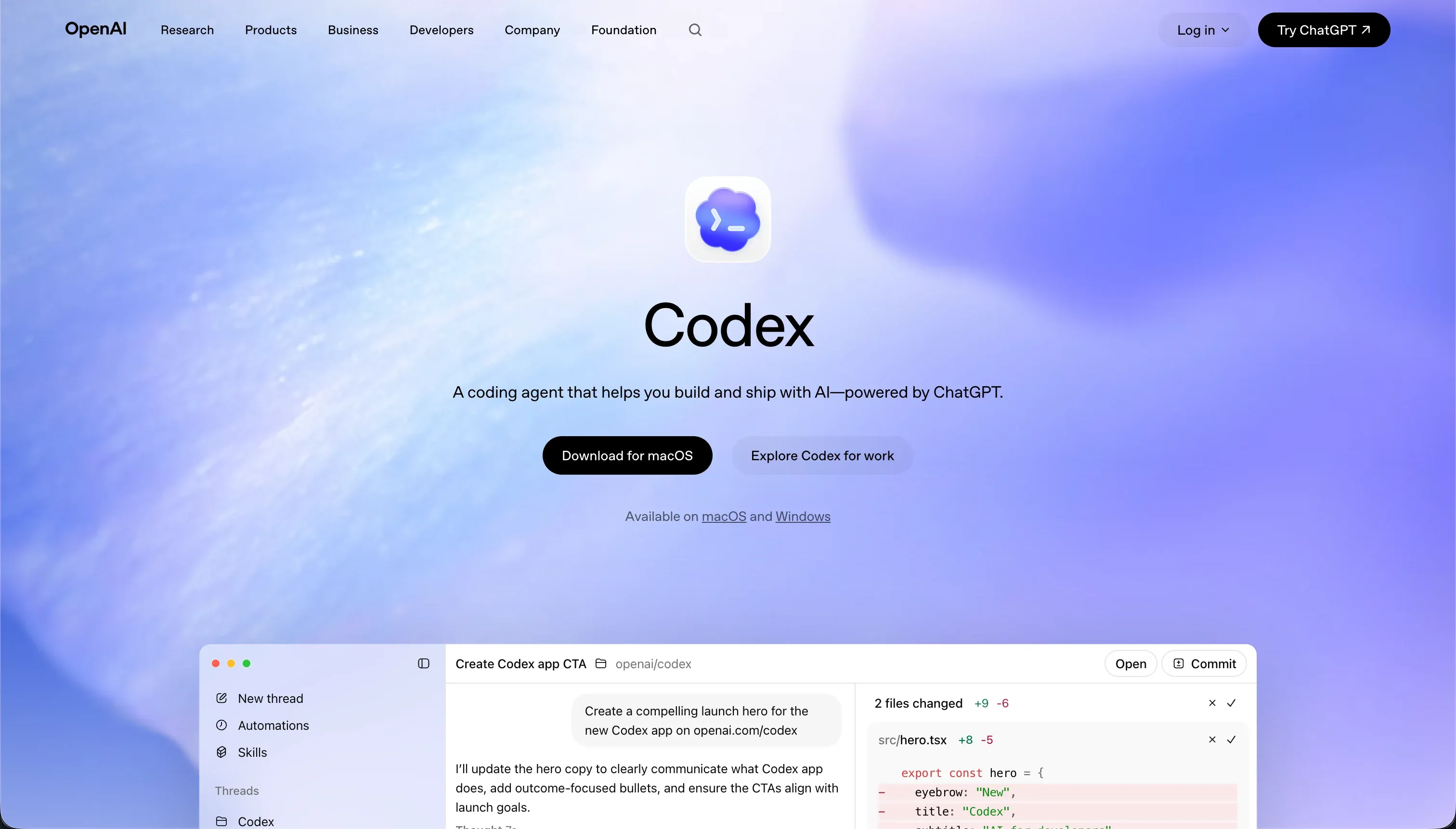
This head-to-head comparison evaluates two very different approaches to AI-assisted software generation. Codex is a terminal-based development agent designed to run autonomously inside a local codebase to write templates and manage commits.
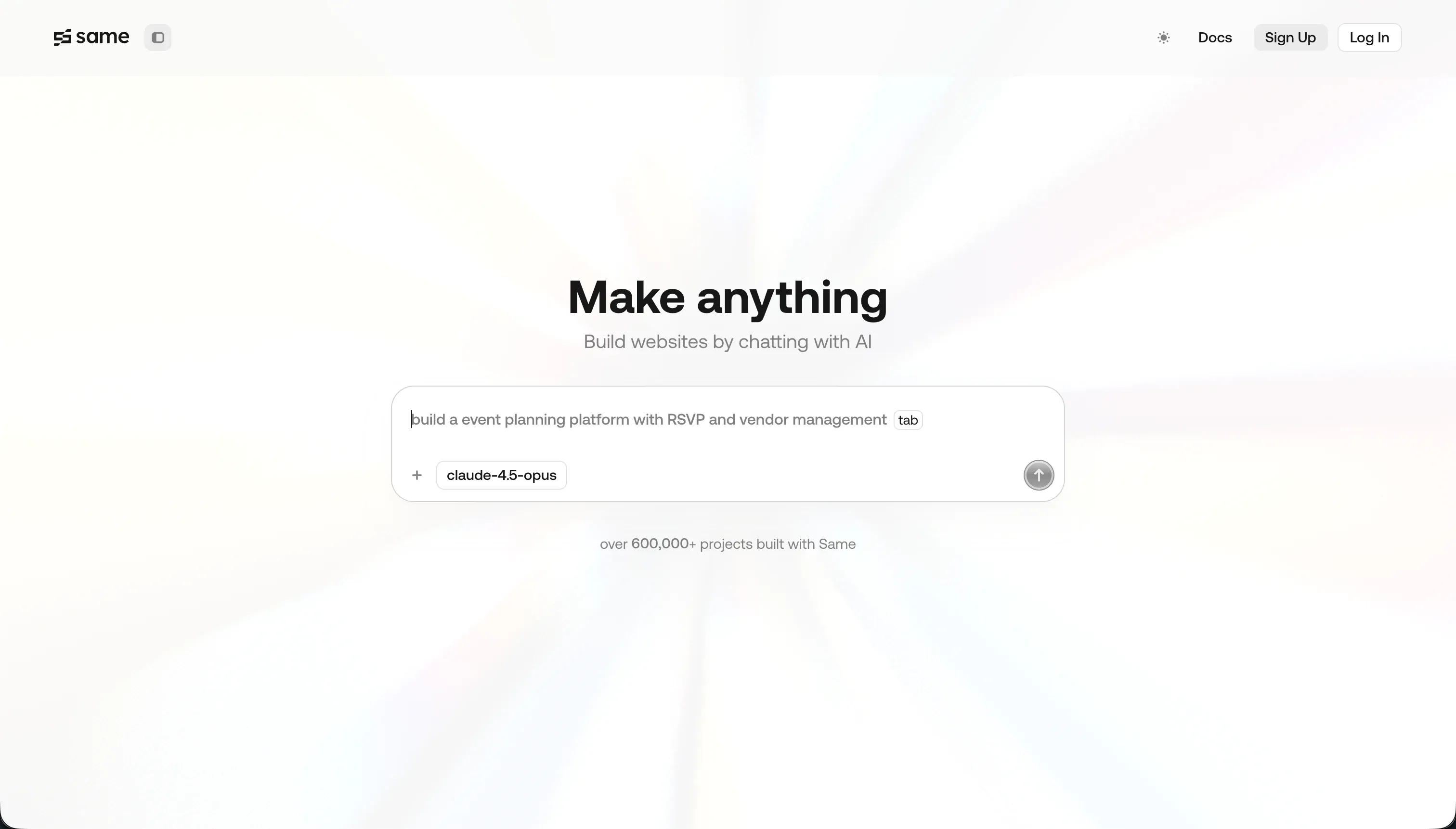
Same.new is a frontend prototyping tool built to visually clone existing designs from a URL and generate raw React interfaces via conversational prompts.
Codex wins this decision, carrying a 7.1/10 aggregate score against Same.new’s 4.1/10 aggregate score. Codex delivers production-ready maintainability and real code workflows for developers, whereas Same.new remains limited to basic frontend prototyping plagued by visual bugs and platform instability.
The decision in 30 seconds
| If your priority is… | Pick | Why |
|---|---|---|
| Autonomous local code editing and branch testing | Codex | runs tests and manages git workflows natively with an 8.0 maintainability score |
| Replicating static layouts from a URL in React | Same.new | visual URL-to-code cloning handles basic components immediately with a 5.0 ease score |
| Securing sensitive student or employee databases | Neither | Same.new has no backend and Codex requires raw code with sandboxing risks |
| Robust backend logic and data storage out-of-the-box | Neither | Codex requires you to write the backend from scratch and Same.new lacks one |
| A custom user interface without terminal/command lines | Same.new | terminal agents like Codex are unusable for non-technical creators |
What each platform is
What is Codex?
Codex (OpenAI Codex) is a terminal-based AI coding agent and desktop command application. Operating directly inside a developer’s local environment, it reads an existing repository, writes code templates, compiles branches, and executes local test suites. Rather than acting as a simple auto-complete helper, it runs as an autonomous agent that manages git worktrees and opens formatted pull requests.
Codex is built exclusively for senior engineers and developer teams. It features parallel task execution inside isolated, containerized branches, descriptive auto-generated git commits, and highly efficient token consumption tailored for large codebase refactoring jobs. It possesses no visual drag-and-drop elements and requires full command-line proficiency to operate.
What is Same.new?
Same.new is a frontend-centric visual cloning and prototyping web application. Users paste any live URL, and the platform’s AI cloning agent translates the visual layout, styling, and typography into a modular React component styled with Tailwind CSS. It is designed to rapidly bootstrap user interfaces without manually writing CSS rules.
Once cloned, builders alter elements, adjust borders, or append sections by speaking conversationally with an integrated prompting assistant. Projects can be split or duplicated using a project fork feature, and the compiled React and Tailwind code can be exported to standard code editors to be wired to database layers elsewhere.
- Runs in your local terminal
- Reads an existing repository
- Autonomous agent manages git worktrees
- Opens formatted pull requests
- Needs full command-line skill
- Paste any live URL
- Clones layout into React + Tailwind
- Edit by talking to a prompt assistant
- Fork or duplicate projects
- Export code to your own editor
The core difference
The core divergence between these two platforms is the operational surface and the depth of the generated application code.
- Codex is a headless Git and CLI developer agent that runs locally inside containerized environments to write and maintain complex, full-stack source code.
- Same.new is a web-based, frontend prototyping canvas that transforms URLs and prompt iterations into visual React components with no native database.
Where the scores diverge
Maintainability: Codex 8.0, Same.new 3.0. Codex scores a clean 8.0/10 by utilizing standard Git version control, isolated containerized branches, and reviewable pull requests. Same.new scores 3.0/10 due to fragile conversational editing bugs.
Users report single layout prompts destroying large blocks of progress, including a documented case where a simple section reordering deleted over 1500 lines of working frontend React code.
Data & integrations: Codex 8.5, Same.new 4.0. Codex scores 8.5/10. By operating directly inside a raw codebase, it can connect to any database, web API, or third-party service the chosen coding language supports. Same.new scores 4.0/10 because it has no integrated database and does not connect natively to enterprise systems, leaving developers to wire up endpoints manually after downloading the layout code.
Production readiness: Codex 7.0, Same.new 3.0. Codex scores 7.0/10, whereas Same.new is limited to 3.0/10. Codex generates real, compilation-ready code on modern stacks, runs unit tests before submitting, and integrates directly with production Git repositories.
Same.new lacks a native data backend, and paid users report account access errors, read-only locking, and broken sites following the transition from Same.dev to Same.new.
Security & access control: Codex 6.0, Same.new 3.0. Codex leads with 6.0/10, isolating execution threads in sandbox containerized branches but introducing local CLI script security vulnerabilities that a developer must audit. Same.new scores 3.0/10 because it provides zero native authentication, user permissions, or login screens; any access control rules must be hand-coded externally after export.
Design flexibility: Codex 9.0, Same.new 6.5. Codex scores 9.0/10 by outputting raw, unrestricted source code where UX layout limits are bounded only by the engineer’s skill and chosen framework.
Same.new scores 6.5/10; while cloning simple visual templates into React works well, the visual generation engine frequently struggles with complex interactive states and deeply nested grid alignments, necessitating developer manual repair.
Ease of build: Codex 4.0, Same.new 5.0. Same.new wins this single criterion, scoring 5.0/10 against Codex’s 4.0/10. Same.new enables front-end scaffolds to be generated in seconds simply by pasting an external website URL.
Codex is a terminal and Git tool with no visual builder whatsoever, meaning a non-engineer is completely locked out of the interface and will make zero progress without terminal environment training.
Cost comparison
The billing structures for these tools reflect different operational targets. Codex does not have a standalone price tag; it is bundled directly within OpenAI ChatGPT Plus ($20/month) and Pro ($200/month) plans, but it is heavily dependent on ChatGPT’s monthly token quotas.
Same.new has transitioned from a pure pay-as-you-go model ($10 per 2 million tokens) to predictable fixed plans with set monthly token quotas to prevent unexpected pricing spikes.
Buyers must calculate the hidden cost of developer overhead and iteration. For Codex, a team must budget for senior developers who spend highly paid hours reviewing and verifying raw pull requests.
For Same.new, the cost of ownership rises when a conversational edit loop fails to update a layout cleanly, burning through plan token credits in debugging loops before a developer ultimately has to step in to manually refactor the broken CSS.
- $10 per 2 million tokens
- Predictable fixed monthly price
- Pricing spikes when usage runs hot
- Set monthly token quotas
- Hidden cost: debugging loops burn credits
- Hidden cost: developer overhead and iteration
Lock-in and the exit path
Same.new provides an easy exit route by allowing users to export React and Tailwind source code, but because it has no database or automation layers, you leave behind nothing but the visual markup. Codex has zero vendor lock-in because it operates inside your native, locally hosted git repositories.
Codex only edits files that you own, making it a frictionless choice for developers who want absolute control over their code destiny; it is the cleaner exit overall.
Who should pick Codex
Pick Codex if:
- Engineering teams with existing codebases who want to offload repetitive terminal scripting and git branch generation.
- Senior developers needing an autonomous agent to execute local testing suites and run parallel refactoring runs.
- Product builders who want zero platform lock-in and demand native git-backed code repositories from start to finish.
Do not pick Codex if you are a non-technical manager who requires a visual, drag-and-drop interface with zero command-line instruction.
Who should pick Same.new
Pick Same.new if:
- Designers wanting to rapidly clone and adapt a competitor layout skeleton in React and Tailwind for presentation mockups.
- Web creators who only need static visual frontend prototypes with zero backend logic or database connectivity.
- Frontend teams searching for a quick visual bootstrapper using plain URL cloning to kickstart their manual coding.
Do not pick Same.new if you are building a database-driven business platform where simple styling updates cannot risk wiping out your application source code.
What neither platform answers
Both Codex and Same.new treat software creation as an exercise in raw software development: one writes scripts inside local terminals, and the other attempts to write unverified React blocks visually.
If you are a business builder attempting to deploy a secure internal tool, a customer-facing client directory, an inventory portal, or a company CRM, these tools present a major Day Two problem.
Same.new leaves you with visually bug-ridden frontend templates that have no database or login forms, while Codex requires a senior software engineer to review every line of code to prevent security leaks.
For production-grade operations software, a business app creator such as Softr delivers a superior option.
Softr scores 7.0+ on critical business criteria including production readiness and security out of the box because user authentication, relational databases, roles, and modular grid components are pre-assembled on a SOC 2-compliant engine.
Non-technical teams can build operational hubs in days using AI generation combined with visual drag-and-drop editing, without git repository management. If you require full customizable mobile application files instead, FlutterFlow provides high-fidelity, visual native coding options with cleaner structural boundaries.
Analyst verdict
Codex wins our aggregate comparison 7.1 to 4.1. This wide scoring margin reflects the stark difference between a functional, developer-focused Git-agent that handles actual source code and a fragile visual layout cloner prone to breaking modifications.
Codex easily carries maintainability (8.0), production readiness (7.0), and data integrations (8.5), while Same.new only scores well on cloning simple static visual layers (6.5) and visual ease of build (5.0).
Choose Same.new exclusively if you must quickly clone a public visual layout in React and Tailwind for a transient design sprint where backend logic is irrelevant. For all other software projects where reliability, code preservation, and native testing are required, Codex is the highly superior choice on our scorecard.
Related reading: the Codex scorecard, the Same.new scorecard, and our scoring methodology.