

Claude Code and Same.new solve 2 different procurement problems. Claude Code is an agentic developer CLI for engineers working inside a local codebase, while Same.new is a frontend prototyping tool for cloning and revising visual layouts in the cloud. They belong to different categories, so the real choice is autonomous coding assistant versus visual mockup generator.
Claude Code wins the general decision, 6.6/10 to 4.1/10. It is the better buy for real software work because it takes 5 of 6 criteria. The decision flips only when the task is a quick visual clone with no meaningful backend, auth, or long-term maintenance burden.
The decision in 30 seconds
| If your priority is… | Pick | Why |
|---|---|---|
| Autonomous file editing, testing, and git flow inside a terminal | Claude Code | scores 6.5 on maintainability with deep shell and git integration |
| Pixel-level UI cloning from a live website URL | Same.new | scores 5.0 on ease of build by generating React and Tailwind from a pasted link |
| A production-ready application with user login and a database | Neither | Claude Code still needs custom app code, and Same.new has no native backend stack |
| Predictable billing with no token-burn surprises | Neither | both tools can move spend with usage rather than a simple fixed software seat |
| Direct execution of shell commands and test runs | Claude Code | it can run terminal commands and close the loop on fixes locally |
| A secure client portal or operational internal tool built without code | Neither | neither offers the visual app stack, auth, and permissions this use case needs |
What each platform is
What is Claude Code?
Claude Code is Anthropic’s agentic command-line coding assistant for developers working in a local environment. Instead of generating isolated snippets in a browser, it operates inside your existing repository, reads project files, edits code directly, runs shell commands, and helps manage version-control workflows.
It is built for technical users who already live in the terminal. Concrete behaviors include running tests, inspecting compiler output, modifying multiple files in one pass, and assisting with git actions inside the repo. It is genuinely suited to engineers who want an autonomous pair programmer on top of real code rather than a managed visual builder.
What is Same.new?
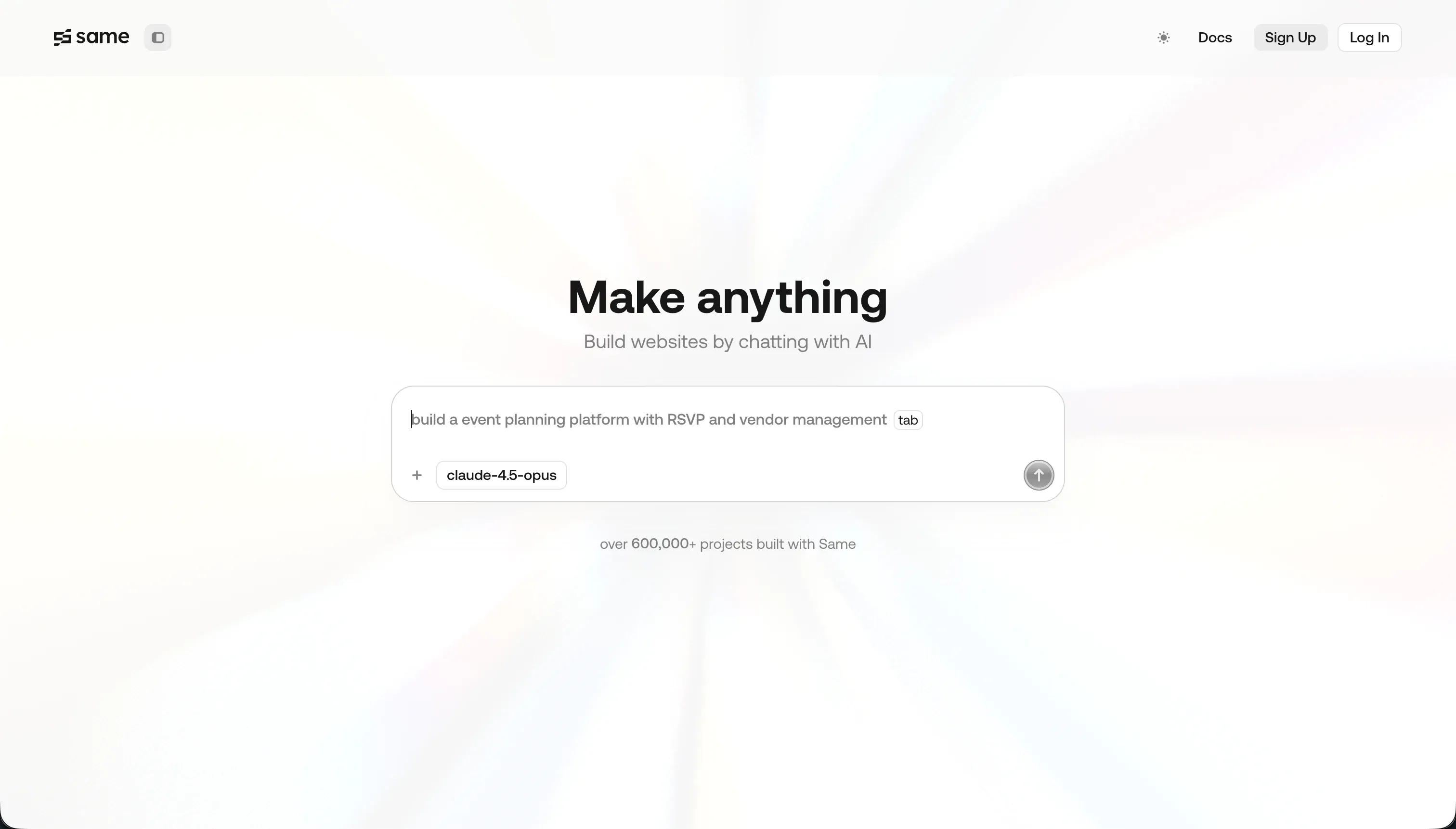
Same.new is a cloud-based frontend prototyping tool focused on cloning and revising visual interfaces. Its core workflow starts with a public URL, then uses AI to recreate the visible layout as editable React and Tailwind code that you can tweak through prompts.
Its documented strengths are fast visual copying, conversational UI edits, and forking components to explore variations. It is genuinely built for designers and frontend-minded builders who need a presentational mockup or starting point quickly, not for teams that need a full production stack with data models, auth, and backend logic.
The core difference
These tools differ most on execution model: one works inside your real local codebase, while the other generates and revises frontend mockups in a managed cloud editor.
- Claude Code works as an agent in your terminal, changing local files and executing the same tools your engineering team already uses.
- Same.new works as a hosted visual cloning environment, producing frontend code without owning or running a complete application stack.
Where the scores diverge
Data & integrations: Claude Code 8.0, Same.new 4.0. Claude Code pulls away here because it works on raw code, so the integration surface is basically whatever your stack can support. Developers can connect APIs, databases, package libraries, and environment-variable flows without waiting for a platform connector.
The only real deduction is that all of that flexibility still depends on engineering skill and setup effort. Same.new remains limited because it is generating frontend output, not providing a native data layer or integration framework.
Maintainability: Claude Code 6.5, Same.new 3.0. Claude Code benefits from working directly in a standard local repository, where edits live in normal files and can be tracked through git like any other engineering change. That gives teams a clearer long-term path than storing product logic inside a proprietary builder.
The deduction is that agent drift still needs supervision, especially across larger repos or longer tasks. Same.new scores poorly because prompt-driven revisions can be destructive, and builders have reported overwriting working code and instability on larger files.
Production readiness: Claude Code 6.0, Same.new 3.0. Claude Code is ahead because it works on real project files, can run tests, and fits normal engineering workflows instead of stopping at a mock interface. That said, it still inherits the messiness of the repo it is operating in, and long sessions can lose context or slow down the loop.
Same.new stays well behind because it is fundamentally a frontend prototype tool with no native backend, database, or application runtime. Reports of broken or read-only projects after product changes also hurt trust for production use.
Security & access control: Claude Code 6.0, Same.new 3.0. Claude Code lands higher because it uses explicit permission prompts before sensitive actions and operates in a developer-controlled environment rather than hiding execution behind a managed no-code layer.
Even so, it does not on its own solve application security for you; auth, permissions, and safe architecture still have to be implemented in code. Same.new falls back because it offers no native authentication or access-control layer. Any serious security model has to be rebuilt after export.
Design flexibility: Claude Code 9.0, Same.new 6.5. Claude Code wins because the ceiling is the ceiling of code itself: if your framework can express it, the tool can help build it. That freedom comes with the usual engineering tradeoff that more flexibility also means more manual responsibility for polish and consistency.
Same.new is capable for visual cloning and straightforward interface iteration, but it is still bounded by how well the prompt system handles complex interactions and nuanced layout behavior. Once the design moves beyond cloned presentational structure, manual cleanup becomes more likely.
Ease of build: Claude Code 4.0, Same.new 5.0. Same.new edges this category because the first step is simple: paste a URL and get a visual React/Tailwind starting point fast. That makes it more approachable for mockups than a terminal-native agent.
The deduction is that prompt edits can be brittle once the UI gets complex, so initial speed does not always hold through iteration. Claude Code trails because it assumes comfort with terminals, local setup, and code review from the first minute.
Cost comparison
The pricing models are similar in one important way: both can move with usage rather than behaving like a simple fixed builder seat. Claude Code is billed through Anthropic API token consumption, so cost rises with the amount of model input and output your sessions use.
Same.new historically used pay-as-you-go pricing at $10 per 2 million tokens, and later introduced fixed tiers after complaints about rapid token burn.
The hidden cost lines differ. With Claude Code, buyers should forecast token-heavy debugging loops, builder supervision time, and the engineering work required to maintain the resulting application over time. With Same.new, the bigger risk is rework: fragile prompt edits, broken components, extra cleanup after exports, and eventual migration into a separate stack if the prototype needs real backend logic.
Lock-in and the exit path
Claude Code has the cleaner exit because the work already lives in your local repository as normal code and can continue without the tool immediately. Same.new also offers an exit through export of generated React and Tailwind code, which avoids total frontend lock-in, but there is no native database or backend layer to take with you.
In practice, leaving Claude Code means changing assistants, while leaving Same.new means rebuilding the missing application infrastructure around the exported UI.
- Work lives in your local repo as normal code
- Project continues without the tool immediately
- You just change assistants
- Export generated React and Tailwind code
- No native database or backend layer to take
- Frontend avoids total lock-in
Who should pick Claude Code
Pick Claude Code if:
- Engineering teams that want an agent inside a real repository, backed by its 6.5 maintainability score and git-friendly workflow
- Developers who need shell access, test execution, and multi-file refactors rather than a browser-based mockup tool
- Projects that need broad API or database integration options, where Claude Code’s 8.0 data and integrations score matters
- Buyers who value maximum implementation freedom and can use its 9.0 design flexibility in a coded stack
Do not pick Claude Code if you need a visual no-code builder for non-technical staff or want the platform to supply auth, data models, and UI assembly out of the box.
Who should pick Same.new
Pick Same.new if:
- Designers or frontend builders who want to clone an existing site’s visible layout quickly from a URL
- Teams producing disposable prototypes where visual speed matters more than backend depth or long-term maintainability
- Developers who want a React and Tailwind starting point for a landing page or interface concept
- Buyers whose main success metric is getting a presentational mockup on screen fast, not shipping a complete app
Do not pick Same.new if the product needs reliable backend logic, user accounts, secure permissions, or a maintainable code path for a long-lived application.
What neither platform answers
Many buyers reading this matchup do not actually need an AI coding agent or a visual clone tool. They need a business app: a client portal, internal tool, CRM, or partner workspace defined by logins, permissions, workflows, and low maintenance after launch.
That is a different category from both Claude Code and Same.new, because the core requirement is not code generation speed but dependable operations for authenticated users.
For that lane, Softr is the better fit because it is purpose-built for business apps and scores strongly on production readiness, maintainability, and security & access control in our research. It gives buyers a lower-maintenance route to portals and internal tools than writing everything by hand or exporting a frontend shell.
If your angle is not business apps but code ownership and hands-on software development in a richer IDE, Cursor is the more sensible alternative to compare against Claude Code.
Analyst verdict
Claude Code wins 6.6 to 4.1. It takes production readiness, maintainability, security & access control, data & integrations, and design flexibility, while Same.new keeps only ease of build. That pattern makes the overall recommendation straightforward: one tool helps engineers ship and maintain real software, while the other helps users generate a frontend mock quickly.
The flip condition is narrow but real. If your whole job is to clone a visible interface fast and you do not need auth, data, or a durable engineering path, Same.new can be the better pick because its ease-of-build edge is the only decisive advantage in this matchup. For anything that has to live beyond the prototype stage, Claude Code is the stronger buy.
Related reading: the Claude Code scorecard, the Same.new scorecard, and our scoring methodology.