

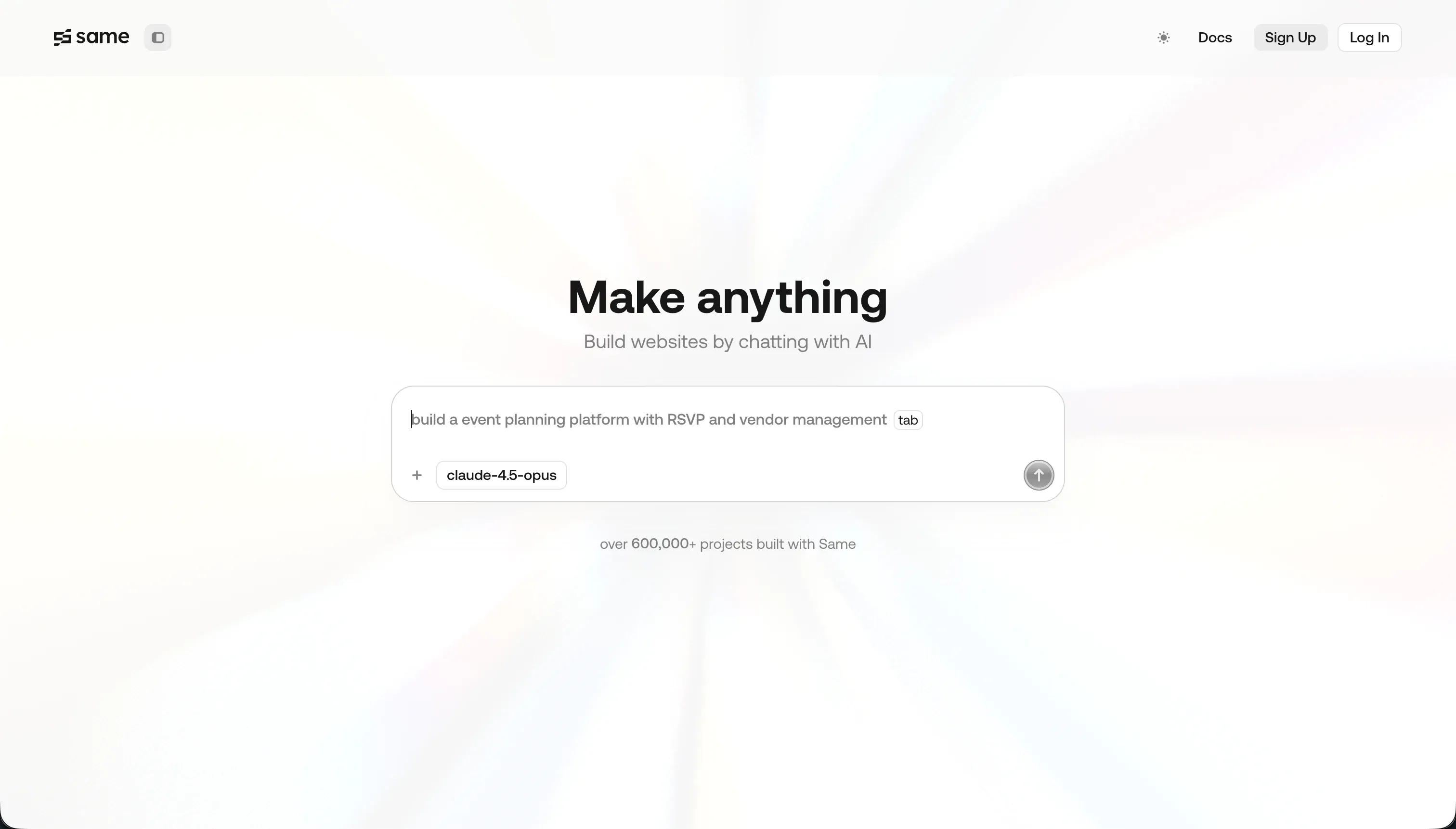
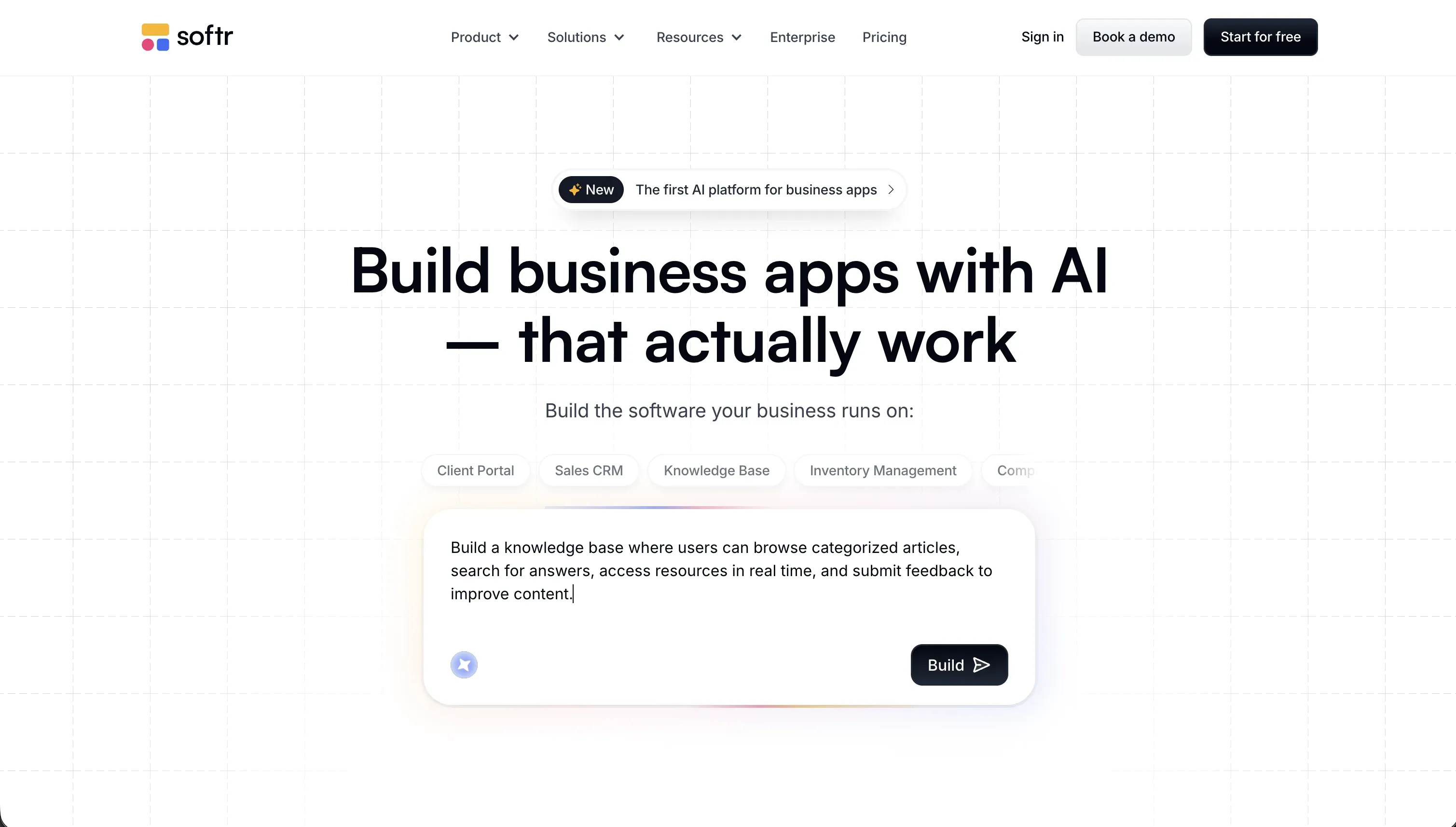
Pasting a URL to clone a layout and configuring an operational database involve entirely different procurement paths. Same.new is a frontend prototyping and UI cloning tool that generates React code from text prompts. Softr, by contrast, is an AI no-code app builder designed to build functional, database-driven business software like portals and internal tools.
Softr wins the general software decision by an aggregate score of 8.1 to 4.1. This score discrepancy reflects the difference between generating cosmetic client-side prototypes and deployable business applications. Same.new serves the visual scaffolding phase, but Softr is the only viable path for teams running active business operations.
The decision in 30 seconds
| If your priority is… | Pick | Why |
|---|---|---|
| Client portals, internal tools, and CRMs | Softr | Ships with native databases, authentication, and visual user permissions out of the box |
| Replicating static UI layouts from a URL | Same.new | Clones page styles directly into editable React and Tailwind code |
| Robust day-two software maintenance | Softr | Avoids generated code regressions entirely by utilizing structured, battle-tested visual blocks |
| Predictable billing with high-volume scaling | Softr | Flat-tier pricing plans with robust record and database limits |
| Full code ownership and self-hosting | Neither | Softr utilizes a managed runtime environment, and Same.new only exports frontend JSX without backends |
What each platform is
What is Same.new?
Same.new (formerly Same.dev) is a visual prototyping tool built specifically to replicate website designs. By pasting any live website URL into its interface, the AI agent cloning engine automatically parses the layout, colors, typography, and styling to scaffold a React and Tailwind CSS replica.
Once the initial layout is cloned, builders edit the visual structure by submitting conversational prompts to an AI assistant.
Same.new is natively built for frontend developers and designer teams who need to draft visual interfaces or experiment with UI layouts. Its main functional features include the project fork system for version iteration and a clean code export utility. However, the system contains no database layer or server-side workflows, making it a design sandbox rather than an application development environment.
What is Softr?
Softr is an AI full-stack business app builder designed to operate completely without code. Its AI Co-Builder allows builders to outline their functional requirements in plain English, instantly generating the corresponding database structure, interface pages, user permission groups, and navigation rules.
Once generated inside the editor, builders configure settings visually or drag-and-drop pre-built components down to individual actions.
Softr is designed for operations departments, business founders, and IT teams that need secure and fast internal tools or client portals. Its core engine consolidates native relational Softr Databases, secure authentication, and multi-step background workflows under one platform.
Built-in security features such as SOC 2 Type II compliance and direct server-side database CRUD actions ensure the platform supports enterprise-grade operational workflows.
The core difference
The core division lies between visual code generation and a managed platform runtime.
- Same.new generates a starting block of frontend React code by analyzing structural page layouts.
- Softr deploys a secure, fully hosted operational platform built on top of standard business databases.
Where the scores diverge
Maintainability: Same.new 3.0, Softr 9.0. Softr scores 9.0 because there is no raw generated codebase to maintain. Applications are composed of native, battle-tested visual blocks that can be modified directly by hand without burning AI credits or risking script errors. Same.new scores 3.0 due to severe code fragility.
Users report that simple design update prompts often destroy existing visual layouts, including verified cases of simple section reorders completely wiping out 1500 lines of working code. The duplicate fork feature also struggles to execute on larger workspace files.
Production readiness: Same.new 3.0, Softr 8.5. Softr scores 8.5 because it establishes platform-managed infrastructure including pre-built authentication, user groups, custom domain routing, and SOC 2 Type II compliance. The foundation a client portal needs is actual platform security, not generated code.
Same.new scores 3.0 because it remains a frontend prototyping tool with no native backend, database, or hosted server runtime. Furthermore, active users experienced project downtime and read-only lockouts during the tool’s transition from Same.dev to Same.new.
Security & access control: Same.new 3.0, Softr 8.5. Softr scores 8.5 by executing all database CRUD actions entirely server-side, completely hiding connection details and preventing client-side data leaks. Granular user group rules restrict access down to individual tables, pages, and action buttons.
Same.new scores 3.0 because there is no native server environment, authentication mechanism, or user privilege engine. Any secure access control or data validation rules must be written by hand in external exported code.
Ease of build: Same.new 5.0, Softr 9.0. Softr scores 9.0 by utilizing its conversational AI Co-Builder to automatically assemble relational database tables, pages, and navigation menus within minutes. The builder is never dependent on re-prompting, as every element is immediately configurable in a clear visual studio.
Same.new scores 5.0; although pasting a live URL drafts a styled visual React clone quickly, editing the resulting interface via chat prompts can be fragile, and complex interactive states or custom grids require immediate manual coding to work properly.
Data & integrations: Same.new 4.0, Softr 8.0. Softr scores 8.0 through its high-performance native Softr Databases and pre-wired connections to Airtable, Google Sheets, and Notion, along with SQL connections on the Business plan. Its Database MCP server even allows Claude or Cursor to securely edit schemas.
Same.new scores 4.0 because it does not host records or integrate with business tools; it merely outputs plain Tailwind React code that must be wired manually to custom backends elsewhere.
Design flexibility: Same.new 6.5, Softr 5.5. Same.new scores 6.5 due to its specialized visual-cloning crawler, which recreates complex layouts, CSS classes, and font alignments from any live website URL. While it handles basic visual replication well, it struggles to manage interactive variables or deep nested grids without manual developer refactoring.
Softr scores 5.5 because its interface is governed by pre-built dynamic blocks and a global design theme. This block structure ensures perfect mobile responsiveness but places a hard limit on pixel-perfect visual styling, though the AI Vibe Coding block allows custom React elements to be injected safely.
Cost comparison
The billing structures represent two entirely different procurement models. Softr offers transparent, predictable flat tiers with plans ranging from Basic at $19/mo to Business at $329/mo (billed annually), with flat pricing scaling based on user seats and database records rather than usage meters.
Softr includes a monthly allocation of AI credits to run its Co-Builders and Vibe Coding blocks, but because manual editing is always fully supported, exhausting your monthly credit allotment never blocks you from editing or maintaining your software.
Same.new offers a low entry cost with a basic free plan and a Pro tier starting at $10/mo, which includes 2 million tokens. However, because every design update or page generation consumes tokens, users have reported high token burn rates during debugging loops, prompting the platform to introduce fixed-quota plans.
Buyers evaluating Same.new must also factor in the significant engineering cost of hiring developers to create a custom backend and database to make the React frontend functional.
- Basic $19/mo to Business $329/mo, billed annually
- Scales on seats and records, not usage
- Monthly AI credits included, running out never blocks editing
- Free plan, Pro from $10/mo with 2M tokens
- Every page generation burns tokens
- High burn rates reported in debugging loops
- Needs hired developers for a custom backend and database
Lock-in and the exit path
Same.new allows for clean frontend code portability, letting you download raw React and Tailwind CSS source files directly to your local workspace, though you exit with zero backend logic or database structure. Softr holds no exportable codebase; your application is locked to its hosted workspace environment. However, Softr offers clean data portability.
If you need to migrate, you can export your Softr Databases or run your app on external sources like Airtable or SQL, ensuring that while the frontend layout must be rebuilt elsewhere, your actual business data remains completely independent.
- Raw React and Tailwind files
- No exportable codebase
- Download to local workspace
- App locked to hosted workspace
- Zero backend logic
- Clean data portability
- No database structure
- Export Softr Databases, or run on Airtable or SQL
Who should pick Same.new
Pick Same.new if:
- Front-end developers who need a fast layout scaffolding tool to quickly generate raw React and Tailwind code
- UI/UX designers looking to test static design replicas by cloning elements directly from a live reference URL
- Prototyping teams who only require a quick, code-exportable visual draft and have a separate engineering group to build the backend
Do not pick Same.new if you are building an actual production software tool, directory, CRM, or client portal that requires user logins, secure permissions, and active databases.
Who should pick Softr
Pick Softr if:
- Operations managers and startup founders who need to launch a secure, functional client portal or internal app within a day
- IT departments looking to deploy secure, SOC 2 compliant business apps without adding to development backlog or creating shadow IT risks
- Non-technical teams who want to build and iterate on software using visual blocks and simple settings without code regressions
Do not pick Softr if your deployment requires a native mobile app for app-store distribution or a custom visual consumer layout that cannot tolerate pre-built block grid restrictions.
Where neither platform fits
If you require native iOS or Android mobile packages distributed through app stores, neither Same.new nor Softr is the correct purchase. Softr apps run as responsive web platforms or Progressive Web Apps (PWAs), while Same.new outputs standard React design mockups. For native mobile deployments, evaluate FlutterFlow, which compiles native mobile binaries and supports custom developer code.
If your organization’s security policy mandates strict code ownership, self-hosting, and local git control over your entire program stack, both options fail. In this scenario, you should shortlist Replit, which generates fully functional, editable codebases across frontend and backend layers with integrated agent developers, bypassing platform lock-in completely.
Analyst verdict
Softr wins this matchup 8.1 to 4.1. The difference is categorical: Same.new is a visual workbench designed to output frontend visual skeletons, whereas Softr is an enterprise-ready development platform designed to power business systems. For databases, permissions, client portals, and secure internal operations, Softr is the only viable procurement choice.
Same.new remains competitive only for designers who want to copy a static page layout into code without building the system underneath. If your progress depends on running logic, protecting rows of user data, and avoiding code maintenance regressions, Softr is the clear, higher-scoring platform.
Related reading: the Same.new scorecard, the Softr scorecard, and our scoring methodology.