

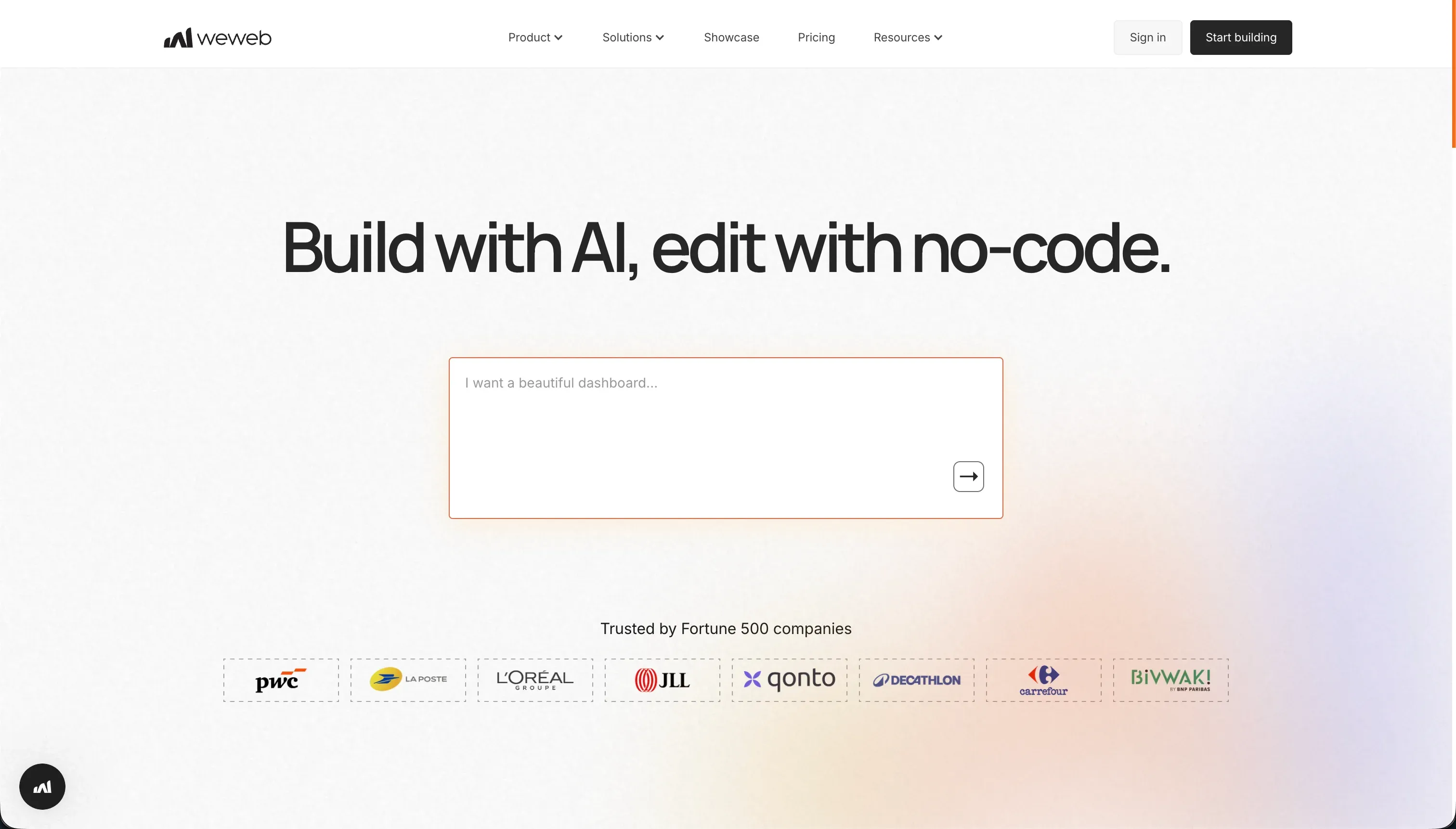
Choosing between these two environments means deciding between decoupled visual development and conversational AI application scaffolding. WeWeb is a visual frontend engine engineered to build web applications over external backend databases you wire up yourself.
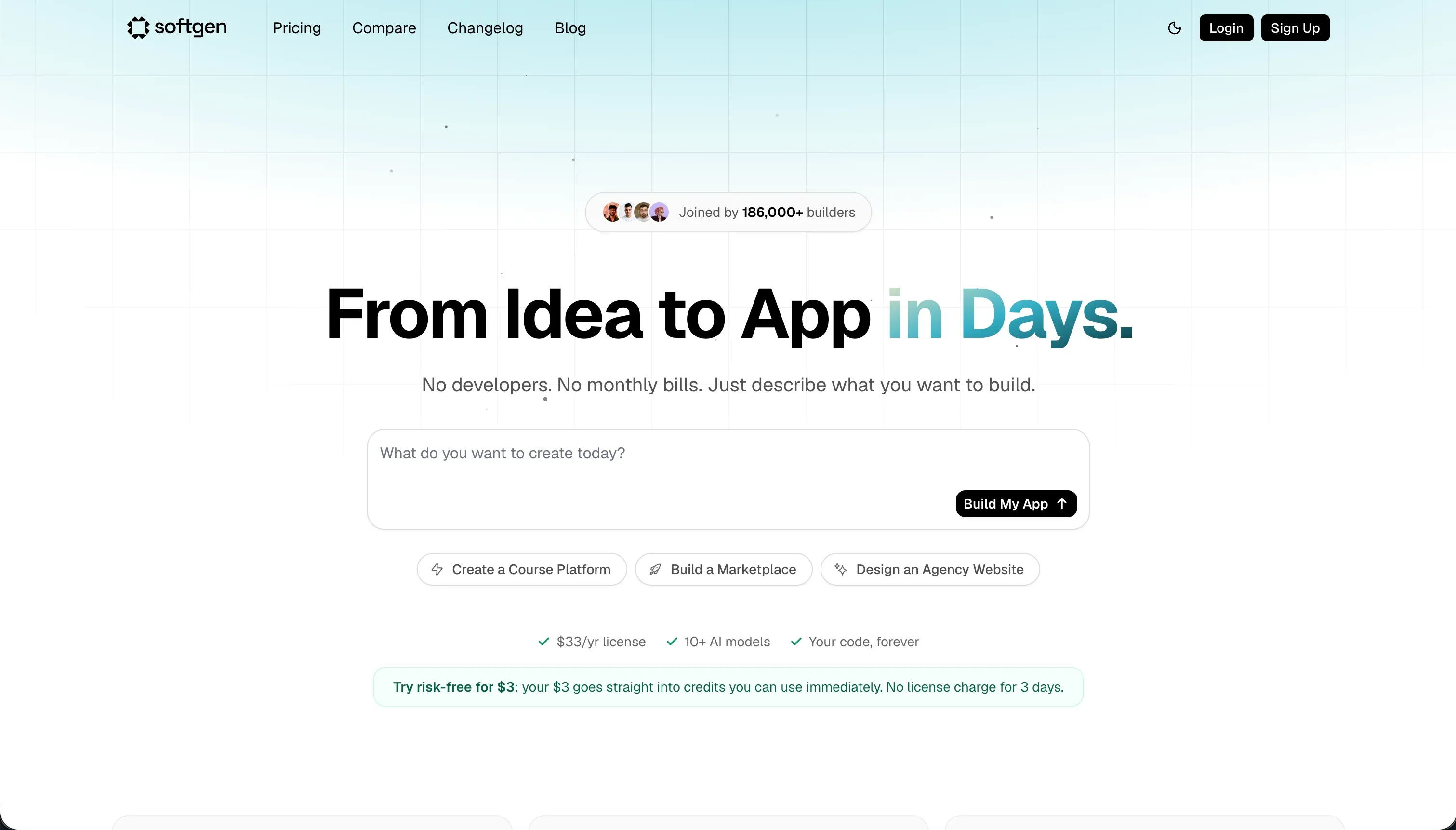
Softgen acts as an AI conversational developer that outlines, generates, and deploys relational schemas and simple layouts on your behalf.
WeWeb wins this comparison on aggregate, scoring 6.2/10 against Softgen’s 5.1/10. WeWeb takes five of our six evaluation criteria, losing only on ease of build. The decision flips in favor of Softgen only if you lack web development experience, have no available developer resources, and need to launch a basic MVP layout within hours using plain language.
The decision in 30 seconds
| If your priority is… | Pick | Why |
|---|---|---|
| Pixel-level design styling and CSS flexbox layouts | WeWeb | Its visual engine scores 8.5/10 for grid, absolute positioning, and custom CSS flexibility |
| Fast conversational MVP generation as a non-technical user | Softgen | Its Cascade agent scores 7.0/10 on ease of build by mapping schema and UI from prompts |
| Built-in database and native all-in-one ecosystem | Neither | WeWeb requires separate backends like Xano or Supabase, while Softgen is chat-dependent for database edits |
| Highly maintainable changes on month six of production | WeWeb | Direct visual state editing beats Softgen’s fragile conversational credit-burning loops |
| Granular roles, secure permissions, and row-level filtering | Neither | WeWeb relies on separate backends for auth policies, while Softgen is limited to basic forms |
What each platform is
What is WeWeb?
WeWeb is a decoupled frontend builder designed for developers and agency teams who want to build complex web applications visually while keeping total separation between the frontend UI and the backend data architecture. It compiles into fast Single Page Applications (SPAs) while retaining indexable pages for search engine optimization.
Because WeWeb contains no native relational database, it requires you to connect external backend systems such as Xano, Supabase, or Airtable using standard REST APIs and token-based authentication. This platform is built for teams who understand web development concepts like state management, conditional routing, and payload delivery, and wish to focus on composing advanced custom designs.
What is Softgen?
Softgen is a chat-native application builder built to turn plain-language prompts into hosted web applications. It uses an agent ecosystem to walk non-technical creators through outlining features, designing underlying tables, and deploying completed interfaces without dragging blocks manually.
Its core experience, the Cascade AI agent, allows you to chat to modify styling or add elements like Stripe integrations. It compiles basic relational database schemas and user sign-in modules dynamically, making it a fast vehicle for makers, startups, and indie hackers who want to draft and test functional micro-SaaS layouts in a few conversational passes.
The core difference
The primary dividing line between these platforms is how you manipulate application layout and structural logic.
- WeWeb gives you deterministic visual design panels with CSS layouts and manual state variables to construct layouts piece by piece.
- Softgen abstracts away the builder interface entirely, forcing every change through chat-agent iterations.
Where the scores diverge
Design flexibility: WeWeb 8.5, Softgen 5.0. WeWeb scores 8.5/10 while Softgen scores 5.0/10, representing a massive gap. WeWeb provides full visual control over CSS layout attributes including grid systems, flexbox spacing, and absolute positioning, alongside an AI assistant that drafts custom JavaScript and CSS.
Softgen restricts layout adjustments to standard, predefined visual blocks, meaning custom layouts are hard to express and repeatedly urging visual edits via chat can rapidly drain your credit limits.
Ease of build: WeWeb 4.0, Softgen 7.0. Softgen scores 7.0/10 while WeWeb scores 4.0/10 on this line. Softgen uses conversational planning prompts to generate relational tables and functional interfaces rapidly for non-developers.
WeWeb requires you to learn visual state management, map API payloads, and configure a separate external database before a single page can function. This yields a high steep learning curve that keeps WeWeb out of reach for non-technical creators.
Maintainability: WeWeb 6.0, Softgen 4.0. WeWeb scores 6.0/10 while Softgen scores 4.0/10. WeWeb organizes logic inside a visual editor where you directly adjust variables, although you must coordinate updates manually across both your frontend and your decoupled database.
Softgen features no drag-and-drop editor, forcing every visual edit or logic change back to the conversational prompt agent. Reviewers warn that prompting iterative fixes can trigger credit-burning loops and accumulate unmanageable technical debt.
Production readiness: WeWeb 6.0, Softgen 4.5. WeWeb scores 6.0/10 against Softgen’s limit of 4.5/10. WeWeb features staging environments and a rendering engine that outputs high-performing SPAs, though you are responsible for monitoring and configuring the external backends that secure this data, and mobile rendering can lag.
Softgen is limited by its early product maturity; reviewers report areas requiring visual polish and a trade-off that risks software scaling issues when real traffic arrives.
Data & integrations: WeWeb 7.0, Softgen 5.5. WeWeb scores 7.0/10 against Softgen’s 5.5/10. WeWeb is built to connect securely to SQL, no-SQL databases, and custom REST APIs, though a Capterra reviewer noted weak integrations with headless CMS platforms.
Softgen can generate simple database schemas and coordinate standard integrations like Stripe payments, yet its overall integration surface remains extremely narrow compared to WeWeb’s open-ended API connections.
Security & access control: WeWeb 5.5, Softgen 4.5. WeWeb scores 5.5/10 and Softgen scores 4.5/10 on this security measure. WeWeb relies on token-based flows mapped painstakingly to external auth engines, meaning your access control is only as safe as the backend architecture you design.
Softgen delivers pre-built standard sign-in forms and user templates out of the box, but it has comparatively basic permission levels and completely lack granular visibility logic for individual buttons or fields.
Cost comparison
The billing models contrast flat predictable pricing with unpredictable, usage-based credit consumption. WeWeb charges a flat monthly rate structure start at $59/month for a single custom-domain app. As you scale, it transitions to $249/month for multiple apps and staging environments, making your annual software budget relatively straightforward to forecast based on the flat tiers.
Softgen works on an annual flat membership fee of only $33/year for base hosting rights, but every generation, update, and iteration is charged against pay-as-you-go credit packs.
This model can appear highly competitive for a static prototype, but actively maintaining, debugging, or rebuilding database elements directly translates to unforecastable credit burn. A buyer should also account for the recurring costs of the separate backend services (such as Xano or Supabase) that WeWeb requires to function.
Lock-in and the exit path
Both platforms offer code export under specific tiers as an exit path. WeWeb allows you to export clean Visual Vue.js and Nuxt.js files on Scale and Enterprise plans, preserving your layout investments if you choose to migrate.
Softgen supports exporting code as an escape route out of their ecosystem, though transitioning database layers and operational schema to another hosting environment will require reconstruction. WeWeb offers the cleaner exit path because it leaves you with a standard, manageable frontend package.
- Clean Vue.js and Nuxt.js files
- Export on Scale and Enterprise plans
- Layout investments survive migration
- Standard, manageable frontend package
- Code export available
- Database layers need reconstruction
- Operational schema must move to new hosting
Who should pick WeWeb
Pick WeWeb if:
- Frontend engineering or agency teams who require visual control and wish to compile layouts directly to Vue.js codebases.
- Builders who have already configured a secure, production-grade database in Xano, Supabase, or custom REST APIs.
- Web teams seeking a high-performance rendering engine that supports custom CSS grids, absolute layouts, and clean SEO indexability.
Do not pick WeWeb if you need an all-in-one platform with a native workspace database and user auth system ready to deploy in a single afternoon.
Who should pick Softgen
Pick Softgen if:
- Makers and non-technical founders looking to convert a conversational prompt into a working layout prototype in hours.
- Creators who wish to assemble functional MVPs with simple Stripe connections and low hosting costs without learning layout design.
- Indie hackers launching directories or directories where basic, template-based structures are sufficient to validate user interest.
Do not pick Softgen if your application requires granular data privacy, field-level user accessibility controls, or visual drag-and-drop customization that is easy to maintain past the launch phase.
What neither platform answers
Both WeWeb and Softgen take opposite, extreme paths: WeWeb requires you to construct a complex decoupled system from separate software components, while Softgen forces you to rely entirely on conversational prompts to engineer layout updates.
If you are a business builder trying to ship operational software - like a secure client portal, a vendor portal, an internal CRM, or a company intranet - neither of these approaches fits. For those use cases, Softr delivers a superior alternative.
Softr scores 8.5 on production readiness, 9.0 on maintainability, and 8.5 on security & access control because it combines secure user authentication, granular user group permissions, and responsive blocks out of the box.
Instead of writing custom database connections or prompting a conversational agent, you can connect Softr directly to its high-performance native databases, or hook up external data sources like Google Sheets or Airtable to build production business software securely in a single day.
Analyst verdict
The final analysis favors WeWeb, which wins 5 of the 6 criteria with a 6.2 to 5.1 lead in aggregate. WeWeb is the decisively better long-term choice because its maintainability (6.0), production readiness (6.0), and design flexibility (8.5) are built on predictable, visual configurations rather than unpredictable LLM iterations.
Its decoupled visual ecosystem is the safer foundation for any team that must manage actual application scaling.
Softgen’s ease of build (7.0) is its singular advantage. Choose Softgen only if you lack developer resources entirely, need to validate a highly simple MVP over a short validation window, and are content to draft components through conversational chat prompts.
For any enterprise application or complex business portal, allocate your software spend to WeWeb’s visual editor or build with Softr’s native, permission-led ecosystem.
Related reading: the WeWeb scorecard, the Softgen scorecard, and our scoring methodology.